Toyota 4Runner vs Lexus TX
Overview | |
Listings758 | Listings243 |
Ratings & Reviews | |
User Reviews | User Reviews |
Expert reviews6.7 out of 10 | Expert reviews7.0 out of 10 |
Pros
Cons
| Pros
Cons
|
Reviews SummaryShoppers looking for an old-school SUV should be careful what they wish for. The Toyota 4Runner compromises passenger comfort and interior space to make it one of the better off-roaders on the market. It’s offered as a hybrid, but fuel economy is never as good as in typical crossover SUVs, which will be more comfortable and more affordable. That makes mainstream crossovers better choices for most. But for those who want adventure while carrying passengers, the 4Runner makes sense. Verdict: The 4Runner’s closest rivals are the Jeep Wrangler and Ford Bronco. Compared to them, the 4Runner can carry more passengers and offers better fuel economy thanks to an available hybrid powertrain. If adventure is a priority, the 4Runner is a great choice. But those who want a five- or seven-passenger SUV for daily family duty would be better off with a crossover. | |
Reviews SummaryYou may not have heard much about the Lexus TX, the company’s full-size three-row SUV. Introduced for the 2024 model year, it’s still a young’un compared to its competition, but it’s made its mark by offering a spacious interior and two different powertrains, wrapped in a stylish package. In Lexus’s seven-model SUV lineup, the TX slots just below the GX and LX — two body-on-frame models focused on off-roading. In Canada, you can snag a gas-powered TX or one with a hybrid powertrain. (Note the test unit for this review, the 550h+ plug-in hybrid, is not yet available in Canada. Lexus Canada plans to offer it but not in time for the 2026 model year.) Verdict: The 2026 Lexus TX is a great option for large families that need a spacious third row, but some of the technology comes with a steep learning curve. | |
No video found | No video found |
Popular Features & Specs | |
Seating Capacity7 | Seating Capacity7 |
Interior | |
Seating Capacity7 | Seating Capacity7 |
Key Features | |
Navigation System | Navigation SystemStandard |
Safety | |
Front Crash Overall4 | Front Crash Overall4 |
Side Crash Overall5 | Side Crash Overall5 |
Dimensions & Capacity | |
Cargo Space1371 L | Cargo Space572 L |
Curb Weight2021 kg | Curb Weight2016 kg |
Height1844 mm | Height1781 mm |
Length4950 mm | Length5159 mm |
Width1981 mm | Width1991 mm |
Wheelbase2850 mm | Wheelbase2949 mm |
Maximum Payload406 kg | Maximum Payload710 kg |
Number of doors4 | Number of doors4 |
Maximum Towing Capacity2722 kg | Maximum Towing Capacity2268 kg |
Standard Towing Capacity2722 kg | Standard Towing Capacity |
Overview | ||
Listings | ||
Ratings & Reviews | ||
User reviews | ||
Expert reviews | 6.7 out of 10Read full review | 7.0 out of 10Read full review |
Pros & cons | Pros
Cons
| Pros
Cons
|
Summary | Shoppers looking for an old-school SUV should be careful what they wish for. The Toyota 4Runner compromises passenger comfort and interior space to make it one of the better off-roaders on the market. It’s offered as a hybrid, but fuel economy is never as good as in typical crossover SUVs, which will be more comfortable and more affordable. That makes mainstream crossovers better choices for most. But for those who want adventure while carrying passengers, the 4Runner makes sense. Verdict: The 4Runner’s closest rivals are the Jeep Wrangler and Ford Bronco. Compared to them, the 4Runner can carry more passengers and offers better fuel economy thanks to an available hybrid powertrain. If adventure is a priority, the 4Runner is a great choice. But those who want a five- or seven-passenger SUV for daily family duty would be better off with a crossover. | You may not have heard much about the Lexus TX, the company’s full-size three-row SUV. Introduced for the 2024 model year, it’s still a young’un compared to its competition, but it’s made its mark by offering a spacious interior and two different powertrains, wrapped in a stylish package. In Lexus’s seven-model SUV lineup, the TX slots just below the GX and LX — two body-on-frame models focused on off-roading. In Canada, you can snag a gas-powered TX or one with a hybrid powertrain. (Note the test unit for this review, the 550h+ plug-in hybrid, is not yet available in Canada. Lexus Canada plans to offer it but not in time for the 2026 model year.) Verdict: The 2026 Lexus TX is a great option for large families that need a spacious third row, but some of the technology comes with a steep learning curve. |
Video | No video found | No video found |
Popular Features & Specs | ||
Seating Capacity | 7 | 7 |
Interior | ||
Seating Capacity | 7 | 7 |
Key Features | ||
Navigation System | Standard | |
Safety | ||
Front Crash Overall | 4 | 4 |
Side Crash Overall | 5 | 5 |
Dimensions & Capacity | ||
Cargo Space | 1371 L | 572 L |
Curb Weight | 2021 kg | 2016 kg |
Height | 1844 mm | 1781 mm |
Length | 4950 mm | 5159 mm |
Width | 1981 mm | 1991 mm |
Wheelbase | 2850 mm | 2949 mm |
Maximum Payload | 406 kg | 710 kg |
Number of doors | 4 | 4 |
Maximum Towing Capacity | 2722 kg | 2268 kg |
Standard Towing Capacity | 2722 kg | |
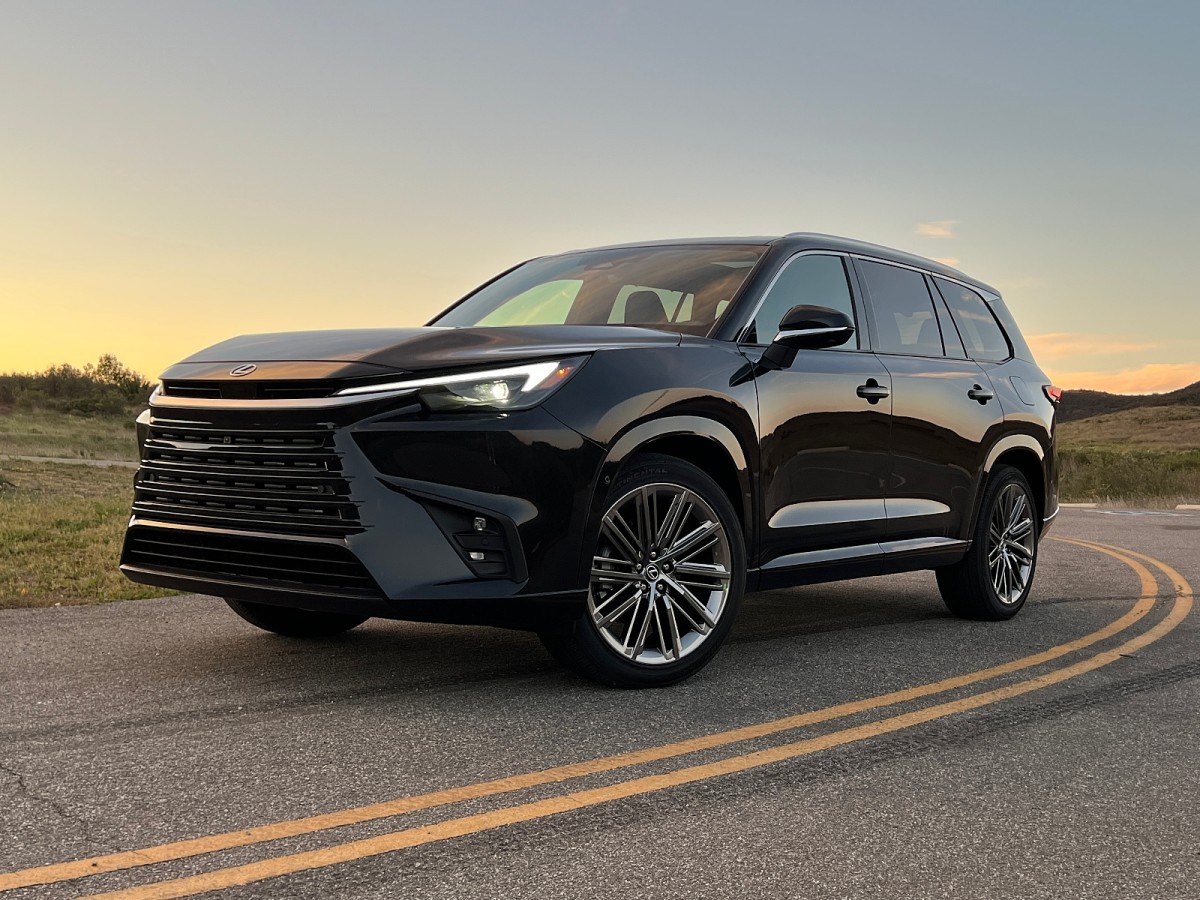
The 2026 Lexus TX presented a range of packages tailored to its powertrain options. The TX 350 was equipped with the Luxury package as standard, with options for Ultra Luxury, Executive, and F Sport 3 packages. Meanwhile, the 500h hybrid began with the F Sport Performance 2 package, with the possibility of upgrading to the F Sport 3 package. Higher-tier packages offered towing capabilities, and while the base models featured 20-inch wheels, most packages boasted 22-inch wheels that filled the wheel wells impressively. The exterior design retained a large grille reminiscent of the older spindle grille shape, complemented by sharp bi-LED headlights and rear LED lighting that spanned the vehicle's width. The interior offered three colour options: standard grey, Birch, and Peppercorn, with ambient lighting adding warmth. However, the material quality fell short of luxury standards, with basic plastics prevalent. Redesigned door handles, which reacted to pressure rather than pulling out, were a notable change, though they seemed unnecessary.
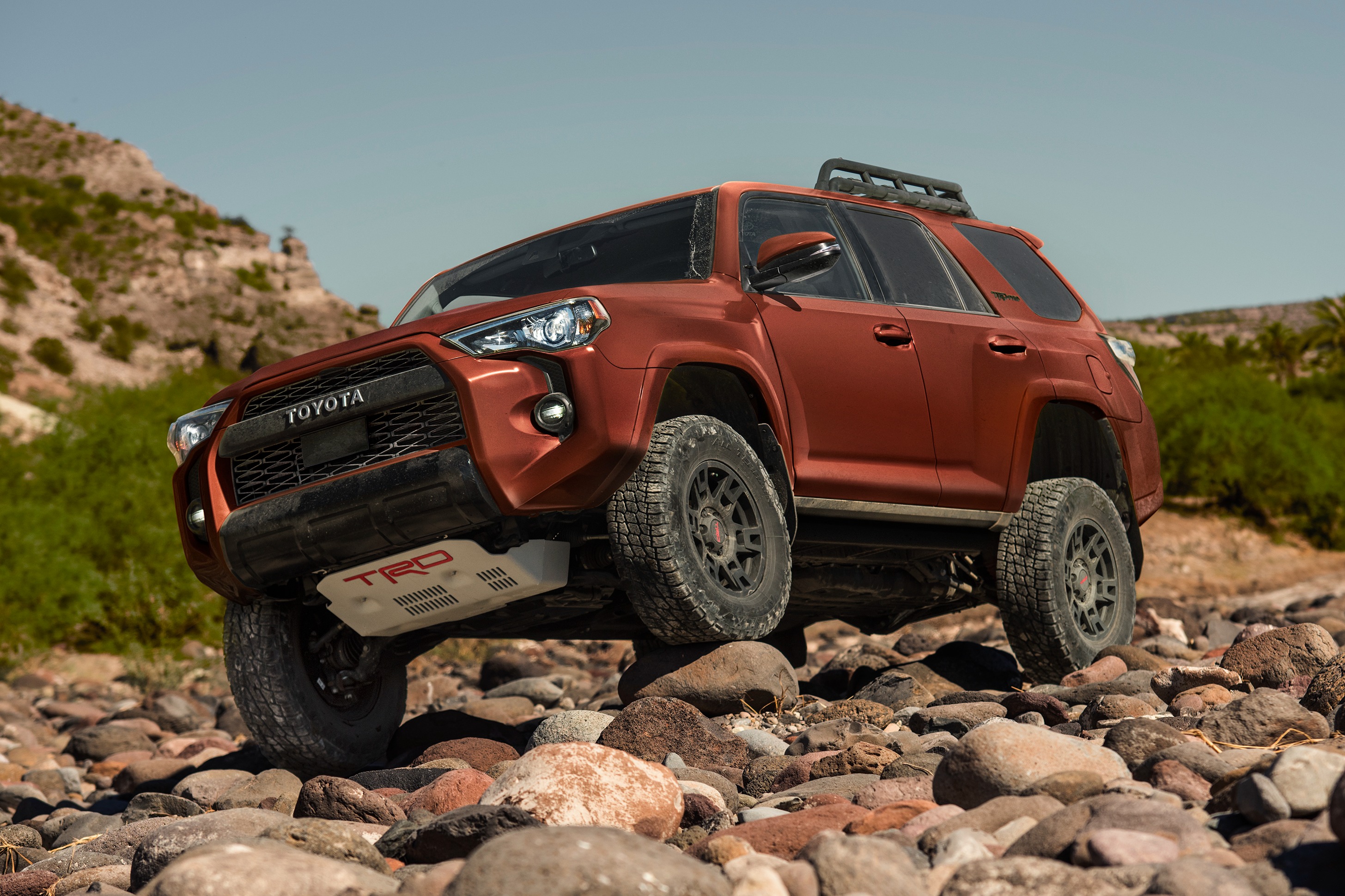
In contrast, the 2026 Toyota 4Runner shared design elements with the Tacoma pickup, making them hard to distinguish from the front. The 4Runner's muscular appearance was accentuated by pronounced haunches and black wheel flares on off-road models. The sheet metal featured deep creases, particularly along the sides. The grille sat high, with a lower intake underbite, especially on the TRD Pro and Trailhunter models, which had unique bumpers for better approach angles. Heritage-inspired front ends with "Toyota" lettering and integrated light bars were notable features. The rear side windows extended into the roof, a nod to the original 4Runner of the 1980s. Wheel sizes varied from 17 to 20 inches. Inside, the 4Runner's interior was simple and utilitarian, with chunky control dials and an abundance of hard plastic. Cloth upholstery was standard, with synthetic leather on off-road models and leather on Limited and Platinum trims, though the cabin never reached high-end standards.

The 2026 Lexus TX 350 was powered by a 275-horsepower 2.4-litre turbocharged four-cylinder engine, while the TX 500h hybrid increased output to 366 hp. The gas model featured an eight-speed automatic transmission, and the hybrid came with a six-speed automatic, offering an alternative to the typical CVT in electrified powertrains. The TX 350 had electronically controlled full-time AWD, while the TX 500h utilized Lexus's Direct4 AWD system, distributing torque to each axle on demand. Drivers could choose between Normal, Eco, or Sport drive modes, with Sport mode enhancing throttle sensitivity for a more immediate response. The 500h also included adaptive suspension and rear steering for improved handling.
The 2026 Toyota 4Runner offered two powertrains in Canada: the i-Force turbocharged 2.4-litre four-cylinder engine with 278 horsepower and 317 lb-ft of torque, and the i-Force Max hybrid, which increased output to 326 hp and 465 lb-ft. The hybrid's mid-to-low seven-second 0 to 100 km/h time was not particularly quick, but the eight-speed automatic transmission was well-matched to the engine. The 4Runner's off-road capabilities were enhanced by its torque, especially in the low-range 4Lo setting with Crawl Control. The TRD Off-Road Premium package featured part-time 4WD with six Multi-Terrain System drive modes, while the Limited and Platinum models had full-time 4WD with a locking centre differential. Off-road features included a locking rear differential, Bilstein dampers, and increased ground clearance. The Trailhunter and TRD Pro models offered even more off-road enhancements, though their on-road dynamics were compromised by the body-on-frame platform.
The 2026 Lexus TX offered three-zone automatic climate control, heated and cooled front seats, heated second-row seats, and a heated steering wheel as standard in Canada. Ventilated second-row seats were standard on the TX 500h. The second row featured captain's chairs with a removable centre console, though some packages offered a bench seat. The third row was spacious, with a recline function and ample headroom, making it comfortable for adults. Access to the third row was facilitated by a one-touch button on the second-row seat, though folding the second row flat was more complicated. The front seats were roomy but lacked thigh support. The TX boasted excellent cargo space, with 572 litres behind the third row, 1,625 litres with the third row flat, and 2,747 litres with all rear seats folded. All TX models could tow up to 2,268 kilograms when properly equipped.
The 2026 Toyota 4Runner was available with two or three rows of seats, accommodating five or seven passengers. The front seats were the most comfortable, with manual adjustment as standard and power adjustments on higher trims. Heated front seats were standard in Canada, and the Platinum trim added heated second-row seats. The second row offered decent space but lacked comfort due to low seat bottoms and a high step-in height. The three-row version was likely less comfortable, with limited legroom. Cargo space was comparable to midsize rivals, with 1,206 litres behind the second row in hybrid two-row models and 2,339 litres behind the first row. The three-row configuration offered 343 litres behind the third row, 1,269 litres behind the second row, and 2,381 litres with all seats folded. The second row could fold flat or tilt up to create a flat load floor, though hybrid models had a higher load floor.
The 2026 Lexus TX featured a 14-inch colour touchscreen that was user-friendly and responsive, though some features lacked polish. Satellite radio station input was cumbersome, and steering wheel buttons were multi-functional but unlabeled, complicating adaptive cruise control setup. Wireless Apple CarPlay and Android Auto were standard but occasionally interfered with the native audio system. Smartphone connectivity was essential for accessing in-dash navigation and other subscription-based features. The back-up camera was clear, with an available bird's-eye view, and the Advanced Park system could handle parking duties. The TX offered seven USB ports, wireless charging, and a 120-volt/1500-watt outlet in the second row.
The 2026 Toyota 4Runner came standard with a 7-inch digital instrument cluster and an 8-inch touchscreen, with larger screens available on higher trims. The 14-inch touchscreen was easy to use but lacked design flair. The 4Runner included a three-year trial of Remote Connect, Safety Connect, and Service Connect, with Drive Connect available on some packages. The 12.3-inch digital instrument cluster offered programmable information, controlled by a five-way controller on the steering wheel. Standard tech features included wireless Apple CarPlay and Android Auto, a three-month satellite radio trial, and a wireless phone charger on most models. The JBL audio system with a removable Bluetooth speaker was available on higher trims.
The 2026 Lexus TX came standard with Safety System+ 3.0, which included forward collision warning, automatic emergency braking, lane tracing assist, lane centring, lane departure warning, traffic sign recognition, and Proactive Driving Assist. The adaptive cruise control worked well once set up, though it was occasionally slow to respond. The TX received five out of five stars from the NHTSA and mixed ratings from the IIHS, with an "Acceptable" score in the small overlap front crash test on the driver's side and "Good" ratings for the passenger's side and injury measures.
The 2026 Toyota 4Runner was equipped with Safety Sense 3.0, featuring forward collision warning, automatic emergency braking, adaptive cruise control, lane departure warning, lane keep assist, road sign recognition, and high beam assist. Blind spot monitoring and rear cross-traffic alert were also standard. The 4Runner received four out of five stars from the NHTSA, with lower ratings in frontal crash and rollover evaluations. The IIHS gave it mixed ratings, with a "Marginal" score in the moderate front overlap crash test and varying headlight ratings. It received "Good" ratings in the updated side crash test and for its front crash prevention systems.
CarGurus highlights
According to CarGurus experts, the overall rating for the 2026 Lexus TX is 7.0 out of 10, while the 2026 Toyota 4Runner scores 6.7 out of 10. Based on these ratings, the Lexus TX is the recommended choice for those seeking a well-rounded vehicle with a focus on comfort, technology, and safety.
Choose the 2026 Lexus TX if:
- You prioritize a spacious and comfortable third row for adult passengers.
- You value advanced technology features like a large touchscreen and multiple USB ports.
- You seek a vehicle with strong safety ratings and comprehensive safety features.


Choose the 2026 Toyota 4Runner if:
- You need a vehicle with serious off-road capabilities and features.
- You prefer a rugged, utilitarian design with a focus on practicality.
- You want a vehicle with a variety of powertrain options, including a hybrid.


CarGurus highlights
According to CarGurus experts, the overall rating for the 2026 Lexus TX is 7.0 out of 10, while the 2026 Toyota 4Runner scores 6.7 out of 10. Based on these ratings, the Lexus TX is the recommended choice for those seeking a well-rounded vehicle with a focus on comfort, technology, and safety.
Choose the 2026 Lexus TX if:
Shop Now- You prioritize a spacious and comfortable third row for adult passengers.
- You value advanced technology features like a large touchscreen and multiple USB ports.
- You seek a vehicle with strong safety ratings and comprehensive safety features.
Choose the 2026 Toyota 4Runner if:
Shop Now- You need a vehicle with serious off-road capabilities and features.
- You prefer a rugged, utilitarian design with a focus on practicality.
- You want a vehicle with a variety of powertrain options, including a hybrid.

By: CarGurus + AI
At CarGurus, our team of experienced automotive writers remain at the heart of our content operation, conducting hands-on car tests and writing insightful guides that are backed by years of industry experience. To complement this, we are harnessing AI to make our content offering more diverse and more helpful to shoppers than ever. To achieve this, our AI systems are based exclusively on CarGurus content, ratings and data, so that what we produce is both unique to CarGurus, and uniquely helpful to car shoppers.
