Toyota 4Runner vs Chevrolet Bolt
Overview | |
Listings768 | Listings781 |
Ratings & Reviews | |
User Reviews | User Reviews |
Expert reviews6.7 out of 10 | Expert reviews6.3 out of 10 |
Pros
Cons
| Pros
Cons
|
Reviews SummaryShoppers looking for an old-school SUV should be careful what they wish for. The Toyota 4Runner compromises passenger comfort and interior space to make it one of the better off-roaders on the market. It’s offered as a hybrid, but fuel economy is never as good as in typical crossover SUVs, which will be more comfortable and more affordable. That makes mainstream crossovers better choices for most. But for those who want adventure while carrying passengers, the 4Runner makes sense. Verdict: The 4Runner’s closest rivals are the Jeep Wrangler and Ford Bronco. Compared to them, the 4Runner can carry more passengers and offers better fuel economy thanks to an available hybrid powertrain. If adventure is a priority, the 4Runner is a great choice. But those who want a five- or seven-passenger SUV for daily family duty would be better off with a crossover. | |
Reviews SummaryWith more range, more power, and improved technology, the Chevrolet Bolt EV returns after a three-year hiatus. It’s also one of the most affordable EVs in Canada, but it’s due to remain in production only until mid-2027. Verdict: The 2027 Chevrolet Bolt EV is an excellent choice for shoppers seeking an electric vehicle that won't break the bank. It may not be all that fancy or refined, but it gets the basics right when it comes to range and capabilities. | |
No video found | No video found |
Popular Features & Specs | |
Seating Capacity7 | Seating Capacity5 |
EV Battery Capacity | EV Battery Capacity65 kWh |
Battery Charge Time (120V) | Battery Charge Time (120V)64 hours |
Battery Charge Time (240V) | Battery Charge Time (240V)9.8 hours |
Engine | |
Engine Name2.4L 278 hp I4 | Engine Name210 hp Electric |
Torque317 lb-ft @ 1700 rpm | Torque |
Horsepower278 hp @ 6000 rpm | Horsepower |
Battery Charge Time (120V) | Battery Charge Time (120V)64 hours |
Battery Charge Time (240V) | Battery Charge Time (240V)9.8 hours |
Drivetrain4X2 | DrivetrainFWD |
Fuel Economy | |
EV Battery Capacity | EV Battery Capacity65 kWh |
Interior | |
Seating Capacity7 | Seating Capacity5 |
Key Features | |
Navigation System | Navigation SystemStandard |
Safety | |
Front Crash Overall4 | Front Crash Overall |
Side Crash Overall5 | Side Crash Overall |
Dimensions & Capacity | |
Cargo Space1371 L | Cargo Space459 L |
Curb Weight2021 kg | Curb Weight1713 kg |
Height1844 mm | Height1623 mm |
Length4950 mm | Length4308 mm |
Width1981 mm | Width2035 mm |
Wheelbase2850 mm | Wheelbase2675 mm |
Maximum Payload406 kg | Maximum Payload396 kg |
Number of doors4 | Number of doors4 |
Maximum Towing Capacity2722 kg | Maximum Towing Capacity |
Standard Towing Capacity2722 kg | Standard Towing Capacity |
Overview | ||
Listings | ||
Ratings & Reviews | ||
User reviews | ||
Expert reviews | 6.7 out of 10Read full review | 6.3 out of 10Read full review |
Pros & cons | Pros
Cons
| Pros
Cons
|
Summary | Shoppers looking for an old-school SUV should be careful what they wish for. The Toyota 4Runner compromises passenger comfort and interior space to make it one of the better off-roaders on the market. It’s offered as a hybrid, but fuel economy is never as good as in typical crossover SUVs, which will be more comfortable and more affordable. That makes mainstream crossovers better choices for most. But for those who want adventure while carrying passengers, the 4Runner makes sense. Verdict: The 4Runner’s closest rivals are the Jeep Wrangler and Ford Bronco. Compared to them, the 4Runner can carry more passengers and offers better fuel economy thanks to an available hybrid powertrain. If adventure is a priority, the 4Runner is a great choice. But those who want a five- or seven-passenger SUV for daily family duty would be better off with a crossover. | With more range, more power, and improved technology, the Chevrolet Bolt EV returns after a three-year hiatus. It’s also one of the most affordable EVs in Canada, but it’s due to remain in production only until mid-2027. Verdict: The 2027 Chevrolet Bolt EV is an excellent choice for shoppers seeking an electric vehicle that won't break the bank. It may not be all that fancy or refined, but it gets the basics right when it comes to range and capabilities. |
Video | No video found | No video found |
Popular Features & Specs | ||
Seating Capacity | 7 | 5 |
EV Battery Capacity | 65 kWh | |
Battery Charge Time (120V) | 64 hours | |
Battery Charge Time (240V) | 9.8 hours | |
Engine | ||
Engine Name | 2.4L 278 hp I4 | 210 hp Electric |
Torque | 317 lb-ft @ 1700 rpm | |
Horsepower | 278 hp @ 6000 rpm | |
Battery Charge Time (120V) | 64 hours | |
Battery Charge Time (240V) | 9.8 hours | |
Drivetrain | 4X2 | FWD |
Fuel Economy | ||
EV Battery Capacity | 65 kWh | |
Interior | ||
Seating Capacity | 7 | 5 |
Key Features | ||
Navigation System | Standard | |
Safety | ||
Front Crash Overall | 4 | |
Side Crash Overall | 5 | |
Dimensions & Capacity | ||
Cargo Space | 1371 L | 459 L |
Curb Weight | 2021 kg | 1713 kg |
Height | 1844 mm | 1623 mm |
Length | 4950 mm | 4308 mm |
Width | 1981 mm | 2035 mm |
Wheelbase | 2850 mm | 2675 mm |
Maximum Payload | 406 kg | 396 kg |
Number of doors | 4 | 4 |
Maximum Towing Capacity | 2722 kg | |
Standard Towing Capacity | 2722 kg | |
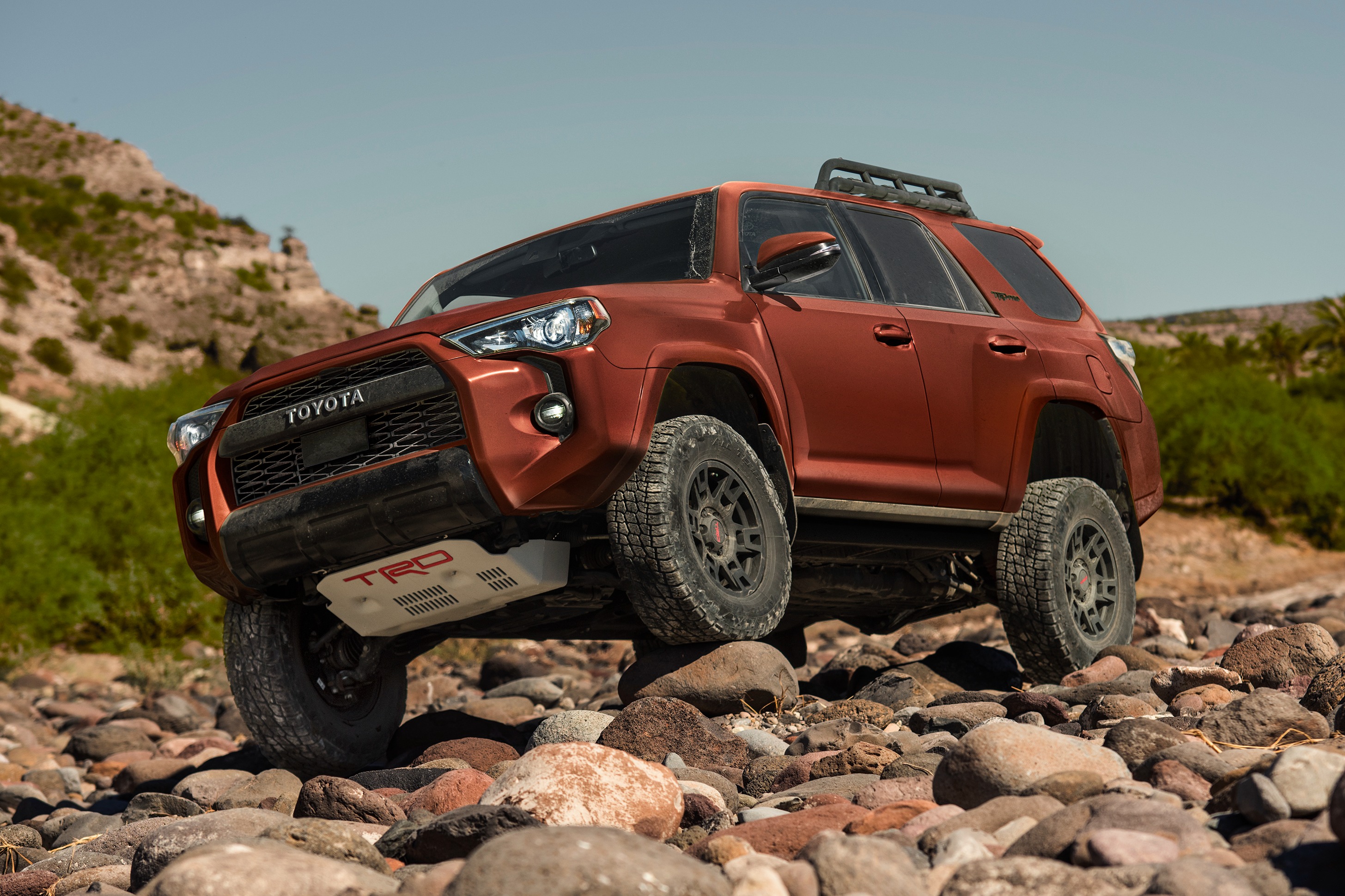
The 2026 Toyota 4Runner shared a striking resemblance with the Tacoma pickup, especially from the front, making it challenging to distinguish between the two. It boasted a robust and muscular appearance, with pronounced haunches at each wheel and black wheel flares on the off-road models. The sheet metal was heavily creased and angled, with particularly deep creases along the sides. The grille sat high, resting above a lower intake with an underbite, particularly noticeable on the TRD Pro and Trailhunter models, which featured unique bumpers for improved approach angles. These models also sported heritage-inspired front ends with "Toyota" lettering on the grille and an integrated light bar. The rear side windows extended into the roof, reminiscent of the original 4Runner from the 1980s. Wheel sizes varied from 17 to 20 inches.
Inside, the 4Runner's interior was simple and utilitarian, featuring chunky control dials that were easy to operate with gloved hands. Hard plastic adorned the dash, centre console, and door tops, with only the centre console bin cover and door armrests offering a softer touch. Cloth upholstery was standard, while synthetic leather was standard on off-road-oriented models for easy cleaning. Leather upholstery was reserved for the Limited and Platinum trims, but even with leather, the cabin never exuded a high-end feel.
The 2027 Chevrolet Bolt retained a familiar look, with only slight styling changes. Its front end resembled a conventional gas-powered car more than an EV, with a thin slot behind the Chevy Bowtie logo and an integrated grille insert in the bumper. The 2027 model continued the legacy of the 2023 version, straddling the line between a large hatchback and a subcompact SUV, known as an "EUV" or electric SUV. Chevy decided to bring back only the EUV body style for 2027. The Bolt EV had a tall and narrow stance, prioritizing utility and interior space over a sporty appearance. The RS model added some gloss black exterior trim for a touch of flair.
Inside, the Bolt's interior underwent a more dramatic makeover while maintaining its basic structure. A larger digital instrument panel sat in front of the driver, and a larger infotainment touchscreen occupied the centre of the dashboard. The previous push-button gear selector was moved to the steering column, freeing up more storage space in the centre console. Storage pockets were also added on the passenger side of the dashboard. The cabin featured hard plastic surfaces that reinforced the Bolt's budget feel, though the elbow touchpoints had thin padding. The base LT trim came with cloth upholstery, while the RS trim upgraded to Evotex synthetic leather with racy red stitching. The rear seating area also featured an abundance of hard plastics and lacked padding for the door armrests.

The 2026 Toyota 4Runner offered two powertrains and two four-wheel-drive (4WD) systems in Canada. The base engine, known as i-Force, was a turbocharged 2.4-litre four-cylinder generating 278 horsepower and 317 pound-feet of torque. The i-Force Max hybrid added an electric motor, increasing output to 326 hp and 465 lb-ft. The 4Runner hybrid, despite its impressive torque figure, wasn't particularly quick, with a mid-to-low seven-second 0 to 100 km/h time. The eight-speed automatic transmission was well-matched to the engine, with more aggressive tuning and throttle response in Sport mode. The hybrid's torque was advantageous for off-roading, providing the necessary power to tackle hills and ruts, especially in the low-range 4Lo setting with Crawl Control engaged.
The 4Runner offered part-time or full-time 4WD, with the TRD Off-Road Premium package featuring the part-time system, allowing drivers to choose from six Multi-Terrain System (MTS) drive modes. These modes controlled throttle, traction control, and braking to navigate various terrains. The Limited and Platinum models had a full-time 4WD system with a locking centre differential for easier street use. Off-road features included a locking rear differential, Bilstein remote-reservoir dampers, running boards, and increased ground clearance. The Trailhunter and TRD Pro models went further with additional off-road enhancements. However, the 4Runner's on-road dynamics were compromised, with notable lean in corners and a firm suspension that didn't absorb bumps well.
The 2027 Chevrolet Bolt featured a new 65-kilowatt-hour lithium-iron phosphate battery pack, reducing costs and reliance on rare earth minerals. A new motor from Chevy's Equinox EV delivered 210 horsepower and 169 pound-feet of torque to the front wheels, resulting in a 0-100 km/h time similar to the previous Bolt EV, typically in the low seven-second range. While this acceleration might seem slow by EV standards, it was quick compared to gas-powered subcompact SUVs and responded immediately to pedal inputs. One-pedal driving was available with medium or high levels of brake regeneration, though the highest setting could be jumpy at low speeds.
The Bolt's ride was firm but not overly stiff, with drivers feeling road imperfections without experiencing shockwaves through the cabin. Road noise was more noticeable due to the absence of an internal combustion engine, but the stereo easily masked it. Despite its tall, narrow stance, the Bolt was surprisingly agile on curvy roads, thanks to the heavy battery in the floor, creating a low centre of gravity. On a full charge, Natural Resources Canada estimated the 2027 Bolt's range at 422 kilometres, an improvement over previous models. The Bolt featured a Tesla-derived North American Charging Standard (NACS) charge port, with adapters for CCS and J1772 connectors. Charging speed increased to 150 kW, allowing a 10% to 80% recharge in 25 minutes.
The 2026 Toyota 4Runner offered seating for five with two rows or up to seven with three rows. The front seats were the most comfortable, though they only came with manual adjustment as standard. Heated front seats were standard in Canada, with power adjustments available on most trims. The second row provided decent space but lacked comfort, with low seat bottoms offering insufficient thigh support. The Platinum trim added heated second-row seats. The three-row version was suspected to have even less comfort, with limited legroom at 808 millimetres. Cargo space was competitive with midsize rivals, with hybrid two-row models offering 1,206 litres behind the second row and 2,339 litres behind the first row. The three-row configuration had 343 litres behind the third row, 1,269 litres behind the second row, and 2,381 litres with all seats folded. The second row could fold flat or tilt up to create a flat load floor, though hybrid models had a higher load floor.
The 2027 Chevrolet Bolt featured an upright driving position with ample space for larger occupants. Taller drivers might have wished for more telescopic extension from the steering wheel, requiring them to scoot the seat forward. The rear seats were also upright, providing plenty of headroom and adequate thigh support. The floor was flat, reducing the penalty for centre-seat passengers. The Bolt offered 459 litres of cargo space behind the rear seats, which was small for the class but still sufficient for most users. A large bin underneath the floor and easy-to-reach release latches for the rear seatbacks added to its practicality. The seats folded flat with the cargo floor in its upper position. While there was no frunk, the Bolt provided ample storage for personal items, including a large bin with movable dividers, a big floor tray, and a deep centre armrest bin. Additional storage included a rubberized wireless phone charger, dashboard pockets, and moderate door pockets.
The 2026 Toyota 4Runner came standard with a 7-inch digital instrument cluster and an 8-inch touchscreen, with larger screens available on higher trims. The 14-inch touchscreen, while large and easy to use, lacked distinctive design elements. It featured quick access icons for navigation, phone, and entertainment. The 4Runner included a three-year trial of Remote Connect, Safety Connect, and Service Connect, with Drive Connect available on some packages. The 12.3-inch digital instrument cluster provided programmable information, controlled via a five-way controller on the steering wheel. Standard tech features included wireless Apple CarPlay and Android Auto, a three-month satellite radio trial, and a wireless phone charger on most trims. The standard radio had eight speakers, while higher trims added a 14-speaker JBL audio system with a removable portable Bluetooth speaker.
The 2027 Chevrolet Bolt featured an 11-inch digital instrument panel and an 11.3-inch centre touchscreen, running on a Google-based operating system. Apple CarPlay and standalone Android Auto were not supported, requiring Bluetooth pairing for personal music libraries. The optional Technology package added a surround-view camera system, a digital rear-view mirror, and a wireless charging pad. The infotainment system was user-friendly, with logical menus, sharp graphics, and quick responses. Separate physical climate controls reduced distraction, and the navigation system helped find charging stations along the route. The Bolt was capable of vehicle-to-load charging, serving as a backup power source for a home with additional equipment and installation.
The 2026 Toyota 4Runner was equipped with Toyota's Safety Sense 3.0 suite, including forward collision warning, automatic emergency braking, adaptive cruise control, lane departure warning, lane keep assist, road sign recognition, and high beam assist. Blind spot monitoring and rear cross-traffic alert were also standard. Despite being overhauled for 2025, the 4Runner received mixed crash scores, with four out of five stars overall from the U.S. National Highway Traffic Safety Administration (NHTSA) and mixed results from the Insurance Institute for Highway Safety (IIHS). It received a Marginal score in the moderate front overlap crash test and varying ratings for headlights, but Good ratings in the updated side crash test and front crash prevention systems.
The 2027 Chevrolet Bolt had not yet been crash-tested by the U.S. National Highway Traffic Safety Administration or the Insurance Institute for Highway Safety, but it was expected to achieve high scores based on its platform. Standard safety features included forward-collision warning, automatic emergency braking, adaptive cruise control, lane-keep assist, blind-spot monitors with active steering assist, and a safety alert seat. The optional Technology package added a surround-view camera system, a digital rear-view mirror, rain-sensing wipers, rear pedestrian alert, and traffic-sign recognition. GM's Super Cruise hands-free automated highway driving system was available for an additional cost.
CarGurus highlights
According to CarGurus experts, the overall rating for the 2026 Toyota 4Runner is 6.7 out of 10, while the 2027 Chevrolet Bolt scores 6.3 out of 10. Based on these ratings, the 2026 Toyota 4Runner is the recommended choice for those seeking a versatile and capable vehicle with strong off-road performance and a comprehensive suite of safety features.
Choose the 2026 Toyota 4Runner if:
- You prioritize off-road capability and rugged design.
- You need a vehicle with versatile seating options for up to seven passengers.
- You value a comprehensive suite of safety features and off-road enhancements.


Choose the 2027 Chevrolet Bolt if:
- You seek an electric vehicle with a practical range and quick charging capabilities.
- You prefer a budget-friendly EV with advanced technology and safety features.
- You want a vehicle with a spacious interior and ample storage options.


CarGurus highlights
According to CarGurus experts, the overall rating for the 2026 Toyota 4Runner is 6.7 out of 10, while the 2027 Chevrolet Bolt scores 6.3 out of 10. Based on these ratings, the 2026 Toyota 4Runner is the recommended choice for those seeking a versatile and capable vehicle with strong off-road performance and a comprehensive suite of safety features.
Choose the 2026 Toyota 4Runner if:
Shop Now- You prioritize off-road capability and rugged design.
- You need a vehicle with versatile seating options for up to seven passengers.
- You value a comprehensive suite of safety features and off-road enhancements.
Choose the 2027 Chevrolet Bolt if:
Shop Now- You seek an electric vehicle with a practical range and quick charging capabilities.
- You prefer a budget-friendly EV with advanced technology and safety features.
- You want a vehicle with a spacious interior and ample storage options.

By: CarGurus + AI
At CarGurus, our team of experienced automotive writers remain at the heart of our content operation, conducting hands-on car tests and writing insightful guides that are backed by years of industry experience. To complement this, we are harnessing AI to make our content offering more diverse and more helpful to shoppers than ever. To achieve this, our AI systems are based exclusively on CarGurus content, ratings and data, so that what we produce is both unique to CarGurus, and uniquely helpful to car shoppers.
