2025 Toyota Sequoia vs 2024 Hyundai Santa Fe
Overview | |
Listings120 | Listings12 |
Ratings & Reviews | |
User Reviews | User Reviews |
Expert reviews8.2 out of 10 | Expert reviews5.5 out of 10 |
Pros
Cons
| Pros
Cons
|
2024 Hyundai Santa Fe Reviews SummaryThe Hyundai Santa Fe is fully redesigned for 2024. It marks a significant departure for the brand in terms of styling, with a bold and blocky profile and stance reminiscent of, dare we say it, a certain British brand known for its off-road prowess. The Santa Fe’s redesign has as much substance as style, with a longer wheelbase, standard third-row seats, and new premium amenities, including a “terrace” approach to designing passenger and cargo space. Verdict: Based on our exploration and time behind the wheel, the 2024 Santa Fe’s redesign is successful, as long as it doesn’t overshadow the rest of Hyundai’s lineup. | |
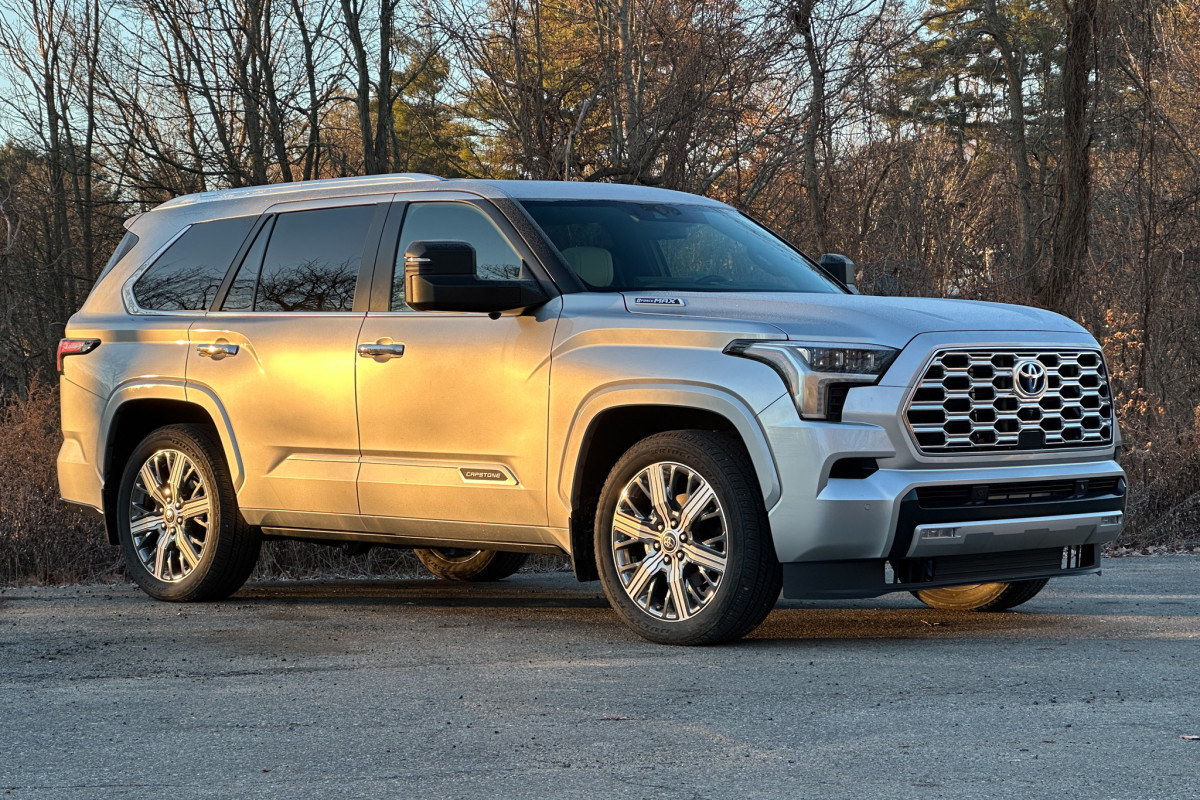
2025 Toyota Sequoia Reviews SummaryThe 2025 Sequoia is Toyota’s full-size SUV, based on the same platform as the Tundra pickup truck and using the same i-Force Max hybrid powertrain. It seats up to eight people, holds up to 2,460 litres of cargo, carries up to 640 kilograms (1,411 pounds) of payload, and tows up to 4,080 kilograms (9,000 pounds) of trailer. But the Toyota Sequoia comes with some fundamental flaws. Verdict: People buy full-size SUVs to carry lots of people, haul lots of cargo, and tow lots of weight. However, due to its packaging requirements, the Sequoia is a rock star only if you’re attaching a trailer to it, and even then, it’s not class-leading in capability. | |
No video found | |
Popular Features & Specs | |
Engine2.5L 277 hp I4 | Engine3.4L 437 hp V6 Hybrid |
DrivetrainFWD | Drivetrain4X2 |
Seating Capacity7 | Seating Capacity8 |
Horsepower277 hp @ 5800 rpm | Horsepower437 hp @ 5200 rpm |
EV Battery Capacity | EV Battery Capacity1.9 kWh |
Fuel Economy (City)11.8 L(e)/100 km | Fuel Economy (City)11.2 L(e)/100 km |
Fuel Economy (Highway)8.1 L(e)/100 km | Fuel Economy (Highway)9.8 L(e)/100 km |
Engine | |
Engine Name2.5L 277 hp I4 | Engine Name3.4L 437 hp V6 Hybrid |
Torque311 lb-ft @ 4000 rpm | Torque583 lb-ft @ 2400 rpm |
Horsepower277 hp @ 5800 rpm | Horsepower437 hp @ 5200 rpm |
DrivetrainFWD | Drivetrain4X2 |
Fuel Economy | |
EV Battery Capacity | EV Battery Capacity1.9 kWh |
Fuel Economy (City)11.8 L(e)/100 km | Fuel Economy (City)11.2 L(e)/100 km |
Fuel Economy (Highway)8.1 L(e)/100 km | Fuel Economy (Highway)9.8 L(e)/100 km |
Interior | |
Seating Capacity7 | Seating Capacity8 |
Key Features | |
Navigation SystemStandard | Navigation System |
Sunroof/Moonroof | Sunroof/MoonroofStandard |
Safety | |
Front Crash Overall4 | Front Crash Overall |
Side Crash Overall5 | Side Crash Overall |
Dimensions & Capacity | |
Cargo Space413 L | Cargo Space631 L |
Curb Weight1970 kg | Curb Weight2549 kg |
Height1720 mm | Height1892 mm |
Length4831 mm | Length5286 mm |
Width1900 mm | Width2027 mm |
Wheelbase2814 mm | Wheelbase3099 mm |
Maximum Payload540 kg | Maximum Payload785 kg |
Number of doors4 | Number of doors4 |
Maximum Towing Capacity1588 kg | Maximum Towing Capacity4318 kg |
Standard Towing Capacity | Standard Towing Capacity4318 kg |
Overview | ||
Listings | ||
Ratings & Reviews | ||
User reviews | ||
Expert reviews | 8.2 out of 10Read full review | 5.5 out of 10Read full review |
Pros & cons | Pros
Cons
| Pros
Cons
|
Summary | The Hyundai Santa Fe is fully redesigned for 2024. It marks a significant departure for the brand in terms of styling, with a bold and blocky profile and stance reminiscent of, dare we say it, a certain British brand known for its off-road prowess. The Santa Fe’s redesign has as much substance as style, with a longer wheelbase, standard third-row seats, and new premium amenities, including a “terrace” approach to designing passenger and cargo space. Verdict: Based on our exploration and time behind the wheel, the 2024 Santa Fe’s redesign is successful, as long as it doesn’t overshadow the rest of Hyundai’s lineup. | The 2025 Sequoia is Toyota’s full-size SUV, based on the same platform as the Tundra pickup truck and using the same i-Force Max hybrid powertrain. It seats up to eight people, holds up to 2,460 litres of cargo, carries up to 640 kilograms (1,411 pounds) of payload, and tows up to 4,080 kilograms (9,000 pounds) of trailer. But the Toyota Sequoia comes with some fundamental flaws. Verdict: People buy full-size SUVs to carry lots of people, haul lots of cargo, and tow lots of weight. However, due to its packaging requirements, the Sequoia is a rock star only if you’re attaching a trailer to it, and even then, it’s not class-leading in capability. |
Video | No video found | |
Popular Features & Specs | ||
Engine | 2.5L 277 hp I4 | 3.4L 437 hp V6 Hybrid |
Drivetrain | FWD | 4X2 |
Seating Capacity | 7 | 8 |
Horsepower | 277 hp @ 5800 rpm | 437 hp @ 5200 rpm |
EV Battery Capacity | 1.9 kWh | |
Fuel Economy (City) | 11.8 L(e)/100 km | 11.2 L(e)/100 km |
Fuel Economy (Highway) | 8.1 L(e)/100 km | 9.8 L(e)/100 km |
Engine | ||
Engine Name | 2.5L 277 hp I4 | 3.4L 437 hp V6 Hybrid |
Torque | 311 lb-ft @ 4000 rpm | 583 lb-ft @ 2400 rpm |
Horsepower | 277 hp @ 5800 rpm | 437 hp @ 5200 rpm |
Drivetrain | FWD | 4X2 |
Fuel Economy | ||
EV Battery Capacity | 1.9 kWh | |
Fuel Economy (City) | 11.8 L(e)/100 km | 11.2 L(e)/100 km |
Fuel Economy (Highway) | 8.1 L(e)/100 km | 9.8 L(e)/100 km |
Interior | ||
Seating Capacity | 7 | 8 |
Key Features | ||
Navigation System | Standard | |
Sunroof/Moonroof | Standard | |
Safety | ||
Front Crash Overall | 4 | |
Side Crash Overall | 5 | |
Dimensions & Capacity | ||
Cargo Space | 413 L | 631 L |
Curb Weight | 1970 kg | 2549 kg |
Height | 1720 mm | 1892 mm |
Length | 4831 mm | 5286 mm |
Width | 1900 mm | 2027 mm |
Wheelbase | 2814 mm | 3099 mm |
Maximum Payload | 540 kg | 785 kg |
Number of doors | 4 | 4 |
Maximum Towing Capacity | 1588 kg | 4318 kg |
Standard Towing Capacity | 4318 kg | |
The 2024 Hyundai Santa Fe presented a distinct departure from its predecessors, showcasing a bold, boxy design that diverged from the sleek, futuristic aesthetics of the Ioniq series. This new look was not only about style but also function, as Hyundai's design chief, SangYup Lee, emphasized the practicality of a box shape for storage capacity. Despite its unconventional appearance, the Santa Fe managed to turn heads with its upscale and elegant presentation, enhanced by a sophisticated palette of exterior colours and anodized-finish badging. The interior was equally impressive, offering premium styling with a mix of soft and hard materials that created a luxurious feel, particularly in the XRT and Ultimate Calligraphy trims.
In contrast, the 2025 Toyota Sequoia, particularly in the 1794 Edition, exuded a rugged charm with its Lunar Rock paint and dark grey painted wheels. While the exterior was eye-catching, the interior was a mix of luxury and practicality, featuring Saddle Tan leather upholstery and open-pore walnut wood trim. However, the cabin was also filled with typical Toyota-grade plastic, which detracted from the overall premium feel. The Sequoia's design was functional, with long rear doors for easier access to the second and third rows, although the high floor and low roof made third-row access awkward for adults. Despite these challenges, the Sequoia offered a spacious interior with comfortable seating, especially in the Platinum and Capstone trims.

The 2024 Hyundai Santa Fe offered a unique approach in Canada by making the hybrid powertrain the entry-level option. The Preferred models featured a 1.6-litre turbocharged four-cylinder hybrid engine, delivering an estimated 231 horsepower and 271 pound-feet of torque, paired with a six-speed automatic transmission. Other models came with a 2.5-litre turbocharged four-cylinder engine, producing 277 horsepower and 311 pound-feet of torque, coupled with an eight-speed dual-clutch automatic transmission. All-wheel drive was standard across the lineup, and the Santa Fe boasted various driving modes, including Normal, Sport, and Snow. The XRT trim added off-road capabilities, making it suitable for adventurous outings. Fuel economy was a highlight, with the hybrid achieving 6.8 L/100 km in the city and 6.9 L/100 km on the highway. The Santa Fe's towing capacity reached up to 1,587 kilograms, with the XRT trim offering an additional 453 kilograms.
The 2025 Toyota Sequoia came equipped with an i-Force Max hybrid powertrain, featuring a twin-turbocharged 3.4-litre V6 engine, an electric motor, and a 10-speed automatic transmission. This setup delivered an impressive 437 horsepower and 583 pound-feet of torque. The Sequoia's part-time four-wheel-drive system offered versatility with 2-Hi, 4-Hi, and 4-Lo settings, along with Eco, Normal, Sport, and Tow/Haul driving modes. Despite its muscular performance, the Sequoia's fuel economy fell short, averaging 14.5 L/100 km in real-world testing. The SUV excelled in towing, with a maximum capacity of 4,137 kilograms, but its driving dynamics were compromised by the rear-mounted battery pack and solid rear axle. The Sequoia's off-road capabilities were limited by its low ground clearance and front air dam, making it less suitable for rugged terrains.
The 2024 Hyundai Santa Fe's design focused on maximizing cargo space, with a wheelbase and body length about five centimetres longer than its predecessor. This extra space was dedicated to the cargo area, inspired by the Korean concept of "chabak," making it ideal for car camping and tailgating. The interior offered spacious first and second rows, with options for bench or captain's chairs, depending on the trim. The Santa Fe's cargo area provided 413 litres of space, expanding to 1,148 and 2,267 litres with the third and second rows folded, respectively. The vehicle also featured a UV sanitization compartment in the glovebox, a thoughtful addition conceived during the Covid-19 pandemic.
The 2025 Toyota Sequoia accommodated up to eight passengers, with the option for second-row captain's chairs in higher trims. The interior featured 10-way power adjustable seats with heating, ventilation, and massage functions in the Platinum and Capstone trims. Access to the third row was facilitated by long rear doors, although the high floor and low roof made it challenging for adults. The Sequoia's cargo space was limited, with only 325 litres available with the third row in use, expanding to 1,387 litres with the third row folded and 2,460 litres with both the second and third rows down. Despite its size, the Sequoia offered less cargo space than some rivals and even Toyota's own Grand Highlander.
The 2024 Hyundai Santa Fe featured a curved panoramic display that elegantly integrated digital real estate without overwhelming the driver. The touchscreen display was intuitive, with easy access to controls and crisp graphics. Wireless Apple CarPlay and Android Auto were standard, along with a 12-speaker Bose stereo and six USB ports. Higher trims offered additional features like wireless charging and Hyundai's BlueLink system, which allowed for vehicle access and information via a smartphone app.
The 2025 Toyota Sequoia came with a 12.3-inch digital instrumentation panel and a 14-inch touchscreen infotainment system from the Limited trim onwards. The Toyota Audio Multimedia system offered various connected services plans, with features like cloud-based navigation and remote engine starting. Wireless Apple CarPlay and Android Auto were standard, along with a 14-speaker JBL premium sound system in higher trims. The system's natural voice recognition was reasonably capable, though it struggled with some commands. The Sequoia also featured a surround-view camera system and a digital rearview mirror for added convenience.
The 2024 Hyundai Santa Fe had not yet been crash-tested by major safety organizations, but it came equipped with a comprehensive suite of advanced safety features. Standard equipment included adaptive cruise control, forward collision-avoidance assist, blind-spot monitors, and lane-keep assist. Higher trims added features like a 360-degree camera system, rain-sensing windshield wipers, and remote automatic parking. The Santa Fe also introduced driver monitoring, using an infrared camera and capacitive sensors to track alertness and issue warnings if necessary.
The 2025 Toyota Sequoia featured Toyota Safety Sense 2.5, which included adaptive cruise control, forward collision warning, lane departure warning, and automatic high-beam headlights. Blind-spot monitoring and rear cross-traffic alert were also standard. While the safety tech was helpful, the lane assist features could be intrusive, causing false warnings and noticeable corrections. At the time of publication, the Sequoia had not been crash-tested by major safety organizations.
CarGurus highlights

According to CarGurus experts, the overall rating for the 2024 Hyundai Santa Fe is 8.2 out of 10, while the 2025 Toyota Sequoia scores 5.5 out of 10. Based on these ratings, the Hyundai Santa Fe is the recommended choice, offering a better balance of performance, technology, and practicality for Canadian consumers.
Choose the 2025 Toyota Sequoia if:
- You require a powerful hybrid powertrain with impressive towing capacity.
- You prefer a full-size SUV with seating for up to eight passengers.
- You appreciate rugged styling and off-road capabilities, despite some limitations.


Choose the 2024 Hyundai Santa Fe if:
- You prioritize fuel efficiency and a hybrid powertrain as the entry-level option.
- You need a spacious cargo area for car camping and tailgating.
- You value advanced technology features like a curved panoramic display and wireless connectivity.


CarGurus highlights
According to CarGurus experts, the overall rating for the 2024 Hyundai Santa Fe is 8.2 out of 10, while the 2025 Toyota Sequoia scores 5.5 out of 10. Based on these ratings, the Hyundai Santa Fe is the recommended choice, offering a better balance of performance, technology, and practicality for Canadian consumers.
Choose the 2025 Toyota Sequoia if:
Shop Now- You require a powerful hybrid powertrain with impressive towing capacity.
- You prefer a full-size SUV with seating for up to eight passengers.
- You appreciate rugged styling and off-road capabilities, despite some limitations.
Choose the 2024 Hyundai Santa Fe if:
Shop Now- You prioritize fuel efficiency and a hybrid powertrain as the entry-level option.
- You need a spacious cargo area for car camping and tailgating.
- You value advanced technology features like a curved panoramic display and wireless connectivity.

By: CarGurus + AI
At CarGurus, our team of experienced automotive writers remain at the heart of our content operation, conducting hands-on car tests and writing insightful guides that are backed by years of industry experience. To complement this, we are harnessing AI to make our content offering more diverse and more helpful to shoppers than ever. To achieve this, our AI systems are based exclusively on CarGurus content, ratings and data, so that what we produce is both unique to CarGurus, and uniquely helpful to car shoppers.
