2025 Hyundai Santa Fe vs 2025 Toyota Sequoia
Overview | |
Listings202 | Listings11 |
Ratings & Reviews | |
User Reviews | User Reviews |
Expert reviews7.7 out of 10 | Expert reviews5.5 out of 10 |
Pros
Cons
| Pros
Cons
|
2025 Hyundai Santa Fe Reviews SummaryMore than twenty years ago, Hyundai gave us its first SUV. Called the Santa Fe, the popular crossover has gone through four generations, all leading up to the design departure that makes this latest model the boldest-looking version yet. Even if you’re not sold on the exterior design, the 2025 Hyundai Santa Fe has plenty to recommend it. Its longer wheelbase means the mid-size crossover has more interior space, and Hyundai has added myriad features that just make sense in a family vehicle of this size. Some rivals might offer more cargo space, but those who are looking for stand-out styling on the road should take a serious look at this blocky crossover. Verdict: The 2025 Hyundai Santa Fe is a mid-size crossover that fashionable families will love. Though, those with more traditional tastes might find it all a bit too much. | |
2025 Toyota Sequoia Reviews SummaryThe 2025 Sequoia is Toyota’s full-size SUV, based on the same platform as the Tundra pickup truck and using the same i-Force Max hybrid powertrain. It seats up to eight people, holds up to 2,460 litres of cargo, carries up to 640 kilograms (1,411 pounds) of payload, and tows up to 4,080 kilograms (9,000 pounds) of trailer. But the Toyota Sequoia comes with some fundamental flaws. Verdict: People buy full-size SUVs to carry lots of people, haul lots of cargo, and tow lots of weight. However, due to its packaging requirements, the Sequoia is a rock star only if you’re attaching a trailer to it, and even then, it’s not class-leading in capability. | |
No video found | No video found |
Popular Features & Specs | |
Engine2.5L 277 hp I4 | Engine3.4L 437 hp V6 Hybrid |
DrivetrainFWD | Drivetrain4X2 |
Seating Capacity7 | Seating Capacity8 |
Horsepower277 hp @ 5800 rpm | Horsepower437 hp @ 5200 rpm |
EV Battery Capacity | EV Battery Capacity1.9 kWh |
Fuel Economy (City)11.8 L(e)/100 km | Fuel Economy (City)11.2 L(e)/100 km |
Fuel Economy (Highway)8.1 L(e)/100 km | Fuel Economy (Highway)9.8 L(e)/100 km |
Engine | |
Engine Name2.5L 277 hp I4 | Engine Name3.4L 437 hp V6 Hybrid |
Torque311 lb-ft @ 4000 rpm | Torque583 lb-ft @ 2400 rpm |
Horsepower277 hp @ 5800 rpm | Horsepower437 hp @ 5200 rpm |
DrivetrainFWD | Drivetrain4X2 |
Fuel Economy | |
EV Battery Capacity | EV Battery Capacity1.9 kWh |
Fuel Economy (City)11.8 L(e)/100 km | Fuel Economy (City)11.2 L(e)/100 km |
Fuel Economy (Highway)8.1 L(e)/100 km | Fuel Economy (Highway)9.8 L(e)/100 km |
Interior | |
Seating Capacity7 | Seating Capacity8 |
Key Features | |
Navigation SystemStandard | Navigation System |
Sunroof/Moonroof | Sunroof/MoonroofStandard |
Safety | |
Front Crash Overall4 | Front Crash Overall |
Side Crash Overall5 | Side Crash Overall |
Dimensions & Capacity | |
Cargo Space413 L | Cargo Space631 L |
Curb Weight1970 kg | Curb Weight2549 kg |
Height1720 mm | Height1892 mm |
Length4831 mm | Length5286 mm |
Width1900 mm | Width2027 mm |
Wheelbase2814 mm | Wheelbase3099 mm |
Maximum Payload540 kg | Maximum Payload785 kg |
Number of doors4 | Number of doors4 |
Maximum Towing Capacity1588 kg | Maximum Towing Capacity4318 kg |
Standard Towing Capacity | Standard Towing Capacity4318 kg |
Overview | ||
Listings | ||
Ratings & Reviews | ||
User reviews | ||
Expert reviews | 7.7 out of 10Read full review | 5.5 out of 10Read full review |
Pros & cons | Pros
Cons
| Pros
Cons
|
Summary | More than twenty years ago, Hyundai gave us its first SUV. Called the Santa Fe, the popular crossover has gone through four generations, all leading up to the design departure that makes this latest model the boldest-looking version yet. Even if you’re not sold on the exterior design, the 2025 Hyundai Santa Fe has plenty to recommend it. Its longer wheelbase means the mid-size crossover has more interior space, and Hyundai has added myriad features that just make sense in a family vehicle of this size. Some rivals might offer more cargo space, but those who are looking for stand-out styling on the road should take a serious look at this blocky crossover. Verdict: The 2025 Hyundai Santa Fe is a mid-size crossover that fashionable families will love. Though, those with more traditional tastes might find it all a bit too much. | The 2025 Sequoia is Toyota’s full-size SUV, based on the same platform as the Tundra pickup truck and using the same i-Force Max hybrid powertrain. It seats up to eight people, holds up to 2,460 litres of cargo, carries up to 640 kilograms (1,411 pounds) of payload, and tows up to 4,080 kilograms (9,000 pounds) of trailer. But the Toyota Sequoia comes with some fundamental flaws. Verdict: People buy full-size SUVs to carry lots of people, haul lots of cargo, and tow lots of weight. However, due to its packaging requirements, the Sequoia is a rock star only if you’re attaching a trailer to it, and even then, it’s not class-leading in capability. |
Video | No video found | No video found |
Popular Features & Specs | ||
Engine | 2.5L 277 hp I4 | 3.4L 437 hp V6 Hybrid |
Drivetrain | FWD | 4X2 |
Seating Capacity | 7 | 8 |
Horsepower | 277 hp @ 5800 rpm | 437 hp @ 5200 rpm |
EV Battery Capacity | 1.9 kWh | |
Fuel Economy (City) | 11.8 L(e)/100 km | 11.2 L(e)/100 km |
Fuel Economy (Highway) | 8.1 L(e)/100 km | 9.8 L(e)/100 km |
Engine | ||
Engine Name | 2.5L 277 hp I4 | 3.4L 437 hp V6 Hybrid |
Torque | 311 lb-ft @ 4000 rpm | 583 lb-ft @ 2400 rpm |
Horsepower | 277 hp @ 5800 rpm | 437 hp @ 5200 rpm |
Drivetrain | FWD | 4X2 |
Fuel Economy | ||
EV Battery Capacity | 1.9 kWh | |
Fuel Economy (City) | 11.8 L(e)/100 km | 11.2 L(e)/100 km |
Fuel Economy (Highway) | 8.1 L(e)/100 km | 9.8 L(e)/100 km |
Interior | ||
Seating Capacity | 7 | 8 |
Key Features | ||
Navigation System | Standard | |
Sunroof/Moonroof | Standard | |
Safety | ||
Front Crash Overall | 4 | |
Side Crash Overall | 5 | |
Dimensions & Capacity | ||
Cargo Space | 413 L | 631 L |
Curb Weight | 1970 kg | 2549 kg |
Height | 1720 mm | 1892 mm |
Length | 4831 mm | 5286 mm |
Width | 1900 mm | 2027 mm |
Wheelbase | 2814 mm | 3099 mm |
Maximum Payload | 540 kg | 785 kg |
Number of doors | 4 | 4 |
Maximum Towing Capacity | 1588 kg | 4318 kg |
Standard Towing Capacity | 4318 kg | |
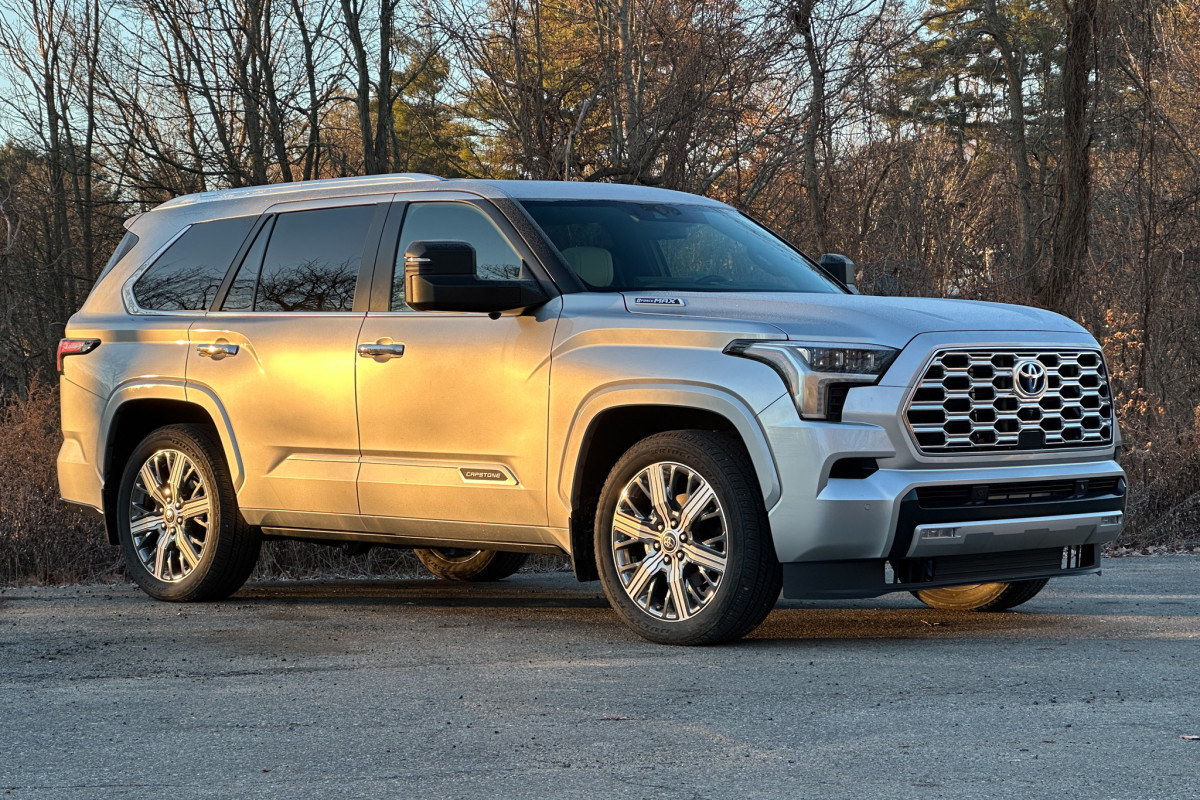
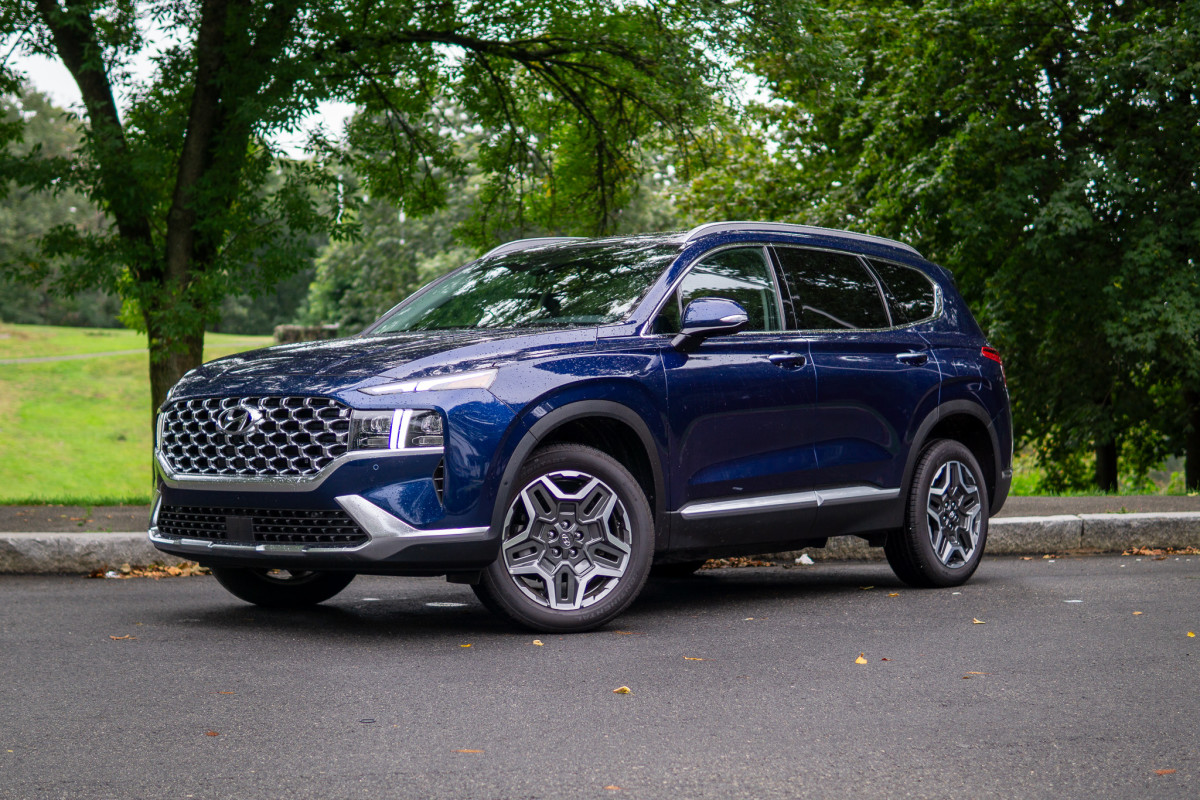
The 2025 Hyundai Santa Fe, available in Canada in XRT, Luxury, and Ultimate Calligraphy trims, maintained its fifth-generation design introduced in 2024. This three-row SUV featured a chunky, boxy appearance with a long wheelbase, flat hood, and snub nose. Its pixelated H-shaped LED headlamps aligned with Hyundai's design aesthetic, offering vibrant colour options like Terracotta Orange and Atlantis Blue. However, the rear design suffered from mismatched proportions, with taillights positioned lower than ideal, affecting the overall visual balance. Each trim had distinct wheel sizes, ranging from 18 to 21 inches, with the XRT trim adding chrome and black accents for an off-road look. Inside, the Santa Fe accommodated seven passengers, except for the Ultimate Calligraphy trim, which featured captain's chairs in the second row. The interior offered leatherette, leather, or Nappa leather upholstery, though some squeaks and rattles were noted during testing. The inclusion of physical HVAC dials was appreciated, but the fan speed buttons were less user-friendly.
The 2025 Toyota Sequoia, particularly the U.S.-only 1794 Edition, shared similarities with the Canadian Platinum trim but featured unique elements like dark grey 20-inch wheels and Saddle Tan leather upholstery. In Canada, the Sequoia lineup included the SR5 TRD Off-road, Limited, Platinum, and Capstone trims, with prices ranging from $87,174 to $106,175. The Sequoia's Lunar Rock paint garnered attention despite its established design, and its rarity on the road added to its appeal. However, the interior, apart from the leather upholstery, was dominated by Toyota-grade plastic, which detracted from the overall quality feel.
The 2025 Hyundai Santa Fe was equipped with a 2.5-litre turbocharged engine producing 277 horsepower and 311 pound-feet of torque, with standard all-wheel drive across the lineup. An eight-speed dual-clutch automatic transmission handled shifting duties. The Santa Fe Hybrid, a separate model, combined a 1.6-litre four-cylinder engine with an electric motor, delivering 231 horsepower and 271 pound-feet of torque, also with standard AWD. The Santa Fe exhibited stability in corners, firm braking, and responsive steering, though turbo lag and occasional transmission delays were noted. The gear selector, located on a stalk, required some getting used to. The XRT trim featured 30-inch all-terrain tires and 21.2 centimetres of ground clearance, enhancing off-road capabilities with improved approach, departure, and breakover angles. However, the Santa Fe was not designed for rugged rock crawling, better suited for graded dirt roads.
The 2025 Toyota Sequoia came standard with the i-Force Max hybrid powertrain, featuring a twin-turbocharged 3.4-litre V6 engine, an electric motor, and a 10-speed automatic transmission. It delivered 437 horsepower and 583 pound-feet of torque, with a part-time four-wheel-drive system offering various settings. Despite its weight of 2,790 kilograms, the Sequoia provided quick acceleration and a robust engine note, though fuel economy fell short of expectations. Maximum towing capacity was 4,137 kilograms, with a peak payload of 640 kilograms. The Sequoia's packaging and driving dynamics were compromised by the rear-mounted battery pack and solid rear axle, affecting rear-seat room and cargo space. The ride was jittery and truck-like, with excessive lateral weight transfer on uneven roads. Ground clearance was 22.1 centimetres, but the front air dam limited the approach angle. Off-road capabilities were hindered by the air dam, though it could be removed for better performance. Steering was light and fluid, but brake performance was lacking, with poor initial bite and fade issues during testing.
The 2025 Hyundai Santa Fe XRT trim offered features like heated front seats, a heated steering wheel, a sunroof, and a 115-volt outlet. The Ultimate Calligraphy trim added heated second-row seats, ventilated front seats, and a premium audio system. The Santa Fe excelled in interior space, boasting the most third-row legroom in its class. The second-row seats had adjustable cushion angles, and both the second and third rows could be folded for increased cargo space. With the third row folded, the Santa Fe offered 1,148 litres of space, expanding to 2,267 litres with the second row folded. Even with all seats occupied, there was 413 litres of cargo space. The rear opening was widened to 127.5 cm, accommodating larger items. Towing capacity varied by trim, with the XRT capable of towing 2,040 kilograms.
The 2025 Toyota Sequoia accommodated up to eight passengers, though seven or six would be more comfortable. The Platinum and Capstone trims featured 10-way power adjustable seats with heating, ventilation, and massage. Heated front seats, a heated steering wheel, and heated mirrors were standard across all trims. Access to the second and third rows was facilitated by long rear doors, though they posed challenges in tight spaces. The Platinum and Capstone trims offered heated and ventilated captain's chairs in the second row, but they lacked sliding functionality. The third row's stadium-style seating provided a good view but limited headroom. Cargo space was limited with the third row in use, offering 325 litres, expandable to 1,387 litres with the third row folded. Maximum cargo volume was 2,460 litres, less than rival full-size SUVs.
The 2025 Hyundai Santa Fe featured a 12.3-inch touchscreen infotainment system and a digital gauge cluster of the same size. The system was user-friendly, with clear graphics and quick response times. Navigation was available on the Luxury and Ultimate Calligraphy trims, but wireless Apple CarPlay and Android Auto were standard. Multiple USB-C ports and a wireless charging pad were included, with the Ultimate Calligraphy trim accommodating two phones. A digital key feature allowed unlocking and starting the car via a smartphone or Apple Watch. The Ultimate Calligraphy trim offered a digital rearview mirror and a head-up display. Bluelink app connectivity was standard, providing remote climate control and alerts, with over-the-air updates ensuring up-to-date software.
The 2025 Toyota Sequoia came with a 12.3-inch digital instrumentation panel and a 14-inch touchscreen infotainment system from the Limited trim onwards. Four connected services plans were available, with trial subscriptions ranging from three to ten years. Features like cloud-based navigation and emergency assistance required active subscriptions. Wireless Apple CarPlay and Android Auto were standard, with a wireless charging pad included from the Limited trim. A 14-speaker JBL premium sound system was available on higher trims. The infotainment system featured a large volume knob but lacked a tuning knob, which was inconvenient. The Intelligent Assistant voice recognition system had limitations, struggling with certain commands. The Sequoia also offered a surround-view camera system and a digital rearview mirror for enhanced visibility.
The 2025 Hyundai Santa Fe offered a comprehensive suite of safety features, including adaptive cruise control, blind spot monitoring, rear cross-traffic alert, and forward collision avoidance assist. Additional features like rear parking collision avoidance assist and Highway Drive Assist were available on higher trims. The Highway Drive Assist feature combined adaptive cruise control and lane following assist, though it occasionally exhibited abrupt braking and acceleration in heavy traffic. The top trim included a blind spot avoidance feature and a Blind View Monitor. The Santa Fe received a four-star overall safety rating from the NHTSA and a "Good" rating from the IIHS, except for "Acceptable" scores in the headlight and LATCH categories.
The 2025 Toyota Sequoia was equipped with Toyota Safety Sense 2.5, which included adaptive cruise control, forward collision warning, automatic emergency braking, lane departure warning, and lane keep assist. Blind-spot monitoring and rear cross-traffic alert were also standard. While the safety tech was helpful, the lane assist features were sometimes intrusive, causing false warnings and noticeable corrections. At the time of publication, crash-test ratings from the IIHS and NHTSA were not available for the Sequoia.
CarGurus highlights
According to CarGurus experts, the overall rating for the 2025 Hyundai Santa Fe is 7.7 out of 10, while the 2025 Toyota Sequoia scores 5.5 out of 10. Based on these ratings, the Hyundai Santa Fe is the recommended choice, offering a better balance of performance, technology, and safety features.
Choose the 2025 Hyundai Santa Fe if:
- You prioritize a spacious interior with excellent third-row legroom and versatile cargo space.
- You value a comprehensive suite of safety features and a strong safety rating.
- You appreciate user-friendly technology with standard wireless Apple CarPlay and Android Auto.


Choose the 2025 Toyota Sequoia if:
- You need a powerful hybrid powertrain with impressive towing capacity.
- You prefer a full-size SUV with a robust and muscular design.
- You want advanced connected services and a premium sound system.


CarGurus highlights
According to CarGurus experts, the overall rating for the 2025 Hyundai Santa Fe is 7.7 out of 10, while the 2025 Toyota Sequoia scores 5.5 out of 10. Based on these ratings, the Hyundai Santa Fe is the recommended choice, offering a better balance of performance, technology, and safety features.
Choose the 2025 Hyundai Santa Fe if:
Shop Now- You prioritize a spacious interior with excellent third-row legroom and versatile cargo space.
- You value a comprehensive suite of safety features and a strong safety rating.
- You appreciate user-friendly technology with standard wireless Apple CarPlay and Android Auto.
Choose the 2025 Toyota Sequoia if:
Shop Now- You need a powerful hybrid powertrain with impressive towing capacity.
- You prefer a full-size SUV with a robust and muscular design.
- You want advanced connected services and a premium sound system.

By: CarGurus + AI
At CarGurus, our team of experienced automotive writers remain at the heart of our content operation, conducting hands-on car tests and writing insightful guides that are backed by years of industry experience. To complement this, we are harnessing AI to make our content offering more diverse and more helpful to shoppers than ever. To achieve this, our AI systems are based exclusively on CarGurus content, ratings and data, so that what we produce is both unique to CarGurus, and uniquely helpful to car shoppers.
