2025 Hyundai Santa Fe Reviews, Pricing & Specs

Pros & cons
What we like
Multiple powertrain options
Impressive technology
Great warranty
What to consider
Design not to all tastes
Not as spacious as some rivals
Expensive in top trims
The CarGurus verdict
Hyundai’s high-tech three-row crossover is a bold yet practical choice.
More than twenty years ago, Hyundai gave us its first SUV. Called the Santa Fe, the popular crossover has gone through four generations, all leading up to the design departure that makes this latest model the boldest-looking version yet.
Even if you’re not sold on the exterior design, the 2025 Hyundai Santa Fe has plenty to recommend it. Its longer wheelbase means the mid-size crossover has more interior space, and Hyundai has added myriad features that just make sense in a family vehicle of this size. Some rivals might offer more cargo space, but those who are looking for stand-out styling on the road should take a serious look at this blocky crossover.
Verdict: The 2025 Hyundai Santa Fe is a mid-size crossover that fashionable families will love. Though, those with more traditional tastes might find it all a bit too much.
out of 10 expert review
Look & feel
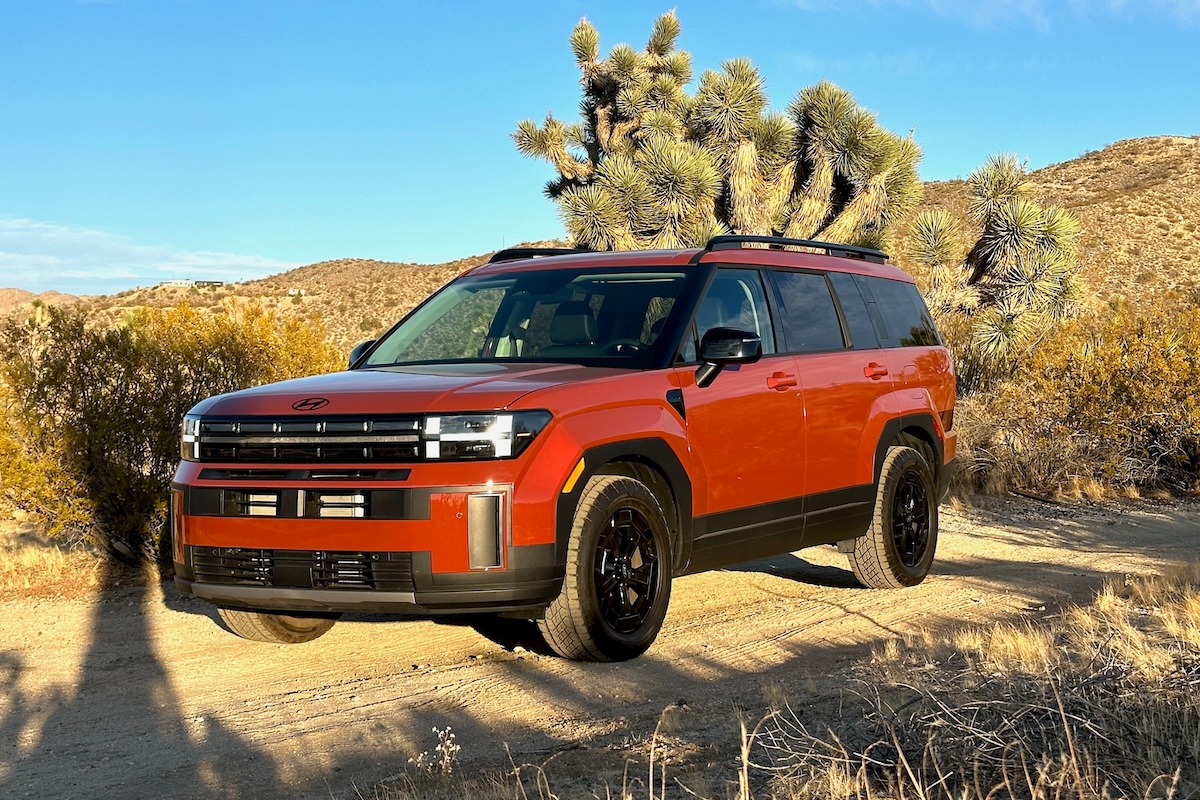
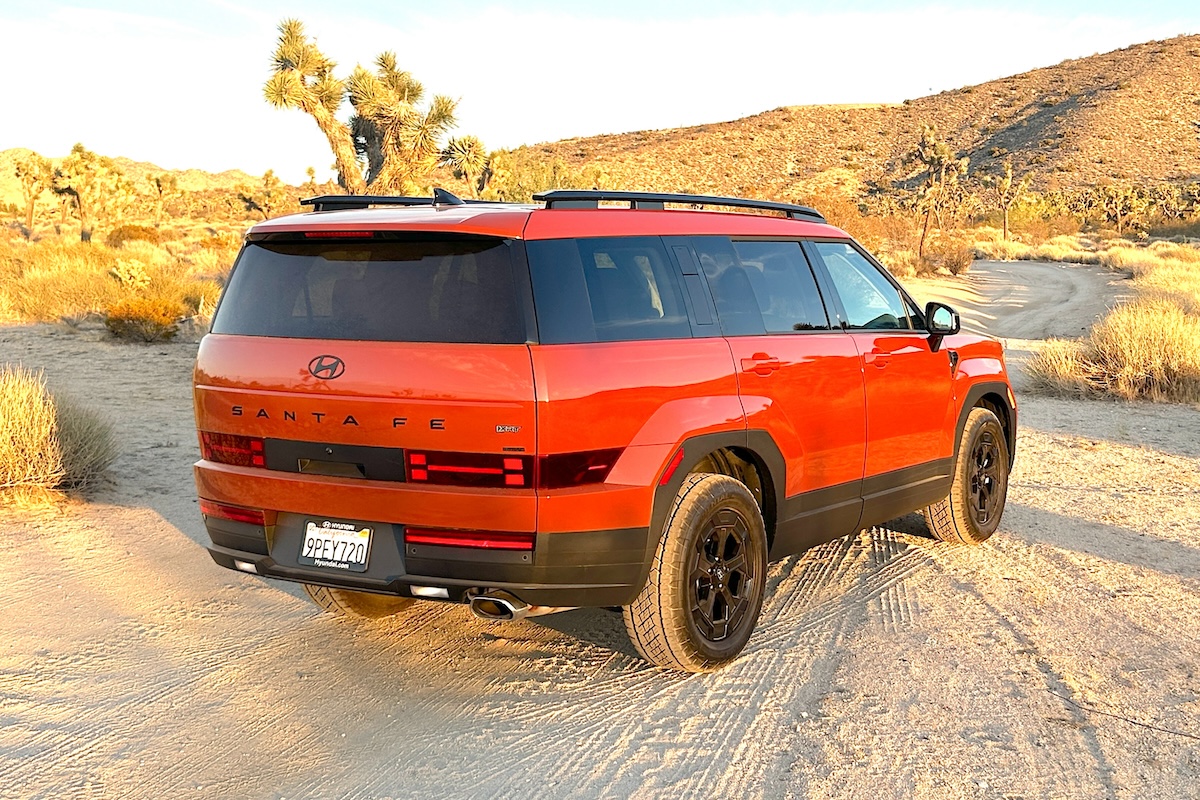
In Canada, the 2025 Hyundai Santa Fe is available in three trims: XRT, Luxury, and Ultimate Calligraphy. This fifth-generation Santa Fe debuted in 2024, so don’t look for any design revisions at this stage of the game. The three-row SUV is a chunky, boxy thing with a long wheelbase, flat hood, and snub nose. The H-shaped LED headlamps are pixelated and fit right in with much of Hyundai’s overall design aesthetic (see the Hyundai Ioniq 5). The brand offers some brighter colours such as Terracotta Orange and Atlantis Blue for those that are tired of the greyscale that dominates the body work of many SUVs these days.
The rear of the Santa Fe, however, is a lesson in mismatched proportions. Like the front, the pixelated H-shaped LED taillights are an excellent choice, but we wish they were just a bit higher. Moving them up on the tailgate would provide a better visual balance in our opinion. While we know that beauty is in the eye of the beholder and it might not bother you, we think it’s egregious enough for us to take away points from what could have been a stellar overall design.
Each trim has its own specific set of wheels, from 18 inches on the XRT all the way up to 21 inches on the top Ultimate Calligraphy. The off-road-focused XRT trim adds some chrome and black trim to the outside as well as black roof rails.
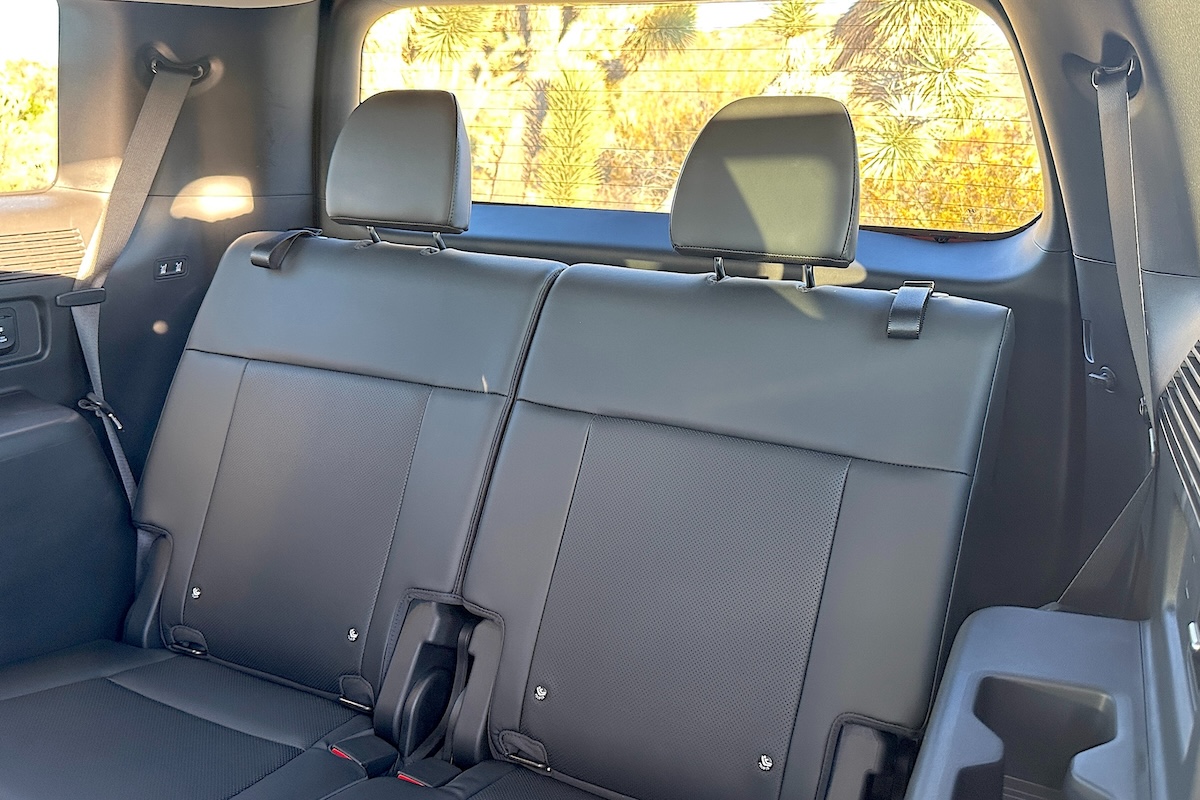
Inside, there’s room for seven except on the top Ultimate Calligraphy trim, which trades the second-row three-seat bench for a set of captain’s chairs. Depending on trim, you can get either leatherette, leather, or Nappa leather upholstery.
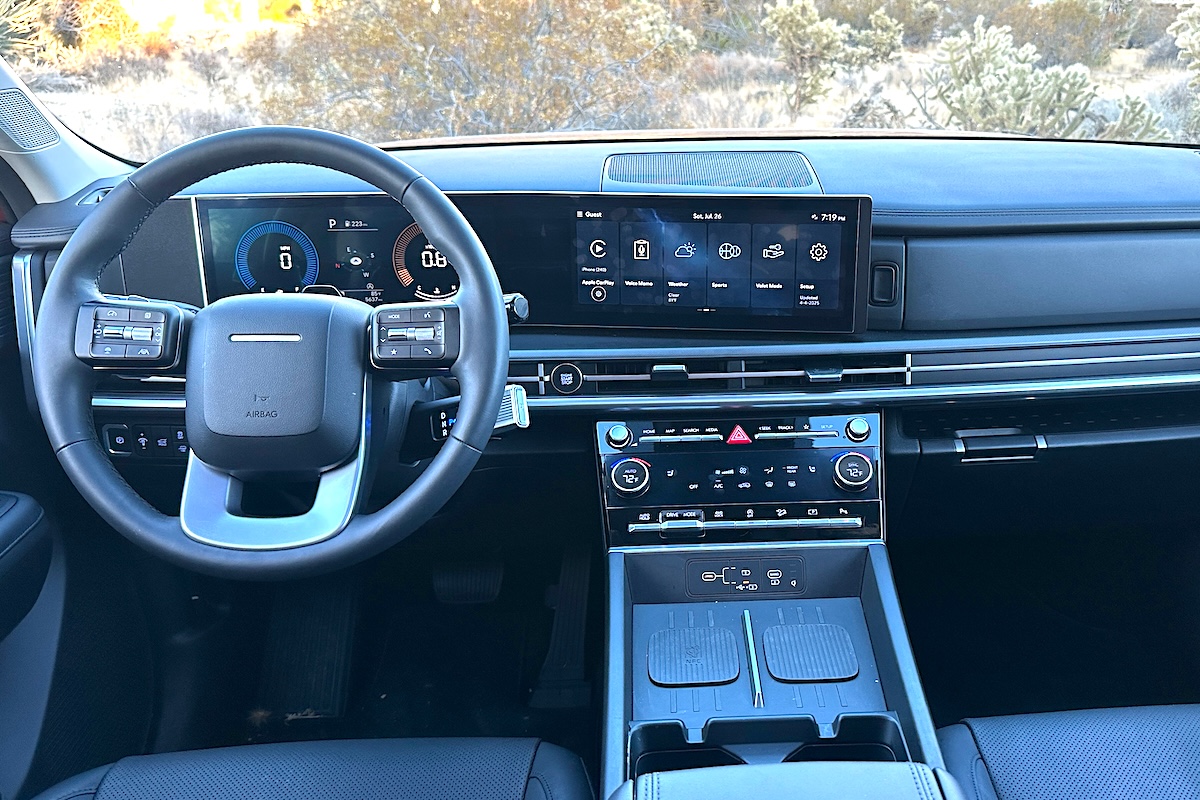
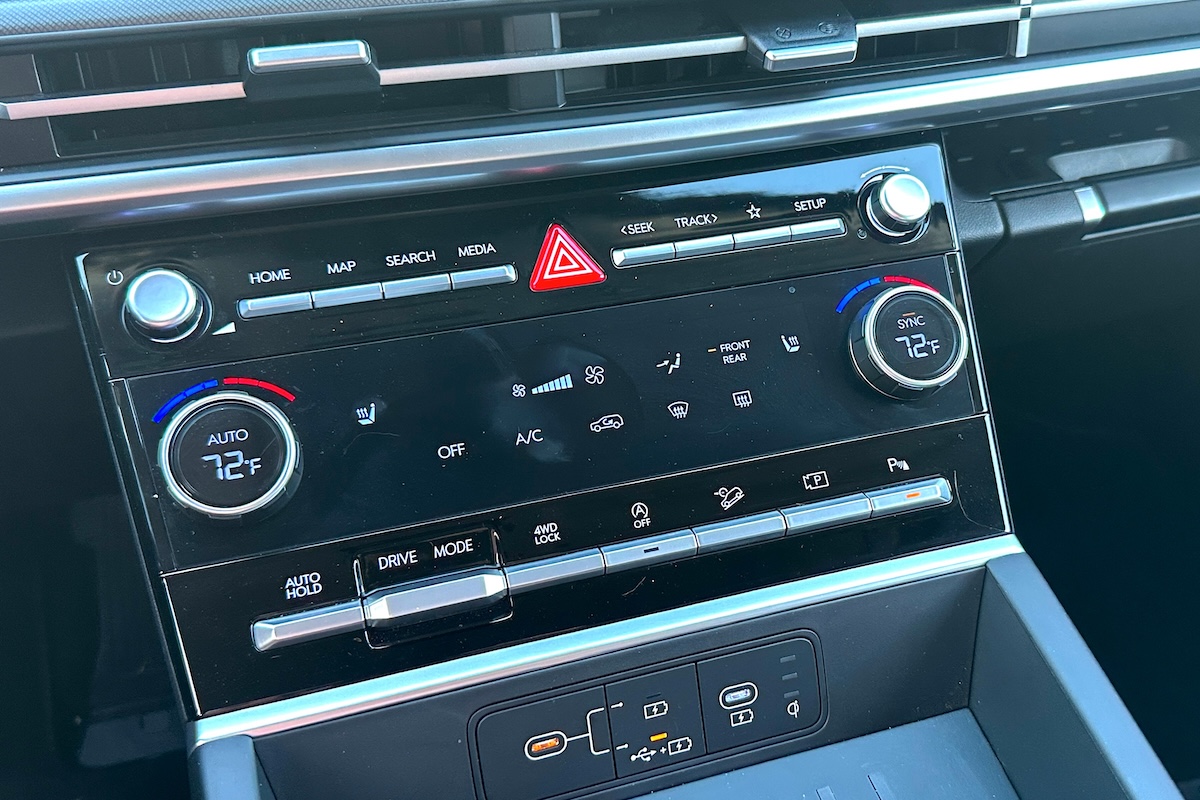
The fit and finish inside looks pretty good, but during our week with the car some squeaks and rattles could be heard from behind the dashboard. We like the inclusion of physical dials for the HVAC temperature, but the fan speed buttons are a bit harder to operate. You won’t find an actual button, just a flat icon that has to be pressed in just the right place to initiate an action.
Performance
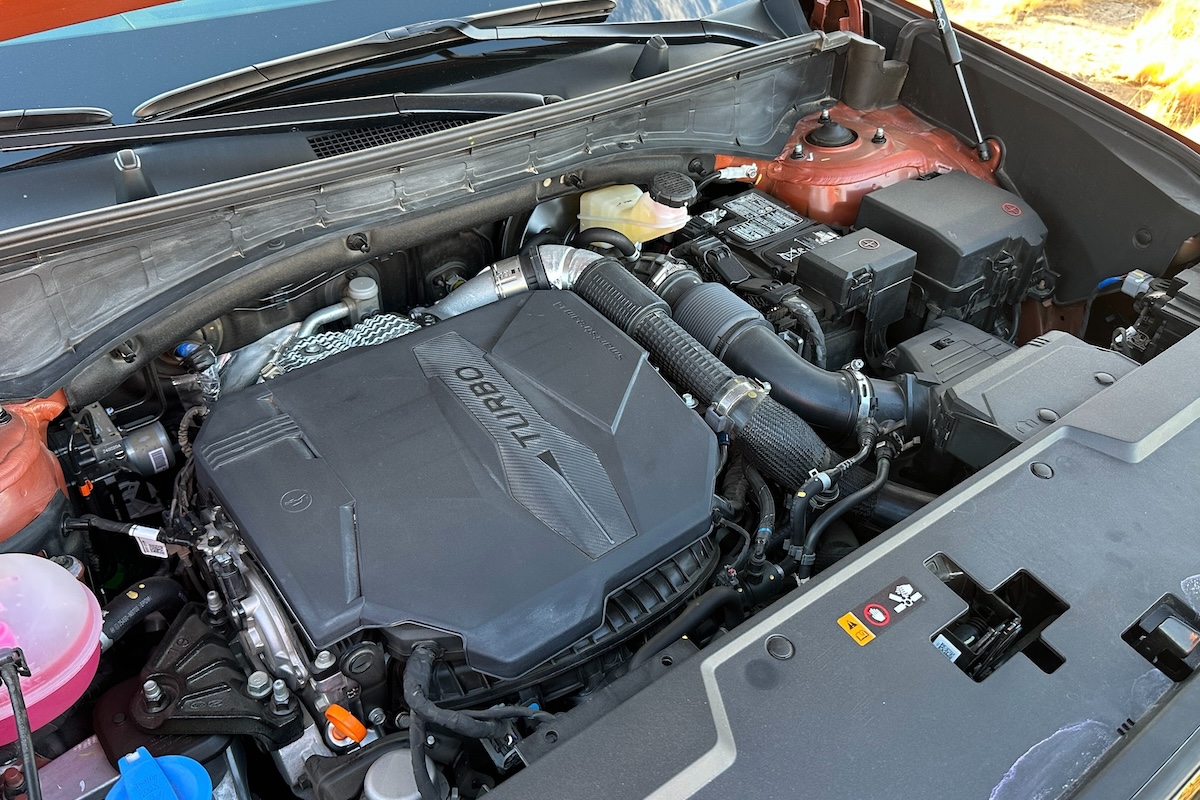
Our test Santa Fe had the standard 2.5-litre turbocharged engine with 277 horsepower and 311 pound-feet of torque. In Canada, all-wheel drive (AWD) is standard across the lineup. An eight-speed dual-clutch automatic transmission takes care of shifting duties. The Hyundai Santa Fe Hybrid, classed as a separate model, combines a 1.6-litre four-cylinder engine with an electric motor for a total of 231 hp and 271 lb-ft of torque. It too has AWD as standard.
In all, the Santa Fe feels stable in the corners with a firm brake feel and responsive steering. However, there is noticeable turbo lag when accelerating, and there were a few times the transmission didn’t give us a quick downshift out of a corner. It’s not a deal-breaker, but you should be prepared to wait for full engine power when passing or merging onto the highway. You might need a while to get used to the gear selector, which is on a stalk on the right-hand side of the steering column. Gears are selected by twisting the end of the stalk forward or backward. Selecting a gear is always an exercise in self-doubt. “Wait, which way is Drive?” Let’s hope your muscle memory is a tad better than ours.
The XRT trim includes 30-inch all-terrain tires to help in off-road driving conditions and, with 21.2 centimetres of ground clearance, sits an extra 4.5 cm higher than the rest of the Santa Fe lineup. As such, the off-road geometry is better, too. The approach angle is 19.3 degrees, departure angle 21.8 degrees, and breakover angle is 19.1 degrees.
Those numbers are fine for the class, but they don’t make the Santa Fe a rugged rock crawler. You’ll be fine on graded dirt roads with a few small obstacles, but leave the big rough stuff to larger three-row SUVs such as the Lexus GX.
Form & function
Our XRT tester is well-equipped with heated front seats, a heated steering wheel, a sunroof, and a 115-volt outlet for powering off-road goodies like a travel refrigerator or a Starlink. However, for all the proverbial bells and whistles, you’ll want to go to the Ultimate Calligraphy. Here you get heated second-row seats, ventilated front seats, and a premium audio system.
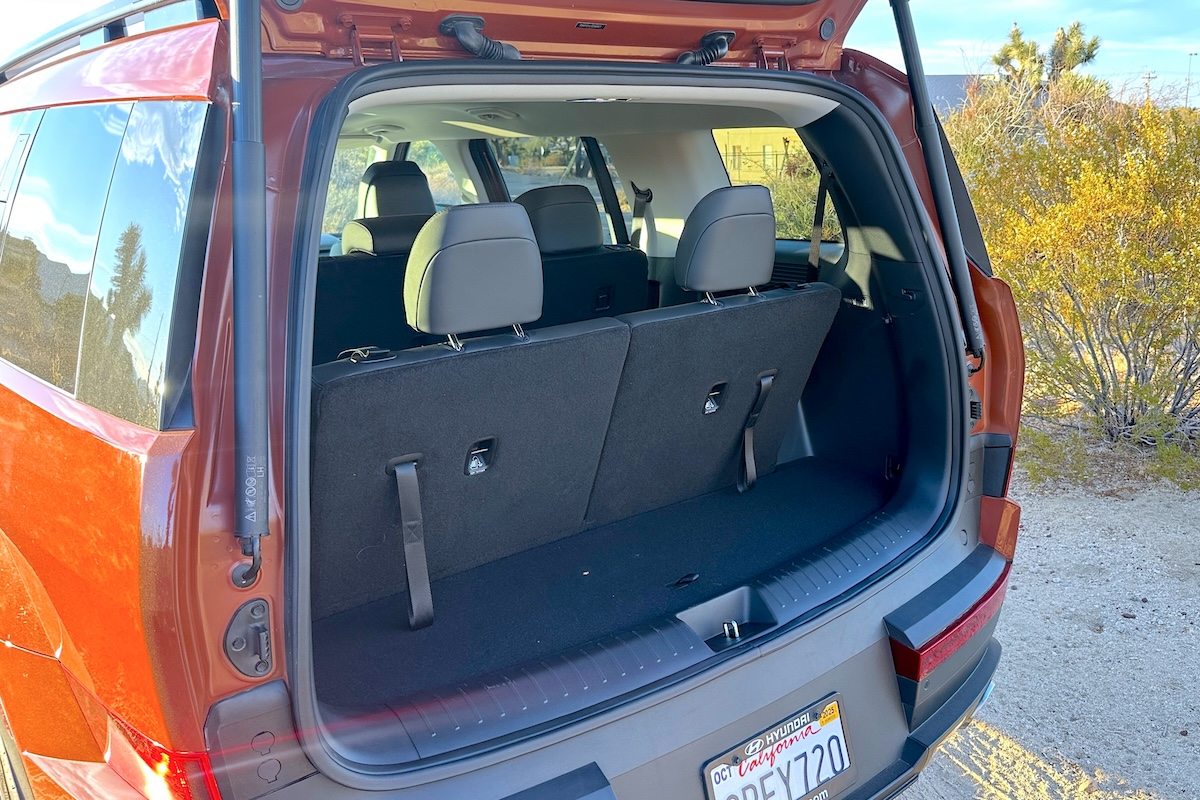
However, what every Santa Fe shares is space. It’s got the most third-row legroom in the class, and the second-row seats have an adjustable cushion angle. When it’s time to haul a bunch of stuff, both the second and third row can be folded by pressing a button in the rear cargo area. Folding the third row results in 1,148 litres of space, and folding the second row opens it up to 2,267 litres. With all three rows occupied, you still have 413 litres of space. Those numbers are pretty good for this class of smaller midsize three-row SUVs, but larger ones like the Honda Pilot, Mazda CX-90, and even the company’s own Palisade naturally offer up more cargo space.
What’s cool about the Santa Fe is the rear opening. After all, what good is having a ton of cargo space if you can’t get your stuff into the vehicle? For this generation, the liftgate width increased roughly 15 centimetres to 127.5 cm, and the height sits at 81 cm. That’s great news for folks who make regular runs to IKEA or who need to carry unwieldy items like bicycles.
If you need to haul any toys, most trims of the Santa Fe can tow 1,587 kilograms (3,500 pounds). The XRT goes a bit bigger with a towing capacity of 2,040 kilograms (4,500 pounds).
Technology
In Canada, every version of the gas-powered Santa Fe gets a 12.3-inch touchscreen for infotainment duties and a digital gauge cluster of the same size. (The base Preferred trim doesn’t get the digital instrument cluster, but that version is hybrid-only in Canada). The infotainment system is easy to use with clear graphics and quick reaction times, but only the Luxury and Ultimate Calligraphy trims have navigation built in. However, it’s not a deal-breaker with the standard wireless Apple CarPlay and Android Auto included.
Charging is taken care of by multiple 27-watt USB-C ports as well as a wireless charging pad, which can accommodate two phones in the Ultimate Calligraphy trim. Wireless charging can be iffy, but this system charged our phone just fine. Speaking of phones, you can use yours—or your Apple watch—as a digital key to unlock and start your car. You can even share the digital key with up to three trusted people.
Our XRT trim didn’t come with the digital rearview mirror, but you can get one in the Ultimate Calligraphy trim. With it, you’ll get a wide-angle view of what’s going on behind the car, regardless of any cargo you might be hauling that’s blocking the mirror. A head-up display is equipped on the Ultimate Calligraphy trim to keep information front and centre.
Standard on every trim of the Santa Fe is Bluelink app connectivity. You can preset your climate control, get alerts if any customized location or speed rules are broken, even get a snapshot from the surround view monitor. For parents who want to keep tabs on a new driver, this is a great service. Finally, over-the-air updates ensure you’ll always have the latest and greatest vehicle software.
Safety
Hyundai is good about offering all kinds of safety features as standard fare, but you’ll need to spend some money to get the whole shebang. Regardless of trim, you’ll get adaptive cruise control with stop-and-go, blind spot monitoring, rear cross-traffic alert, front and rear parking sensors, forward collision avoidance assist with pedestrian, cyclist, and junction turning detection, lane keeping and lane following assist, a driver attention monitor, and safe exit assist, among other features. You have to pony up for rear parking collision avoidance assist, side park distance warning, and Highway Drive Assist.
In other new Hyundai models, we’ve found the Highway Drive Assist feature to be smooth and easy. This feature combines adaptive cruise control and lane following assist to take some of the stress out of commuting. However, in one particularly bad traffic jam the system continually slammed on the brakes at the last minute when the lead car was at rest and then floored it as soon as said lead car moved ahead. However, a few days later while using it in the same rate of traffic, the system worked fine.
The top trim gets a blind spot avoidance feature that will apply the brakes if it thinks you’re about to change lanes into another vehicle. The top two trims get the nifty Blind View Monitor that displays a video feed of your blind spot directly in the gauge cluster when signaling.
The U.S. National Highway Traffic Safety Administration (NHTSA) gave the 2025 Hyundai Santa Fe a four-out-of-five-star overall safety rating. The Insurance Institute for Highway Safety (IIHS) rated the Santa Fe as a top “Good” in all sections except in the headlight and LATCH categories, where it scored “Acceptable”.
Cost-effectiveness
The Hyundai Santa Fe Hybrid returns the best fuel economy of the lot, averaging 6.9 litres per 100 kilometres combined. Natural Resources Canada estimates that the ICE model gets a fuel rating of 10.6 L/100 km combined. The XRT, with its knobbier tires, returns 10.8 L/100 km combined. That exactly lines up with our week-long average in our XRT tester, and these numbers are right in line with other three-row midsize SUVs.
Hyundai Canada’s new-car warranty is good for five years or 100,000 kilometres. You also get free roadside assistance for five years with unlimited kilometres.
For the 2025 model year, the MSRP for the gas-only Santa Fe XRT starts at $51,039, including the $2,100 destination charge and other fees. The Santa Fe Luxury costs $54,039, and the Ultimate Calligraphy trim is priced at $57,839. Our XRT tester is frankly too pricey for something that isn’t as off-roady as Hyundai wants it to be.
On the other hand, the Santa Fe is appealingly priced relative to larger three-row midsize SUVs such as the Kia Telluride, Honda Pilot, Mazda CX-90, and Hyundai’s own Palisade. For those who don’t need three rows full-time but want to retain the option, the Santa Fe can be a great alternative.
What owners say
It was the Calligraphy trim and so it had every safety and convenience feature. Great value for the price
June 5, 2025I absolutely love how the outside of them look. The lights on the back do look a little funny, but I think that the inside and features that it comes with makes up for that.
August 2, 2025Trims & specs
Base MSRP $43,600 | Seating 7 |
Engine 2.5L 277 hp I4 | Cargo Capacity 14.6 cu ft |
Combined MPG 24 | Drivetrain FWD |
Base MSRP $40,850 | Seating 7 |
Engine 2.5L 277 hp I4 | Cargo Capacity 14.6 cu ft |
Combined MPG 22 | Drivetrain AWD |
Base MSRP $34,200 | Seating 7 |
Engine 2.5L 277 hp I4 | Cargo Capacity 14.6 cu ft |
Combined MPG 24 | Drivetrain FWD |
Base MSRP N/A | Seating N/A |
Engine N/A | Cargo Capacity N/A |
Combined MPG N/A | Drivetrain N/A |
Base MSRP $45,400 | Seating 7 |
Engine 2.5L 277 hp I4 | Cargo Capacity 14.6 cu ft |
Combined MPG 24 | Drivetrain AWD |
Base MSRP $38,500 | Seating 7 |
Engine 2.5L 277 hp I4 | Cargo Capacity 14.6 cu ft |
Combined MPG 24 | Drivetrain AWD |
Base MSRP $46,750 | Seating 6 |
Engine 2.5L 277 hp I4 | Cargo Capacity 14.6 cu ft |
Combined MPG 24 | Drivetrain FWD |
Base MSRP $36,000 | Seating 7 |
Engine 2.5L 277 hp I4 | Cargo Capacity 14.6 cu ft |
Combined MPG 24 | Drivetrain AWD |
Base MSRP N/A | Seating N/A |
Engine N/A | Cargo Capacity N/A |
Combined MPG N/A | Drivetrain N/A |
Base MSRP $36,700 | Seating 7 |
Engine 2.5L 277 hp I4 | Cargo Capacity 14.6 cu ft |
Combined MPG 24 | Drivetrain FWD |
Base MSRP $48,550 | Seating 6 |
Engine 2.5L 277 hp I4 | Cargo Capacity 14.6 cu ft |
Combined MPG 24 | Drivetrain AWD |


Pricing trends
Current avg. market price
$43,721
Trending down by 1.0% this month
May 2026 - November 2026