Toyota Sequoia vs Hyundai Ioniq 9
Overview | |
MSRP$62,425 | MSRP$58,995 |
Listings108 | Listings177 |
Ratings & Reviews | |
User Reviews | User Reviews |
Expert reviews5.5 out of 10 | Expert reviews7.3 out of 10 |
Pros
Cons
| Pros
Cons
|
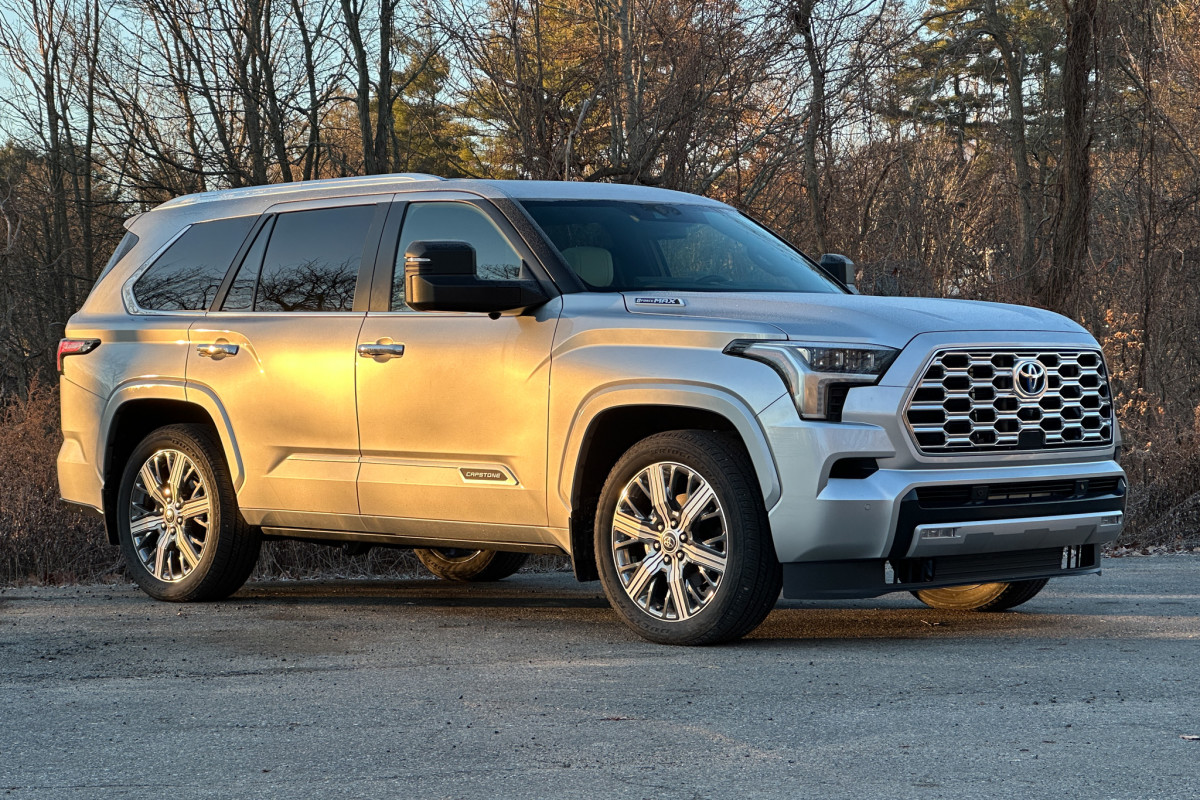
Reviews SummaryThe 2025 Sequoia is Toyota’s full-size SUV, based on the same platform as the Tundra pickup truck and using the same i-Force Max hybrid powertrain. It seats up to eight people, holds up to 2,460 litres of cargo, carries up to 640 kilograms (1,411 pounds) of payload, and tows up to 4,080 kilograms (9,000 pounds) of trailer. But the Toyota Sequoia comes with some fundamental flaws. Verdict: People buy full-size SUVs to carry lots of people, haul lots of cargo, and tow lots of weight. However, due to its packaging requirements, the Sequoia is a rock star only if you’re attaching a trailer to it, and even then, it’s not class-leading in capability. | |
Reviews SummaryAlthough the 2026 Hyundai Ioniq 9 isn’t the first three-row electric SUV through the door, it may be the best choice for most shoppers. With a starting price of $59,999 before fees and qualifying for EV rebates where they still exist, it’s much more affordable than a Tesla Model X or a Rivian R1S. And its standard 110.3-kWh battery pack provides a long range compared to a base-model Kia EV9. Verdict: The Hyundai Ioniq 9 isn’t a perfect vehicle, but it offers terrific passenger space, good tech, and family-friendly features. Shoppers may find its design polarizing — you could easily say the same about the Hyundai Ioniq 5 or the Ioniq 6 — but families interested in electric vehicles will do well to test drive this new option. | |
No video found | |
Popular Features & Specs | |
Engine3.4L 437 hp V6 Hybrid | Engine215 hp Electric |
Drive Train4X2 | Drive TrainRWD |
Seating Capacity8 | Seating Capacity7 |
Horsepower437 hp @ 5200 rpm | Horsepower |
EV Battery Capacity1.9 kWh | EV Battery Capacity110 kWh |
MPG City21 | MPG City103 |
MPG Highway24 | MPG Highway81 |
Battery Charge Time (120V) | Battery Charge Time (120V)93 hours |
Battery Charge Time (240V) | Battery Charge Time (240V)9.7 hours |
Engine | |
Engine Name3.4L 437 hp V6 Hybrid | Engine Name215 hp Electric |
Torque583 lb-ft @ 2400 rpm | Torque |
Horsepower437 hp @ 5200 rpm | Horsepower |
Battery Charge Time (120V) | Battery Charge Time (120V)93 hours |
Battery Charge Time (240V) | Battery Charge Time (240V)9.7 hours |
Drivetrain4X2 | DrivetrainRWD |
Fuel Economy | |
EV Battery Capacity1.9 kWh | EV Battery Capacity110 kWh |
MPG City21 | MPG City103 |
MPG Highway24 | MPG Highway81 |
Interior | |
Seating Capacity8 | Seating Capacity7 |
Key Features | |
Navigation System | Navigation SystemStandard |
Sunroof/MoonroofStandard | Sunroof/Moonroof |
Safety | |
Front Crash Overall | Front Crash Overall5 |
Side Crash Overall | Side Crash Overall5 |
Dimensions & Capacity | |
Cargo Space22.3 cu ft | Cargo Space21.9 cu ft |
Curb Weight5620 lbs | Curb Weight5507 lbs |
Height74.5 in | Height70.5 in |
Length208.1 in | Length199.2 in |
Width79.8 in | Width78.0 in |
Wheelbase122.0 in | Wheelbase123.2 in |
Maximum Payload1730 lbs | Maximum Payload1393 lbs |
Number of doors4 | Number of doors4 |
Maximum Towing Capacity9520 lbs | Maximum Towing Capacity3500 lbs |
Standard Towing Capacity9520 lbs | Standard Towing Capacity |
Overview | ||
MSRP | $62,425 | $58,995 |
Listings | ||
Ratings & Reviews | ||
User reviews | ||
Expert reviews | 5.5 out of 10Read full review | 7.3 out of 10Read full review |
Pros & cons | Pros
Cons
| Pros
Cons
|
Summary | The 2025 Sequoia is Toyota’s full-size SUV, based on the same platform as the Tundra pickup truck and using the same i-Force Max hybrid powertrain. It seats up to eight people, holds up to 2,460 litres of cargo, carries up to 640 kilograms (1,411 pounds) of payload, and tows up to 4,080 kilograms (9,000 pounds) of trailer. But the Toyota Sequoia comes with some fundamental flaws. Verdict: People buy full-size SUVs to carry lots of people, haul lots of cargo, and tow lots of weight. However, due to its packaging requirements, the Sequoia is a rock star only if you’re attaching a trailer to it, and even then, it’s not class-leading in capability. | Although the 2026 Hyundai Ioniq 9 isn’t the first three-row electric SUV through the door, it may be the best choice for most shoppers. With a starting price of $59,999 before fees and qualifying for EV rebates where they still exist, it’s much more affordable than a Tesla Model X or a Rivian R1S. And its standard 110.3-kWh battery pack provides a long range compared to a base-model Kia EV9. Verdict: The Hyundai Ioniq 9 isn’t a perfect vehicle, but it offers terrific passenger space, good tech, and family-friendly features. Shoppers may find its design polarizing — you could easily say the same about the Hyundai Ioniq 5 or the Ioniq 6 — but families interested in electric vehicles will do well to test drive this new option. |
Video | No video found | |
Popular Features & Specs | ||
Engine | 3.4L 437 hp V6 Hybrid | 215 hp Electric |
Drive Train | 4X2 | RWD |
Seating Capacity | 8 | 7 |
Horsepower | 437 hp @ 5200 rpm | |
EV Battery Capacity | 1.9 kWh | 110 kWh |
MPG City | 21 | 103 |
MPG Highway | 24 | 81 |
Battery Charge Time (120V) | 93 hours | |
Battery Charge Time (240V) | 9.7 hours | |
Engine | ||
Engine Name | 3.4L 437 hp V6 Hybrid | 215 hp Electric |
Torque | 583 lb-ft @ 2400 rpm | |
Horsepower | 437 hp @ 5200 rpm | |
Battery Charge Time (120V) | 93 hours | |
Battery Charge Time (240V) | 9.7 hours | |
Drivetrain | 4X2 | RWD |
Fuel Economy | ||
EV Battery Capacity | 1.9 kWh | 110 kWh |
MPG City | 21 | 103 |
MPG Highway | 24 | 81 |
Interior | ||
Seating Capacity | 8 | 7 |
Key Features | ||
Navigation System | Standard | |
Sunroof/Moonroof | Standard | |
Safety | ||
Front Crash Overall | 5 | |
Side Crash Overall | 5 | |
Dimensions & Capacity | ||
Cargo Space | 22.3 cu ft | 21.9 cu ft |
Curb Weight | 5620 lbs | 5507 lbs |
Height | 74.5 in | 70.5 in |
Length | 208.1 in | 199.2 in |
Width | 79.8 in | 78.0 in |
Wheelbase | 122.0 in | 123.2 in |
Maximum Payload | 1730 lbs | 1393 lbs |
Number of doors | 4 | 4 |
Maximum Towing Capacity | 9520 lbs | 3500 lbs |
Standard Towing Capacity | 9520 lbs | |


By: CarGurus + AI
At CarGurus, our team of experienced automotive writers remain at the heart of our content operation, conducting hands-on car tests and writing insightful guides that are backed by years of industry experience. To complement this, we are harnessing AI to make our content offering more diverse and more helpful to shoppers than ever. To achieve this, our AI systems are based exclusively on CarGurus content, ratings and data, so that what we produce is both unique to CarGurus, and uniquely helpful to car shoppers.

