Honda Pilot vs Hyundai VENUE
Overview | |
Listings1368 | Listings2330 |
Ratings & Reviews | |
User Reviews | User Reviews |
Expert reviews7.0 out of 10 | Expert reviews5.3 out of 10 |
Pros
Cons
| Pros
Cons
|
Reviews SummaryWhile it has a more truck-like presence, the 2026 Honda Pilot remains fundamentally the same as before—and that's a good thing. It's the automaker's midsize three-row crossover SUV, competing against family-focused models such as the Toyota Grand Highlander and the Ford Explorer. Verdict: Clever features help the Pilot stand out from other three-row SUVs. Our only major complaint is the lack of a more fuel-efficient model. | |
Reviews SummaryAutomakers have traditionally had a hard time making money on entry-level subcompact cars because they have low profit margins. But North America has largely moved away from cars to crossover SUVs — and higher prices. That allows car companies to offer an entry-level subcompact SUV for thousands more than a similar sedan or hatchback. Such is the case with the Hyundai Venue, which costs more than its predecessor, the subcompact Accent that was dropped in Canada after the 2020 model year. While the price is higher, the advantage for buyers is a vehicle that generally has more cargo space and is more practical. We recently drove the 2026 Hyundai Venue to find out if a subcompact crossover is a better buy than a cheaper subcompact car. Verdict: The Hyundai Venue sacrifices refinement for a price point that isn’t as low as a comparable subcompact car. We’d be tempted to spend a little more for a slightly larger compact car with more power, features, and refinement. | |
No video found | |
Popular Features & Specs | |
Engine3.5L 285 hp V6 | Engine1.6L 121 hp I4 |
DrivetrainFWD | DrivetrainFWD |
Seating Capacity8 | Seating Capacity5 |
Horsepower285 hp @ 6100 rpm | Horsepower121 hp @ 6300 rpm |
Fuel Economy (City)12.4 L(e)/100 km | Fuel Economy (City)8.1 L(e)/100 km |
Fuel Economy (Highway)8.7 L(e)/100 km | Fuel Economy (Highway)7.1 L(e)/100 km |
Engine | |
Engine Name3.5L 285 hp V6 | Engine Name1.6L 121 hp I4 |
Torque262 lb-ft @ 5000 rpm | Torque113 lb-ft @ 4500 rpm |
Horsepower285 hp @ 6100 rpm | Horsepower121 hp @ 6300 rpm |
DrivetrainFWD | DrivetrainFWD |
Fuel Economy | |
Fuel Economy (City)12.4 L(e)/100 km | Fuel Economy (City)8.1 L(e)/100 km |
Fuel Economy (Highway)8.7 L(e)/100 km | Fuel Economy (Highway)7.1 L(e)/100 km |
Interior | |
Seating Capacity8 | Seating Capacity5 |
Key Features | |
Navigation SystemStandard | Navigation System |
Safety | |
Front Crash Overall4 | Front Crash Overall4 |
Side Crash Overall5 | Side Crash Overall5 |
Dimensions & Capacity | |
Cargo Space527 L | Cargo Space530 L |
Curb Weight1967 kg | Curb Weight1185 kg |
Height1803 mm | Height1565 mm |
Length5083 mm | Length4041 mm |
Width1994 mm | Width1770 mm |
Wheelbase2891 mm | Wheelbase2520 mm |
Maximum Payload608 kg | Maximum Payload525 kg |
Number of doors4 | Number of doors4 |
Maximum Towing Capacity1588 kg | Maximum Towing Capacity |
Overview | ||
Listings | ||
Ratings & Reviews | ||
User reviews | ||
Expert reviews | 7.0 out of 10Read full review | 5.3 out of 10Read full review |
Pros & cons | Pros
Cons
| Pros
Cons
|
Summary | While it has a more truck-like presence, the 2026 Honda Pilot remains fundamentally the same as before—and that's a good thing. It's the automaker's midsize three-row crossover SUV, competing against family-focused models such as the Toyota Grand Highlander and the Ford Explorer. Verdict: Clever features help the Pilot stand out from other three-row SUVs. Our only major complaint is the lack of a more fuel-efficient model. | Automakers have traditionally had a hard time making money on entry-level subcompact cars because they have low profit margins. But North America has largely moved away from cars to crossover SUVs — and higher prices. That allows car companies to offer an entry-level subcompact SUV for thousands more than a similar sedan or hatchback. Such is the case with the Hyundai Venue, which costs more than its predecessor, the subcompact Accent that was dropped in Canada after the 2020 model year. While the price is higher, the advantage for buyers is a vehicle that generally has more cargo space and is more practical. We recently drove the 2026 Hyundai Venue to find out if a subcompact crossover is a better buy than a cheaper subcompact car. Verdict: The Hyundai Venue sacrifices refinement for a price point that isn’t as low as a comparable subcompact car. We’d be tempted to spend a little more for a slightly larger compact car with more power, features, and refinement. |
Video | No video found | |
Popular Features & Specs | ||
Engine | 3.5L 285 hp V6 | 1.6L 121 hp I4 |
Drivetrain | FWD | FWD |
Seating Capacity | 8 | 5 |
Horsepower | 285 hp @ 6100 rpm | 121 hp @ 6300 rpm |
Fuel Economy (City) | 12.4 L(e)/100 km | 8.1 L(e)/100 km |
Fuel Economy (Highway) | 8.7 L(e)/100 km | 7.1 L(e)/100 km |
Engine | ||
Engine Name | 3.5L 285 hp V6 | 1.6L 121 hp I4 |
Torque | 262 lb-ft @ 5000 rpm | 113 lb-ft @ 4500 rpm |
Horsepower | 285 hp @ 6100 rpm | 121 hp @ 6300 rpm |
Drivetrain | FWD | FWD |
Fuel Economy | ||
Fuel Economy (City) | 12.4 L(e)/100 km | 8.1 L(e)/100 km |
Fuel Economy (Highway) | 8.7 L(e)/100 km | 7.1 L(e)/100 km |
Interior | ||
Seating Capacity | 8 | 5 |
Key Features | ||
Navigation System | Standard | |
Safety | ||
Front Crash Overall | 4 | 4 |
Side Crash Overall | 5 | 5 |
Dimensions & Capacity | ||
Cargo Space | 527 L | 530 L |
Curb Weight | 1967 kg | 1185 kg |
Height | 1803 mm | 1565 mm |
Length | 5083 mm | 4041 mm |
Width | 1994 mm | 1770 mm |
Wheelbase | 2891 mm | 2520 mm |
Maximum Payload | 608 kg | 525 kg |
Number of doors | 4 | 4 |
Maximum Towing Capacity | 1588 kg | |
The 2026 Hyundai Venue was classified as a crossover SUV, though its design leaned more towards a tall hatchback. It featured only front-wheel drive and had a ground clearance of 17 centimetres, which was higher than a typical car but not as elevated as a standard crossover SUV. The Venue's design was compact and narrow, reminiscent of European runabouts. Its upright windshield and bluff nose gave it an SUV-like appearance, complemented by available roof rails. The Venue's high nose was paired with lower headlights and high-set daytime running lights, while black rocker panels and wheel flares added to its SUV aesthetic. Inside, the Venue offered a simple and functional look, with a digital instrument cluster and a small touchscreen that resembled an iPad affixed to the dash.
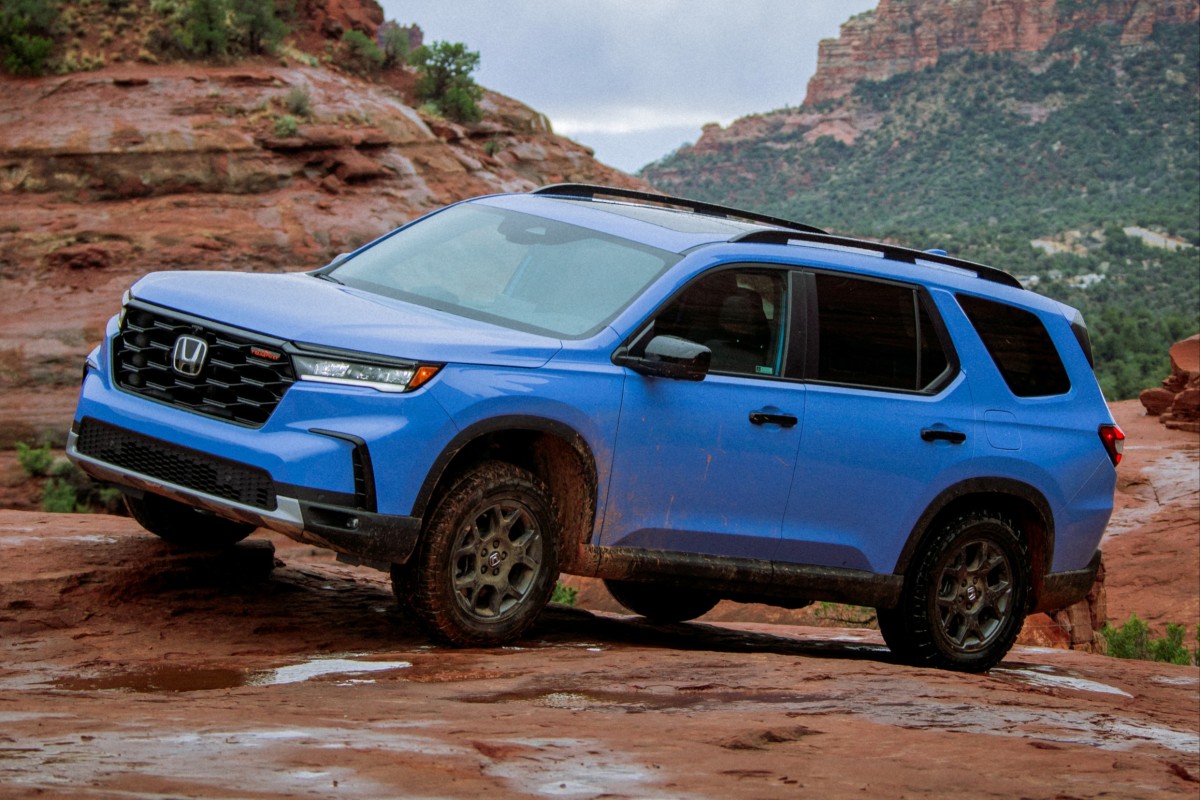
In contrast, the 2026 Honda Pilot underwent a makeover, adopting a more truck-like appearance with a larger, blockier grille and grey plastic scuff plates. The design updates aligned with the rugged direction introduced three years prior. The Pilot's interior retained its spacious and versatile layout, with notable upgrades such as larger infotainment and digital instrument panels. The top trims featured diamond quilting on the seats and contrast stitching, adding visual flair. Despite these changes, the Pilot maintained its reputation as a practical midsize SUV with high material quality and construction standards.


The 2026 Hyundai Venue was powered by a naturally aspirated 1.6-litre four-cylinder engine, producing 121 horsepower and 113 pound-feet of torque. This power was delivered through a continuously variable transmission (CVT) to the front wheels, with no all-wheel drive option. The Venue's acceleration was modest, with a 0-100 km/h time ranging from 8.5 to 8.8 seconds, aided by its lightweight 1,251-kilogram frame. While peppy in city traffic, the Venue struggled at highway speeds, with the transmission slow to downshift for more power. Handling was stable and direct, benefiting from its small size and low weight, though the ride could be jiggly on uneven surfaces due to its solid rear axle.
The 2026 Honda Pilot retained its 3.5-litre V6 engine, generating 285 horsepower and 262 pound-feet of torque, paired with a 10-speed automatic transmission. In Canada, all-wheel drive was standard. The Pilot offered adequate acceleration, with responsive handling and a confident V6 sound. The brake pedal effort was soft, suitable for a family SUV, though occasional subtle downshifts affected smooth stops. Honda revised the steering for improved feedback and stability, addressing previous vagueness on highways. Overall, the Pilot maintained its confident driving dynamics, navigating curves with ease while prioritizing practicality over sportiness.
The 2026 Hyundai Venue featured cloth and synthetic leather seats with black upholstery and white contrast stitching, offering decent comfort and six-way manual adjustments. While headroom was ample, legroom was limited for taller occupants. The rear seat accommodated average-sized adults, but taller passengers faced legroom challenges. The rear seats folded flat in a 60/40 split, providing 528 litres of cargo space, which was modest compared to typical compact crossovers. The Venue's interior was dominated by hard black plastic, with limited soft-touch surfaces, reflecting cost-cutting measures.
The 2026 Honda Pilot's cabin remained spacious and versatile, with a removable second-row centre seat offering flexibility between a bench and captain's chairs. The seats provided ample legroom and comfort, though the lack of a centre armrest was a drawback. Access to the third row was easy, with adequate space for smaller adults. The Pilot offered generous cargo capacity, with up to 3,219 litres available when both rear rows were folded. The front seats featured ample storage, including a long tray, large cupholders, and a giant centre armrest bin, enhancing practicality.
The 2026 Hyundai Venue was equipped with an 8-inch touchscreen for basic infotainment functions, including phone, radio, media, and phone projection connections. While lacking features like navigation and a Wi-Fi hotspot, it offered wireless Apple CarPlay and Android Auto. The digital instrument cluster displayed limited information, and a wireless charging pad was standard in Canada. The audio system was a simple six-speaker unit, adequate for basic listening needs.
The 2026 Honda Pilot upgraded to a 12.3-inch infotainment touchscreen and a 10.2-inch digital instrument panel. The system featured customizable shortcuts and ran on the latest Honda software, offering wireless Apple CarPlay and Android Auto. The EX-L trim included a wireless phone charger, though it required precise positioning. The Pilot retained unique features like multiple camera angles and the CabinTalk intercom system, enhancing its tech offerings.
The 2026 Hyundai Venue came with standard safety features, including forward collision warning, automatic emergency braking, lane keep assist, and a driver attention monitor. Blind spot monitoring and rear cross-traffic alert were available on all but the base trim. The Venue received a four-star safety rating from the NHTSA, with mixed ratings from the IIHS.
The 2026 Honda Pilot's safety features included the Honda Sensing suite, with forward collision warning, lane-departure warning, lane-keep assist, adaptive cruise control, and more. While crash test scores for 2026 were unavailable, the structurally unchanged model was expected to maintain its five-star NHTSA rating and IIHS Top Safety Pick status. The safety systems generally performed well, though the forward collision warning was occasionally too sensitive.
CarGurus highlights

According to CarGurus experts, the overall rating for the 2026 Hyundai Venue is 5.3 out of 10, while the 2026 Honda Pilot scores 7.0 out of 10. Based on these ratings, the 2026 Honda Pilot is the recommended choice, offering superior performance, interior space, and safety features, making it a more well-rounded option for families and those seeking a practical midsize SUV.
Choose the 2026 Honda Pilot if:
- You need a spacious and versatile interior with flexible seating options.
- Advanced safety features and high safety ratings are important to you.
- You desire a more powerful engine and all-wheel drive capability.


Choose the 2026 Hyundai VENUE if:
- You prefer a compact and lightweight vehicle for easy city manoeuvrability.
- Budget-friendly pricing is a priority, with essential features included.
- You value wireless Apple CarPlay and Android Auto in a smaller package.


CarGurus highlights
According to CarGurus experts, the overall rating for the 2026 Hyundai Venue is 5.3 out of 10, while the 2026 Honda Pilot scores 7.0 out of 10. Based on these ratings, the 2026 Honda Pilot is the recommended choice, offering superior performance, interior space, and safety features, making it a more well-rounded option for families and those seeking a practical midsize SUV.
Choose the 2026 Honda Pilot if:
Shop Now- You need a spacious and versatile interior with flexible seating options.
- Advanced safety features and high safety ratings are important to you.
- You desire a more powerful engine and all-wheel drive capability.
Choose the 2026 Hyundai VENUE if:
Shop Now- You prefer a compact and lightweight vehicle for easy city manoeuvrability.
- Budget-friendly pricing is a priority, with essential features included.
- You value wireless Apple CarPlay and Android Auto in a smaller package.

By: CarGurus + AI
At CarGurus, our team of experienced automotive writers remain at the heart of our content operation, conducting hands-on car tests and writing insightful guides that are backed by years of industry experience. To complement this, we are harnessing AI to make our content offering more diverse and more helpful to shoppers than ever. To achieve this, our AI systems are based exclusively on CarGurus content, ratings and data, so that what we produce is both unique to CarGurus, and uniquely helpful to car shoppers.
