2026 Honda Pilot Reviews, Pricing & Specs



Pros & cons
What we like
Comfortable
Plenty of cargo space
Plenty of passenger space
What to consider
No hybrid option
Expert review
The 2026 Honda Pilot returns with a brawny new look.
While it has a more truck-like presence, the 2026 Honda Pilot remains fundamentally the same as before—and that's a good thing. It's the automaker's midsize three-row crossover SUV, competing against family-focused models such as the Toyota Grand Highlander and the Ford Explorer.
Verdict: Clever features help the Pilot stand out from other three-row SUVs. Our only major complaint is the lack of a more fuel-efficient model.
out of 10 expert review
Look & feel
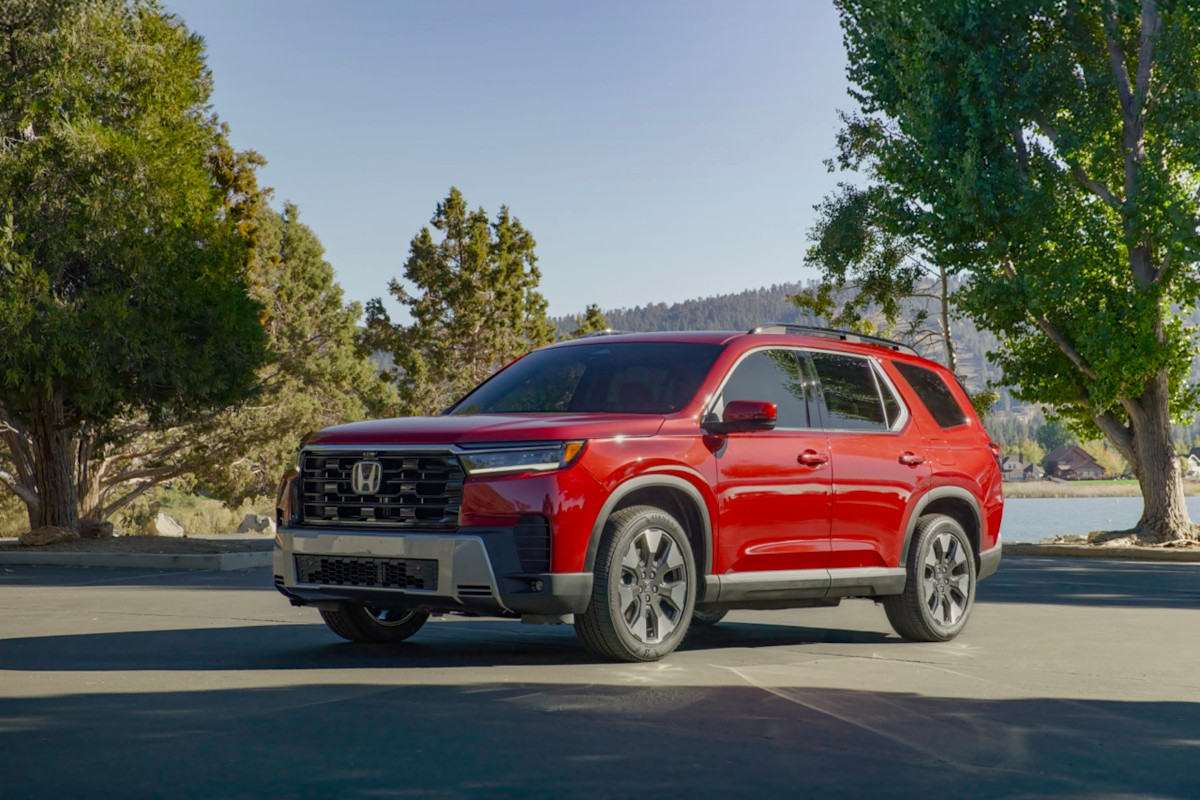
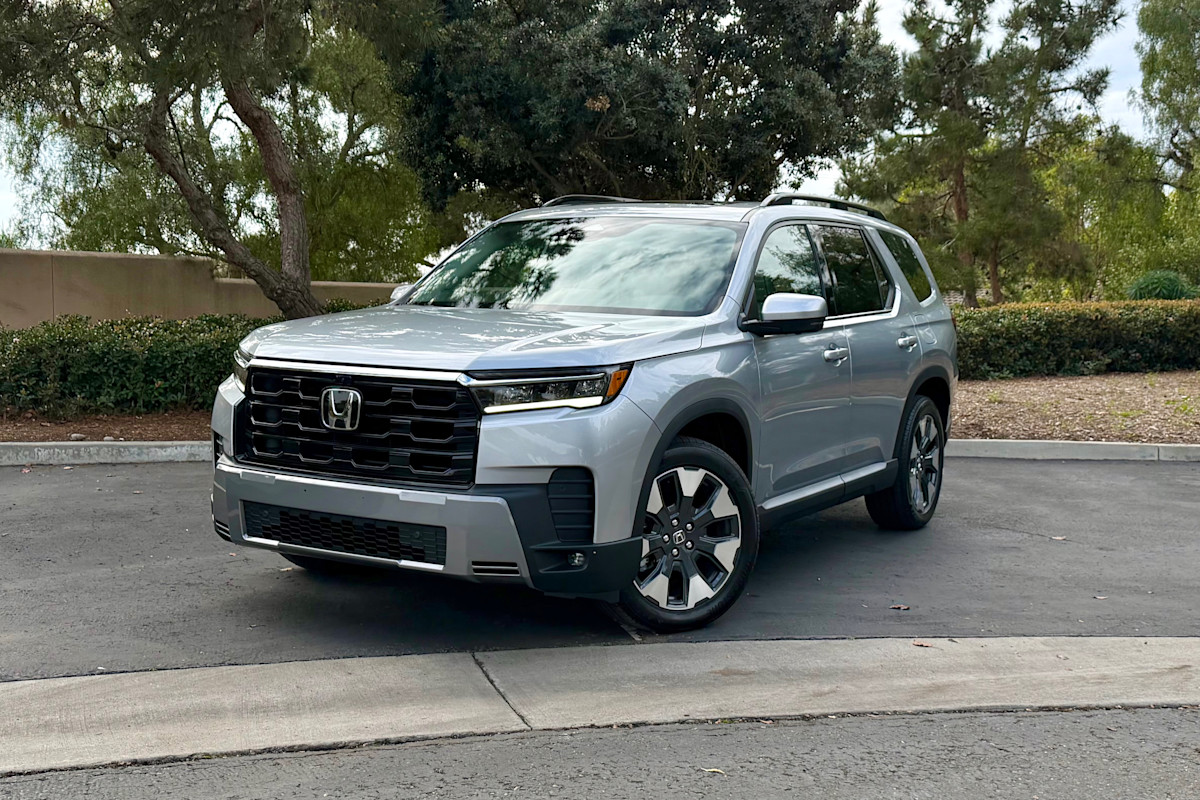
The Honda Pilot receives a makeover for the 2026 model year. Up front, the angular grille from last year is replaced by a larger and blockier opening that connects to a grey plastic scuff plate. The result is a more truck-like appearance, following an industry-wide trend in that direction. To a lesser degree, standard roof rails add some utilitarian style, while the rear bumper adds a similar scuff plate to the front. The rest of the Pilot's exterior hasn't changed much, and the latest updates follow the more rugged design direction this generation debuted with just three years ago.
The Pilot's interior also returns in a similar form as before, though with a few notable upgrades. Both the infotainment touchscreen and the digital instrument panel are larger, and the volume knob has been relocated to just below the frame. The changes to the top trims are more significant, including a unique diamond quilting for the top sections of the seats in a synthetic suede material. Contrast stitching adds a bit more visual flair, as does a new trim element on the centre console and door panels. Depending on the angle and lighting, it can look like wood, or stone, or even a quasi-snakeskin pattern.
The 2026 changes don't really move the needle one way or the other. At its core, the Pilot remains a tastefully designed midsize SUV with an edge when it comes to practicality. Inside, it meets or exceeds expectations for the class, both in terms of material quality and construction.
Performance
Under the hood of the 2026 Honda Pilot is the same 3.5-litre V6 engine as before. It produces 285 horsepower and 262 pound-feet of torque and is paired with a 10-speed automatic transmission. In Canada, all-wheel drive (AWD) is standard.
Acceleration is more than adequate, and the Pilot responds reasonably quickly. In our time behind the wheel, we never felt the need to floor the pedal when merging onto a flowing highway, and passing slower traffic didn't require advanced planning. The muted V6 also sounds more confident than a four-cylinder engine. When slowing to a stop, the brake pedal effort is on the soft side, which seems appropriate for a family SUV. We did notice some very subtle downshifts and resulting lurches that kept us from rolling to a perfectly smooth stop, but only occasionally.
Honda revised the steering for 2026, promising improved feedback and a more stable on-centre feel. The Pilot's steering was previously a bit too light on the highway, resulting in a slightly vague feel. We weren't focused on finding the differences, but the vagueness wasn't an issue this time around. In most ways, the Pilot drives just like it did before. It's confident when navigating curves, but like any sensible three-row SUV, it doesn't feel sporty.
Form & function
Very little has changed with the Pilot's cabin for 2026, and that's a good thing. This Honda was already one of the better SUVs in its class in terms of interior space and versatility. One of the most notable features is the removable second-row centre seat, giving owners the flexibility of both a bench and captain's chairs. Even better, there's a space just large enough to stow that seat under the cargo floor, and it's not oppressively heavy to move.
That centre seat isn't as roomy as the outboard positions, making it more appropriate for smaller passengers. The seats flanking it are plenty spacious for larger adults and have a remarkable amount of legroom. The seats slide fore and aft by a sizable distance, and they also recline. They’re comfortable enough to make it easy to drift asleep, but the lack of a centre armrest will have you leaning into the door.
Access to the third row is easy. A single push of a button folds the second-row seatback and slides the seat all the way forward. Passengers still have to clamber inelegantly to access the rearmost row, but space is adequate for smaller adults. The seat cushions are mounted lower to the floor, reducing thigh support, but this is very common among three-row SUVs. Average-sized adults should be fine back there for shorter drives, while kids will have more than enough room. As with most three-row SUVs, the materials in the rearmost row are of a lower grade. Hard plastics abound with no padded space for elbows. At least Honda included some USB charge ports back there.
Behind the third row, the Pilot can hold up to 635 litres of cargo (or 618 in the TrailSport trim). If you don't have the second-row seat stowed underneath, that large underfloor bin is very accommodating. Folding the third row is relatively easy, requiring only a light tug on a strap as the spring-loaded seatback flops flat with the load floor. In this configuration, you can transport up to 1,702 litres of cargo with the second-row seats slid forward (or 1,685 litres with the Sport and TrailSport trims). The middle-row seats fold in an instant with a lift of a side lever, and at its maximum with both rows folded, the Pilot can hold up to a minivan-like 3,219 litres, depending on trim.
For smaller personal items, the front seats offer plenty of storage. A long tray in front of the passenger stands out among generously sized cupholders and a giant centre armrest bin. The front door pockets feature two levels, and a separate bottle holder is within easier grasp.
Technology
For 2026, the Honda Pilot upgrades to a larger standard 12.3-inch infotainment touchscreen and a 10.2-inch digital instrument panel for all trim levels. The physical shortcut buttons that used to frame the left side of the touchscreen are gone, and the volume knob is placed somewhat awkwardly just below on the dashboard. There are still shortcuts, but they're now on the display and can be customized to show your most frequently used features. The system runs on the latest Honda software and is as quick to respond and easy to use as before.
The on-screen graphics are legible at a glance, and the large tiles are easier to tap, which in turn makes them less distracting. Wireless Apple CarPlay and Android Auto are also included, though you'll still have to upgrade to the EX-L trim to get a wireless phone charger. That charging pad also proved a bit temperamental. We needed to position our phone precisely to make a connection, and it experienced occasional disconnections as the phone slid around when we drove over curves and bumps.
Much like the other changes for 2026, the tech enhancements don't make a significant impact. The Pilot was already pretty good in this area, and some of its unique features carry over. These include multiple camera angles for tight parking spots or off-roading as well as the CabinTalk feature that allows the driver to use the speakers as an intercom, potentially quelling child uprisings.
Safety
Crash test scores for the 2026 Honda Pilot were not available from the U.S. National Highway Traffic Safety Administration (NHTSA) at the time of writing. However, considering it remains structurally unchanged from 2025, we expect scores similar to the overall rating of five out of five stars last year’s model received.
The Insurance Institute for Highway Safety (IIHS) also hadn't published results for the 2026 Pilot at the time of writing, but just like the NHTSA, it gave the 2025 Pilot high scores and named it a Top Safety Pick.
All Pilot trims come with the Honda Sensing suite of safety features, which includes forward collision warning with automatic emergency braking, lane-departure warning, lane-keep assist, adaptive cruise control, a blind-spot monitor with rear cross-traffic alert, a driver-attention monitor, a traffic-sign reader, and automatic high-beam headlights. All but the base Sport model also get automatic braking at low speeds and parking proximity sensors.
For the most part, the safety features we were able to sample worked flawlessly. That said, the forward collision warning was a bit too sensitive, but that at least only resulted in a quick alert in the instrument panel and no braking intervention. Lane departure warning is similarly sensitive if you don't trace a matching path to the road stripes.
Cost-effectiveness
Prices in Canada for the 2026 Honda Pilot start at $58,696 (including the $2,000 destination charge and other fees) for the entry-level Sport trim. At the top of the range, the Black Edition will set you back $69,546. All Pilots have the same powertrain, so there's no power or performance advantage between models, though the TrailSport remains an outlier for its decent off-road abilities. For most shoppers, the EX-L should easily satisfy with its removable second-row seat and front-row leather seats. The Touring trim dresses things up with a panoramic sunroof, premium audio, and a hands-free power liftgate, but we're not convinced the price jump is worth it.
The 2026 Pilot is estimated to return 11 litres per 100 kilometres combined (12.4 city, 9.3 highway) in the Sport and EX-L trims, 11.2 L/100 km combined (12.7 city, 9.4 highway) in the Touring and Black Edition trims, and 11.8 L/100 km combined (13.2 city, 10.1 highway) in TrailSport configuration. Those figures are comparable to the conventionally powered Hyundai Palisade's and a bit higher than the Toyota Grand Highlander's. It's important to note that both rivals are also available as more fuel-efficient hybrids, with the Grand Highlander estimated as low as 7 L/100 km combined and the Palisade as low as 8.1 L/100 km combined.
Fuel efficiency is one of the few areas where the Honda Pilot falls short of the competition, but the rest of this well-designed SUV should make up for it.

What owners say
Trims & specs
Base MSRP $52,495 | Seating 8 |
Engine 3.5L 285 hp V6 | Cargo Capacity 18.6 cu ft |
Combined MPG 22 | Drivetrain AWD |
Base MSRP $51,295 | Seating 8 |
Engine 3.5L 285 hp V6 | Cargo Capacity 18.6 cu ft |
Combined MPG 22 | Drivetrain AWD |
Base MSRP $53,695 | Seating 8 |
Engine 3.5L 285 hp V6 | Cargo Capacity 18.6 cu ft |
Combined MPG 22 | Drivetrain AWD |
Base MSRP $44,495 | Seating 8 |
Engine 3.5L 285 hp V6 | Cargo Capacity 18.6 cu ft |
Combined MPG 22 | Drivetrain AWD |
Base MSRP $55,195 | Seating 8 |
Engine 3.5L 285 hp V6 | Cargo Capacity 18.6 cu ft |
Combined MPG 22 | Drivetrain AWD |
Base MSRP $50,595 | Seating 7 |
Engine 3.5L 285 hp V6 | Cargo Capacity 18.6 cu ft |
Combined MPG 20 | Drivetrain AWD |
Base MSRP $42,395 | Seating 8 |
Engine 3.5L 285 hp V6 | Cargo Capacity 18.6 cu ft |
Combined MPG 23 | Drivetrain FWD |
Base MSRP $44,695 | Seating 8 |
Engine 3.5L 285 hp V6 | Cargo Capacity 18.6 cu ft |
Combined MPG 23 | Drivetrain FWD |
Base MSRP $46,795 | Seating 8 |
Engine 3.5L 285 hp V6 | Cargo Capacity 18.6 cu ft |
Combined MPG 22 | Drivetrain AWD |


Pricing trends
MSRP range
$42,395 - $55,195
Current avg. market price
$65,755
Trending down by 2.0% this month
April 2026 - October 2026