2026 Toyota RAV4 Plug-in Hybrid vs 2026 Toyota 4Runner
Overview | |
Listings115 | Listings229 |
Ratings & Reviews | |
User Reviews | User Reviews |
Expert reviews7.0 out of 10 | Expert reviews6.7 out of 10 |
Pros
Cons
| Pros
Cons
|
2026 Toyota RAV4 Plug-in Hybrid Reviews SummaryThe more powerful RAV4 PHEV is even stronger for 2026, and Toyota has introduced a new GR Sport trim to showcase its sportier side. The expanded lineup has three distinct trims, and the electric range has increased by at least 20% over the 2025 RAV4. With these changes, Toyota has furthered its lead over plug-in hybrid newcomers such as the Hyundai Tucson and Kia Sportage — and even the Lexus NX 450h+. Verdict: This is the best version of the RAV4, though the slightly sportier GR Sport pushes the bounds of affordability. With improved tech and a greater focus on electrification as well as available DC charging, the RAV4 Plug-in Hybrid leans forward. | |
2026 Toyota 4Runner Reviews SummaryShoppers looking for an old-school SUV should be careful what they wish for. The Toyota 4Runner compromises passenger comfort and interior space to make it one of the better off-roaders on the market. It’s offered as a hybrid, but fuel economy is never as good as in typical crossover SUVs, which will be more comfortable and more affordable. That makes mainstream crossovers better choices for most. But for those who want adventure while carrying passengers, the 4Runner makes sense. Verdict: The 4Runner’s closest rivals are the Jeep Wrangler and Ford Bronco. Compared to them, the 4Runner can carry more passengers and offers better fuel economy thanks to an available hybrid powertrain. If adventure is a priority, the 4Runner is a great choice. But those who want a five- or seven-passenger SUV for daily family duty would be better off with a crossover. | |
No video found | No video found |
Popular Features & Specs | |
Seating Capacity | Seating Capacity7 |
Interior | |
Seating Capacity | Seating Capacity7 |
Safety | |
Front Crash Overall | Front Crash Overall4 |
Side Crash Overall | Side Crash Overall5 |
Dimensions & Capacity | |
Cargo Space | Cargo Space1371 L |
Curb Weight | Curb Weight2021 kg |
Height | Height1844 mm |
Length | Length4950 mm |
Width | Width1981 mm |
Wheelbase | Wheelbase2850 mm |
Maximum Payload | Maximum Payload406 kg |
Number of doors | Number of doors4 |
Maximum Towing Capacity | Maximum Towing Capacity2722 kg |
Standard Towing Capacity | Standard Towing Capacity2722 kg |
Overview | ||
Listings | ||
Ratings & Reviews | ||
User reviews | ||
Expert reviews | 7.0 out of 10Read full review | 6.7 out of 10Read full review |
Pros & cons | Pros
Cons
| Pros
Cons
|
Summary | The more powerful RAV4 PHEV is even stronger for 2026, and Toyota has introduced a new GR Sport trim to showcase its sportier side. The expanded lineup has three distinct trims, and the electric range has increased by at least 20% over the 2025 RAV4. With these changes, Toyota has furthered its lead over plug-in hybrid newcomers such as the Hyundai Tucson and Kia Sportage — and even the Lexus NX 450h+. Verdict: This is the best version of the RAV4, though the slightly sportier GR Sport pushes the bounds of affordability. With improved tech and a greater focus on electrification as well as available DC charging, the RAV4 Plug-in Hybrid leans forward. | Shoppers looking for an old-school SUV should be careful what they wish for. The Toyota 4Runner compromises passenger comfort and interior space to make it one of the better off-roaders on the market. It’s offered as a hybrid, but fuel economy is never as good as in typical crossover SUVs, which will be more comfortable and more affordable. That makes mainstream crossovers better choices for most. But for those who want adventure while carrying passengers, the 4Runner makes sense. Verdict: The 4Runner’s closest rivals are the Jeep Wrangler and Ford Bronco. Compared to them, the 4Runner can carry more passengers and offers better fuel economy thanks to an available hybrid powertrain. If adventure is a priority, the 4Runner is a great choice. But those who want a five- or seven-passenger SUV for daily family duty would be better off with a crossover. |
Video | No video found | No video found |
Popular Features & Specs | ||
Seating Capacity | 7 | |
Interior | ||
Seating Capacity | 7 | |
Safety | ||
Front Crash Overall | 4 | |
Side Crash Overall | 5 | |
Dimensions & Capacity | ||
Cargo Space | 1371 L | |
Curb Weight | 2021 kg | |
Height | 1844 mm | |
Length | 4950 mm | |
Width | 1981 mm | |
Wheelbase | 2850 mm | |
Maximum Payload | 406 kg | |
Number of doors | 4 | |
Maximum Towing Capacity | 2722 kg | |
Standard Towing Capacity | 2722 kg | |
The 2026 Toyota RAV4 Plug-in Hybrid was available exclusively in the Sport design in Canada, with trims including the base SE, XSE, and the new GR Sport. The GR Sport trim, inspired by Toyota’s Gazoo Racing division, featured a more aggressive look with a pronounced grille and rear diffuser, extending the vehicle's length by nearly five centimetres. The RAV4 maintained a boxy, truck-like presence with squared-off lines and bulging fenders reminiscent of the Highlander models. Gloss black accents adorned the Sport trims, and the GR Sport stood out with red brake calipers, 20-inch black alloy wheels, and a wide mesh grille. Inside, the RAV4 Plug-in Hybrid offered a streamlined design with a 12.3-inch digital instrument cluster and a choice between a 10.5-inch or 12.9-inch touchscreen. The interior featured stylish drive mode knobs and a flexible centre console, enhancing the overall driving experience.
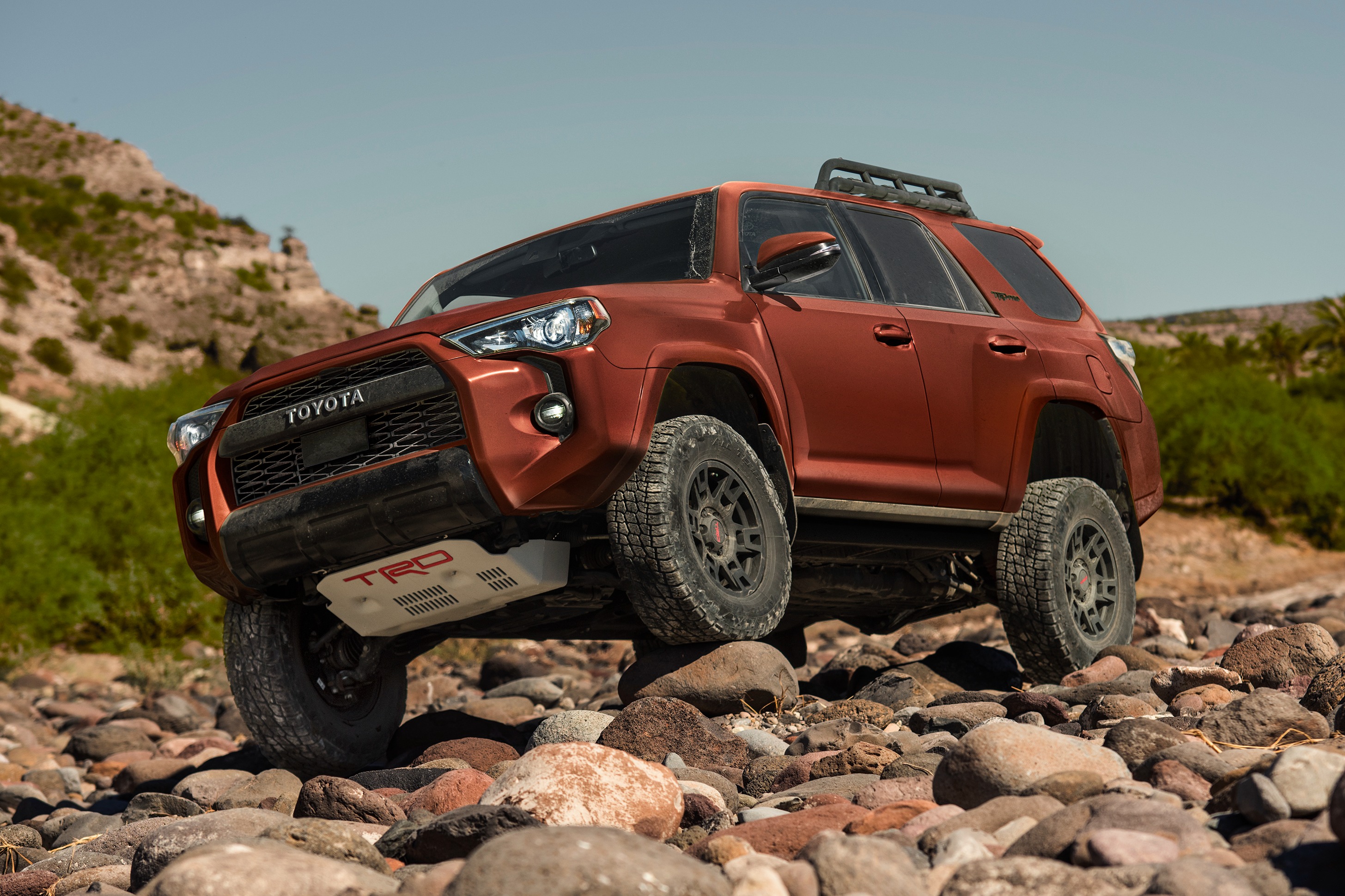
In contrast, the 2026 Toyota 4Runner shared design elements with the Tacoma pickup, presenting a muscular look with pronounced haunches and black wheel flares for off-road models. The front grille sat high, complemented by heritage-inspired front ends on the TRD Pro and Trailhunter models. The 4Runner's interior was simple and utilitarian, with chunky control dials and an abundance of hard plastic. Cloth upholstery was standard, with synthetic leather on off-road models and leather on the Limited and Platinum trims. Despite its rugged exterior, the 4Runner's cabin lacked the high-end feel, focusing more on functionality than luxury.
The 2026 Toyota RAV4 Plug-in Hybrid featured an updated 2.5-litre inline four-cylinder engine, producing 186 horsepower, an increase from the previous 177 hp. The PHEV model boasted a larger 22.7-kwh battery pack and more efficient semiconductors, resulting in an estimated range increase from 68 kilometres to 80 kilometres. With a total power output of 324 hp, the RAV4 Plug-in Hybrid was the most powerful RAV4 to date. It offered a seamless transition between power modes, with an unofficial 0-100 km/h time in the low five seconds. The GR Sport trim, with its lower ride height and enhanced suspension, provided a sportier driving experience, handling terrain more evenly than the heavier XSE model.
The 2026 Toyota 4Runner offered two powertrains: a turbocharged 2.4-litre four-cylinder engine with 278 horsepower and the i-Force Max hybrid, which increased output to 326 hp and 465 lb-ft of torque. Despite the impressive torque, the 4Runner hybrid had a mid-to-low seven-second 0-100 km/h time. The eight-speed automatic transmission was well-matched to the engine, with more aggressive tuning in Sport mode. The 4Runner excelled in off-road conditions, with features like Crawl Control and Multi-Terrain System drive modes. However, its on-road dynamics were compromised, with notable lean in corners and a firm suspension that didn't absorb bumps well.
The 2026 Toyota RAV4 Plug-in Hybrid maintained its dimensions from the previous generation, offering clever storage features and a comfortable interior. The base SE trim included power-adjustable and heated front seats, while higher trims featured synthetic leather upholstery and ventilated seats. The RAV4's interior space was optimized, with 960 millimetres of rear legroom and a cargo area of 951 litres, expandable to 1,798 litres with the rear seats folded.
The 2026 Toyota 4Runner offered two or three rows of seating, accommodating up to seven passengers. The front seats were the most comfortable, with power adjustments available on higher trims. The second row provided decent space but lacked thigh support, and the third row was best suited for children due to limited legroom. Cargo space was comparable to midsize rivals, with hybrid models offering 1,206 litres behind the second row and 2,339 litres with seats folded. The gas-powered three-row configuration had slightly different measurements.
The 2026 Toyota RAV4 Plug-in Hybrid featured a 12.3-inch digital instrument cluster and an enhanced 10.5-inch touchscreen system, with a larger 12.9-inch touchscreen on top trims. The system included wireless Apple CarPlay and Android Auto, with customizable tiles and improved graphics. Toyota's new operating system, Arene, enhanced responsiveness and offered a subscription-based Voice Assistant for various functions.
The 2026 Toyota 4Runner came standard with a 7-inch digital instrument cluster and an 8-inch touchscreen, expanding to 12.3 inches and 14 inches on higher trims. The 14-inch screen, while large and easy to use, lacked distinctive design elements. The 4Runner included a three-year trial of Remote Connect, Safety Connect, and Service Connect, with Drive Connect available as a subscription. The digital instrument cluster offered programmable information, and standard tech features included wireless Apple CarPlay and Android Auto.
The 2026 Toyota RAV4 Plug-in Hybrid came equipped with Toyota Safety Sense 4.0, featuring a comprehensive suite of driver assistance systems. These included automatic emergency braking with pedestrian detection, lane departure alert, adaptive cruise control, blind spot monitoring, and a surround-view camera system on higher trims. The RAV4's safety record was historically strong, with expected improvements in crash protection.
The 2026 Toyota 4Runner featured Toyota Safety Sense 3.0, including forward collision warning, automatic emergency braking, adaptive cruise control, and more. Despite being overhauled for 2025, the 4Runner received mixed crash scores, with four-star ratings from the NHTSA and a Marginal score from the IIHS in certain tests. However, it performed well in side crash tests and front crash prevention systems.
CarGurus highlights
According to CarGurus experts, the overall rating for the 2026 Toyota RAV4 Plug-in Hybrid was 7.0 out of 10, while the 2026 Toyota 4Runner scored 6.7 out of 10. Based on these ratings, the RAV4 Plug-in Hybrid is the recommended choice for those seeking a more efficient, technologically advanced, and safer vehicle.
Choose the 2026 Toyota RAV4 Plug-in Hybrid if:
- You prioritize a more powerful and efficient hybrid powertrain with a longer electric range.
- You prefer a modern interior with advanced technology and customizable digital displays.
- You value a comprehensive suite of safety features and a strong safety record.


Choose the 2026 Toyota 4Runner if:
- You need a rugged, off-road-capable vehicle with advanced off-road features.
- You require a versatile seating configuration for up to seven passengers.
- You appreciate a simple, utilitarian interior with practical controls for off-road adventures.


CarGurus highlights
According to CarGurus experts, the overall rating for the 2026 Toyota RAV4 Plug-in Hybrid was 7.0 out of 10, while the 2026 Toyota 4Runner scored 6.7 out of 10. Based on these ratings, the RAV4 Plug-in Hybrid is the recommended choice for those seeking a more efficient, technologically advanced, and safer vehicle.
Choose the 2026 Toyota RAV4 Plug-in Hybrid if:
Shop Now- You prioritize a more powerful and efficient hybrid powertrain with a longer electric range.
- You prefer a modern interior with advanced technology and customizable digital displays.
- You value a comprehensive suite of safety features and a strong safety record.
Choose the 2026 Toyota 4Runner if:
Shop Now- You need a rugged, off-road-capable vehicle with advanced off-road features.
- You require a versatile seating configuration for up to seven passengers.
- You appreciate a simple, utilitarian interior with practical controls for off-road adventures.

By: CarGurus + AI
At CarGurus, our team of experienced automotive writers remain at the heart of our content operation, conducting hands-on car tests and writing insightful guides that are backed by years of industry experience. To complement this, we are harnessing AI to make our content offering more diverse and more helpful to shoppers than ever. To achieve this, our AI systems are based exclusively on CarGurus content, ratings and data, so that what we produce is both unique to CarGurus, and uniquely helpful to car shoppers.
