2025 Toyota Sienna vs 2025 Toyota 4Runner
Overview | |
MSRP$41,270 | MSRP$39,485 |
Listings53 | Listings121 |
Ratings & Reviews | |
User Reviews | User Reviews |
Expert reviews7.7 out of 10 | Expert reviews6.3 out of 10 |
Pros
Cons
| Pros
Cons
|
2025 Toyota 4Runner Reviews SummaryAfter a very long 15 years, we’ve finally got a new Toyota 4Runner with more capabilities, power, comfort, and technology. It's also more efficient thanks to a new hybrid option and more composed on pavement, but it remains a solid all-terrain vehicle to extend your adventures further. Verdict: Toyota doesn't throw out the formula with its newly redesigned 4Runner. Instead, the 2025 model keeps many of the features shoppers have loved for over a decade, while also adding a more contemporary selection of four-cylinder powertrains. | |
2025 Toyota Sienna Reviews SummaryIn addition to promising 6.6–6.8 litres per 100 kilometres in combined driving, the 2025 Sienna distinguishes itself in several ways. It offers an available all-wheel-drive (AWD) system for extra traction. And while its maximum cargo capacity measurement falls short of rivals, you never need to remove the second-row seats to use it. Verdict: Saving money on gas, making life simpler, and the option of AWD are all good things in a minivan. They make the Toyota Sienna worth considering if you’re also looking at cars such as the Chrysler Pacifica, Honda Odyssey, and Kia Carnival. | |
No video found | |
Popular Features & Specs | |
Engine2.4L 278 hp I4 | Engine2.5L 245 hp I4 Hybrid |
Drivetrain4X2 | DrivetrainFWD |
Seating Capacity7 | Seating Capacity8 |
Horsepower278 hp @ 6000 rpm | Horsepower |
EV Battery Capacity | EV Battery Capacity1.9 kWh |
MPG City20 | MPG City36 |
MPG Highway26 | MPG Highway36 |
Engine | |
Engine Name2.4L 278 hp I4 | Engine Name2.5L 245 hp I4 Hybrid |
Torque317 lb-ft @ 1700 rpm | Torque |
Horsepower278 hp @ 6000 rpm | Horsepower |
Drivetrain4X2 | DrivetrainFWD |
Fuel Economy | |
EV Battery Capacity | EV Battery Capacity1.9 kWh |
MPG City20 | MPG City36 |
MPG Highway26 | MPG Highway36 |
Interior | |
Seating Capacity7 | Seating Capacity8 |
Safety | |
Front Crash Overall4 | Front Crash Overall4 |
Side Crash Overall5 | Side Crash Overall5 |
Dimensions & Capacity | |
Cargo Space48.4 cu ft | Cargo Space33.5 cu ft |
Curb Weight4455 lbs | Curb Weight4610 lbs |
Height72.6 in | Height68.5 in |
Length194.9 in | Length203.7 in |
Width78.0 in | Width78.5 in |
Wheelbase112.2 in | Wheelbase120.5 in |
Maximum Payload895 lbs | Maximum Payload1560 lbs |
Number of doors4 | Number of doors4 |
Maximum Towing Capacity6000 lbs | Maximum Towing Capacity3500 lbs |
Standard Towing Capacity6000 lbs | Standard Towing Capacity |
Overview | ||
MSRP | $41,270 | $39,485 |
Listings | ||
Ratings & Reviews | ||
User reviews | ||
Expert reviews | 7.7 out of 10Read full review | 6.3 out of 10Read full review |
Pros & cons | Pros
Cons
| Pros
Cons
|
Summary | After a very long 15 years, we’ve finally got a new Toyota 4Runner with more capabilities, power, comfort, and technology. It's also more efficient thanks to a new hybrid option and more composed on pavement, but it remains a solid all-terrain vehicle to extend your adventures further. Verdict: Toyota doesn't throw out the formula with its newly redesigned 4Runner. Instead, the 2025 model keeps many of the features shoppers have loved for over a decade, while also adding a more contemporary selection of four-cylinder powertrains. | In addition to promising 6.6–6.8 litres per 100 kilometres in combined driving, the 2025 Sienna distinguishes itself in several ways. It offers an available all-wheel-drive (AWD) system for extra traction. And while its maximum cargo capacity measurement falls short of rivals, you never need to remove the second-row seats to use it. Verdict: Saving money on gas, making life simpler, and the option of AWD are all good things in a minivan. They make the Toyota Sienna worth considering if you’re also looking at cars such as the Chrysler Pacifica, Honda Odyssey, and Kia Carnival. |
Video | No video found | |
Popular Features & Specs | ||
Engine | 2.4L 278 hp I4 | 2.5L 245 hp I4 Hybrid |
Drivetrain | 4X2 | FWD |
Seating Capacity | 7 | 8 |
Horsepower | 278 hp @ 6000 rpm | |
EV Battery Capacity | 1.9 kWh | |
MPG City | 20 | 36 |
MPG Highway | 26 | 36 |
Engine | ||
Engine Name | 2.4L 278 hp I4 | 2.5L 245 hp I4 Hybrid |
Torque | 317 lb-ft @ 1700 rpm | |
Horsepower | 278 hp @ 6000 rpm | |
Drivetrain | 4X2 | FWD |
Fuel Economy | ||
EV Battery Capacity | 1.9 kWh | |
MPG City | 20 | 36 |
MPG Highway | 26 | 36 |
Interior | ||
Seating Capacity | 7 | 8 |
Safety | ||
Front Crash Overall | 4 | 4 |
Side Crash Overall | 5 | 5 |
Dimensions & Capacity | ||
Cargo Space | 48.4 cu ft | 33.5 cu ft |
Curb Weight | 4455 lbs | 4610 lbs |
Height | 72.6 in | 68.5 in |
Length | 194.9 in | 203.7 in |
Width | 78.0 in | 78.5 in |
Wheelbase | 112.2 in | 120.5 in |
Maximum Payload | 895 lbs | 1560 lbs |
Number of doors | 4 | 4 |
Maximum Towing Capacity | 6000 lbs | 3500 lbs |
Standard Towing Capacity | 6000 lbs | |
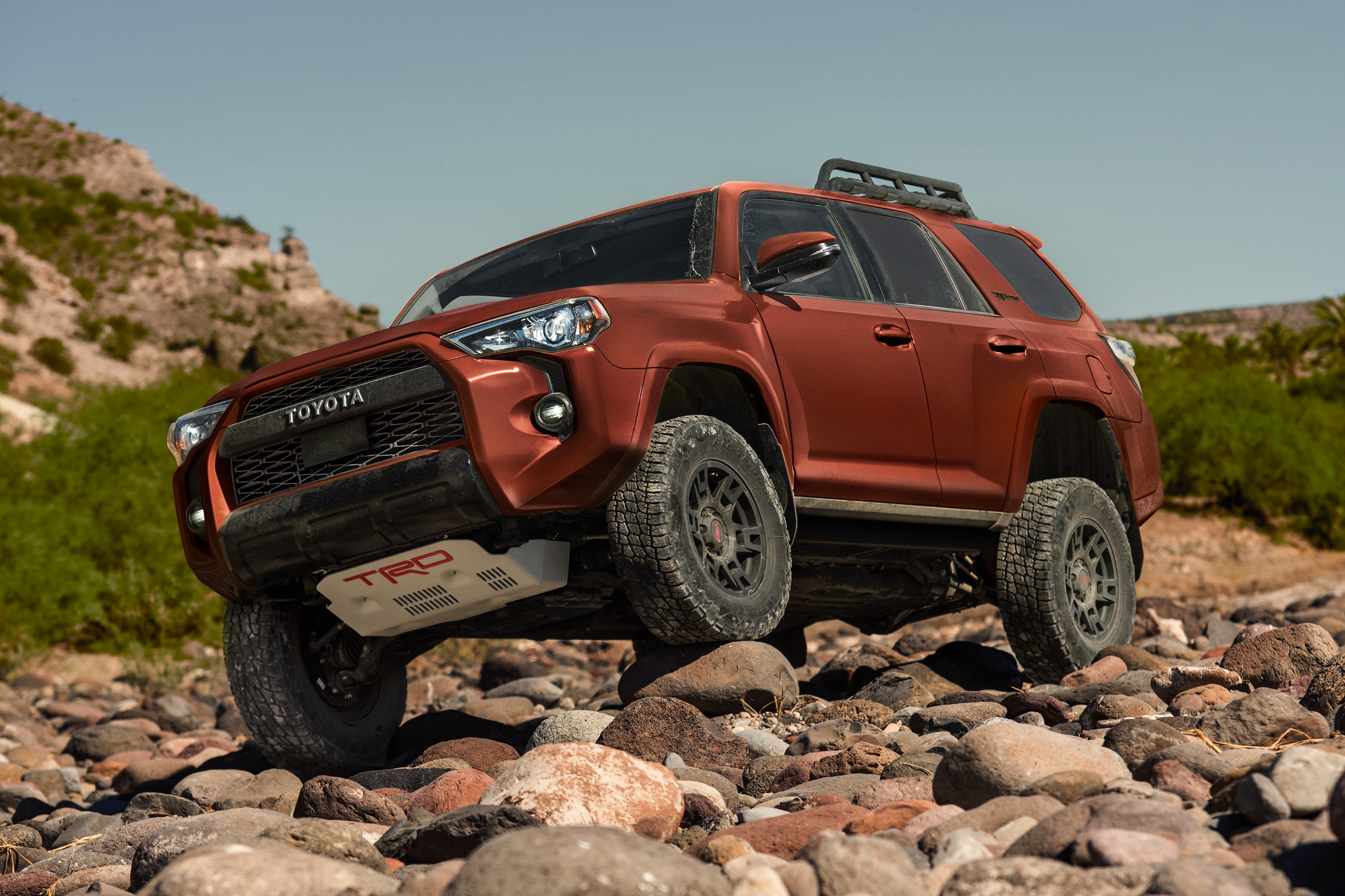
The 2025 Toyota 4Runner, in its sixth generation, maintained a design evolution rather than a complete overhaul. It retained the horseshoe-shaped grilles from the previous generation, now with a more robust and industrial look. The side body panels featured deep beveled creases that seamlessly blended with the flared wheel arches, giving the 4Runner a broad-shouldered stance suitable for an off-road SUV. Paying homage to its predecessors, the 4Runner included the original's slanted rearmost window and a sliding rear window for easier cargo access. Inside, the 4Runner mirrored the Tacoma pickup truck, with a beveled styling motif throughout the cabin. While hard plastics were prevalent for durability, there was light cushioning for comfort. The materials were of higher quality than those in a Jeep Wrangler or Ford Bronco, though not as refined as a Land Rover Defender.
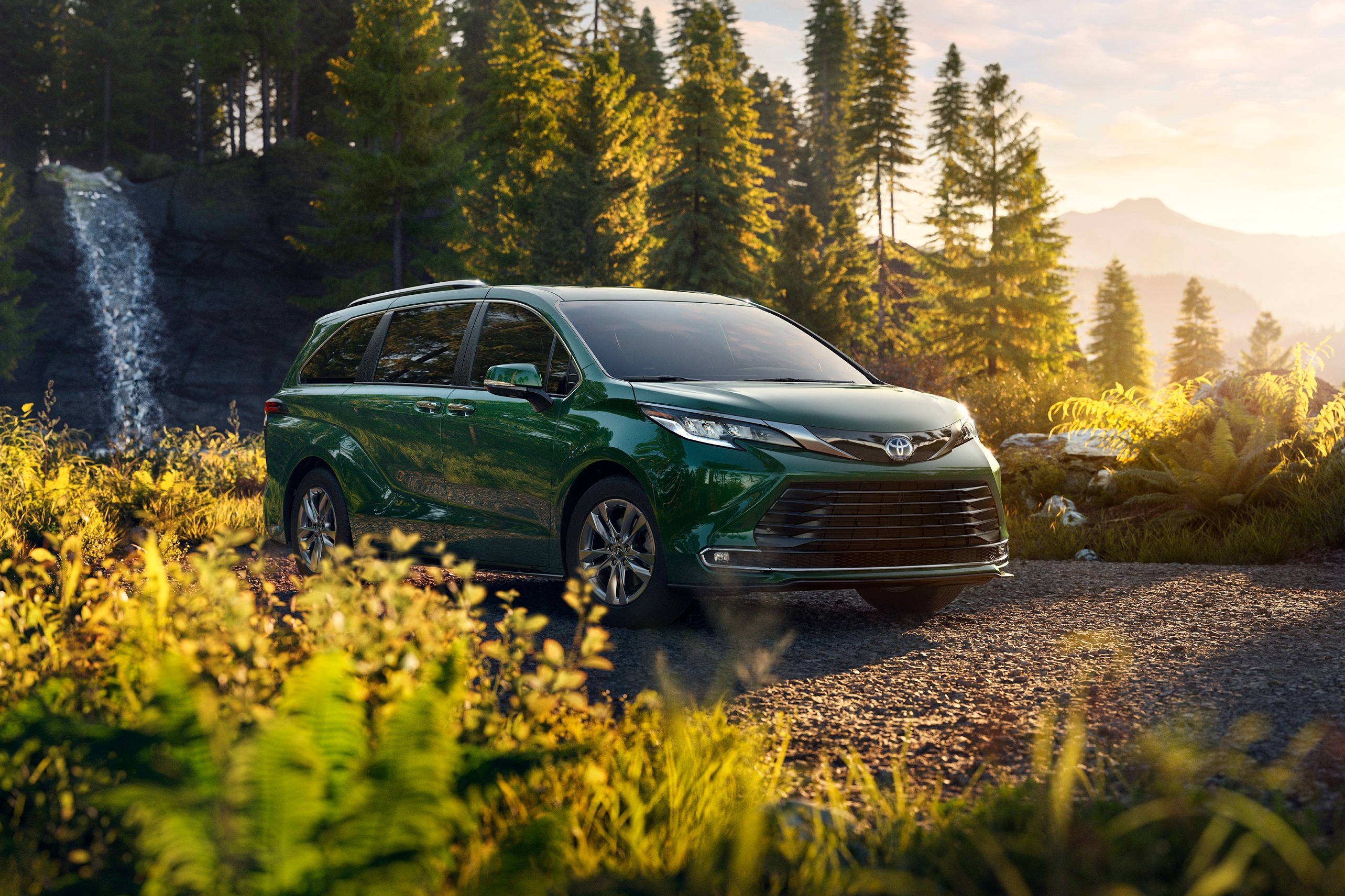
The 2025 Toyota Sienna, despite its attempts at style, still resembled a traditional minivan. Its trapezoidal grille and upswept body lines gave it a unique look, but the minivan shape remained. The Sienna's rear end mirrored the front's cinched-in-the-middle appearance, with narrow taillights adding a family resemblance to the Camry sedan. The Platinum package introduced new flower-petal wheel designs. The Sienna Limited with the Platinum package, in Magnetic Grey, topped the Canadian lineup, which included LE, XLE, and XSE trims. Prices ranged from $51,219 to $73,753, including destination charges. The interior, updated for 2025, featured a new woodgrain finish, though opinions on its aesthetics varied. Overall, the Sienna's interior was considered an improvement over previous models.
The 2025 Toyota 4Runner offered two engine choices. The base model came with a 2.4-litre turbocharged four-cylinder engine, producing 317 horsepower and 278 pound-feet of torque, paired with an eight-speed automatic transmission. This setup promised better acceleration and fuel economy than the previous five-speed unit. In Canada, part-time 4WD was standard, with full-time 4WD available in the Limited and Platinum packages. The Hybrid i-Force Max powertrain, based on the same four-cylinder engine, combined with a 1.87-kWh battery pack and an electric motor, delivered 326 hp and 465 lb-ft of torque. This hybrid variant offered more power at lower speeds, beneficial for off-roading. The 4Runner's handling improved significantly, with reduced nosedive and body roll, making it more composed on pavement. Off-road capabilities remained strong, with eight distinct packages offering varying levels of off-road prowess. The TRD Pro and Trailhunter models were the most capable, though the Trailhunter's snorkel added wind noise.
The 2025 Toyota Sienna featured a hybrid powertrain with a 2.5-litre four-cylinder engine and a CVT. FWD was standard, with AWD available, featuring an additional rear-mounted electric motor. The net horsepower was 245, which was modest for a vehicle seating up to eight and towing up to 1,587 kilograms. However, the electric assist motor provided immediate torque, preventing the Sienna from feeling sluggish. In city driving, the powertrain was quiet, though the CVT moaned under hard acceleration. The Sienna's hybrid system prioritized fuel economy, with an official rating of 6.6 litres per 100 kilometres in combined driving. However, during testing, it averaged 8.9 L/100 km. Handling was predictable but not particularly engaging, with squishy steering in curves. The Sienna XSE offered a sport-tuned suspension for a slightly more dynamic drive. The ride was smooth and absorbent, akin to a marshmallow on wheels, and the vehicle was impressively quiet on the highway.
The 2025 Toyota 4Runner was nearly 13 centimetres longer than its predecessor, with a 6-centimetre increase between the axles. Despite this, passenger space gains were minimal. The front seats accommodated taller passengers, but the middle row offered only adequate legroom. A third row was available on non-hybrid models, though it was cramped and lacked thigh support. The cockpit was well-organized, with oversized climate control knobs and tactile off-road controls. Storage included door pockets, a dashboard tray, cupholders, and a centre armrest bin. Cargo capacity was 1,371 litres behind the second row, reduced to 1,206 litres in the Hybrid due to the raised floor. A sturdy roof rack compensated for cargo deficits, supporting up to 360 kilograms.
The 2025 Toyota Sienna prioritized form and function, with power-adjustable, heated, and ventilated front seats in the Limited with Platinum package. However, the cushions felt hard after extended driving. The second-row captain's chairs with ottoman-style leg rests were popular with teenagers, and the third-row seat accommodated adults. Storage was generous, though finding secure spots for one-litre water bottles was challenging. Cargo space was 949 litres behind the third row, expanding to 2,129 litres with the third row stowed. Maximum cargo capacity was 2,860 litres, less than rivals due to the non-removable second-row seats. Toyota's research suggested most owners didn't maximize space by removing seats, but this limited load capacity for those needing it occasionally.
The 2025 Toyota 4Runner featured an 8-inch infotainment touchscreen as standard, with a 14-inch option available. Both were user-friendly, with logical menus and quick responses. Wireless Apple CarPlay and Android Auto were included, along with a charging pad. Hybrid variants had a digital instrument panel, available in most gas models' packages. Off-road models offered external camera views for precise tire placement, with automatic activation at low speeds. A 14-speaker JBL audio system was available, with a portable centre speaker doubling as a Bluetooth speaker. Remote monitoring and control were possible via a smartphone app, with a digital key function replacing the key fob.
The 2025 Toyota Sienna's higher-spec models featured a 12.3-inch digital instrumentation panel and a 12.3-inch touchscreen for the Toyota Audio Multimedia system. The Limited with Platinum package included four-zone climate control, a 10-inch HUD, and a camera-based digital rearview mirror. A rear 11.6-inch display, HDMI input, remote, and wireless headphones were standard on the Limited trim. The TAM system offered four connected services plans, with varying complimentary subscription periods. The digital assistant, part of the Drive Connect plan, responded accurately to commands. If the subscription lapsed, wireless Apple CarPlay or Android Auto could replace the native navigation system. The Limited trim included a 12-speaker JBL audio system, though sound quality was muddy with excessive bass. The four-zone climate control system was appreciated, and the digital rearview camera offered zoom capabilities.
As of the writing, crash test results for the 2025 Toyota 4Runner were unavailable from NHTSA or IIHS. However, the Tacoma pickup, on which the 4Runner is based, was named a Top Safety Pick by IIHS. All 4Runner models came with Toyota Safety Sense 3.0, including features like frontal collision warning, lane-keep assist, adaptive cruise control, traffic sign reader, and automatic high beams. The Proactive Driving Assist feature, which could be intrusive, was also included but could be disabled. In Canada, a blind-spot monitor with rear cross-traffic alert was standard.
The 2025 Toyota Sienna featured Toyota Safety Sense 2.0, an older technology set compared to TSS 3.0. This version dispensed with some of the more intrusive features of TSS 3.0, which was preferred by some drivers. TSS 2.0 included forward collision warning, pedestrian detection, lane departure warning, lane-keeping assist, lane-centring assist, and adaptive cruise control. Automatic high-beam headlights, blind-spot monitoring, and rear cross-traffic alert were also standard. The lane-centring assist performed well, though the adaptive cruise control required vigilance in urban areas. The Sienna added a rear-seat reminder system for 2025, alerting the driver to movement in the cabin after exiting. NHTSA gave the Sienna a five-star overall rating, though it scored lower in frontal crash tests, with three stars for driver protection.
CarGurus highlights
According to CarGurus experts, the overall rating for the 2025 Toyota 4Runner is 7.7 out of 10, while the 2025 Toyota Sienna scores 6.3 out of 10. Based on these ratings, the 2025 Toyota 4Runner is the recommended choice, offering superior off-road capabilities, advanced technology, and a robust design that appeals to adventure enthusiasts.
Choose the 2025 Toyota Sienna if:
- You need a practical minivan with generous interior space and seating for up to eight passengers.
- You prefer a hybrid powertrain that prioritizes fuel economy for city and highway driving.
- You value a comprehensive infotainment system with connected services and a digital assistant for convenience.


Choose the 2025 Toyota 4Runner if:
- You prioritize off-road capabilities and need a vehicle that can handle challenging terrains with ease.
- You value a robust and industrial design with a broad-shouldered stance suitable for an off-road SUV.
- You appreciate advanced technology features, including a user-friendly infotainment system and comprehensive off-road camera views.


CarGurus highlights
According to CarGurus experts, the overall rating for the 2025 Toyota 4Runner is 7.7 out of 10, while the 2025 Toyota Sienna scores 6.3 out of 10. Based on these ratings, the 2025 Toyota 4Runner is the recommended choice, offering superior off-road capabilities, advanced technology, and a robust design that appeals to adventure enthusiasts.
Choose the 2025 Toyota Sienna if:
Shop Now- You need a practical minivan with generous interior space and seating for up to eight passengers.
- You prefer a hybrid powertrain that prioritizes fuel economy for city and highway driving.
- You value a comprehensive infotainment system with connected services and a digital assistant for convenience.
Choose the 2025 Toyota 4Runner if:
Shop Now- You prioritize off-road capabilities and need a vehicle that can handle challenging terrains with ease.
- You value a robust and industrial design with a broad-shouldered stance suitable for an off-road SUV.
- You appreciate advanced technology features, including a user-friendly infotainment system and comprehensive off-road camera views.

By: CarGurus + AI
At CarGurus, our team of experienced automotive writers remain at the heart of our content operation, conducting hands-on car tests and writing insightful guides that are backed by years of industry experience. To complement this, we are harnessing AI to make our content offering more diverse and more helpful to shoppers than ever. To achieve this, our AI systems are based exclusively on CarGurus content, ratings and data, so that what we produce is both unique to CarGurus, and uniquely helpful to car shoppers.
