2026 Volkswagen Atlas vs 2025 Toyota 4Runner
Overview | |
Listings72 | Listings252 |
Ratings & Reviews | |
User Reviews | User Reviews |
Expert reviews7.7 out of 10 | Expert reviews6.8 out of 10 |
Pros
Cons
| Pros
Cons
|
2025 Toyota 4Runner Reviews SummaryAfter a very long 15 years, we’ve finally got a new Toyota 4Runner with more capabilities, power, comfort, and technology. It's also more efficient thanks to a new hybrid option and more composed on pavement, but it remains a solid all-terrain vehicle to extend your adventures further. Verdict: Toyota doesn't throw out the formula with its newly redesigned 4Runner. Instead, the 2025 model keeps many of the features shoppers have loved for over a decade, while also adding a more contemporary selection of four-cylinder powertrains. | |
2026 Volkswagen Atlas Reviews SummaryThe 2026 Volkswagen Atlas continues as VW’s North American-market three-row SUV (a two-row Atlas Cross Sport is also available, but we’ll cover that separately), and it’s largely unchanged from its substantial 2024 refresh. What remains, however, is a vehicle that impresses with its upscale appearance and genuinely spacious interior. A stiff ride and poorly executed technology will fight and frustrate you every step of the way, but the Atlas will nonetheless make you look good. Verdict: The 2026 Volkswagen Atlas delivers on its core promise of style and space at a non-luxury price point. If you can tolerate its sub-par ride quality and maddening infotainment system—or if you simply plan to rely on Apple CarPlay and ignore the native tech—this handsome three-row SUV offers compelling value for shoppers prioritizing looks and space. | |
No video found | |
Popular Features & Specs | |
Engine2.4L 278 hp I4 | Engine2.0L 269 hp I4 |
Drivetrain4X2 | DrivetrainFWD |
Seating Capacity7 | Seating Capacity7 |
Horsepower278 hp @ 6000 rpm | Horsepower |
Fuel Economy (City)11.8 L(e)/100 km | Fuel Economy (City)11.8 L(e)/100 km |
Fuel Economy (Highway)9.0 L(e)/100 km | Fuel Economy (Highway)8.7 L(e)/100 km |
Engine | |
Engine Name2.4L 278 hp I4 | Engine Name2.0L 269 hp I4 |
Torque317 lb-ft @ 1700 rpm | Torque |
Horsepower278 hp @ 6000 rpm | Horsepower |
Drivetrain4X2 | DrivetrainFWD |
Fuel Economy | |
Fuel Economy (City)11.8 L(e)/100 km | Fuel Economy (City)11.8 L(e)/100 km |
Fuel Economy (Highway)9.0 L(e)/100 km | Fuel Economy (Highway)8.7 L(e)/100 km |
Interior | |
Seating Capacity7 | Seating Capacity7 |
Safety | |
Front Crash Overall4 | Front Crash Overall4 |
Side Crash Overall5 | Side Crash Overall5 |
Dimensions & Capacity | |
Cargo Space1371 L | Cargo Space583 L |
Curb Weight2021 kg | Curb Weight1958 kg |
Height1844 mm | Height1788 mm |
Length4950 mm | Length5098 mm |
Width1981 mm | Width2248 mm |
Wheelbase2850 mm | Wheelbase2979 mm |
Maximum Payload406 kg | Maximum Payload500 kg |
Number of doors4 | Number of doors4 |
Maximum Towing Capacity2722 kg | Maximum Towing Capacity907 kg |
Standard Towing Capacity2722 kg | Standard Towing Capacity |
Overview | ||
Listings | ||
Ratings & Reviews | ||
User reviews | ||
Expert reviews | 7.7 out of 10Read full review | 6.8 out of 10Read full review |
Pros & cons | Pros
Cons
| Pros
Cons
|
Summary | After a very long 15 years, we’ve finally got a new Toyota 4Runner with more capabilities, power, comfort, and technology. It's also more efficient thanks to a new hybrid option and more composed on pavement, but it remains a solid all-terrain vehicle to extend your adventures further. Verdict: Toyota doesn't throw out the formula with its newly redesigned 4Runner. Instead, the 2025 model keeps many of the features shoppers have loved for over a decade, while also adding a more contemporary selection of four-cylinder powertrains. | The 2026 Volkswagen Atlas continues as VW’s North American-market three-row SUV (a two-row Atlas Cross Sport is also available, but we’ll cover that separately), and it’s largely unchanged from its substantial 2024 refresh. What remains, however, is a vehicle that impresses with its upscale appearance and genuinely spacious interior. A stiff ride and poorly executed technology will fight and frustrate you every step of the way, but the Atlas will nonetheless make you look good. Verdict: The 2026 Volkswagen Atlas delivers on its core promise of style and space at a non-luxury price point. If you can tolerate its sub-par ride quality and maddening infotainment system—or if you simply plan to rely on Apple CarPlay and ignore the native tech—this handsome three-row SUV offers compelling value for shoppers prioritizing looks and space. |
Video | No video found | |
Popular Features & Specs | ||
Engine | 2.4L 278 hp I4 | 2.0L 269 hp I4 |
Drivetrain | 4X2 | FWD |
Seating Capacity | 7 | 7 |
Horsepower | 278 hp @ 6000 rpm | |
Fuel Economy (City) | 11.8 L(e)/100 km | 11.8 L(e)/100 km |
Fuel Economy (Highway) | 9.0 L(e)/100 km | 8.7 L(e)/100 km |
Engine | ||
Engine Name | 2.4L 278 hp I4 | 2.0L 269 hp I4 |
Torque | 317 lb-ft @ 1700 rpm | |
Horsepower | 278 hp @ 6000 rpm | |
Drivetrain | 4X2 | FWD |
Fuel Economy | ||
Fuel Economy (City) | 11.8 L(e)/100 km | 11.8 L(e)/100 km |
Fuel Economy (Highway) | 9.0 L(e)/100 km | 8.7 L(e)/100 km |
Interior | ||
Seating Capacity | 7 | 7 |
Safety | ||
Front Crash Overall | 4 | 4 |
Side Crash Overall | 5 | 5 |
Dimensions & Capacity | ||
Cargo Space | 1371 L | 583 L |
Curb Weight | 2021 kg | 1958 kg |
Height | 1844 mm | 1788 mm |
Length | 4950 mm | 5098 mm |
Width | 1981 mm | 2248 mm |
Wheelbase | 2850 mm | 2979 mm |
Maximum Payload | 406 kg | 500 kg |
Number of doors | 4 | 4 |
Maximum Towing Capacity | 2722 kg | 907 kg |
Standard Towing Capacity | 2722 kg | |
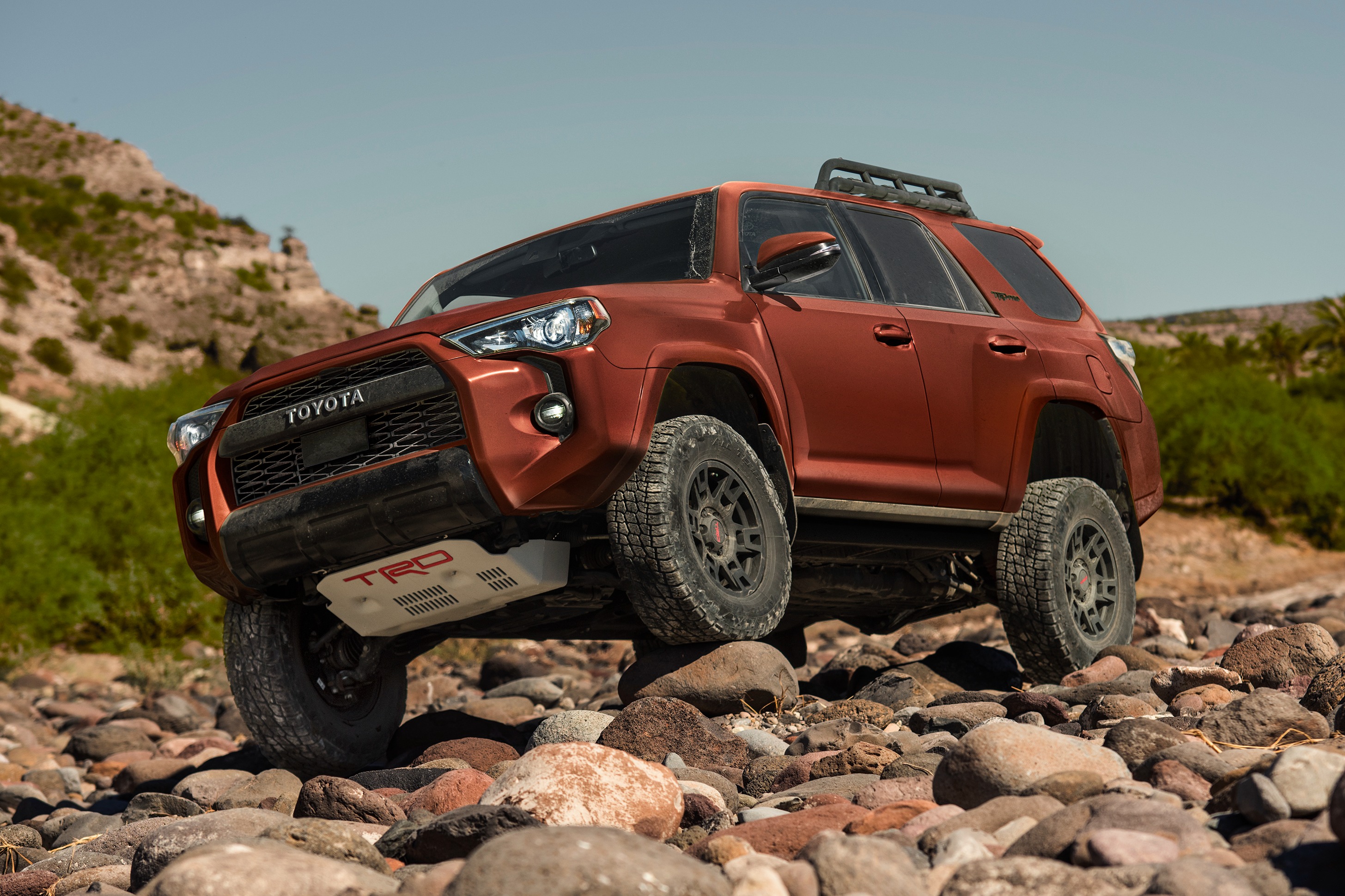
The 2025 Toyota 4Runner, in its sixth generation, maintained a design evolution rather than a complete overhaul. It retained the horseshoe-shaped grilles from the previous generation, but with a more robust and industrial exterior. The side body panels featured deep beveled creases that seamlessly blended with the flared wheel arches, giving the 4Runner a broad-shouldered stance suitable for an off-road SUV. Paying homage to its predecessors, the 4Runner included design elements like the slanted rearmost window, while the sliding rear window facilitated easier cargo access. Inside, the 4Runner mirrored the Tacoma pickup truck, with a beveled styling motif throughout the cabin. The interior was both purposeful and comfortable, with hard plastics for durability and light cushioning for comfort. The materials were of higher quality than those in a Jeep Wrangler or Ford Bronco, though not as refined as the Land Rover Defender.
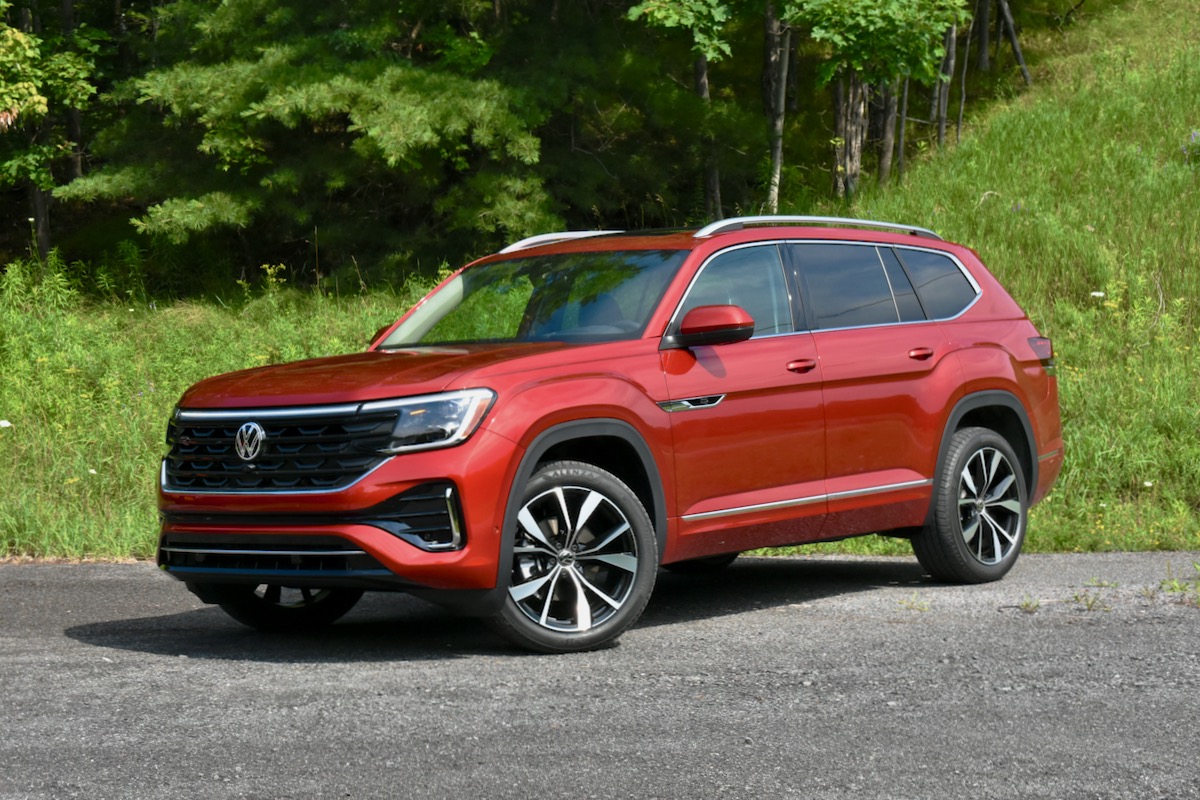
The 2026 Volkswagen Atlas, particularly in the Execline trim, bordered on luxury crossover territory with its expensive appearance. Starting from the base Comfortline trim, the Atlas featured full-LED lighting, power-adjustable heated side mirrors, and a sculpted silhouette. The Peak Edition added rugged elements like all-terrain tires and blackout trim pieces. The Execline trim boasted 21-inch two-tone alloy wheels and R-Line design elements. The Pure Grey paint on our test vehicle resisted dirt well, and the Titan Black upholstery was practical for muddy conditions. Despite its upscale look, the Atlas was priced competitively, starting at $54,492 for the base Comfortline and $64,492 for the Execline, making it cheaper than some competitors. Inside, the Execline featured quilted diamond-pattern leather seats, metallic accents, and a 12-inch touchscreen, though the latter was more about form than function. The Atlas's interior was upscale, with standard heated and ventilated front seats and a panoramic sunroof on higher trims. However, the ride quality, particularly with the Execline's large wheels, was less refined than some rivals.
The 2025 Toyota 4Runner offered two engine choices. The standard 2.4-litre turbocharged four-cylinder engine produced 317 horsepower and 278 pound-feet of torque, paired with an eight-speed automatic transmission. This setup promised improved acceleration and fuel economy over the previous generation. In Canada, part-time 4WD was standard, with full-time 4WD available on higher trims. The Hybrid i-Force Max powertrain, based on the same four-cylinder engine, combined with a 1.87-kWh battery pack and an electric motor, delivered 326 hp and 465 lb-ft of torque. This variant provided stronger power at lower speeds, beneficial for off-roading. The 4Runner was quieter inside, reducing driver fatigue on long journeys. It was more composed on pavement, with improved handling and steering. Off-road capabilities remained strong, with eight distinct packages offering varying levels of off-road abilities. The TRD Pro and Trailhunter models were the most capable, with approach angles between 18 and 33 degrees, departure angles between 22 and 24 degrees, and ground clearance between 20.5 and 25.6 centimetres.
The 2026 Volkswagen Atlas retained the same engine as previous models, a turbocharged 2.0-litre inline four-cylinder producing 269 horsepower and 273 pound-feet of torque. It was paired with an eight-speed automatic transmission and standard AWD in Canada. The engine, known for its refinement and efficiency, was configured for flexibility. Peak torque arrived at 1,600 rpm and held steady through 4,500 rpm, providing a wide power band. However, initial acceleration felt adequate but not eager, with a 0-100 km/h time of about eight seconds. The Atlas settled into a competent rhythm once in motion, with smooth highway merging and minimal downshifting. A Drive Mode Select system offered various driving modes, with Sport mode adding throttle response but increasing fuel consumption. We recorded 10.7 litres per 100 kilometres during our test drive, slightly better than the estimated 11 L/100 km for the Execline trim. The 4Motion AWD system performed well in rain and light snow, though it wasn't intended for serious off-roading. The Atlas's ride quality was a drawback, with the Execline's 21-inch wheels transmitting vibration and harshness, though the steering and brakes were competent.
The 2025 Toyota 4Runner was nearly 13 centimetres longer than its predecessor, with a 6-centimetre increase between the axles. Despite this, passenger space gains were minimal. The front seats offered ample room for taller passengers, but the middle row was less accommodating, with adequate legroom and headroom. A third row was available on non-hybrid models, but it was cramped and lacked thigh support. The cockpit was well-organized, with oversized climate control knobs and grouped off-road controls for easy operation. Storage included door pockets, a dashboard tray, cupholders, and a centre armrest bin. Cargo capacity was 1,371 litres behind the second row, reduced to 1,206 litres in the Hybrid due to the raised floor. A sturdy roof rack supported a static load of 360 kilograms.
The 2026 Volkswagen Atlas excelled in accommodating passengers and cargo. The Execline's front seats were heated, ventilated, and equipped with massage, with supportive seating for long drives. The driver's seat had 10-way power adjustment, while the passenger's seat was manually adjusted on lower trims and powered on higher trims. Outward visibility was excellent, with large side mirrors and a clear rear view. The second row featured captain's chairs that folded flat and tipped forward for easy third-row access. The third row offered decent leg support and enough legroom for taller passengers. Cargo capacity was a competitive advantage, with 583 litres behind the third row, 1,572 litres with the third row folded, and 2,735 litres total. The Atlas provided competitive space across all three rows and ample cargo capacity.
The 2025 Toyota 4Runner featured an 8-inch infotainment touchscreen as standard, with a 14-inch option available. Both were user-friendly, with logical menus and quick responses. Wireless Apple CarPlay and Android Auto were included, along with a charging pad. Hybrid variants had a digital instrument panel, and most gas models offered it in extra-cost packages. Off-road models had external camera views for trail navigation, with automatic activation at low speeds. A 14-speaker JBL audio system was available, along with a portable Bluetooth speaker. Remote monitoring and control were possible through a smartphone app, and a digital key function was offered.
The 2026 Volkswagen Atlas came with a 12-inch touchscreen running VW's MIB3 operating system, a 10.25-inch Digital Cockpit Pro instrument cluster, wireless Apple CarPlay and Android Auto, wireless charging, and six USB-C ports. The Highline trim added a Harman Kardon audio system and a surround-view camera system, while the Execline included a head-up display. Despite its impressive specs, the MIB3 system was frustrating to use, with a complex interface and invisible touch-sensitive controls at night. The voice control system was unreliable, making Apple CarPlay or Android Auto preferable. The Harman Kardon audio system sounded excellent, and the Digital Cockpit Pro was configurable, but the tech prioritized form over function.
The 2025 Toyota 4Runner had not yet been crash-tested by the NHTSA or IIHS, but the Tacoma pickup on which it was based was a Top Safety Pick by the IIHS. All 4Runner models came with Toyota Safety Sense 3.0, including frontal collision warning, lane-keep assist, adaptive cruise control, a traffic sign reader, and automatic high beams. Proactive Driving Assist was also included, though it could be intrusive. In Canada, a blind-spot monitor with rear cross-traffic alert was standard.
The 2026 Volkswagen Atlas earned a five-star overall safety rating from the NHTSA, with five stars in side-crash testing and four stars in frontal and rollover tests. The IIHS named the 2025 Atlas a Top Safety Pick+, though 2026 ratings were unavailable. Volkswagen's IQ.Drive suite of driver assistance features was standard across all trims, including forward-collision warning, blind-spot monitors, lane-keep assist, rear cross-traffic alert, adaptive cruise control, and Travel Assist. Emergency Assist was also included. The systems performed well during testing, with adaptive cruise control proving reliable.
CarGurus highlights
According to CarGurus experts, the overall rating for the 2025 Toyota 4Runner is 7.7 out of 10, while the 2026 Volkswagen Atlas scores 6.8 out of 10. Based on these ratings, the 2025 Toyota 4Runner is the recommended choice, offering a better balance of off-road capability, interior comfort, and user-friendly technology.
Choose the 2026 Volkswagen Atlas if:
- You need ample passenger and cargo space for family trips.
- You prefer a vehicle with a luxurious appearance and upscale interior.
- You want a comprehensive suite of standard safety features.


Choose the 2025 Toyota 4Runner if:
- You prioritize off-road capabilities and rugged design.
- You value a quieter interior and improved on-road handling.
- You appreciate user-friendly tech features and logical controls.


CarGurus highlights
According to CarGurus experts, the overall rating for the 2025 Toyota 4Runner is 7.7 out of 10, while the 2026 Volkswagen Atlas scores 6.8 out of 10. Based on these ratings, the 2025 Toyota 4Runner is the recommended choice, offering a better balance of off-road capability, interior comfort, and user-friendly technology.
Choose the 2026 Volkswagen Atlas if:
Shop Now- You need ample passenger and cargo space for family trips.
- You prefer a vehicle with a luxurious appearance and upscale interior.
- You want a comprehensive suite of standard safety features.
Choose the 2025 Toyota 4Runner if:
Shop Now- You prioritize off-road capabilities and rugged design.
- You value a quieter interior and improved on-road handling.
- You appreciate user-friendly tech features and logical controls.

By: CarGurus + AI
At CarGurus, our team of experienced automotive writers remain at the heart of our content operation, conducting hands-on car tests and writing insightful guides that are backed by years of industry experience. To complement this, we are harnessing AI to make our content offering more diverse and more helpful to shoppers than ever. To achieve this, our AI systems are based exclusively on CarGurus content, ratings and data, so that what we produce is both unique to CarGurus, and uniquely helpful to car shoppers.
