2025 Volkswagen Atlas vs 2025 Toyota Sequoia
Overview | |
Listings11 | Listings100 |
Ratings & Reviews | |
User Reviews | User Reviews |
Expert reviews5.5 out of 10 | Expert reviews6.7 out of 10 |
Pros
Cons
| Pros
Cons
|
2025 Toyota Sequoia Reviews SummaryThe 2025 Sequoia is Toyota’s full-size SUV, based on the same platform as the Tundra pickup truck and using the same i-Force Max hybrid powertrain. It seats up to eight people, holds up to 2,460 litres of cargo, carries up to 640 kilograms (1,411 pounds) of payload, and tows up to 4,080 kilograms (9,000 pounds) of trailer. But the Toyota Sequoia comes with some fundamental flaws. Verdict: People buy full-size SUVs to carry lots of people, haul lots of cargo, and tow lots of weight. However, due to its packaging requirements, the Sequoia is a rock star only if you’re attaching a trailer to it, and even then, it’s not class-leading in capability. | |
2025 Volkswagen Atlas Reviews SummaryThe 2025 Atlas is Volkswagen’s midsize, three-row crossover SUV. It debuted for the 2018 model year, designed specifically for North America and manufactured in VW’s Chattanooga, Tennessee, assembly plant. Over the years, it has received numerous updates to keep it fresh and technologically competitive, most recently for 2024 when styling, powertrain, and tech upgrades were introduced. The 2025 Atlas therefore arrives with only minor updates. Verdict: This family-sized SUV has more interior space than most rivals, making the 2025 VW Atlas a great choice if passenger and cargo room are high on your list of requirements. However, unimpressive fuel economy, dissatisfying ride quality, and a sometimes-infuriating infotainment interface could have you mapping out alternatives to an Atlas. | |
No video found | No video found |
Popular Features & Specs | |
Engine3.4L 437 hp V6 Hybrid | Engine2.0L 269 hp I4 |
Drivetrain4X2 | DrivetrainFWD |
Seating Capacity8 | Seating Capacity7 |
Horsepower437 hp @ 5200 rpm | Horsepower |
EV Battery Capacity1.9 kWh | EV Battery Capacity |
Fuel Economy (City)11.2 L(e)/100 km | Fuel Economy (City)11.8 L(e)/100 km |
Fuel Economy (Highway)9.8 L(e)/100 km | Fuel Economy (Highway)9.0 L(e)/100 km |
Engine | |
Engine Name3.4L 437 hp V6 Hybrid | Engine Name2.0L 269 hp I4 |
Torque583 lb-ft @ 2400 rpm | Torque |
Horsepower437 hp @ 5200 rpm | Horsepower |
Drivetrain4X2 | DrivetrainFWD |
Fuel Economy | |
EV Battery Capacity1.9 kWh | EV Battery Capacity |
Fuel Economy (City)11.2 L(e)/100 km | Fuel Economy (City)11.8 L(e)/100 km |
Fuel Economy (Highway)9.8 L(e)/100 km | Fuel Economy (Highway)9.0 L(e)/100 km |
Interior | |
Seating Capacity8 | Seating Capacity7 |
Key Features | |
Sunroof/MoonroofStandard | Sunroof/Moonroof |
Safety | |
Front Crash Overall | Front Crash Overall4 |
Side Crash Overall | Side Crash Overall5 |
Dimensions & Capacity | |
Cargo Space631 L | Cargo Space583 L |
Curb Weight2549 kg | Curb Weight1970 kg |
Height1892 mm | Height1788 mm |
Length5286 mm | Length5098 mm |
Width2027 mm | Width2248 mm |
Wheelbase3099 mm | Wheelbase2979 mm |
Maximum Payload785 kg | Maximum Payload495 kg |
Number of doors4 | Number of doors4 |
Maximum Towing Capacity4318 kg | Maximum Towing Capacity907 kg |
Standard Towing Capacity4318 kg | Standard Towing Capacity |
Overview | ||
Listings | ||
Ratings & Reviews | ||
User reviews | ||
Expert reviews | 5.5 out of 10Read full review | 6.7 out of 10Read full review |
Pros & cons | Pros
Cons
| Pros
Cons
|
Summary | The 2025 Sequoia is Toyota’s full-size SUV, based on the same platform as the Tundra pickup truck and using the same i-Force Max hybrid powertrain. It seats up to eight people, holds up to 2,460 litres of cargo, carries up to 640 kilograms (1,411 pounds) of payload, and tows up to 4,080 kilograms (9,000 pounds) of trailer. But the Toyota Sequoia comes with some fundamental flaws. Verdict: People buy full-size SUVs to carry lots of people, haul lots of cargo, and tow lots of weight. However, due to its packaging requirements, the Sequoia is a rock star only if you’re attaching a trailer to it, and even then, it’s not class-leading in capability. | The 2025 Atlas is Volkswagen’s midsize, three-row crossover SUV. It debuted for the 2018 model year, designed specifically for North America and manufactured in VW’s Chattanooga, Tennessee, assembly plant. Over the years, it has received numerous updates to keep it fresh and technologically competitive, most recently for 2024 when styling, powertrain, and tech upgrades were introduced. The 2025 Atlas therefore arrives with only minor updates. Verdict: This family-sized SUV has more interior space than most rivals, making the 2025 VW Atlas a great choice if passenger and cargo room are high on your list of requirements. However, unimpressive fuel economy, dissatisfying ride quality, and a sometimes-infuriating infotainment interface could have you mapping out alternatives to an Atlas. |
Video | No video found | No video found |
Popular Features & Specs | ||
Engine | 3.4L 437 hp V6 Hybrid | 2.0L 269 hp I4 |
Drivetrain | 4X2 | FWD |
Seating Capacity | 8 | 7 |
Horsepower | 437 hp @ 5200 rpm | |
EV Battery Capacity | 1.9 kWh | |
Fuel Economy (City) | 11.2 L(e)/100 km | 11.8 L(e)/100 km |
Fuel Economy (Highway) | 9.8 L(e)/100 km | 9.0 L(e)/100 km |
Engine | ||
Engine Name | 3.4L 437 hp V6 Hybrid | 2.0L 269 hp I4 |
Torque | 583 lb-ft @ 2400 rpm | |
Horsepower | 437 hp @ 5200 rpm | |
Drivetrain | 4X2 | FWD |
Fuel Economy | ||
EV Battery Capacity | 1.9 kWh | |
Fuel Economy (City) | 11.2 L(e)/100 km | 11.8 L(e)/100 km |
Fuel Economy (Highway) | 9.8 L(e)/100 km | 9.0 L(e)/100 km |
Interior | ||
Seating Capacity | 8 | 7 |
Key Features | ||
Sunroof/Moonroof | Standard | |
Safety | ||
Front Crash Overall | 4 | |
Side Crash Overall | 5 | |
Dimensions & Capacity | ||
Cargo Space | 631 L | 583 L |
Curb Weight | 2549 kg | 1970 kg |
Height | 1892 mm | 1788 mm |
Length | 5286 mm | 5098 mm |
Width | 2027 mm | 2248 mm |
Wheelbase | 3099 mm | 2979 mm |
Maximum Payload | 785 kg | 495 kg |
Number of doors | 4 | 4 |
Maximum Towing Capacity | 4318 kg | 907 kg |
Standard Towing Capacity | 4318 kg | |
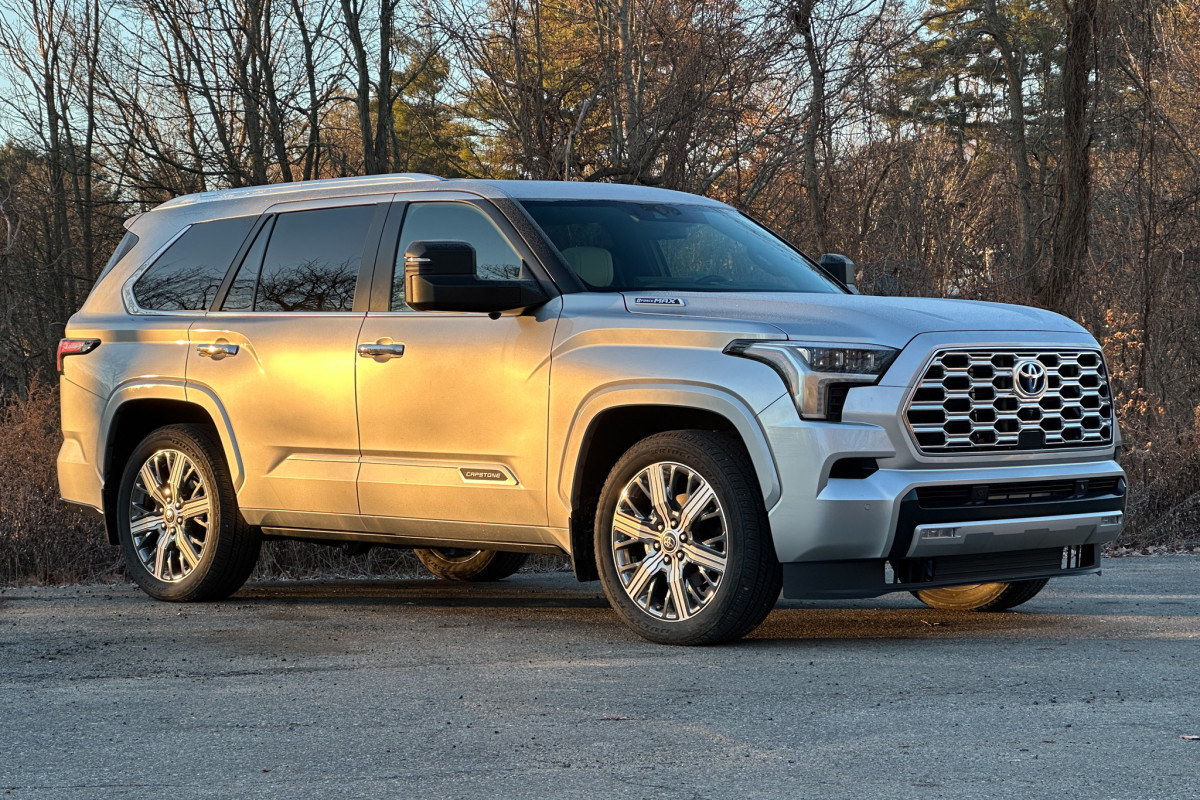
The 2025 Toyota Sequoia, particularly in the U.S.-only 1794 Edition trim, presented a rugged yet refined appearance with its dark grey 20-inch wheels and reduced chrome accents. Despite its current-generation design being a few years old, the Sequoia still managed to turn heads, especially in its Lunar Rock paint. Inside, the cabin was a mix of Saddle Tan leather upholstery and open-pore walnut wood trim, although the prevalent use of Toyota-grade plastic detracted from the overall luxury feel. In Canada, the Sequoia lineup offered a range of trims, from the base SR5 TRD Off-road to the high-end Capstone, with prices spanning from $87,174 to $106,175, excluding the federal luxury tax on the highest trims.
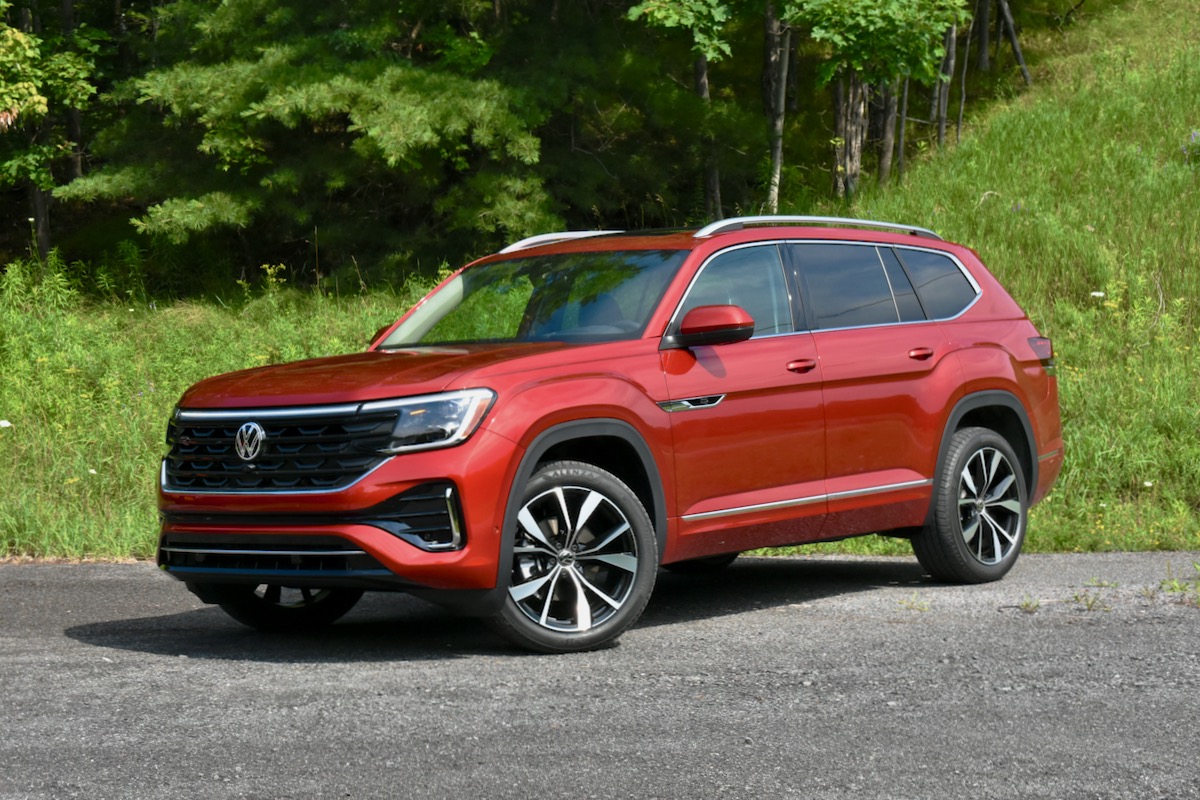
The 2025 Volkswagen Atlas, available in Canada in four trims, including the sporty Execline, showcased a muscular and upscale design. The test model, finished in Mountain Lake Blue, featured polished aluminum detailing, front and rear light bars, and 21-inch wheels, giving it a commanding presence. Inside, the Atlas boasted a warm and inviting environment with diamond-stitched leather, metallic accents, and artificial wood. The digital instrumentation and large infotainment touchscreen promised a high-tech experience, although the touch-sensitive controls for temperature and stereo volume were less satisfying to use. The Atlas's design and features made it a standout in its class, offering both style and functionality.
The 2025 Toyota Sequoia came equipped with an i-Force Max hybrid powertrain, combining a twin-turbocharged 3.4-litre V6 engine, an electric motor, and a 1.87-kilowatt-hour nickel metal hydride battery pack, delivering 437 horsepower and 583 pound-feet of torque. Despite its muscular performance, the Sequoia's fuel economy was disappointing, averaging 14.5 L/100 km in real-world testing compared to the expected 11.7 L/100 km. The Sequoia's towing capacity was impressive, with a maximum of 4,137 kilograms, but its driving dynamics were compromised by the rear-mounted battery pack and solid rear axle, leading to a jittery ride and limited rear-seat room.
The 2025 Volkswagen Atlas featured a new turbocharged 2.0-litre four-cylinder engine, producing 269 horsepower and 273 pound-feet of torque. While initially seeming underpowered for an eight-passenger SUV, the engine proved refined and capable, especially when utilizing its generous torque curve. The Atlas's fuel economy was moderate, with a combined rating of 12.3 L/100 km during testing. However, the ride quality was less than ideal, with a brittle suspension and excessive body motions at highway speeds. Despite these drawbacks, the Atlas's handling was predictable, and the brakes performed well under stress.
The 2025 Toyota Sequoia offered seating for up to eight people, though the third row was best suited for shorter passengers due to limited headroom. The Platinum and Capstone trims featured comfortable 10-way power adjustable seats with heating, ventilation, and massage functions. Access to the third row was challenging due to the high floor and low roof, and cargo space was limited, with a maximum of 2,460 litres when both the second and third rows were folded. The Sequoia's interior was practical but lacked the spaciousness of some rivals.
In contrast, the 2025 Volkswagen Atlas excelled in form and function, providing one of the most comfortable third-row seats in its class. The Execline model's front seats were supportive, and the second-row bench offered ample space for three adults. The Atlas's cargo area was generous, with 583 litres behind the third row and a maximum of 2,735 litres with all seats folded. The SUV's design prioritized passenger comfort and storage, making it an excellent choice for families.
The 2025 Toyota Sequoia featured a 12.3-inch digital instrumentation panel and a 14-inch touchscreen infotainment system, with various connected services plans available. While wireless Apple CarPlay and Android Auto were standard, the lack of a tuning knob was frustrating. The Intelligent Assistant voice recognition system was capable but had limitations, and the surround-view camera system was a helpful addition.
The 2025 Volkswagen Atlas utilized VW's MIB3 operating system on a 12-inch touchscreen display. While the system offered wireless Apple CarPlay and Android Auto, the lack of traditional controls and a reliable native voice assistant was a drawback. The Harman Kardon audio system was impressive, but the MIB3's user experience was marred by glitches and a non-intuitive interface.
The 2025 Toyota Sequoia came standard with Toyota Safety Sense 2.5, offering adaptive cruise control, forward collision warning, automatic emergency braking, and more. However, the lane assist features were often intrusive, leading to frequent false warnings. At the time of publication, crash-test ratings from the IIHS and NHTSA were unavailable.
The 2025 Volkswagen Atlas featured IQ.Drive, a suite of driver assistance features including adaptive cruise control, lane-keep assist, and more. The system was generally accurate and refined, with minimal false warnings. The Atlas received a five-star overall safety rating from the NHTSA and was a 2024 IIHS "Top Safety Pick."
CarGurus highlights
According to CarGurus experts, the overall rating for the 2025 Toyota Sequoia is 5.5 out of 10, while the 2025 Volkswagen Atlas scores 6.7 out of 10. Based on these ratings, the Volkswagen Atlas is the recommended choice, offering a more comfortable interior, better safety ratings, and a more refined driving experience.
Choose the 2025 Volkswagen Atlas if:
- You need a spacious and comfortable interior with excellent third-row seating.
- You appreciate a refined turbocharged engine with a satisfying torque curve.
- You want a vehicle with a high safety rating and reliable driver assistance features.


Choose the 2025 Toyota Sequoia if:
- You prioritize towing capacity and need a vehicle capable of hauling heavy loads.
- You prefer a hybrid powertrain with strong acceleration and a muscular engine note.
- You value a comprehensive suite of safety features, even if some are intrusive.


CarGurus highlights
According to CarGurus experts, the overall rating for the 2025 Toyota Sequoia is 5.5 out of 10, while the 2025 Volkswagen Atlas scores 6.7 out of 10. Based on these ratings, the Volkswagen Atlas is the recommended choice, offering a more comfortable interior, better safety ratings, and a more refined driving experience.
Choose the 2025 Volkswagen Atlas if:
Shop Now- You need a spacious and comfortable interior with excellent third-row seating.
- You appreciate a refined turbocharged engine with a satisfying torque curve.
- You want a vehicle with a high safety rating and reliable driver assistance features.
Choose the 2025 Toyota Sequoia if:
Shop Now- You prioritize towing capacity and need a vehicle capable of hauling heavy loads.
- You prefer a hybrid powertrain with strong acceleration and a muscular engine note.
- You value a comprehensive suite of safety features, even if some are intrusive.

By: CarGurus + AI
At CarGurus, our team of experienced automotive writers remain at the heart of our content operation, conducting hands-on car tests and writing insightful guides that are backed by years of industry experience. To complement this, we are harnessing AI to make our content offering more diverse and more helpful to shoppers than ever. To achieve this, our AI systems are based exclusively on CarGurus content, ratings and data, so that what we produce is both unique to CarGurus, and uniquely helpful to car shoppers.
