2025 Toyota Sequoia vs 2026 Volkswagen Atlas
Overview | |
Listings11 | Listings252 |
Ratings & Reviews | |
User Reviews | User Reviews |
Expert reviews5.5 out of 10 | Expert reviews6.8 out of 10 |
Pros
Cons
| Pros
Cons
|
2025 Toyota Sequoia Reviews SummaryThe 2025 Sequoia is Toyota’s full-size SUV, based on the same platform as the Tundra pickup truck and using the same i-Force Max hybrid powertrain. It seats up to eight people, holds up to 2,460 litres of cargo, carries up to 640 kilograms (1,411 pounds) of payload, and tows up to 4,080 kilograms (9,000 pounds) of trailer. But the Toyota Sequoia comes with some fundamental flaws. Verdict: People buy full-size SUVs to carry lots of people, haul lots of cargo, and tow lots of weight. However, due to its packaging requirements, the Sequoia is a rock star only if you’re attaching a trailer to it, and even then, it’s not class-leading in capability. | |
2026 Volkswagen Atlas Reviews SummaryThe 2026 Volkswagen Atlas continues as VW’s North American-market three-row SUV (a two-row Atlas Cross Sport is also available, but we’ll cover that separately), and it’s largely unchanged from its substantial 2024 refresh. What remains, however, is a vehicle that impresses with its upscale appearance and genuinely spacious interior. A stiff ride and poorly executed technology will fight and frustrate you every step of the way, but the Atlas will nonetheless make you look good. Verdict: The 2026 Volkswagen Atlas delivers on its core promise of style and space at a non-luxury price point. If you can tolerate its sub-par ride quality and maddening infotainment system—or if you simply plan to rely on Apple CarPlay and ignore the native tech—this handsome three-row SUV offers compelling value for shoppers prioritizing looks and space. | |
No video found | No video found |
Popular Features & Specs | |
Engine3.4L 437 hp V6 Hybrid | Engine2.0L 269 hp I4 |
Drivetrain4X2 | DrivetrainFWD |
Seating Capacity8 | Seating Capacity7 |
Horsepower437 hp @ 5200 rpm | Horsepower |
EV Battery Capacity1.9 kWh | EV Battery Capacity |
Fuel Economy (City)11.2 L(e)/100 km | Fuel Economy (City)11.8 L(e)/100 km |
Fuel Economy (Highway)9.8 L(e)/100 km | Fuel Economy (Highway)8.7 L(e)/100 km |
Engine | |
Engine Name3.4L 437 hp V6 Hybrid | Engine Name2.0L 269 hp I4 |
Torque583 lb-ft @ 2400 rpm | Torque |
Horsepower437 hp @ 5200 rpm | Horsepower |
Drivetrain4X2 | DrivetrainFWD |
Fuel Economy | |
EV Battery Capacity1.9 kWh | EV Battery Capacity |
Fuel Economy (City)11.2 L(e)/100 km | Fuel Economy (City)11.8 L(e)/100 km |
Fuel Economy (Highway)9.8 L(e)/100 km | Fuel Economy (Highway)8.7 L(e)/100 km |
Interior | |
Seating Capacity8 | Seating Capacity7 |
Key Features | |
Sunroof/MoonroofStandard | Sunroof/Moonroof |
Safety | |
Front Crash Overall | Front Crash Overall4 |
Side Crash Overall | Side Crash Overall5 |
Dimensions & Capacity | |
Cargo Space631 L | Cargo Space583 L |
Curb Weight2549 kg | Curb Weight1958 kg |
Height1892 mm | Height1788 mm |
Length5286 mm | Length5098 mm |
Width2027 mm | Width2248 mm |
Wheelbase3099 mm | Wheelbase2979 mm |
Maximum Payload785 kg | Maximum Payload500 kg |
Number of doors4 | Number of doors4 |
Maximum Towing Capacity4318 kg | Maximum Towing Capacity907 kg |
Standard Towing Capacity4318 kg | Standard Towing Capacity |
Overview | ||
Listings | ||
Ratings & Reviews | ||
User reviews | ||
Expert reviews | 5.5 out of 10Read full review | 6.8 out of 10Read full review |
Pros & cons | Pros
Cons
| Pros
Cons
|
Summary | The 2025 Sequoia is Toyota’s full-size SUV, based on the same platform as the Tundra pickup truck and using the same i-Force Max hybrid powertrain. It seats up to eight people, holds up to 2,460 litres of cargo, carries up to 640 kilograms (1,411 pounds) of payload, and tows up to 4,080 kilograms (9,000 pounds) of trailer. But the Toyota Sequoia comes with some fundamental flaws. Verdict: People buy full-size SUVs to carry lots of people, haul lots of cargo, and tow lots of weight. However, due to its packaging requirements, the Sequoia is a rock star only if you’re attaching a trailer to it, and even then, it’s not class-leading in capability. | The 2026 Volkswagen Atlas continues as VW’s North American-market three-row SUV (a two-row Atlas Cross Sport is also available, but we’ll cover that separately), and it’s largely unchanged from its substantial 2024 refresh. What remains, however, is a vehicle that impresses with its upscale appearance and genuinely spacious interior. A stiff ride and poorly executed technology will fight and frustrate you every step of the way, but the Atlas will nonetheless make you look good. Verdict: The 2026 Volkswagen Atlas delivers on its core promise of style and space at a non-luxury price point. If you can tolerate its sub-par ride quality and maddening infotainment system—or if you simply plan to rely on Apple CarPlay and ignore the native tech—this handsome three-row SUV offers compelling value for shoppers prioritizing looks and space. |
Video | No video found | No video found |
Popular Features & Specs | ||
Engine | 3.4L 437 hp V6 Hybrid | 2.0L 269 hp I4 |
Drivetrain | 4X2 | FWD |
Seating Capacity | 8 | 7 |
Horsepower | 437 hp @ 5200 rpm | |
EV Battery Capacity | 1.9 kWh | |
Fuel Economy (City) | 11.2 L(e)/100 km | 11.8 L(e)/100 km |
Fuel Economy (Highway) | 9.8 L(e)/100 km | 8.7 L(e)/100 km |
Engine | ||
Engine Name | 3.4L 437 hp V6 Hybrid | 2.0L 269 hp I4 |
Torque | 583 lb-ft @ 2400 rpm | |
Horsepower | 437 hp @ 5200 rpm | |
Drivetrain | 4X2 | FWD |
Fuel Economy | ||
EV Battery Capacity | 1.9 kWh | |
Fuel Economy (City) | 11.2 L(e)/100 km | 11.8 L(e)/100 km |
Fuel Economy (Highway) | 9.8 L(e)/100 km | 8.7 L(e)/100 km |
Interior | ||
Seating Capacity | 8 | 7 |
Key Features | ||
Sunroof/Moonroof | Standard | |
Safety | ||
Front Crash Overall | 4 | |
Side Crash Overall | 5 | |
Dimensions & Capacity | ||
Cargo Space | 631 L | 583 L |
Curb Weight | 2549 kg | 1958 kg |
Height | 1892 mm | 1788 mm |
Length | 5286 mm | 5098 mm |
Width | 2027 mm | 2248 mm |
Wheelbase | 3099 mm | 2979 mm |
Maximum Payload | 785 kg | 500 kg |
Number of doors | 4 | 4 |
Maximum Towing Capacity | 4318 kg | 907 kg |
Standard Towing Capacity | 4318 kg | |
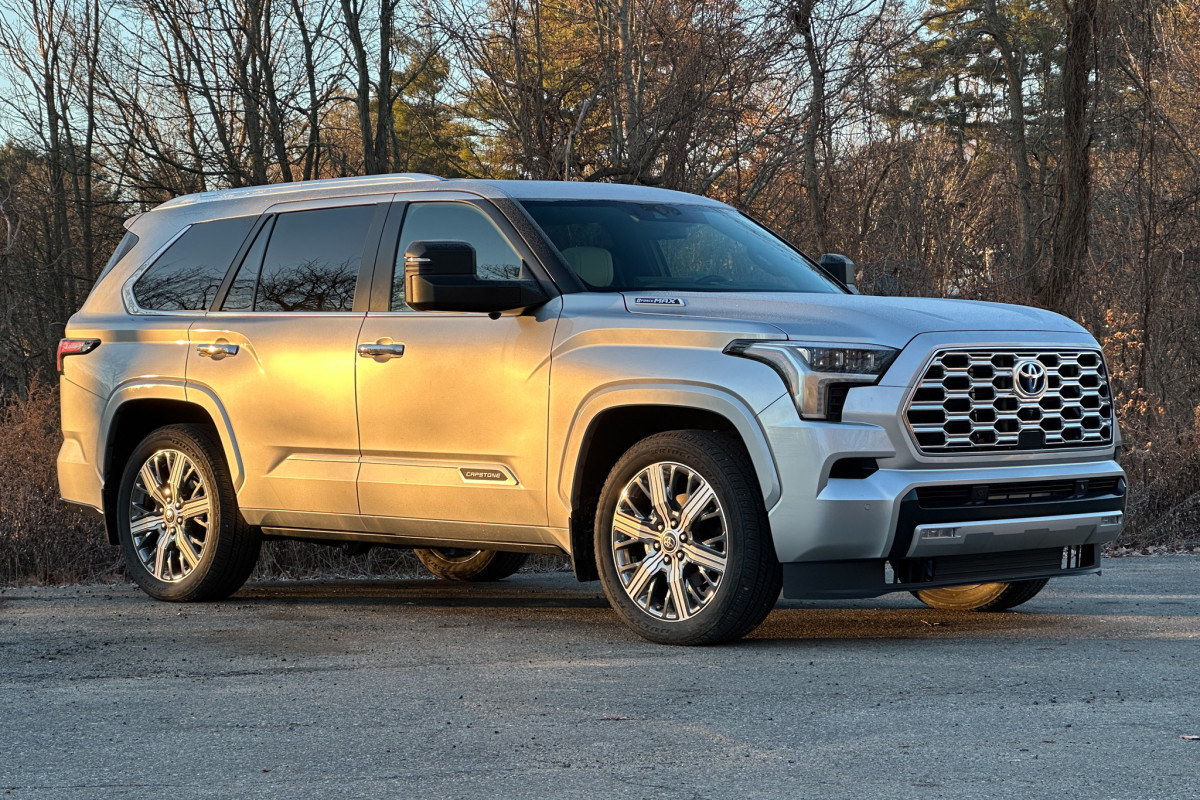
The 2025 Toyota Sequoia, particularly in the 1794 Edition trim, presented a unique aesthetic with its dark grey painted 20-inch wheels and reduced chrome accents compared to its Canadian counterpart, the Platinum trim. Despite its few years on the market, the Sequoia's rarity on the road and its Lunar Rock paint drew attention. Inside, the cabin was a mix of Saddle Tan leather upholstery and typical Toyota-grade plastic, which detracted from the overall premium feel. The Sequoia lineup in Canada offered a range of trims, from the base SR5 TRD Off-road to the luxurious Capstone, with prices spanning from $87,174 to $106,175, excluding the federal luxury tax on higher trims.
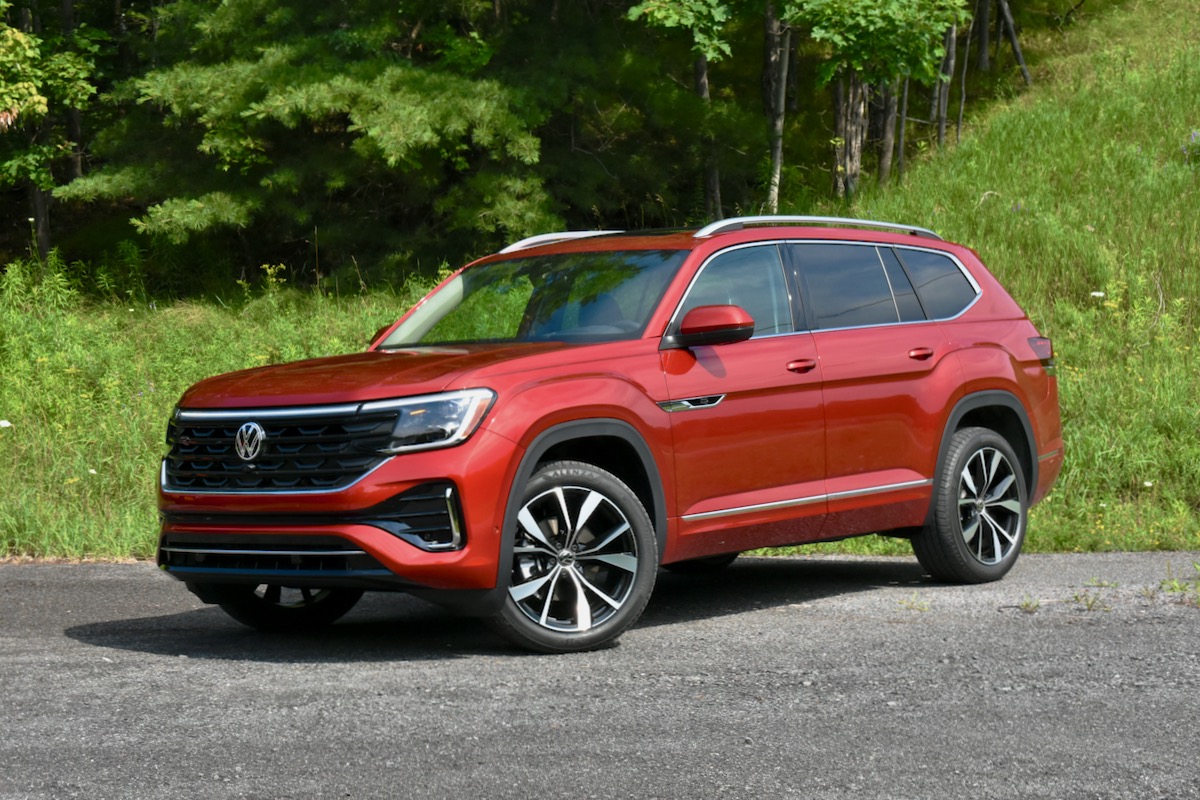
The 2026 Volkswagen Atlas, particularly in the Execline trim, exuded a sense of luxury with its Pure Grey paint and Titan Black upholstery. The Atlas's design, with its full-LED lighting and sculpted silhouette, maintained a modern appeal since its 2018 debut. The Execline trim featured 21-inch two-tone alloy wheels and R-Line exterior elements, enhancing its upscale appearance. Despite its premium look, the Atlas was competitively priced, starting at $64,492, making it more affordable than some of its rivals. Inside, the Atlas offered a warm and inviting environment with quilted diamond-pattern leather seats and metallic accents, although the infotainment system's functionality left room for improvement.
The 2025 Toyota Sequoia was powered by an i-Force Max hybrid powertrain, combining a twin-turbocharged 3.4-litre V6 engine, an electric motor, and a 1.87-kilowatt-hour nickel metal hydride battery pack, delivering 437 horsepower and 583 pound-feet of torque. Despite its muscular performance, the Sequoia's fuel economy was disappointing, averaging 14.5 L/100 km in testing, compared to the expected 11.7 L/100 km. The Sequoia's towing capacity was impressive, with a maximum of 4,137 kilograms, but its driving dynamics were compromised by the rear-mounted battery pack and solid rear axle, leading to a jittery ride and limited rear-seat room.
The 2026 Volkswagen Atlas featured a turbocharged 2.0-litre inline four-cylinder engine, producing 269 horsepower and 273 pound-feet of torque, paired with an eight-speed automatic transmission and standard all-wheel drive in Canada. The Atlas's engine, known for its refinement and efficiency, provided a wide power band, making it feel capable despite its modest output. The Atlas achieved a fuel economy of 10.7 L/100 km during testing, slightly better than the estimated 11 L/100 km. While the Atlas's ride quality was compromised by its large 21-inch wheels, its steering and braking performance were commendable, offering a confident driving experience.
The 2025 Toyota Sequoia accommodated up to eight passengers, though the third row was best suited for shorter individuals due to limited headroom. The Platinum and Capstone trims offered comfortable 10-way power adjustable seats with heating, ventilation, and massage functions. However, the Sequoia's high floor and low roof made accessing the third row awkward. Cargo space was limited, with only 325 litres behind the third row, expanding to 1,387 litres with the third row folded, and 2,460 litres with both rear rows down, falling short of rivals.
The 2026 Volkswagen Atlas excelled in passenger and cargo space, comfortably seating six with its captain's chairs. The third row offered decent leg support, and the cargo capacity was impressive, with 583 litres behind the third row, 1,572 litres with the third row folded, and a total of 2,735 litres. The Atlas's interior was designed for comfort, with heated, ventilated, and massaging front seats, and excellent outward visibility, making it a practical choice for families.
The 2025 Toyota Sequoia featured a 12.3-inch digital instrumentation panel and a 14-inch touchscreen infotainment system, with various connected services available through subscription plans. While wireless Apple CarPlay and Android Auto were standard, the infotainment system's reliance on subscriptions for advanced features was a drawback. The surround-view camera system and digital rearview mirror were useful additions, but the lack of a tuning knob was frustrating.
The 2026 Volkswagen Atlas came with a 12-inch touchscreen and a 10.25-inch Digital Cockpit Pro instrument cluster, offering wireless Apple CarPlay and Android Auto. However, the MIB3 infotainment system was cumbersome to use, with touch-sensitive controls that were invisible at night. The Harman Kardon audio system provided excellent sound quality, but the overall tech experience was marred by the system's complexity and lack of intuitive functionality.
The 2025 Toyota Sequoia was equipped with Toyota Safety Sense 2.5, offering a comprehensive suite of driver assistance features, including adaptive cruise control, forward collision warning, and lane keep assist. However, the lane assist features were often intrusive, leading to false warnings and a less satisfying driving experience. Crash-test ratings from the IIHS and NHTSA were not available at the time of publication.
The 2026 Volkswagen Atlas received a five-star overall safety rating from the NHTSA and was named a Top Safety Pick+ by the IIHS for the 2025 model. The Atlas's IQ.Drive suite of driver assistance features was standard across all trims, providing a robust set of safety technologies, including forward-collision warning, adaptive cruise control, and Travel Assist. The systems performed reliably during testing, enhancing the Atlas's safety credentials.
CarGurus highlights
According to CarGurus experts, the overall rating for the 2025 Toyota Sequoia is 5.5 out of 10, while the 2026 Volkswagen Atlas scores 6.8 out of 10. Based on these ratings, the 2026 Volkswagen Atlas is the recommended choice, offering a better balance of comfort, space, and safety features, making it a more practical and appealing option for families.
Choose the 2025 Toyota Sequoia if:
- You need a powerful hybrid powertrain with impressive towing capacity.
- You prefer a vehicle with a muscular design and unique aesthetic.
- You value a comprehensive suite of driver assistance features.


Choose the 2026 Volkswagen Atlas if:
- You require ample passenger and cargo space for family trips.
- You appreciate a luxurious interior with high-quality materials.
- You want a vehicle with a strong safety rating and reliable driver assistance systems.


CarGurus highlights
According to CarGurus experts, the overall rating for the 2025 Toyota Sequoia is 5.5 out of 10, while the 2026 Volkswagen Atlas scores 6.8 out of 10. Based on these ratings, the 2026 Volkswagen Atlas is the recommended choice, offering a better balance of comfort, space, and safety features, making it a more practical and appealing option for families.
Choose the 2025 Toyota Sequoia if:
Shop Now- You need a powerful hybrid powertrain with impressive towing capacity.
- You prefer a vehicle with a muscular design and unique aesthetic.
- You value a comprehensive suite of driver assistance features.
Choose the 2026 Volkswagen Atlas if:
Shop Now- You require ample passenger and cargo space for family trips.
- You appreciate a luxurious interior with high-quality materials.
- You want a vehicle with a strong safety rating and reliable driver assistance systems.

By: CarGurus + AI
At CarGurus, our team of experienced automotive writers remain at the heart of our content operation, conducting hands-on car tests and writing insightful guides that are backed by years of industry experience. To complement this, we are harnessing AI to make our content offering more diverse and more helpful to shoppers than ever. To achieve this, our AI systems are based exclusively on CarGurus content, ratings and data, so that what we produce is both unique to CarGurus, and uniquely helpful to car shoppers.
