2026 Volkswagen Atlas Reviews, Pricing & Specs


Pros & cons
What we like
Stylish design
High-end interior
Plenty of cargo space
What to consider
Poor ride quality
Unintuitive technology
Pedestrian performance
Expert review
Stylish, spacious, and a little frustrating, the 2026 Volkswagen Atlas is as lovely as it is flawed.
The 2026 Volkswagen Atlas continues as VW’s North American-market three-row SUV (a two-row Atlas Cross Sport is also available, but we’ll cover that separately), and it’s largely unchanged from its substantial 2024 refresh. What remains, however, is a vehicle that impresses with its upscale appearance and genuinely spacious interior. A stiff ride and poorly executed technology will fight and frustrate you every step of the way, but the Atlas will nonetheless make you look good.
Verdict: The 2026 Volkswagen Atlas delivers on its core promise of style and space at a non-luxury price point. If you can tolerate its sub-par ride quality and maddening infotainment system—or if you simply plan to rely on Apple CarPlay and ignore the native tech—this handsome three-row SUV offers compelling value for shoppers prioritizing looks and space.
out of 10 expert review
Look & feel
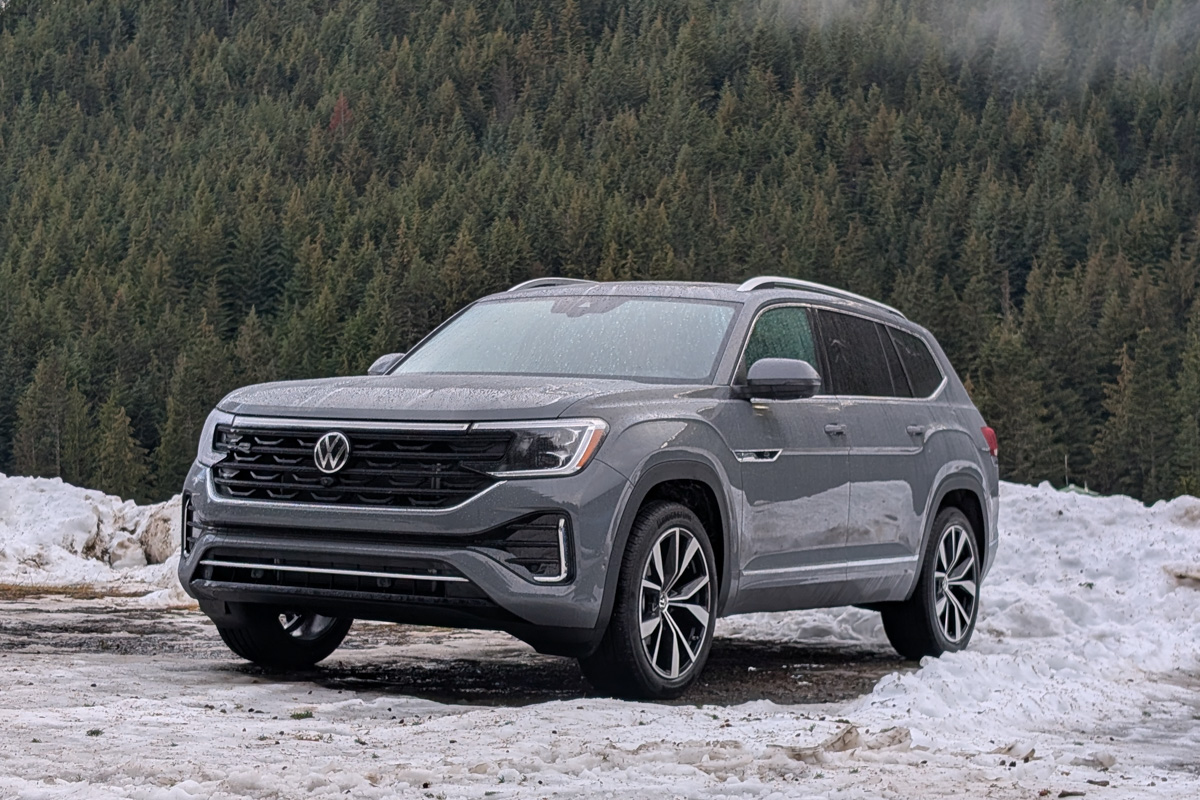
Every Volkswagen Atlas looks expensive, but the Execline trim we tested stands at the border of luxury crossover territory.
Starting with the base Comfortline trim level, the Atlas showcases full-LED lighting, power-adjustable heated side mirrors, a trailer hitch, roof rails, and a sculpted silhouette that has aged remarkably well since the model’s 2018 debut. Stepping up to the Peak Edition adds an illuminated logo and light bar up front, all-terrain tires, unique bumpers, more rugged side sills and a rear diffuser, chrome exhaust bezels, and plenty of blackout trim pieces, including the lower portion of the grille, the mirror caps, and the window surrounds.
The Highline doesn’t upgrade much on the Atlas exterior apart from 20-inch wheels, while the Execline upgrades to 21-inch two-tone alloy wheels and R-Line exterior design elements.
Our test vehicle wore Pure Grey paint, which somehow resisted looking dirty even after several hundred kilometres of winter driving. Helping with the facade of cleanliness was our car’s Titan Black upholstery. Although we like the look of Volkswagen’s Shetland Beige interior, the black was better for a group of muddy adults, and the upholstery’s silver underlay brought just enough light to the overall look.
We’ll get into specific pricing later, but the Atlas looks more expensive than it is. Although the Execline isn’t cheap, starting at “only” $64,492 (all prices include Volkswagen’s $2,250 destination charge and other fees), it looks right at home next to a BMW X5, which starts at nearly $30,000 more. The base Comfortline, meanwhile, starts at $54,492, meaning this 2026 Volkswagen mid-size SUV is cheaper than the newest competitors from Honda, Hyundai, and Toyota. And we’d argue that the VW looks better, too.
Inside, quilted diamond-pattern leather covers the seats in Execline models, including matching perforation on the headrests. Metallic accents and artificial wood trim along the dash create a warm, inviting environment, and a 12-inch touchscreen promises a high-tech experience, although the latter is unfortunately more a story of form than function.
Even on the lowest-tier trims, shoppers still enjoy at least leatherette seating surfaces, and leather arrives as standard on the Highline trim. Likewise, every Atlas delivers standard heated and ventilated front seats, while the Execline adds massage functionality. A panoramic sunroof is available on the Peak Edition and standard on the Highline.
Volkswagen has largely resisted the urge to plaster the inside of the Atlas with gloss-black plastic, but the insidious material has still found plenty of real estate around the shifter and the touchscreen’s bezel. As our photos show, it will pick up fingerprints despite even your best efforts.
Putting aside the plastic bits, the Atlas looks and feels expensive. In fact, the only other mass-market three-row SUV that can match it for upscale appointments and design is the Mazda CX-90, which takes a different but equally effective approach to its premium styling. Everything else in the segment—the Toyota Grand Highlander, the Honda Pilot, the Subaru Ascent, the Chevrolet Traverse—looks decidedly more utilitarian by comparison.
The irony, of course, is that such good looks can’t entirely mask some frustrating functional shortcomings, but we’ll get to those.
Performance
The 2026 Volkswagen Atlas uses the same engine as the 2024 and 2025 models. A turbocharged 2.0-litre inline four-cylinder making 269 horsepower and 273 pound-feet of torque is the sole offering. It’s connected to an eight-speed automatic transmission and, in Canada, standard all-wheel drive (AWD).
The current engine is an iteration of Volkswagen’s near-ubiquitous EA888 powerplant, which has been deployed in everything from rental-spec Jettas to the Golf R hot hatchback. It’s a known quantity—refined, efficient for its output, and extremely tunable—and in the case of the Atlas, it’s been configured for flexibility rather than excitement. Peak torque arrives at just 1,600 rpm and holds steady through 4,500 rpm. That wide and usable power band helps the Atlas feel more capable than its output numbers suggest, particularly once you’re already under way.
From a stop, however, the Atlas doesn’t feel particularly quick. There’s a beat before the turbo spools and the transmission sorts out its power management. With four adults and a full load of cargo aboard our test car, initial acceleration felt adequate but not exactly eager. Volkswagen claims a 0-100 km/h time of roughly eight seconds for an AWD Atlas, which sounds about right. The Honda Pilot, for reference, does that sprint roughly a second quicker.
Once in motion, the Atlas settles into a competent rhythm. Highway merging didn’t give us any drama, and the engine pulled along smoothly as we drove country roads. With its wide torque curve, the Atlas doesn’t downshift constantly to access more power, and the eight-speed automation transmission generally picks the right gear without fuss.
A Drive Mode Select system offers Eco, Comfort, Sport, Custom, and Snow options. Choosing Sport noticeably adds more throttle response and holds gears for longer, which makes the Atlas a bit more fun but also a bit thirstier.
We recorded 10.7 litres per 100 kilometres along our test drive route, which consisted mostly of fast-flowing driving along highways and country roads, although we dipped in and out of the city, too. While our evaluation came in a bit better than Natural Resources Canada’s 11 L/100 km combined estimate for the Execline trim, we wouldn’t be surprised to see the numbers creep higher with more city traffic thrown into the mix (rhe Comfortline trim is rated at 10.7 L/100 km combined, while the Peak Edition gets a 11.1 L/100 km combined rating).
The 4Motion AWD system performed without complaint in the rain and light snow we encountered, though our testing wasn’t intensive enough to truly evaluate Snow mode’s effectiveness. Volkswagen’s AWD system is capable of sending 50% of the engine’s torque to the rear axle, but it decouples the rear wheels under light loads to save fuel. It’s primarily designed for pavement with occasional slippery-surface excursions, but even the Peak Edition isn’t intended for serious off-roading. Maximum towing capacity is 2,268 kilograms (5,000 pounds) for most models, putting it in line with much of the competition but a touch behind the Nissan Pathfinder’s 2,720-kilogram (6,000-pound) limit.
Where the Atlas truly stumbles is with ride quality. Things might feel a bit smoother in a lower trim or the Peak Edition thanks to their smaller wheels, but our Atlas Execline model’s 21-inch wheels and 265/45R21 tires transmitted an uncomfortable amount of vibration and harshness into our backsides, particularly when our trip traversed imperfect pavement (or, help us, no pavement at all).
This isn’t a new complaint, either. Our previous reviews of the Atlas note similar issues, particularly attributing the problem to the top trim’s largest wheels. It’s a shame as the chassis is otherwise very competent. The steering feels appropriately weighted, particularly in Sport mode, and it provides enough feedback for confident cornering in the mountains. The brakes also resist fade and feel linear in their response, and while body roll is noticeable, it’s also predictable. The Atlas never does anything unexpected.
Overall, the Atlas does its job as a six- or seven-passenger people-mover without much fuss. It’s only the ride quality that leaves it feeling less refined than some rivals, including the Honda Pilot and the Hyundai Palisade Hybrid. It’s not a dealbreaker (and it may be resolvable in part by swapping in smaller wheels), but it’s a regular reminder of how this SUV prioritizes style over composure.
Form & function
We specifically requested the Volkswagen Atlas for this trip because of its ability to comfortably accommodate a mess of adults and their luggage for multiple days. And, sure enough, the trip went off with nary a complaint.
As noted earlier, the Execline’s front seats are heated, ventilated, and equipped with massage, and in fact all Atlas models have heat and ventilation up front. The seats themselves are supportive without feeling overly bolstered, and they proved comfortable over two-hour-long stretches of uninterrupted driving on varied terrain. The driver’s seat comes with 10-way power adjustment (and memory on the top two trims), while the passenger’s seat is a six-way, manually adjusted affair on the bottom two trim levels and eight-way powered on the Highline and Execline.
Outward visibility is excellent with each hood corner visible. Large side mirrors and a clear view out the back make positioning the Atlas easy, even without using the reversing camera or the available surround-view camera system.
The second row is also very pleasant. Our test vehicle’s captain’s chairs (making it a six-seater) fold flat and, even better, tip forward without collapsing, meaning you can easily access the third-row rear seats when a child’s car seat is installed in the middle row. The two-person bench seat in the way back sits high enough off the floor to provide decent leg support, a detail many three-row vehicles miss. With the second row slid forward a few centimetres, the third row offers enough legroom for taller passengers to ride in the back without too much discomfort — although we didn’t stuff anyone back there for too long.
Cargo capacity is a competitive advantage for the 2026 Volkswagen Atlas. Behind the third row, you’ll find 583 litres of cargo space—more than the 2026 Hyundai Palisade and significantly more than the 2026 Mazda CX-90. Folding the third row opens the cargo hold up to 1,572 litres, enough for all our luggage and four pairs of skis (but just barely). Total cargo space measures 2,735 litres, putting it just behind the positively massive Toyota Grand Highlander.
If your mission is hauling people and belongings in comfort, the Volkswagen Atlas excels. It offers competitive space across all three rows, including genuinely usable third-row seating, and its cargo capacity trails on the segment's largest vehicles.
Technology
The 2026 Volkswagen Atlas comes standard with a 12-inch touchscreen running the third generation of VW’s Modular Infotainment Toolkit (MIB3) operating system. Shoppers also get a 10.25-inch Digital Cockpit Pro instrument cluster, wireless Apple CarPlay and Android Auto, wireless charging, and six USB-C ports (a total of eight are available on all but the Comfortline trim). Level up to the Highline trim and Volkswagen will add a Harman Kardon 12-speaker premium audio system and the aforementioned 360-degree surround-view camera system, while the Execline also includes a head-up display (HUD).
On paper it sounds impressive, and we appreciate the wireless connectivity. That's because, in practice, the MIB3 system is maddeningly frustrating to use.
The interface looks sharp with clean graphics and modern design. But actually accomplishing tasks requires a frustrating number of presses, taps, and dives into menus and submenus. Worse still, the touch-sensitive slider controls at the base of the touchscreen for the HVAC and volume aren’t visible at night. They become functionally invisible when darkness falls, forcing you to either fumble around hoping to land on the right spot or use the steering-wheel volume controls and touchscreen menus for temperature. Neither solution is acceptable in any vehicle in 2026.
The voice control system exists courtesy of VW’s subscription-enabled IDA voice assistant, but it hasn’t been reliable in past testing. Instead, our strong recommendation is to use Apple CarPlay or Android Auto and forget the native system exists. Once connected wirelessly, both platforms work flawlessly, providing the intuitive interfaces and reliable voice assistants we’ve come to expect from Apple and Google.
The Harman Kardon audio system sounds excellent with clear highs and satisfying bass, and the Digital Cockpit Pro instrument cluster is very configurable. It offers multiple view options including full-screen navigation, although that has to be paired with the native nav system we’ve already cautioned against.
The frustration is that Volkswagen clearly understands how to design good-looking interfaces—the graphics are genuinely attractive. But beautiful screens mean little when basic functions are too frustrating to execute. With the Atlas, the tech is form prioritized over function in the most literal sense.
Safety
The 2026 Volkswagen Atlas earned a five-star overall safety rating from the U.S. National Highway Traffic Safety Administration (NHTSA) with five stars in side-crash testing and four stars in frontal and rollover tests. The Insurance Institute for Highway Safety (IIHS) named the 2025 Atlas a Top Safety Pick+, though updated ratings for 2026 weren’t available at the time of writing.
Volkswagen’s IQ.Drive suite of driver assistance features is standard across all Atlas trims. This is a notable value proposition, particularly on the base Comfortline. The collection of safety features includes forward-collision warning and automatic emergency braking with pedestrian and cyclist detection, blind-spot monitors, lane-keep assist, rear cross-traffic alert, adaptive cruise control with stop-and-go capability, and Travel Assist, Volkswagen’s semi-autonomous driving assistance tech. Emergency Assist is also included, which can bring the vehicle to a controlled stop if the driver becomes unresponsive.
We used these systems—although we didn't have cause for Emergency Assist or automatic emergency braking—over more than 300 kilometres of varied driving conditions, and they each performed without drama. Even in highway traffic near the city, adaptive cruise control proved reliable. Most importantly, none of the systems’ performance compelled us to turn them off.
The Execline adds Park Assist, although we did not find it necessary. Despite the Atlas’s size, it is easy to maneuver, even in tight parking lots.
Cost-effectiveness
The 2026 Volkswagen Atlas occupies an interesting position in the three-row crossover market. The base MSRP starts at $54,492 for the Comfortline trim (all prices include the mandatory $2,250 destination charge and other fees), the Peak Edition at $58,492, the Highline at $61,492, and the Execline at $64,492.
That pricing undercuts competitors such as the Honda Pilot, the Hyundai Palisade, and the Toyota Grand Highlander at their respective entry points, but the Volkswagen Atlas Execline is generally in line with the most expensive trims from its competitive set.
What you get for that money is genuinely impressive in some areas and genuinely frustrating in others. The styling punches well above the price point, and the interior appointments—particularly in Execline trim—are upscale and thoughtfully executed. Space and cargo capacity are competitive for the class, with the Atlas offering more of the latter than most of the field.
The trade-offs, however, are very real. Many shoppers won’t appreciate the VW Atlas’s stiff ride quality, and while smaller wheels might help, they’d also compromise the car’s visual appeal—one of its greatest strengths. The infotainment system’s poor usability is an even greater and daily frustration, albeit one that many shoppers will naturally mitigate with Apple CarPlay or Android Auto. Finally, while the Atlas’s performance is adequate, the advent of more hybrid three-row vehicles such as the Palisade Hybrid, the Grand Highlander Hybrid, and the upcoming Kia Telluride Hybrid make even our 10.7 L/100 km fuel economy observation less than impressive for a modern crossover.
Volkswagen provides a four-year, 80,000-kilometre warranty, a competitive length among mainstream automakers.
The 2026 Volkswagen Atlas makes sense as a family SUV for shoppers who prioritize style and space over driving refinement and polished technology features. If looking good and hauling people (and their stuff) matters more than ride quality and intuitive tech, the Atlas delivers genuine value.

What owners say
Trims & specs
Base MSRP $49,620 | Seating 7 |
Engine 2.0L 269 hp I4 | Cargo Capacity 20.6 cu ft |
Combined MPG 22 | Drivetrain AWD |
Base MSRP $45,630 | Seating 7 |
Engine 2.0L 269 hp I4 | Cargo Capacity 20.6 cu ft |
Combined MPG 23 | Drivetrain AWD |
Base MSRP $41,210 | Seating 7 |
Engine 2.0L 269 hp I4 | Cargo Capacity 20.6 cu ft |
Combined MPG 23 | Drivetrain AWD |
Base MSRP $39,310 | Seating 7 |
Engine 2.0L 269 hp I4 | Cargo Capacity 20.6 cu ft |
Combined MPG 23 | Drivetrain FWD |
Base MSRP $54,630 | Seating 7 |
Engine 2.0L 269 hp I4 | Cargo Capacity 20.6 cu ft |
Combined MPG 22 | Drivetrain AWD |
Base MSRP $48,060 | Seating 7 |
Engine 2.0L 269 hp I4 | Cargo Capacity 20.6 cu ft |
Combined MPG 22 | Drivetrain AWD |
Base MSRP $43,730 | Seating 7 |
Engine 2.0L 269 hp I4 | Cargo Capacity 20.6 cu ft |
Combined MPG 23 | Drivetrain FWD |


Pricing trends
MSRP range
$39,310 - $54,630
Current avg. market price
$57,865
Trending down by 1.0% this month
April 2026 - October 2026