2024 Volkswagen Tiguan vs 2025 Toyota Sequoia
Overview | |
MSRP$28,880 | MSRP$62,425 |
Listings421 | Listings14 |
Ratings & Reviews | |
User Reviews | User Reviews |
Expert reviews7.5 out of 10 | Expert reviews5.5 out of 10 |
Pros
Cons
| Pros
Cons
|
2024 Volkswagen Tiguan Reviews SummaryVolkswagen’s best-selling model boosts its value with upgrades for the 2024 model year. Verdict: We weren’t enamored of the driving experience in the Tiguan, and we wish Volkswagen would offer a hybrid or plug-in hybrid option. But the automaker backs the vehicle’s premium looks with value in areas we think more likely to matter to most shoppers. | |
2025 Toyota Sequoia Reviews SummaryThe 2025 Sequoia is Toyota’s full-size SUV, based on the same platform as the Tundra pickup truck and using the same i-Force Max hybrid powertrain. It seats up to eight people, holds up to 2,460 litres of cargo, carries up to 640 kilograms (1,411 pounds) of payload, and tows up to 4,080 kilograms (9,000 pounds) of trailer. But the Toyota Sequoia comes with some fundamental flaws. Verdict: People buy full-size SUVs to carry lots of people, haul lots of cargo, and tow lots of weight. However, due to its packaging requirements, the Sequoia is a rock star only if you’re attaching a trailer to it, and even then, it’s not class-leading in capability. | |
No video found | No video found |
Popular Features & Specs | |
Engine2.0L 184 hp I4 | Engine3.4L 437 hp V6 Hybrid |
DrivetrainFWD | Drivetrain4X2 |
Seating Capacity7 | Seating Capacity8 |
Horsepower184 hp @ 4400 rpm | Horsepower437 hp @ 5200 rpm |
EV Battery Capacity | EV Battery Capacity1.9 kWh |
MPG City24 | MPG City21 |
MPG Highway31 | MPG Highway24 |
Engine | |
Engine Name2.0L 184 hp I4 | Engine Name3.4L 437 hp V6 Hybrid |
Torque221 lb-ft @ 1600 rpm | Torque583 lb-ft @ 2400 rpm |
Horsepower184 hp @ 4400 rpm | Horsepower437 hp @ 5200 rpm |
DrivetrainFWD | Drivetrain4X2 |
Fuel Economy | |
EV Battery Capacity | EV Battery Capacity1.9 kWh |
MPG City24 | MPG City21 |
MPG Highway31 | MPG Highway24 |
Interior | |
Seating Capacity7 | Seating Capacity8 |
Key Features | |
Sunroof/Moonroof | Sunroof/MoonroofStandard |
Safety | |
Front Crash Overall4 | Front Crash Overall |
Side Crash Overall5 | Side Crash Overall |
Dimensions & Capacity | |
Cargo Space12.0 cu ft | Cargo Space22.3 cu ft |
Curb Weight3732 lbs | Curb Weight5620 lbs |
Height66.4 in | Height74.5 in |
Length186.1 in | Length208.1 in |
Width82.6 in | Width79.8 in |
Wheelbase109.9 in | Wheelbase122.0 in |
Maximum Payload1301 lbs | Maximum Payload1730 lbs |
Number of doors4 | Number of doors4 |
Maximum Towing Capacity1500 lbs | Maximum Towing Capacity9520 lbs |
Standard Towing Capacity | Standard Towing Capacity9520 lbs |
Overview | ||
MSRP | $28,880 | $62,425 |
Listings | ||
Ratings & Reviews | ||
User reviews | ||
Expert reviews | 7.5 out of 10Read full review | 5.5 out of 10Read full review |
Pros & cons | Pros
Cons
| Pros
Cons
|
Summary | Volkswagen’s best-selling model boosts its value with upgrades for the 2024 model year. Verdict: We weren’t enamored of the driving experience in the Tiguan, and we wish Volkswagen would offer a hybrid or plug-in hybrid option. But the automaker backs the vehicle’s premium looks with value in areas we think more likely to matter to most shoppers. | The 2025 Sequoia is Toyota’s full-size SUV, based on the same platform as the Tundra pickup truck and using the same i-Force Max hybrid powertrain. It seats up to eight people, holds up to 2,460 litres of cargo, carries up to 640 kilograms (1,411 pounds) of payload, and tows up to 4,080 kilograms (9,000 pounds) of trailer. But the Toyota Sequoia comes with some fundamental flaws. Verdict: People buy full-size SUVs to carry lots of people, haul lots of cargo, and tow lots of weight. However, due to its packaging requirements, the Sequoia is a rock star only if you’re attaching a trailer to it, and even then, it’s not class-leading in capability. |
Video | No video found | No video found |
Popular Features & Specs | ||
Engine | 2.0L 184 hp I4 | 3.4L 437 hp V6 Hybrid |
Drivetrain | FWD | 4X2 |
Seating Capacity | 7 | 8 |
Horsepower | 184 hp @ 4400 rpm | 437 hp @ 5200 rpm |
EV Battery Capacity | 1.9 kWh | |
MPG City | 24 | 21 |
MPG Highway | 31 | 24 |
Engine | ||
Engine Name | 2.0L 184 hp I4 | 3.4L 437 hp V6 Hybrid |
Torque | 221 lb-ft @ 1600 rpm | 583 lb-ft @ 2400 rpm |
Horsepower | 184 hp @ 4400 rpm | 437 hp @ 5200 rpm |
Drivetrain | FWD | 4X2 |
Fuel Economy | ||
EV Battery Capacity | 1.9 kWh | |
MPG City | 24 | 21 |
MPG Highway | 31 | 24 |
Interior | ||
Seating Capacity | 7 | 8 |
Key Features | ||
Sunroof/Moonroof | Standard | |
Safety | ||
Front Crash Overall | 4 | |
Side Crash Overall | 5 | |
Dimensions & Capacity | ||
Cargo Space | 12.0 cu ft | 22.3 cu ft |
Curb Weight | 3732 lbs | 5620 lbs |
Height | 66.4 in | 74.5 in |
Length | 186.1 in | 208.1 in |
Width | 82.6 in | 79.8 in |
Wheelbase | 109.9 in | 122.0 in |
Maximum Payload | 1301 lbs | 1730 lbs |
Number of doors | 4 | 4 |
Maximum Towing Capacity | 1500 lbs | 9520 lbs |
Standard Towing Capacity | 9520 lbs | |
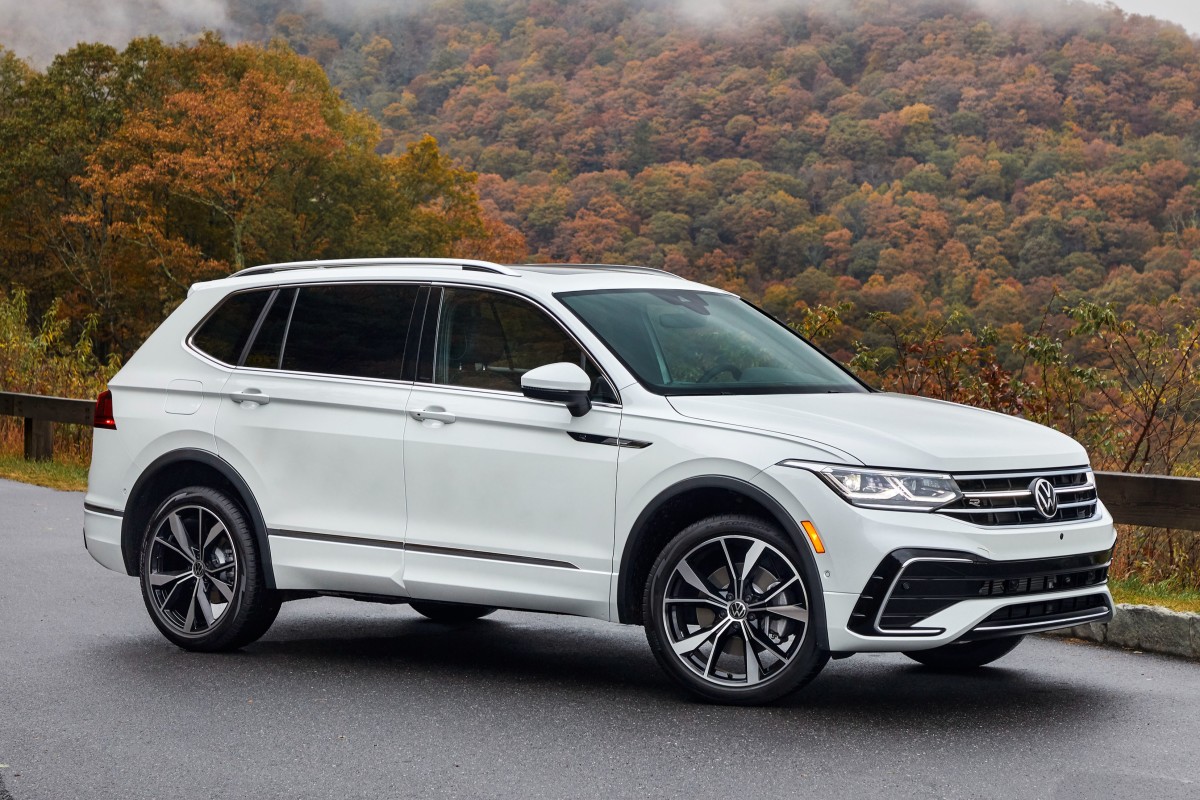
The 2024 Volkswagen Tiguan presented itself as a stylish and premium-looking compact crossover, often perceived as more upscale than its non-European counterparts. Its design elements, such as standard LED headlights and taillights, along with an illuminated grille light line on the Highline R-Line trim, contributed to its sophisticated appearance. The exterior featured silver roof rails on the Highline R-Line, while lower trims had black ones. The rear end showcased the model name in a bold, all-caps style, complemented by the classic Volkswagen badge. Colour options were limited on the base Trendline trim, but higher trims offered more vibrant choices, including blue and red, as well as various interior colourways.
Inside, the Tiguan offered a range of features across its trims. The base Trendline came with heated front seats and cloth upholstery, while the Comfortline added power-adjustable driver’s seat and leatherette upholstery. The R-Line trims included a panoramic sunroof, and the Highline R-Line further upgraded to real leather, front-seat ventilation, a heated steering wheel, and driver’s seat memory. The Highline R-Line also provided power adjustability for the front passenger seat and heated rear seats, enhancing comfort and convenience.
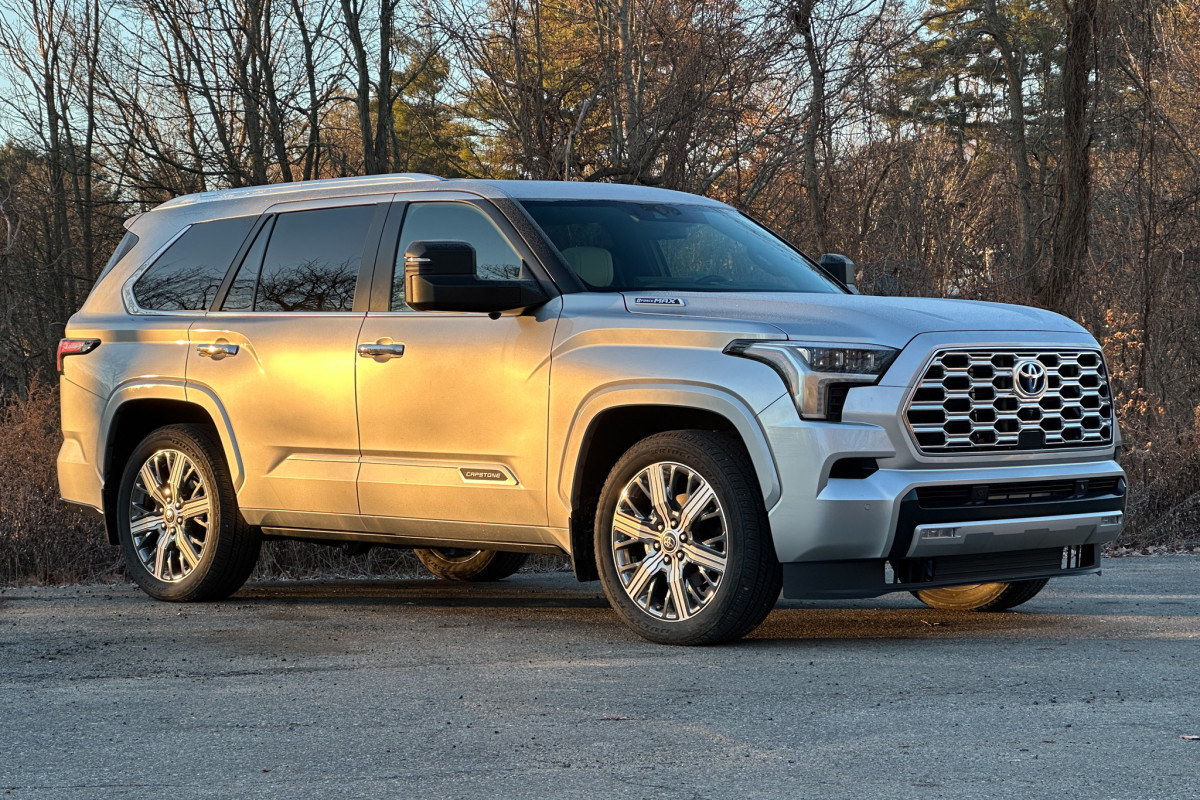
The 2025 Toyota Sequoia, particularly in the U.S.-only 1794 Edition trim, stood out with its distinctive Lunar Rock paint and dark grey painted 20-inch wheels. Despite being on the market for a few years, the Sequoia continued to attract attention due to its rarity on the road. The interior of the test vehicle featured Saddle Tan leather upholstery and open-pore walnut wood trim, although these were not available in the Canadian market. The cabin was predominantly covered in Toyota-grade plastic, which detracted from the overall premium feel.
In Canada, the Sequoia lineup included various trims, such as the base SR5 TRD Off-road, Limited, Platinum, and Capstone, with prices ranging from $87,174 to $106,175. The Sequoia offered a spacious interior with seating for up to eight people, although the third row was best suited for shorter passengers. The Platinum and Capstone trims featured 10-way power-adjustable seats with heating, ventilation, and massage functions, ensuring comfort for front occupants. However, the high floor and low roof made accessing the third row challenging for adults, and cargo space was limited with the third row in use.

The 2024 Volkswagen Tiguan was equipped with a turbocharged 2.0-litre four-cylinder engine, delivering 184 horsepower and 221 pound-feet of torque. This engine was paired with an eight-speed automatic transmission, providing a more traditional driving experience compared to the common CVTs. In Canada, the Tiguan came standard with Volkswagen’s 4Motion all-wheel drive. Fuel economy ratings were 10.6 litres per 100 kilometres in the city, 8.0 on the highway, and 9.4 combined for non R-Line trims, while the R-Line trims had slightly higher consumption figures.
During testing, the Tiguan Highline R-Line exhibited inconsistent power delivery, with noticeable turbo and transmission lag during acceleration. The gas pedal was touchy, even in Eco mode, and the brake pedal had excessive travel, making it poorly matched with the accelerator. Steering was light and somewhat rubbery, but visibility and handling were commendable, contributing to a maneuverable feel. Road noise was minimal, and the ride was comfortable, although the seating surfaces drew some complaints from passengers.
The 2025 Toyota Sequoia featured an i-Force Max hybrid powertrain, combining a twin-turbocharged 3.4-litre V6 engine, an electric motor, and a 1.87-kilowatt-hour nickel metal hydride battery pack. This setup produced an impressive 437 horsepower and 583 pound-feet of torque, paired with a 10-speed automatic transmission. In Canada, a part-time four-wheel-drive system was standard, offering various driving modes, including Eco, Normal, Sport, and Tow/Haul.
Despite its weight of 2,790 kilograms, the Sequoia’s hybrid drivetrain provided quick acceleration and a satisfying engine note. However, fuel economy fell short of expectations, with the test vehicle averaging 14.5 litres per 100 kilometres, compared to the expected 11.7 L/100 km. The Sequoia excelled in towing capacity, with a maximum of 4,137 kilograms on the base SR5 TRD Off-road trim. However, the solid rear axle and battery placement compromised rear-seat room and cargo space, affecting driving dynamics. The ride was jittery over bumps, and the steering, while light and fluid, lacked feedback. Brakes were difficult to modulate, and fade was an issue during hard braking tests.
The 2024 Volkswagen Tiguan offered a choice between two-row and three-row configurations, with the third row available as an $800 option. The two-row version provided 1,064 litres of cargo space with all seats in place, expanding to 2,078 litres with the rear seats folded. In the three-row configuration, cargo space was reduced to 340 litres behind the third row, 934 litres with it folded, and 1,849 litres with only the front seats in use. Passenger space remained largely unaffected, with ample headroom and legroom in the first two rows. The third row, however, was notably tighter, making it suitable for shorter passengers.
The Tiguan’s compact crossover status made it one of the few vehicles in its class to offer a third row, alongside the Mitsubishi Outlander. Despite the limited space in the third row, the Tiguan’s dimensions were more generous compared to its competitor, providing a relatively roomy experience for passengers.
The 2025 Toyota Sequoia accommodated up to eight passengers, with the option for second-row captain’s chairs on higher trims. The Platinum and Capstone trims featured 10-way power-adjustable seats with heating, ventilation, and massage functions, ensuring comfort for front occupants. However, the high floor and low roof made accessing the third row challenging for adults, and headroom was limited. The third row’s stadium-style seating offered a good view forward, but passengers could easily bounce and hit their heads on the roof over bumps.
Cargo space in the Sequoia was limited with the third row in use, offering only 325 litres. An adjustable shelf helped maximize the space, but it remained insufficient compared to rival full-size SUVs. Folding the third row down and sliding it forward increased cargo capacity to 1,387 litres, while the maximum volume with both the third and second rows folded was 2,460 litres. These figures were less than those of competitors and even Toyota’s own Grand Highlander midsize SUV.
The 2024 Volkswagen Tiguan featured haptic touch slider buttons for climate control, which were responsive and easy to operate. However, the physical volume knob integrated with the on/off button was less user-friendly. The infotainment system relied on monochromatic graphics, accessed through an 8-inch centre touchscreen with wireless Apple CarPlay and Android Auto. The base Trendline had USB-C ports, while higher trims offered wireless charging. The Digital Cockpit System was standard, with the R-Line trims featuring a fully configurable 10.25-inch Digital Cockpit Pro screen. The nine-speaker Fender Premium Audio System was a highlight, providing excellent sound quality.
The 2025 Toyota Sequoia came equipped with a 12.3-inch digital instrumentation panel and a 14-inch touchscreen infotainment system, starting at the Limited trim. Four connected services plans were available, with trial subscriptions ranging from three to ten years. The Toyota Audio Multimedia system offered features like cloud-based navigation and voice recognition, but many required active subscriptions. Wireless Apple CarPlay and Android Auto were standard, along with a wireless charging pad. The 14-speaker JBL premium sound system was included in higher trims. The oversized volume knob was convenient, but the lack of a tuning knob was frustrating. The Intelligent Assistant voice recognition system had limitations, struggling with certain commands.
The 2024 Volkswagen Tiguan earned a 2022 Top Safety Pick+ award from the IIHS, indicating its strong safety credentials. Standard safety features in Canada included forward collision avoidance with automatic emergency braking, pedestrian detection, emergency calling, blind spot monitoring, and rear cross-traffic alert. Adaptive cruise control, lane assist, and Emergency Assist were available from the Comfortline trim, providing semi-autonomous highway driving capabilities. Park Distance Control became standard at the Comfortline R-Line Black trim level, although its judgment was sometimes lacking.
The 2025 Toyota Sequoia came with Toyota Safety Sense 2.5, offering a comprehensive suite of driving assistance features. These included adaptive cruise control, forward collision warning with pedestrian detection, automatic emergency braking, lane departure warning, lane keep assist, lane-centring assist, and automatic high-beam headlights. Blind-spot monitoring and rear cross-traffic alert were also standard. However, the lane assist features could be intrusive, causing false warnings and noticeable corrections. At the time of publication, crash-test ratings from the IIHS and NHTSA were not available for the Sequoia.
CarGurus highlights
According to CarGurus experts, the overall rating for the 2024 Volkswagen Tiguan is 7.5 out of 10, while the 2025 Toyota Sequoia scores 5.5 out of 10. Based on these ratings, the 2024 Volkswagen Tiguan is the recommended choice, offering a better balance of style, performance, and safety features.
Choose the 2024 Volkswagen Tiguan if:
- You prioritize a stylish and premium-looking compact crossover with a well-designed exterior.
- You value a comfortable and maneuverable driving experience with good visibility and handling.
- You seek a vehicle with strong safety credentials and a comprehensive suite of safety features.


Choose the 2025 Toyota Sequoia if:
- You need a full-size SUV with a powerful hybrid powertrain and impressive towing capacity.
- You require a spacious interior with comfortable seating for up to eight passengers.
- You appreciate advanced technology features, including a large touchscreen infotainment system and premium sound options.


CarGurus highlights
According to CarGurus experts, the overall rating for the 2024 Volkswagen Tiguan is 7.5 out of 10, while the 2025 Toyota Sequoia scores 5.5 out of 10. Based on these ratings, the 2024 Volkswagen Tiguan is the recommended choice, offering a better balance of style, performance, and safety features.
Choose the 2024 Volkswagen Tiguan if:
Shop Now- You prioritize a stylish and premium-looking compact crossover with a well-designed exterior.
- You value a comfortable and maneuverable driving experience with good visibility and handling.
- You seek a vehicle with strong safety credentials and a comprehensive suite of safety features.
Choose the 2025 Toyota Sequoia if:
Shop Now- You need a full-size SUV with a powerful hybrid powertrain and impressive towing capacity.
- You require a spacious interior with comfortable seating for up to eight passengers.
- You appreciate advanced technology features, including a large touchscreen infotainment system and premium sound options.

By: CarGurus + AI
At CarGurus, our team of experienced automotive writers remain at the heart of our content operation, conducting hands-on car tests and writing insightful guides that are backed by years of industry experience. To complement this, we are harnessing AI to make our content offering more diverse and more helpful to shoppers than ever. To achieve this, our AI systems are based exclusively on CarGurus content, ratings and data, so that what we produce is both unique to CarGurus, and uniquely helpful to car shoppers.
