2024 Hyundai Kona vs 2025 Toyota Sequoia
Overview | |
Listings248 | Listings11 |
Ratings & Reviews | |
User Reviews | User Reviews |
Expert reviews8.3 out of 10 | Expert reviews5.5 out of 10 |
Pros
Cons
| Pros
Cons
|
2024 Hyundai Kona Reviews SummaryThe Kona debuted for 2018 and got an electric counterpart when the Kona EV hit the market the following year. Hyundai's subcompact SUV got a refresh for 2022, which also saw the addition of the hot-hatch Kona N to the stable. Now, the Kona kicks off a whole new generation, with a new look, new tech, and, naturally, a new price tag to match. In a crowded segment, do the new features match–or perhaps even exceed–the added cost? | |
2025 Toyota Sequoia Reviews SummaryThe 2025 Sequoia is Toyota’s full-size SUV, based on the same platform as the Tundra pickup truck and using the same i-Force Max hybrid powertrain. It seats up to eight people, holds up to 2,460 litres of cargo, carries up to 640 kilograms (1,411 pounds) of payload, and tows up to 4,080 kilograms (9,000 pounds) of trailer. But the Toyota Sequoia comes with some fundamental flaws. Verdict: People buy full-size SUVs to carry lots of people, haul lots of cargo, and tow lots of weight. However, due to its packaging requirements, the Sequoia is a rock star only if you’re attaching a trailer to it, and even then, it’s not class-leading in capability. | |
No video found | |
Popular Features & Specs | |
Engine2.0L 147 hp I4 | Engine3.4L 437 hp V6 Hybrid |
DrivetrainFWD | Drivetrain4X2 |
Seating Capacity5 | Seating Capacity8 |
Horsepower147 hp @ 6200 rpm | Horsepower437 hp @ 5200 rpm |
EV Battery Capacity | EV Battery Capacity1.9 kWh |
Fuel Economy (City)8.1 L(e)/100 km | Fuel Economy (City)11.2 L(e)/100 km |
Fuel Economy (Highway)6.9 L(e)/100 km | Fuel Economy (Highway)9.8 L(e)/100 km |
Engine | |
Engine Name2.0L 147 hp I4 | Engine Name3.4L 437 hp V6 Hybrid |
Torque132 lb-ft @ 4500 rpm | Torque583 lb-ft @ 2400 rpm |
Horsepower147 hp @ 6200 rpm | Horsepower437 hp @ 5200 rpm |
DrivetrainFWD | Drivetrain4X2 |
Fuel Economy | |
EV Battery Capacity | EV Battery Capacity1.9 kWh |
Fuel Economy (City)8.1 L(e)/100 km | Fuel Economy (City)11.2 L(e)/100 km |
Fuel Economy (Highway)6.9 L(e)/100 km | Fuel Economy (Highway)9.8 L(e)/100 km |
Interior | |
Seating Capacity5 | Seating Capacity8 |
Key Features | |
Navigation SystemStandard | Navigation System |
Sunroof/Moonroof | Sunroof/MoonroofStandard |
Safety | |
Front Crash Overall4 | Front Crash Overall |
Side Crash Overall5 | Side Crash Overall |
Dimensions & Capacity | |
Cargo Space722 L | Cargo Space631 L |
Curb Weight1363 kg | Curb Weight2549 kg |
Height1580 mm | Height1892 mm |
Length4351 mm | Length5286 mm |
Width1826 mm | Width2027 mm |
Wheelbase2659 mm | Wheelbase3099 mm |
Maximum Payload492 kg | Maximum Payload785 kg |
Number of doors4 | Number of doors4 |
Maximum Towing Capacity | Maximum Towing Capacity4318 kg |
Standard Towing Capacity | Standard Towing Capacity4318 kg |
Overview | ||
Listings | ||
Ratings & Reviews | ||
User reviews | ||
Expert reviews | 8.3 out of 10Read full review | 5.5 out of 10Read full review |
Pros & cons | Pros
Cons
| Pros
Cons
|
Summary | The Kona debuted for 2018 and got an electric counterpart when the Kona EV hit the market the following year. Hyundai's subcompact SUV got a refresh for 2022, which also saw the addition of the hot-hatch Kona N to the stable. Now, the Kona kicks off a whole new generation, with a new look, new tech, and, naturally, a new price tag to match. In a crowded segment, do the new features match–or perhaps even exceed–the added cost? | The 2025 Sequoia is Toyota’s full-size SUV, based on the same platform as the Tundra pickup truck and using the same i-Force Max hybrid powertrain. It seats up to eight people, holds up to 2,460 litres of cargo, carries up to 640 kilograms (1,411 pounds) of payload, and tows up to 4,080 kilograms (9,000 pounds) of trailer. But the Toyota Sequoia comes with some fundamental flaws. Verdict: People buy full-size SUVs to carry lots of people, haul lots of cargo, and tow lots of weight. However, due to its packaging requirements, the Sequoia is a rock star only if you’re attaching a trailer to it, and even then, it’s not class-leading in capability. |
Video | No video found | |
Popular Features & Specs | ||
Engine | 2.0L 147 hp I4 | 3.4L 437 hp V6 Hybrid |
Drivetrain | FWD | 4X2 |
Seating Capacity | 5 | 8 |
Horsepower | 147 hp @ 6200 rpm | 437 hp @ 5200 rpm |
EV Battery Capacity | 1.9 kWh | |
Fuel Economy (City) | 8.1 L(e)/100 km | 11.2 L(e)/100 km |
Fuel Economy (Highway) | 6.9 L(e)/100 km | 9.8 L(e)/100 km |
Engine | ||
Engine Name | 2.0L 147 hp I4 | 3.4L 437 hp V6 Hybrid |
Torque | 132 lb-ft @ 4500 rpm | 583 lb-ft @ 2400 rpm |
Horsepower | 147 hp @ 6200 rpm | 437 hp @ 5200 rpm |
Drivetrain | FWD | 4X2 |
Fuel Economy | ||
EV Battery Capacity | 1.9 kWh | |
Fuel Economy (City) | 8.1 L(e)/100 km | 11.2 L(e)/100 km |
Fuel Economy (Highway) | 6.9 L(e)/100 km | 9.8 L(e)/100 km |
Interior | ||
Seating Capacity | 5 | 8 |
Key Features | ||
Navigation System | Standard | |
Sunroof/Moonroof | Standard | |
Safety | ||
Front Crash Overall | 4 | |
Side Crash Overall | 5 | |
Dimensions & Capacity | ||
Cargo Space | 722 L | 631 L |
Curb Weight | 1363 kg | 2549 kg |
Height | 1580 mm | 1892 mm |
Length | 4351 mm | 5286 mm |
Width | 1826 mm | 2027 mm |
Wheelbase | 2659 mm | 3099 mm |
Maximum Payload | 492 kg | 785 kg |
Number of doors | 4 | 4 |
Maximum Towing Capacity | 4318 kg | |
Standard Towing Capacity | 4318 kg | |
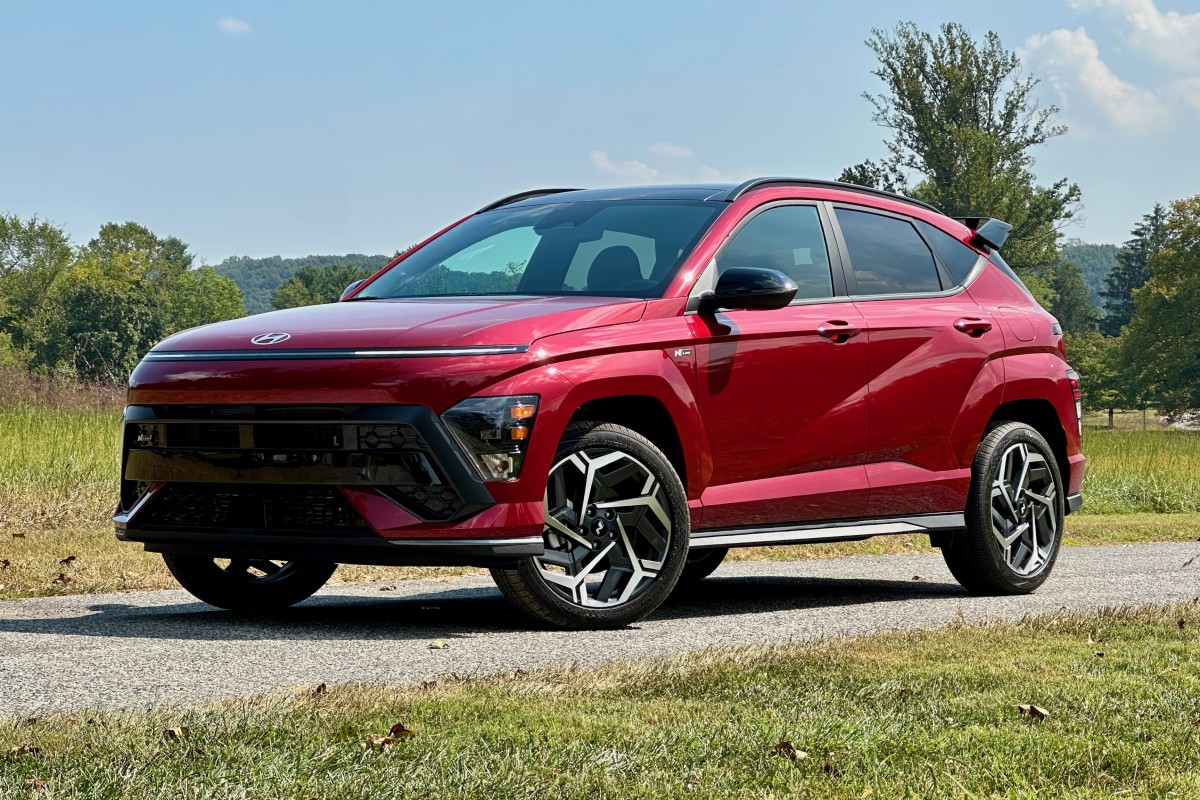
The 2024 Hyundai Kona was designed with an electric vehicle (EV) focus, evident in its sleek, modern appearance. The front grille resembled that of the Ioniq 5, featuring a single-piece design that signified its electric powertrain. The Kona showcased a "seamless horizon" design with a prominent skinny LED headlight at the front. Despite its increased size, the Kona maintained its recognizable silhouette, with new design elements like the creased "parametric surface" on the doors and more angular black body cladding on the Essential and Preferred trims. The N Line trim featured body-coloured wheel arches, adding a sporty touch. Standard LED lighting and varying wheel sizes across trims completed its updated look. Inside, the Kona's cabin was revamped with a driver-oriented centre stack, a relocated gear shift, and a curved display housing driver-information and infotainment screens, enhancing the overall driving experience.
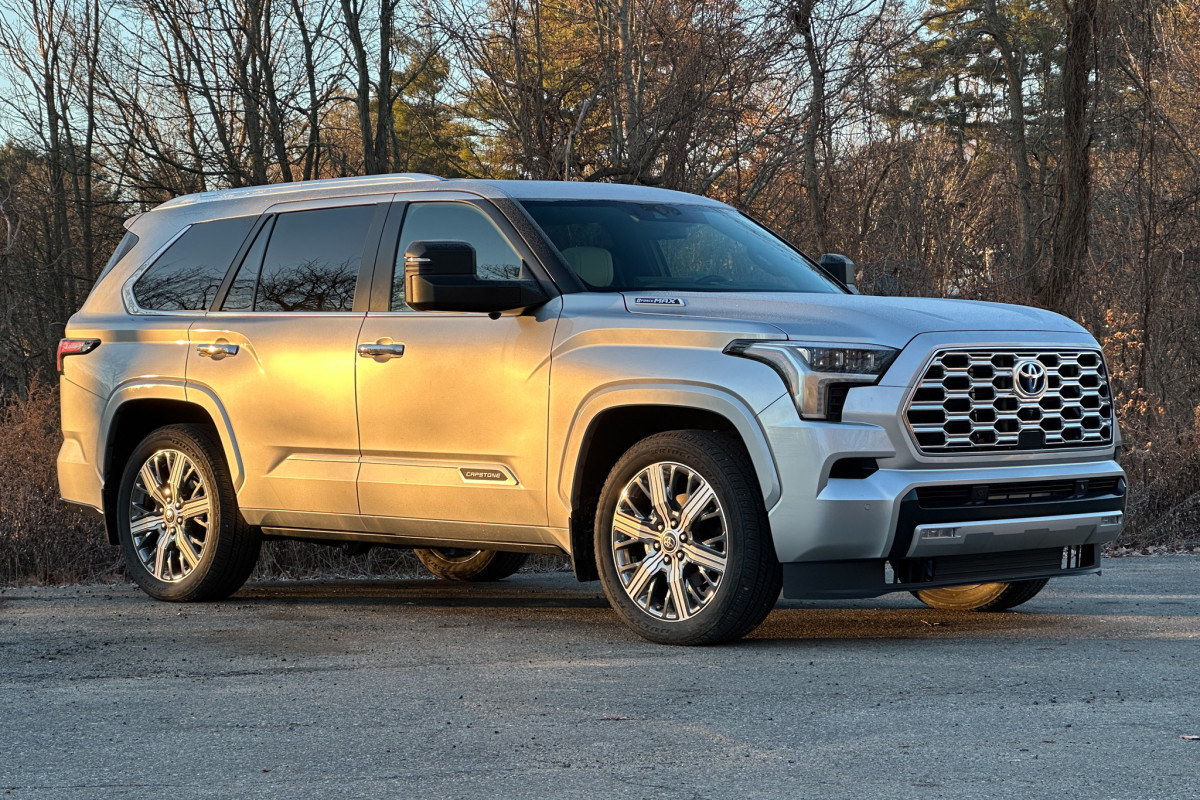
The 2025 Toyota Sequoia, particularly in the U.S.-only 1794 Edition, was a striking presence with its Lunar Rock paint and dark grey 20-inch wheels. Despite being on the market for a few years, the Sequoia's rarity on the road made it stand out. The interior featured Saddle Tan leather upholstery and open-pore walnut wood trim, although these were not available in Canada. The Sequoia's cabin was primarily covered in Toyota-grade plastic, which was less impressive. The Canadian lineup included various trims, from the base SR5 TRD Off-road to the luxurious Capstone, with prices ranging from $87,174 to $106,175. The Sequoia's design and features aimed to capture attention, but its interior materials and overall execution left room for improvement.


The 2024 Hyundai Kona retained its predecessor's engine lineup, offering a naturally aspirated 2.0-litre four-cylinder engine for the Essential and Preferred trims, producing 147 horsepower and 132 lb-ft of torque, paired with a CVT. The N Line trims featured a turbocharged 1.6-litre four-cylinder engine, delivering 190 horsepower and 195 lb-ft of torque, now coupled with an 8-speed automatic transmission. The N Line also included paddle shifters. During a test drive in Maryland, the Kona N Line demonstrated intuitive steering and nimble handling, although acceleration felt slightly sluggish even with the turbo. Front-wheel drive was standard, with all-wheel drive available for an additional $2,000 on Essential and Preferred trims and standard on the N Line. Fuel economy varied, with the N Line AWD consuming 9.7 L/100 km in the city, 8.3 on the highway, and 9.1 combined.
The 2025 Toyota Sequoia came equipped with an i-Force Max hybrid powertrain, featuring a twin-turbocharged 3.4-litre V6 engine, an electric motor, and a 1.87-kilowatt-hour nickel metal hydride battery pack, paired with a 10-speed automatic transmission. This setup produced 437 horsepower and 583 lb-ft of torque. In Canada, a part-time 4WD system was standard, offering various driving modes. Despite its weight of 2,790 kilograms, the Sequoia delivered impressive acceleration and a robust engine note. However, its fuel economy fell short, averaging 14.5 L/100 km in combined driving, contrary to the expected 11.7 L/100 km. The Sequoia excelled in towing, with a maximum capacity of 4,137 kilograms and a peak payload of 640 kilograms. However, its packaging and driving dynamics were compromised by the rear-mounted battery pack and solid rear axle, affecting ride quality and cargo space.
The 2024 Hyundai Kona's increased length significantly improved rear-seat legroom, offering 970 millimetres, and cargo capacity, expanding to 723 litres with the rear seats up and 1,803 litres with them folded. The cabin featured a handy shelf on the passenger's side of the dash and a "guardrail" on the wireless charging pad. Seating options varied across trims, with cloth seats on Essential and Preferred, leatherette with the Preferred Trend package, and a leather/suede combination for N Line. Ventilated front seats were available on the N Line with the Ultimate package, a first for the Kona. Heated front seats were standard in Canada, with a heated steering wheel included from the Preferred trim.
The 2025 Toyota Sequoia accommodated up to eight passengers, though seven or six would be more comfortable. The Platinum and Capstone trims offered 10-way power adjustable seats with heating, ventilation, and massage. Heated front seats, a heated steering wheel, and heated outboard mirrors were standard across all trims. Accessing the second and third rows was facilitated by long rear doors, though they posed challenges in tight spaces. The third row's stadium-style seating provided a good view but limited headroom. Cargo space was limited with the third row in use, offering 325 litres, expandable to 1,387 litres with the third row folded and 2,460 litres with both rows down. These figures were less than rival full-size SUVs, and even Toyota's Grand Highlander offered more room.
The 2024 Hyundai Kona featured a 12.3-inch touchscreen infotainment display as standard, with wireless Apple CarPlay and Android Auto available on all trims except the N Line with the Ultimate package. The upgraded stereo system in the N Line's Ultimate package was provided by Bose. The Kona included two USB-C ports in the front and two at the back for rear-seat passengers. Dual 12.3-inch displays created a panoramic view in the N Line, and OTA update capability was standard. Hyundai's Bluelink connected services and a digital key feature were also included.
The 2025 Toyota Sequoia boasted a 12.3-inch digital instrumentation panel and a 14-inch touchscreen infotainment system from the Limited trim. Four connected services plans were available, with trial subscriptions ranging from three to ten years. Wireless Apple CarPlay and Android Auto were standard, and a wireless charging pad was included from the Limited trim. A 14-speaker JBL premium sound system was available on higher trims. The Toyota Audio Multimedia system featured a natural voice recognition system, though it had limitations. The Sequoia also included a surround-view camera system and a digital rearview mirror.
The 2024 Hyundai Kona came equipped with advanced driver-assistance features, including Safe Exit Warning, blind-spot collision avoidance, and rear cross-traffic collision avoidance. High-beam assist was standard, and adaptive cruise control was included from the Preferred trim. The N Line's Ultimate package added Surround View Monitor and blind-spot view monitor. Hyundai's Highway Driving Assist suite impressed with its smooth lane-keep assist.
The 2025 Toyota Sequoia featured Toyota Safety Sense 2.5, including adaptive cruise control, forward collision warning, automatic emergency braking, lane departure warning, lane keep assist, and automatic high-beam headlights. Blind-spot monitoring and rear cross-traffic alert were also standard. However, the lane assist features were sometimes intrusive, causing false warnings and noticeable corrections. Crash-test ratings were not available at the time of publication.
CarGurus highlights
According to CarGurus experts, the overall rating for the 2024 Hyundai Kona is 8.3 out of 10, while the 2025 Toyota Sequoia scores 5.5 out of 10. Based on these ratings, the 2024 Hyundai Kona is the recommended choice, offering a better balance of design, technology, and safety features for consumers seeking a compact SUV.
Choose the 2024 Hyundai Kona if:
- You prioritize a modern, electric-focused design with advanced technology features.
- You need a compact SUV with improved rear-seat legroom and cargo capacity.
- You value a comprehensive suite of safety features and driver-assistance technologies.


Choose the 2025 Toyota Sequoia if:
- You require a full-size SUV with powerful towing capabilities and a robust hybrid powertrain.
- You prefer a spacious interior with premium seating options and advanced infotainment systems.
- You need a vehicle with a comprehensive suite of safety features, despite some intrusive lane assist functions.


CarGurus highlights
According to CarGurus experts, the overall rating for the 2024 Hyundai Kona is 8.3 out of 10, while the 2025 Toyota Sequoia scores 5.5 out of 10. Based on these ratings, the 2024 Hyundai Kona is the recommended choice, offering a better balance of design, technology, and safety features for consumers seeking a compact SUV.
Choose the 2024 Hyundai Kona if:
Shop Now- You prioritize a modern, electric-focused design with advanced technology features.
- You need a compact SUV with improved rear-seat legroom and cargo capacity.
- You value a comprehensive suite of safety features and driver-assistance technologies.
Choose the 2025 Toyota Sequoia if:
Shop Now- You require a full-size SUV with powerful towing capabilities and a robust hybrid powertrain.
- You prefer a spacious interior with premium seating options and advanced infotainment systems.
- You need a vehicle with a comprehensive suite of safety features, despite some intrusive lane assist functions.

By: CarGurus + AI
At CarGurus, our team of experienced automotive writers remain at the heart of our content operation, conducting hands-on car tests and writing insightful guides that are backed by years of industry experience. To complement this, we are harnessing AI to make our content offering more diverse and more helpful to shoppers than ever. To achieve this, our AI systems are based exclusively on CarGurus content, ratings and data, so that what we produce is both unique to CarGurus, and uniquely helpful to car shoppers.
