2021 Toyota 4Runner vs 2020 Ford Edge
Overview | |
MSRP$31,100 | MSRP$36,765 |
Listings143 | Listings83 |
Ratings & Reviews | |
User Reviews | User Reviews |
Expert reviews8.0 out of 10 | Expert reviews6.2 out of 10 |
Pros
Cons
| |
2020 Ford Edge Reviews SummaryThe Ford Edge isn’t exactly memorable, which isn’t a bad thing. It isn’t a good thing either. Cars can be remembered for attractive design, fun driving dynamics, or being a solid value. They can also be remembered in a negative light for a polarizing design, poor build quality, or being unsafe to the point of scandal. But the 2020 Ford Edge is just... there. It is a midsize two-row SUV that doesn’t offend, but also doesn’t “wow.” But just as critically, the Edge is getting long in the tooth. In the SUV segment, constant iteration is necessary for survival, and the Edge is in need of a redesign. But in lieu of new blood, Ford has done well to keep the Edge fitted with the latest infotainment and safety technology. It also offers a performance variant, called the Edge ST. This is something that you won’t find in the Edge’s competitors, the Nissan Murano and Honda Passport. But is it enough to keep the Edge relevant against its more contemporary rivals? Read on to find out. | |
2021 Toyota 4Runner Reviews SummaryDespite its design age, poor fuel efficiency, rough ride, iffy handling, and marginal safety ratings, the current-generation Toyota 4Runner remains a popular choice in a midsize SUV. Why? Its reputation for reliability and resale value, coupled with its undeniable utility, rugged image, and go-anywhere and do-anything capability, are the selling points. And if that's why you want a 2021 Toyota 4Runner, it won't disappoint you as long as you accept its shortcomings. | |
No video found | No video found |
Popular Features & Specs | |
Engine2.0L 250 hp I4 | Engine4.0L 270 hp V6 |
Drive TrainFWD | Drive Train4X2 |
Seating Capacity5 | Seating Capacity7 |
Horsepower250 hp @ 5500 rpm | Horsepower270 hp @ 5600 rpm |
MPG City21 | MPG City16 |
MPG Highway29 | MPG Highway19 |
Engine | |
Engine Name2.0L 250 hp I4 | Engine Name4.0L 270 hp V6 |
Torque280 lb-ft @ 3000 rpm | Torque278 lb-ft @ 4400 rpm |
Horsepower250 hp @ 5500 rpm | Horsepower270 hp @ 5600 rpm |
DrivetrainFWD | Drivetrain4X2 |
Fuel Economy | |
MPG City21 | MPG City16 |
MPG Highway29 | MPG Highway19 |
Interior | |
Seating Capacity5 | Seating Capacity7 |
Safety | |
Front Crash Overall5 | Front Crash Overall4 |
Side Crash Overall5 | Side Crash Overall5 |
Dimensions & Capacity | |
Cargo Space39.2 cu ft | Cargo Space47.2 cu ft |
Curb Weight4027 lbs | Curb Weight4400 lbs |
Height68.3 in | Height71.5 in |
Length188.8 in | Length190.2 in |
Width85.8 in | Width75.8 in |
Wheelbase112.2 in | Wheelbase109.8 in |
Maximum Payload1243 lbs | Maximum Payload1700 lbs |
Number of doors4 | Number of doors4 |
Maximum Towing Capacity1500 lbs | Maximum Towing Capacity5000 lbs |
Standard Towing Capacity | Standard Towing Capacity5000 lbs |
Overview | ||
MSRP | $31,100 | $36,765 |
Listings | ||
Ratings & Reviews | ||
User reviews | ||
Expert reviews | 8.0 out of 10Read full review | 6.2 out of 10Read full review |
Pros & cons | Pros
Cons
| |
Summary | The Ford Edge isn’t exactly memorable, which isn’t a bad thing. It isn’t a good thing either. Cars can be remembered for attractive design, fun driving dynamics, or being a solid value. They can also be remembered in a negative light for a polarizing design, poor build quality, or being unsafe to the point of scandal. But the 2020 Ford Edge is just... there. It is a midsize two-row SUV that doesn’t offend, but also doesn’t “wow.” But just as critically, the Edge is getting long in the tooth. In the SUV segment, constant iteration is necessary for survival, and the Edge is in need of a redesign. But in lieu of new blood, Ford has done well to keep the Edge fitted with the latest infotainment and safety technology. It also offers a performance variant, called the Edge ST. This is something that you won’t find in the Edge’s competitors, the Nissan Murano and Honda Passport. But is it enough to keep the Edge relevant against its more contemporary rivals? Read on to find out. | Despite its design age, poor fuel efficiency, rough ride, iffy handling, and marginal safety ratings, the current-generation Toyota 4Runner remains a popular choice in a midsize SUV. Why? Its reputation for reliability and resale value, coupled with its undeniable utility, rugged image, and go-anywhere and do-anything capability, are the selling points. And if that's why you want a 2021 Toyota 4Runner, it won't disappoint you as long as you accept its shortcomings. |
Video | No video found | No video found |
Popular Features & Specs | ||
Engine | 2.0L 250 hp I4 | 4.0L 270 hp V6 |
Drive Train | FWD | 4X2 |
Seating Capacity | 5 | 7 |
Horsepower | 250 hp @ 5500 rpm | 270 hp @ 5600 rpm |
MPG City | 21 | 16 |
MPG Highway | 29 | 19 |
Engine | ||
Engine Name | 2.0L 250 hp I4 | 4.0L 270 hp V6 |
Torque | 280 lb-ft @ 3000 rpm | 278 lb-ft @ 4400 rpm |
Horsepower | 250 hp @ 5500 rpm | 270 hp @ 5600 rpm |
Drivetrain | FWD | 4X2 |
Fuel Economy | ||
MPG City | 21 | 16 |
MPG Highway | 29 | 19 |
Interior | ||
Seating Capacity | 5 | 7 |
Safety | ||
Front Crash Overall | 5 | 4 |
Side Crash Overall | 5 | 5 |
Dimensions & Capacity | ||
Cargo Space | 39.2 cu ft | 47.2 cu ft |
Curb Weight | 4027 lbs | 4400 lbs |
Height | 68.3 in | 71.5 in |
Length | 188.8 in | 190.2 in |
Width | 85.8 in | 75.8 in |
Wheelbase | 112.2 in | 109.8 in |
Maximum Payload | 1243 lbs | 1700 lbs |
Number of doors | 4 | 4 |
Maximum Towing Capacity | 1500 lbs | 5000 lbs |
Standard Towing Capacity | 5000 lbs | |
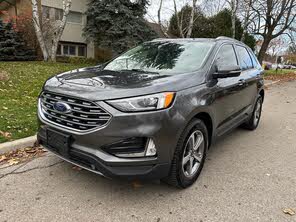
The 2020 Ford Edge, introduced initially in 2006, was based on the Ford Fusion sedan platform, offering a car-like ride and ample cabin space. By 2019, the Edge received a styling update, maintaining its angular headlights and trapezoidal grille, reminiscent of the Fusion. Despite these updates, the interior showed signs of aging, with awkwardly arranged controls and a mix of soft-touch materials and hard plastics. The Edge was available in SE, SEL, Titanium, and ST trims, each offering a range of features from heated seats to advanced infotainment systems.
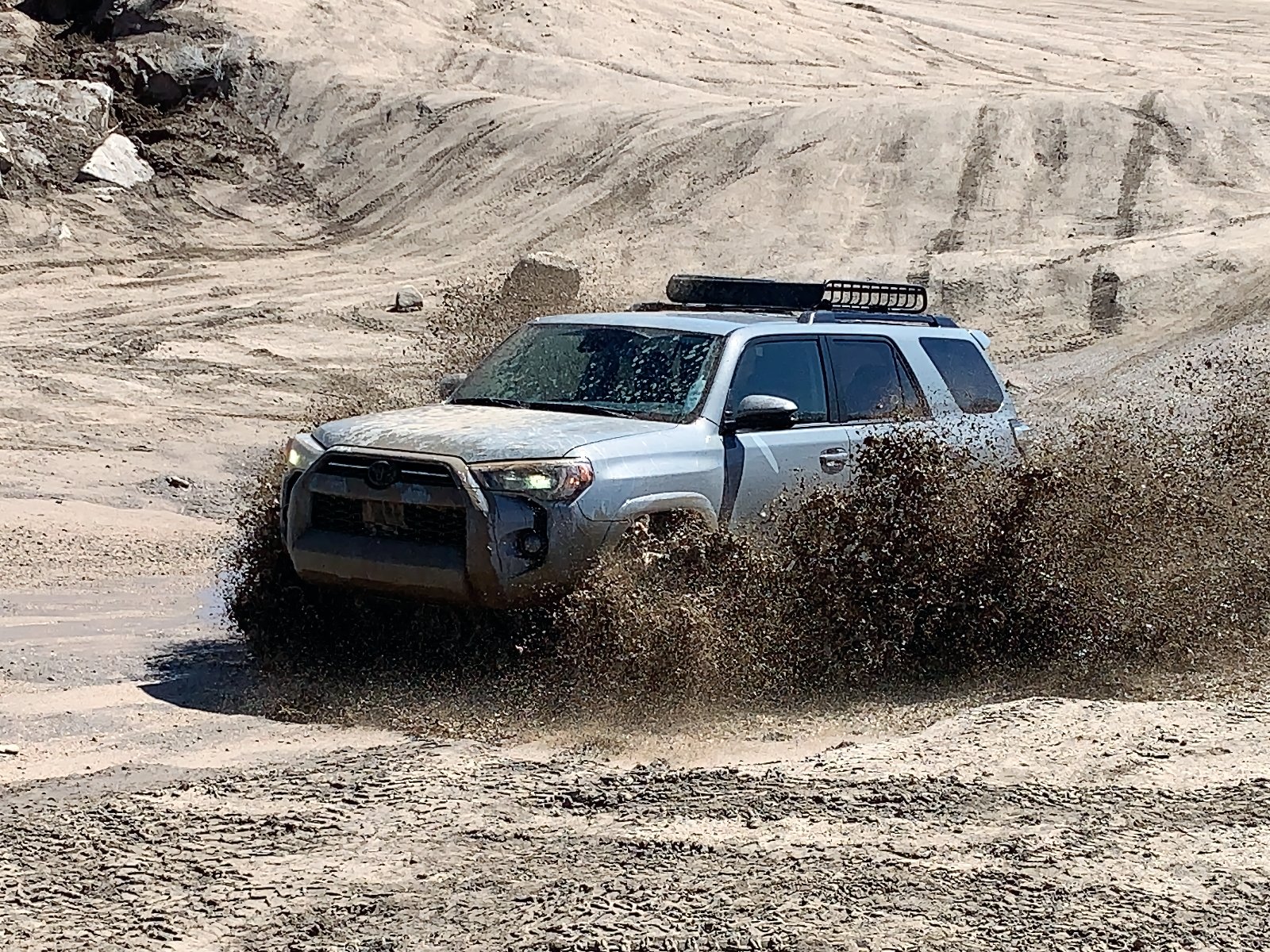
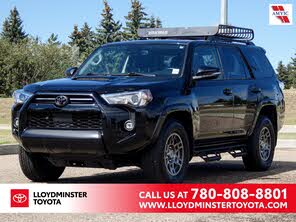
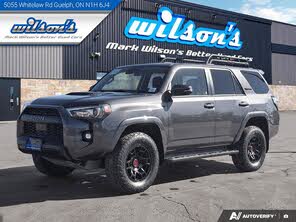
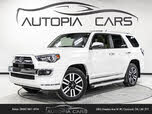
In contrast, the 2021 Toyota 4Runner, last redesigned over a decade ago, retained its rugged, utilitarian design. While not conventionally attractive, its two-box body and flared fenders exuded timeless styling and utility. The 4Runner's interior was characterized by hard plastics and a straightforward dashboard with large knobs and buttons. Despite its age, the 4Runner's design was appreciated for its durability and simplicity, appealing to those seeking a reliable, no-frills SUV.


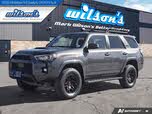
The 2020 Ford Edge came standard with a 2.0-litre turbocharged four-cylinder engine, producing 250 horsepower and 275 pound-feet of torque. This engine provided solid low-end acceleration, though it struggled at higher speeds. The Edge's suspension was designed to handle rough roads, offering a refined and engaging driving experience. The performance-oriented Edge ST featured a 2.7-litre twin-turbo EcoBoost V6, delivering 335 horsepower and 380 pound-feet of torque, with a sport mode enhancing throttle response and transmission mapping.
The 2021 Toyota 4Runner was equipped with a 4.0-litre V6 engine, generating 270 horsepower and 278 pound-feet of torque. Its five-speed automatic transmission powered the rear axle, with part-time 4WD available. The 4Runner excelled off-road, thanks to features like A-Trac, a locking rear differential, and Multi-Terrain Select. However, on pavement, it felt slow and clunky, with heavy steering and brakes. Its truck-like driving characteristics were part of its charm, though fuel efficiency was a concern, averaging 14.0 L/100 km during testing.
The 2020 Ford Edge offered a spacious cabin with a commanding view of the road. Its two-row seating provided ample head- and legroom, with 1,110 litres of cargo space behind the rear seats, expandable to 2,078 litres with the rear seats folded. The SEL and Titanium trims featured a hands-free power liftgate, enhancing convenience.
The 2021 Toyota 4Runner sat high off the ground, offering comfortable seating with good legroom and visibility. Its cargo space measured up to 1,337 litres behind the back seat and 2,540 litres with the rear seat folded. The 4Runner's back bumper served as a practical seating area, and its big roof rack provided additional storage for adventures.
The 2020 Ford Edge featured the SYNC 3 infotainment system with an 8-inch touchscreen, Apple CarPlay, and Android Auto. It included two smart-charging USB ports and a rearview camera, with a semi-digital instrument panel available on higher trims.
The 2021 Toyota 4Runner's entry-level Trail grade offered basic technology, including an 8-inch touchscreen with Bluetooth, Apple CarPlay, and Android Auto. It also featured a windshield wiper de-icer and a 120-volt AC power outlet. Higher trims added a dynamic navigation system and upgraded audio.
The 2020 Ford Edge came standard with a comprehensive suite of safety features, including Ford Co-Pilot360, which offered automatic emergency braking, lane departure warning, and blind-spot monitoring. It received a "Top Safety Pick" rating from the IIHS and a five-star overall safety rating from the NHTSA.
The 2021 Toyota 4Runner included Toyota Safety Sense P, with adaptive cruise control, forward-collision warning, and lane departure warning. However, it lacked blind-spot monitoring. The 4Runner received a three-star rollover resistance rating from the NHTSA and a "Good" roof crush strength rating from the IIHS, though its frontal-impact protection ratings were less favourable.
CarGurus highlights

According to CarGurus experts, the overall rating for the 2020 Ford Edge is 8.0 out of 10, while the 2021 Toyota 4Runner scores 6.2 out of 10. Based on these ratings, the Ford Edge is the recommended choice, offering a more modern and comfortable driving experience with superior safety features.
Choose the 2021 Toyota 4Runner if:
- You need a rugged, off-road-capable SUV with proven durability.
- You appreciate a simple, utilitarian design with practical features.
- You require ample cargo space and a versatile interior for outdoor adventures.



Choose the 2020 Ford Edge if:
- You prioritize a modern infotainment system with seamless smartphone integration.
- You seek a comfortable, spacious cabin with ample cargo space for road trips.
- You value advanced safety features and high safety ratings.



CarGurus highlights
According to CarGurus experts, the overall rating for the 2020 Ford Edge is 8.0 out of 10, while the 2021 Toyota 4Runner scores 6.2 out of 10. Based on these ratings, the Ford Edge is the recommended choice, offering a more modern and comfortable driving experience with superior safety features.
Choose the 2021 Toyota 4Runner if:
Shop Now- You need a rugged, off-road-capable SUV with proven durability.
- You appreciate a simple, utilitarian design with practical features.
- You require ample cargo space and a versatile interior for outdoor adventures.




Choose the 2020 Ford Edge if:
Shop Now- You prioritize a modern infotainment system with seamless smartphone integration.
- You seek a comfortable, spacious cabin with ample cargo space for road trips.
- You value advanced safety features and high safety ratings.


By: CarGurus + AI
At CarGurus, our team of experienced automotive writers remain at the heart of our content operation, conducting hands-on car tests and writing insightful guides that are backed by years of industry experience. To complement this, we are harnessing AI to make our content offering more diverse and more helpful to shoppers than ever. To achieve this, our AI systems are based exclusively on CarGurus content, ratings and data, so that what we produce is both unique to CarGurus, and uniquely helpful to car shoppers.