2020 Ford Edge Reviews, Pricing & Specs




Pros & cons
What we like
Standard advanced safety features
Easy-to-use technology
What to consider
Uninspired styling
Underwhelming base engine
Expert review
By 2020 the Ford Edge was showing signs of age in its design, but makes up for it with plenty of standard tech and safety features.
The Ford Edge isn’t exactly memorable, which isn’t a bad thing. It isn’t a good thing either. Cars can be remembered for attractive design, fun driving dynamics, or being a solid value. They can also be remembered in a negative light for a polarizing design, poor build quality, or being unsafe to the point of scandal. But the 2020 Ford Edge is just... there. It is a midsize two-row SUV that doesn’t offend, but also doesn’t “wow.” But just as critically, the Edge is getting long in the tooth. In the SUV segment, constant iteration is necessary for survival, and the Edge is in need of a redesign.
But in lieu of new blood, Ford has done well to keep the Edge fitted with the latest infotainment and safety technology. It also offers a performance variant, called the Edge ST. This is something that you won’t find in the Edge’s competitors, the Nissan Murano and Honda Passport. But is it enough to keep the Edge relevant against its more contemporary rivals? Read on to find out.
out of 10 expert review
Look & feel
The Ford Edge was first introduced in 2006 for the 2007 model year. At the time, automakers were still figuring out this whole crossover SUV thing. The Edge was and still is based on the same platform as the Ford Fusion sedan, which provides a car-like ride and plenty of cabin space.
The second generation of the Edge arrived for the 2015 model year and received a styling update for 2019. Ford was wise to keep the styling fresh, but it was just a few years too late. Rivals like Honda and Toyota completely redesign vehicles about every six years, with a mid-cycle refresh every three years. Ford is behind schedule and is about to get blown out of the water by the reintroduction of the near-luxury Toyota Venza crossover.
The 2019 styling update, which carries over to 2020, does give the Edge the impression of being a crossover version of the Fusion. It shares the angular headlights and large, trapezoidal grille of the sedan. Inside, the Edge shows signs of its age. The overall layout is the same as it’s been since 2015, with subtle changes from 2019. The centre console has small climate and radio controls, and the buttons are arranged very awkwardly. The rotary shifter is a contemporary design cue for Ford vehicles and does solve some space and packaging issues.
The cabin quality is pretty good. There are plenty of soft-touch materials used and fit-and-finish is solid. But these efforts are largely negated by the heavy use of hard plastics, including the plastic panels that make up the centre console and centre stack.
The Edge is available in SE, SEL, Titanium, and ST trims. The SE comes standard with SiriusXM satellite radio, a Wi-Fi hotspot, two USB ports, heated front seats and side mirrors, a heated steering wheel, 18-inch aluminum wheels, and remote, keyless entry. The SE also comes with Ford’s SYNC 3 infotainment system with Apple CarPlay, Android Auto, and Bluetooth. For 2020, Ford has added dual-zone climate control to the list of standard equipment. The Edge also comes standard with a comprehensive suite of driver assistance features under the Ford Co-Pilot360 banner.
The Edge SEL trim features LED fog lights, synthetic leather upholstery, and a power-adjustable front seats. The SEL also adds a nine-speaker premium audio system and an auto-dimming rearview mirror.
The Titanium trim provides 19-inch nickel-plated aluminum wheels, unique headlight design, and genuine leather upholstery. The Titanium also features a 10-way power-adjustable front passenger seat, driver’s seat memory presets, and a wall-style power outlet. Heated rear seats and ventilated front seats are also included.
The ST is the performance variant of the Edge. It has nearly all the same features as the Titanium but adds a bigger, more powerful, engine and sportier styling.
Performance
The 2020 Ford Edge comes standard with a 2.0-litre turbocharged four-cylinder engine. It makes power specs of 250 horsepower and 275 pound-feet of torque. Power is routed to the front wheels or available all-wheel drive through an eight-speed automatic transmission. This engine provides solid low-end acceleration that is great for getting around town. At higher speeds, it has a harder time finding power, but it is adequate for accelerating onto the highway.
The Edge is designed with weather-ravaged roads in mind. The suspension soaks up potholes with ease, yet it is not overly cushy. It smooths out road imperfections, but is refined and can be engaging to drive.
If you want more speed or are seeking an even more engaging driving experience, look to the sporty Ford Edge ST. This performance variant of the Edge is the only trim with the 2.7-litre twin-turbo EcoBoost V6 powertrain. It sends 335 horsepower and 380 pound-feet of torque through an eight-speed automatic to standard AWD.
Acceleration with the ST is almost an inverse of the rest of the lineup; it has a bit of turbo lag at low speeds, but once the revs get up, the ST has plenty of power on tap. The steering is heavy like you would expect in a performance car, and cornering is fantastic. The Edge ST handles like a car half its size. A Sport mode enhances the driving experience with the push of a button, livening up the throttle response and automatic-transmission mapping. It also alters the instrument panel to present critical performance information. An ST Performance Brake Package is available. It includes unique wheels, summer performance tires, and upgraded performance brakes.
Form & function
Aside from its driving characteristics, the Edge’s strongest suit is its cabin layout. You have a commanding view of the road without being overly upright. The seats are surrounded by plenty of cubbies and compartments, and everything is big and deep, designed for commuting or road trips.
Second-row head- and legroom are plentiful. There’s no need to move the front seats forward to make the rear seats comfortable. It may not offer a third row, but Ford made sure the two rows that are provided are spacious and comfortable.
The Edge provides 1,110 litres of cargo space behind the rear seats. By folding the 60/40 split-fold rear seats, that number grows to 2,078 litres. That is more total cargo space than a Jeep Grand Cherokee (1,028 litres), though slightly less than a Nissan Murano (1,121 litres) or a Honda Passport (1,430 litres). The SEL and Titanium trims come with a hands-free foot-activated power rear liftgate.
Technology
Ford provides an impressive level of standard technology in the Edge. Every trim comes standard with Ford’s SYNC 3 infotainment system. SYNC 3 includes an 8-inch touchscreen and is very easy to use. The screen has a row of icons at the bottom for audio, phone, navigation (where available), apps, and settings across the bottom of the screen. It also provides a helpful home button in the upper left-hand corner of the screen. This means you won’t get lost in menus, or have to press extra buttons to get from a setting screen back to the radio.
SYNC 3 also includes Apple CarPlay and Android Auto integration as standard features. This is great because you don’t need to pay extra for navigation if you don’t want to. Even on the base trim, you can simply use your preferred maps app on your mobile device.
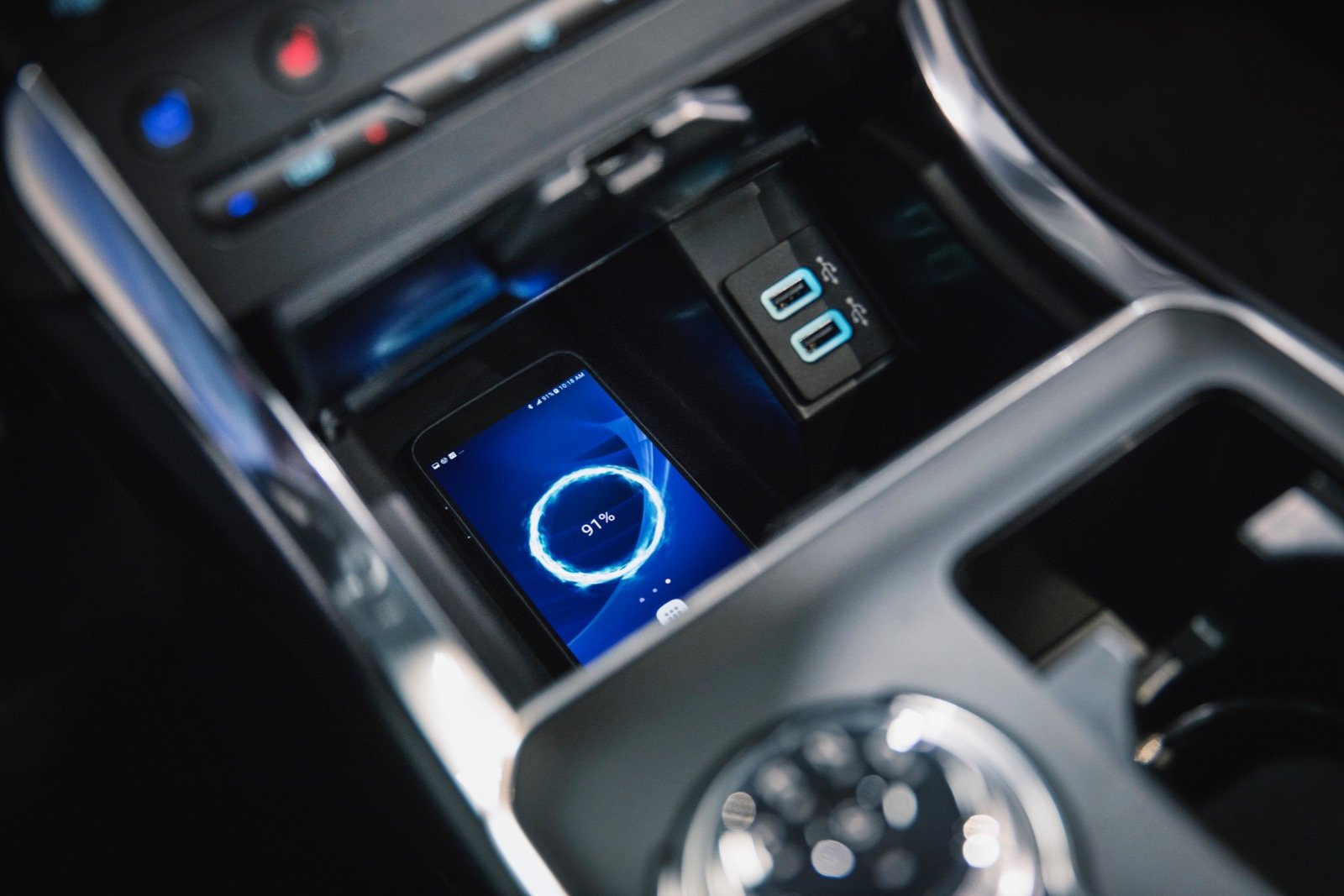
The Edge comes standard with two smart-charging USB ports and a rearview camera. A semi-digital instrument panel with dual screens is also available on the SEL and ST and is standard on the Titanium.
Safety
The Edge comes standard with a full array of front and side-impact airbags, as well as AdvanceTrac traction control with Roll Stability Control and Curve Control. It also comes standard with a tire pressure monitoring system and a child seat anchoring system.
In addition to these safety features, the Ford Co-Pilot360 safety system comes standard on every trim of the Edge. This suite of advanced driver assistance systems includes automatic emergency braking with pedestrian detection, forward collision warning, lane departure warning, automatic high beams, and blind-spot monitoring with rear cross-traffic alert.
Moving up to the SEL trim allows buyers the option to select the upgraded Co-Pilot360 Assist+ package. This enhances CoPilot360 by adding adaptive cruise control that can stop-and-go with traffic. It also adds active lane centring, which keeps the Edge from veering out of the lane. Together, these features give the Edge some basic form of semi-autonomous driving while on the highway.
The 2020 Ford Edge received a "Top Safety Pick" rating from the Insurance Institute for Highway Safety (IIHS). It got the highest "good" score in all IIHS crash tests, but received "average" and "poor" (depending on trim level) headlight ratings. The Edge also received a five-star overall safety rating from the National Highway Traffic Safety Administration (NHTSA), with five stars in frontal and side crash tests, and four stars in rollover crash tests.
Cost-effectiveness
The most fuel-efficient version of the Edge is the 2.0-litre four-cylinder engine with front-wheel drive (FWD). It returns Natural Resources Canada-estimated fuel consumption of 11.2 litres per 100 kilometres in the city, 8.1 on the highway, and 9.8 combined. This engine paired with AWD returns 11.4 L/100 km city, 8.3 highway, and 10.0 combined. The Edge ST returns 12.5 L/100 km city, 9.2 hwy, and 11.0 combined with its V6 engine.
Base MSRP for the 2020 Ford Edge SE is $36,299 with AWD. The SEL trim starts at $38,299 with FWD and $40,299 with AWD, while the Ford Edge Titanium starts at $43,699 with standard AWD. A range-topping ST model starts at $49,399. Destination charges cost $1,950 extra. The Nissan Murano and Honda Passport have nearly identical starting prices, and the Jeep Grand Cherokee costs just a hair more. CarGurus recommends checking out the Ford Edge SEL, as it offers the right amount of content for the right price.
The Ford Edge gets outpaced by many other midsize SUVs. The Grand Cherokee is more capable, the Passport is more versatile, and the Murano is more upscale and comfortable. But the Ford Edge plays the “jack-of-all-trades” card well. It doesn’t beat any of these rivals in any one phase, but the combination of attributes makes the Edge a versatile, well-equipped SUV.
Note: Images show a US model.

What owners say
"Overall, Ford Edge owners are quite pleased with their vehicles, appreciating the comfort, spaciousness, and modern features. Many drivers highlighted the solid build quality and the roomy interior, making it great for tall individuals and families. However, some owners expressed concerns over technical issues, particularly with the transmission and certain tech features that didn’t default to their preference. Overall, the 2020 Edge is viewed as a top choice in its class, even when compared to luxury brands."
I was impressed with the features of the Ford Edge SE (i.e. backup camera, lane assist, multiple airbags, roominess, etc.) I was also impressed with the comfort of the seats and the comfort of the ride on rougher paved roads. Compared to my 2019 Ford Escape Titanium, I have only found two negatives: 1. Remote start is not on the keyfob but only available through the phone app 2. Manual liftgate instead of the power liftgate
March 2, 2026This car has all the bells and whistles. Lane assist, auto headlights and whipers, wireless charging pad, number pad entry so you can leave your car running but locked, hands free lift gate sun and moon roof. The list goes on.
June 29, 2025It is the best vehicle in its class for the money. I would compare this to an Audi SQ5, Mercedes AMG GL class, Mazda CX-5, Chevrolet Blazer, Genesis GV70 and many others.
December 23, 2023What owners say
I was impressed with the features of the Ford Edge SE (i.e. backup camera, lane assist, multiple airbags, roominess, etc.) I was also impressed with the comfort of the seats and the comfort of the ride on rougher paved roads. Compared to my 2019 Ford Escape Titanium, I have only found two negatives: 1. Remote start is not on the keyfob but only available through the phone app 2. Manual liftgate instead of the power liftgate
March 2, 2026This car has all the bells and whistles. Lane assist, auto headlights and whipers, wireless charging pad, number pad entry so you can leave your car running but locked, hands free lift gate sun and moon roof. The list goes on.
June 29, 2025It is the best vehicle in its class for the money. I would compare this to an Audi SQ5, Mercedes AMG GL class, Mazda CX-5, Chevrolet Blazer, Genesis GV70 and many others.
December 23, 2023Felt like we were driving a solid quality built vehicle
September 17, 2020I love my Ford Edge Titanium. It has all the options and enough room in the back for my dog. Great driving vehicle. Very comfortable. I Love the cooling seats.
August 8, 2023Inside the cabin, the 2020 Edge offers a comfortable and spacious environment. The seats provide good support for long journeys, and the overall build quality is solid. The available upscale features and materials add a touch of luxury, further enhancing the driving experience. The intuitive infotainment system is user-friendly and offers modern connectivity options, keeping occupants connected and entertained on the go.
July 7, 2023Excellent vehicle and the 2020 in particular is the best year, even better than 21 through 23.
May 22, 2023The Ford Edge ST is a fantastic vehicle with lots of power, great room for stretching out and has all of the amenities you could want.
May 13, 2024First car. Highly recommended. Sits tall for an AWD and is comfortable. Nice quiet ride.
January 31, 2023The 2020 Edge Titanium had all the features I wanted plus others that I was glad to have.
October 20, 2021Trims & specs
Base MSRP $43,265 | Seating 5 |
Engine 2.7L 335 hp V6 | Cargo Capacity 39.2 cu ft |
Combined MPG 22 | Drivetrain AWD |
Base MSRP $34,355 | Seating 5 |
Engine 2.0L 250 hp I4 | Cargo Capacity 39.2 cu ft |
Combined MPG 25 | Drivetrain FWD |
Base MSRP $38,100 | Seating 5 |
Engine 2.0L 250 hp I4 | Cargo Capacity 39.2 cu ft |
Combined MPG 25 | Drivetrain FWD |
Base MSRP $40,095 | Seating 5 |
Engine 2.0L 250 hp I4 | Cargo Capacity 39.2 cu ft |
Combined MPG 24 | Drivetrain AWD |
Base MSRP $33,095 | Seating 5 |
Engine 2.0L 250 hp I4 | Cargo Capacity 39.2 cu ft |
Combined MPG 24 | Drivetrain AWD |
Base MSRP $38,100 | Seating 5 |
Engine 2.0L 250 hp I4 | Cargo Capacity 39.2 cu ft |
Combined MPG 25 | Drivetrain FWD |
Base MSRP $40,095 | Seating 5 |
Engine 2.0L 250 hp I4 | Cargo Capacity 39.2 cu ft |
Combined MPG 24 | Drivetrain AWD |
Base MSRP $36,350 | Seating 5 |
Engine 2.0L 250 hp I4 | Cargo Capacity 39.2 cu ft |
Combined MPG 24 | Drivetrain AWD |
Base MSRP $31,100 | Seating 5 |
Engine 2.0L 250 hp I4 | Cargo Capacity 39.2 cu ft |
Combined MPG 25 | Drivetrain FWD |


Pricing trends
MSRP range
$31,100 - $43,265
Current avg. market price
$19,748
Trending down by 2.2% this month
May 2026 - October 2026

