2021 Toyota 4Runner Reviews, Pricing & Specs


Expert review
The 2021 Toyota 4Runner isn't for everybody. But for its intended buyer, it's just about perfect.
Despite its design age, poor fuel efficiency, rough ride, iffy handling, and marginal safety ratings, the current-generation Toyota 4Runner remains a popular choice in a midsize SUV. Why? Its reputation for reliability and resale value, coupled with its undeniable utility, rugged image, and go-anywhere and do-anything capability, are the selling points. And if that's why you want a 2021 Toyota 4Runner, it won't disappoint you as long as you accept its shortcomings.
out of 10 expert review
Look & feel
Toyota last redesigned the 4Runner 12 years ago. Sure, over that period, the automaker has updated but, you could still buy a used one right now and wind up with pretty much the same thing as a new one, perhaps without some of the latest infotainment and safety technologies.
Attractive isn't the right word for the 4Runner. Somewhere along the way, most versions adopted a gape-mouthed and angry visage; the chrome-festooned 4Runner Limited the notable exception. Nevertheless, the overall design has aged remarkably well, the two-box body with flared fenders and trapezoidal wheel arches broadcasting balanced proportions, timeless styling, and undeniable utility. The 4Runner is like a good tool, and good tools don't require frequent redesigns.
For the 2021 model year, Toyota offers the 4Runner in Trail and SR5 trim levels with the latter being available with TRD Off Road, Limited, Venture, Nightshade, and TRD Pro packages in Canada. Pricing ranges from an MSRP of $46,200 before destination charges for a 4Runner Trail with standard part-time four-wheel drive (4WD) to $62,430 for the Toyota 4Runner SR5 with the TRD Pro package.
The Trail model features black cloth upholstery with a power-adjustable driver’s seat but no heated front seats, and all-season floor mats. Hard plastic is the rule rather than the exception when it comes to the 4Runner's interior. But this material is entirely in keeping with the SUV's mission and is easy to clean up. The dashboard is old-school, with big knobs, big buttons, and manual air conditioning that you must adjust for yourself.
These qualities are, in part, what endears a 4Runner to its owner. This SUV represents a simple, durable good on four wheels, something you can buy today and still drive decades from now.
Provided there are still gasoline stations, of course.
Performance
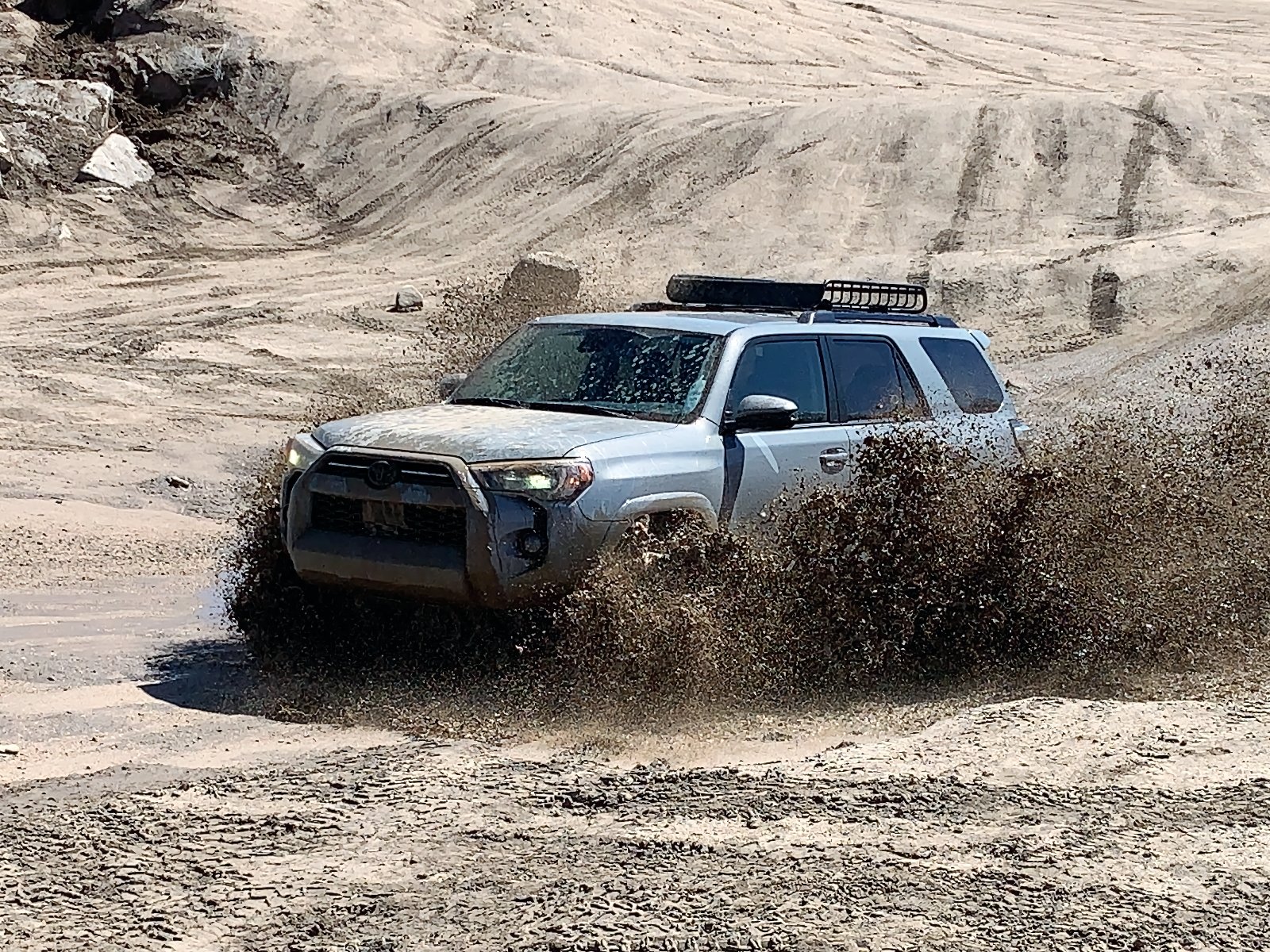
We took the 4Runner off-roading following several storms that dumped rain. It was here that we discovered the benefits of A-Trac, which is the 4Runner's standard off-road traction control system.
A set of gnarly moguls stopped the 4Runner dead in its tracks, rocking on two wheels, the ones in the air spinning. After pushing the A-Trac button, this technology braked the spinning wheels, allowing the ones in contact with the ground to get some power and move the 4Runner forward.
Otherwise, the 4Runner tackled mud, hills, and ruts with the vehicular equivalent of a shrug. And if you add the TRD Off-Road, Venture, or TRD Pro packages, you'll get a locking rear differential, Multi-Terrain Select, and Crawl Control—each of which is designed to get the 4Runner deep into the backcountry and back out again.
Every 4Runner has a 4.0-litre V6 engine making 270 horsepower at 5,600 rpm and 278 pound-feet of torque at 4,400 rpm. A five-speed automatic transmission powers the rear axle in rear-wheel drive unless you shift the part-time 4WD drivetrain into 4-Hi or 4-Lo. The maximum towing capacity is 2,268 kilograms (5,000 pounds).
Driven where most people are likely to use a 4Runner most of the time, this SUV feels slow, heavy, and clunky. Those descriptors apply to the on-pavement ride and handling and how the steering and the brakes work. When parking, you'll get an arm workout. And when traveling in stop-and-go traffic, you're likely to have a tough time ensuring smooth braking.
Partially, these characteristics are because of the 4Runner's age. But mainly, it's because this is an authentic SUV with body-on-frame construction, not one of those bloated station wagons (crossovers) wearing an SUV Halloween costume.
In the dirt, the 4Runner is fantastic. In the suburbs, not so much. But its truck-like driving characteristics are a part of its undeniable charm. Whether or not you can live with them daily is another matter entirely, a decision only you can make.
Oh, and you'd better be ready to stop at the gas station frequently. Natural Resources Canada says this SUV will use 13.8 litres per 100 kilometres in combined driving (12.5 L/100 km hwy). We averaged 14.0 L/100 km during our week with the 4Runner, including the off-roading excursion. So, with its 87-litre fuel tank, the average range is about 620 kilometres.
Form & function
The 2021 Toyota 4Runner sits high off the ground, which isn't a problem if you have long legs. Shorter-limbed members of the human race may have some trouble climbing aboard, especially if you haven't opted for the available running boards.
Once everybody is in, they'll find the 4Runner remarkably comfortable. Both the front and rear seats offer proper support, and the back seat has a generous amount of legroom, good visibility out, air conditioning vents, and USB charging ports. Open the moonroof, power down all four windows, lower the rear tailgate glass, and a 4Runner supplies much of the same open-air feeling as a Jeep Wrangler. A third-row seat is available for the 4Runner, but our test vehicle did not have it. Notably, the 4Runner's back bumper serves as a perfect place to sit when changing into a wetsuit, out of muddy boots, or for just watching the sunset.
Depending on configuration and equipment, cargo space measures up to 1,337 litres behind the back seat and 2,540 litres with the rear seat folded down. That, combined with the big roof rack, should be plenty of room for any adventure. Interior storage is decent, too.
Technology
Due to its position low on the 4Runner trim ladder, the entry-level Trail grade does not come with much in the way of technology.
If you live where cold winters are typical, the windshield wiper de-icer system is something to smile about. The 120-volt 100W/400W AC power outlet in the cargo area is worth noting, too. But otherwise, this version of the 4Runner is old-school.
Toyota equips the 4Runner with a standard 8-inch touchscreen infotainment system. It's fully featured, including Bluetooth, Apple CarPlay, Android Auto, and SiriusXM satellite radio with a three-month All Access trial subscription, and five USB ports. Additionally, it comes with a year of free Safety Connect subscription services.
Several packages upgrade the audio system, which also upgrades the infotainment to add a dynamic navigation system. It also adds a one-year subscription to Destination Assist concierge services.
It might not look sophisticated, but the software powering the infotainment system sure is. The navigation map included some off-road trails. Physical shortcut buttons and volume and tuning knobs make using the system easy, and Toyota sizes and spaces them so that you can operate them while wearing gloves. The 8-inch screen might be on the small side, but the functionality here more than makes up for it.
Safety
Toyota Safety Sense P (TSS-P) is not the most sophisticated of the automaker's advanced driving assistance system packages, but it includes the basics. And it has pedestrian detection, which is what that "P" is all about.
Standard TSS-P equipment includes adaptive cruise control, but it doesn't bring the 4Runner to a stop, so you've still got to handle that task. It also has forward-collision warning, automatic forward emergency braking, lane departure warning, and automatic high-beam headlights. Notice that a blind-spot warning system with rear cross-traffic warning is not on this list. You can't get those features on a 4Runner.
That's unfortunate, especially considering that blind-spot monitoring is so effective at notifying drivers when it is unsafe to change lanes. Swerve too hard in a 4Runner to avoid colliding with a vehicle in the lane next to you, and you might get a chance to see if the three-star rollover resistance rating from the National Highway Traffic Safety Administration (NHTSA) is valid. Know, however, that the Insurance Institute for Highway Safety (IIHS) gives the 4Runner's roof crush strength its top rating of "Good," so there's that.
Unfortunately, the IIHS also says the 4Runner's protection for the driver in a small overlap frontal-impact collision is Marginal. And the NHTSA gives the SUV's front passenger protection a three-star rating in a frontal-impact crash.
More than anything, these latter two ratings likely reflect the SUV's age. Modern designs often use ultra-high-strength steel and specific engineering principles to channel crash energy away from the occupant compartment more effectively. When Toyota started crafting the current 4Runner more than 15 years ago, the approach to safety wasn't quite as advanced.
Cost-effectiveness
Toyota has long since paid for its investment in the current 4Runner, which keeps the SUV's prices relatively low. Even though it is roomier inside, is more capable off-road, and has more personality than any family-sized crossover, it's not more expensive.
Few competitors exist for the 4Runner. The obvious one is the Jeep Wrangler, which delivers an even rawer driving experience. The Ford Bronco is new (and not yet on sale) and appears to promise the open-air freedom of the Jeep combined with more refinement and technology than the 4Runner. We'll see. And it will be a long time before Ford is offering discounts on any Broncos.
If nothing else, you can depend on a 4Runner's dependability. This SUV seems to be indestructible, even when you spend a good amount of time beating on it. You could, theoretically, buy one today and, regardless of your current age, make it the last vehicle you ever own. There is real long-term value in that. Just realize that you're going to spend a ton of money on gas to keep a 4Runner rolling down the road.
Note: Images show a US model.

What owners say
"Overall, owners of the 2021 Toyota 4Runner are very pleased with their purchase, highlighting its rugged durability and excellent features. They particularly enjoy the spacious interior, off-road capabilities, and various convenient technologies like adaptive cruise control and Apple CarPlay. However, many drivers feel the gas mileage could be better, and some miss features like park assist or memory seating options. The 4Runner is seen as a solid investment for families and off-road enthusiasts alike."
I think that it is a good vehicle, but way overpriced.
April 30, 2026Absolutely LOVE the 4Runner TRD Pro. It is pretty, has great features and drives well. I think that Toyota’s last a longtime and I have always been happy with them.
November 26, 2023I couldn’t be happier with my purchase. The 4Runner is beautiful inside & out. Hardly any road noise, it has so much room and I love the remote start. It’s everything I’ve wanted and I’ll definitely feel safer on the road with my newborn.
September 21, 2023What owners say
I think that it is a good vehicle, but way overpriced.
April 30, 2026Absolutely LOVE the 4Runner TRD Pro. It is pretty, has great features and drives well. I think that Toyota’s last a longtime and I have always been happy with them.
November 26, 2023I couldn’t be happier with my purchase. The 4Runner is beautiful inside & out. Hardly any road noise, it has so much room and I love the remote start. It’s everything I’ve wanted and I’ll definitely feel safer on the road with my newborn.
September 21, 2023Love this car! Has everything I was looking for, sits off the ground, truck like feel with the security and toughness of a dependable ride. I would highly recommend.
May 13, 2022This car is amazing! I love the strong build and look of the car. The model has a very sporty frame and is a showstopper. It drives extremely well especially on the trails in the mountains. The nautical blue color is very attractive, a real eye catcher. The interior is spacious with beautiful leather seats and anti spill rugs. The value of this car is very high.
July 26, 2022Best SUV on the market by far!! Don’t bother wasting your money on anything else, especially if you’re an off-road enthusiast.
April 18, 2021Features are good, really like the adaptive cruise control and apple car play and heated seats. Great value for the money, I don’t think you can go wrong with a Toyota, the only thing that’s missing for me personally is a heated steering wheel . The wisest man I’ve ever known was my father, and he only drove Toyota’s , I guess this apple didn’t fall far from the tree.
February 25, 2021A classic top of the line quality vehicle for the price. The TRD is a fun version but I think the Luxury of the Limited is unmatched and can still be customized if you want. Love the automatic back window!
September 10, 2024Great car and had everything we wanted. Leather seats, sunroof, 4x4, 3rd row seating, etc. The all black murdered out look was a bonus win!
March 6, 2023Amazing car as long as you are not expecting great gas mileage, and if you don’t expect it to drive like a crossover vehicle. These vehicles have pure truck DNA in them, and drive like it. I was surprised by how smooth it was with the KDSS system though! I expect tremendous reliability and longevity from this vehicle.
July 3, 2021Trims & specs
Base MSRP $43,325 | Seating 5 |
Engine 4.0L 270 hp V6 | Cargo Capacity 47.2 cu ft |
Combined MPG 17 | Drivetrain 4X4 |
Base MSRP $47,705 | Seating 7 |
Engine 4.0L 270 hp V6 | Cargo Capacity 47.2 cu ft |
Combined MPG 17 | Drivetrain AWD |
Base MSRP $50,745 | Seating 5 |
Engine 4.0L 270 hp V6 | Cargo Capacity 47.2 cu ft |
Combined MPG 17 | Drivetrain 4X4 |
Base MSRP $39,825 | Seating 7 |
Engine 4.0L 270 hp V6 | Cargo Capacity 47.2 cu ft |
Combined MPG 17 | Drivetrain 4X2 |
Base MSRP $40,730 | Seating 5 |
Engine 4.0L 270 hp V6 | Cargo Capacity 47.2 cu ft |
Combined MPG 17 | Drivetrain 4X4 |
Base MSRP $36,765 | Seating 7 |
Engine 4.0L 270 hp V6 | Cargo Capacity 47.2 cu ft |
Combined MPG 17 | Drivetrain 4X2 |
Base MSRP $41,700 | Seating 7 |
Engine 4.0L 270 hp V6 | Cargo Capacity 47.2 cu ft |
Combined MPG 17 | Drivetrain 4X4 |
Base MSRP $47,085 | Seating 7 |
Engine 4.0L 270 hp V6 | Cargo Capacity 47.2 cu ft |
Combined MPG 17 | Drivetrain 4X2 |
Base MSRP $38,640 | Seating 7 |
Engine 4.0L 270 hp V6 | Cargo Capacity 47.2 cu ft |
Combined MPG 17 | Drivetrain 4X4 |
Base MSRP $45,670 | Seating 7 |
Engine 4.0L 270 hp V6 | Cargo Capacity 47.2 cu ft |
Combined MPG 17 | Drivetrain 4X2 |
Base MSRP $40,615 | Seating 5 |
Engine 4.0L 270 hp V6 | Cargo Capacity 46.3 cu ft |
Combined MPG 17 | Drivetrain 4X4 |
Base MSRP $49,120 | Seating 7 |
Engine 4.0L 270 hp V6 | Cargo Capacity 47.2 cu ft |
Combined MPG 17 | Drivetrain AWD |
Base MSRP $38,740 | Seating 5 |
Engine 4.0L 270 hp V6 | Cargo Capacity 46.3 cu ft |
Combined MPG 17 | Drivetrain 4X2 |
Base MSRP $44,895 | Seating 5 |
Engine 4.0L 270 hp V6 | Cargo Capacity 47.2 cu ft |
Combined MPG 17 | Drivetrain 4X4 |


Pricing trends
MSRP range
$36,765 - $50,745
Current avg. market price
$47,364
Trending up by 1.2% this month
May 2026 - October 2026

