Ford Escape vs Chevrolet Bolt
Overview | |
Years produced2001-Present | Years produced2027 |
Listings2514 | Listings781 |
Ratings & Reviews | |
User Reviews | User Reviews |
Expert reviews6.2 out of 10 | Expert reviews6.3 out of 10 |
Pros
Cons
| Pros
Cons
|
Reviews SummaryReportedly, Ford will discontinue the Escape at the end of the current fourth-generation run. Once among the most popular vehicles in its class, Ford recently zigged with the Escape’s design and positioning when the market zagged. Boxy, rugged-looking crossovers are what people want, not soft and sophisticated pseudo-cars like the current Escape. Fortunately, Ford has the Bronco Sport in its lineup, which is getting all of the automaker’s attention. Meanwhile, the 2024 Ford Escape receives no major changes following a substantial makeover in 2023, though it appears the Base trim is canceled. | |
Reviews SummaryWith more range, more power, and improved technology, the Chevrolet Bolt EV returns after a three-year hiatus. It’s also one of the most affordable EVs in Canada, but it’s due to remain in production only until mid-2027. Verdict: The 2027 Chevrolet Bolt EV is an excellent choice for shoppers seeking an electric vehicle that won't break the bank. It may not be all that fancy or refined, but it gets the basics right when it comes to range and capabilities. | |
No video found | No video found |
Popular Features & Specs | |
Engine1.5L 180 hp I3 | Engine |
DrivetrainFWD | Drivetrain |
Seating Capacity5 | Seating Capacity5 |
Horsepower180 hp @ 6000 rpm | Horsepower |
EV Battery Capacity | EV Battery Capacity65 kWh |
Fuel Economy (City)8.7 L(e)/100 km | Fuel Economy (City) |
Fuel Economy (Highway)6.9 L(e)/100 km | Fuel Economy (Highway) |
Battery Charge Time (120V) | Battery Charge Time (120V)64 hours |
Battery Charge Time (240V) | Battery Charge Time (240V)9.8 hours |
Engine | |
Engine Name1.5L 180 hp I3 | Engine Name210 hp Electric |
Torque199 lb-ft @ 3000 rpm | Torque |
Horsepower180 hp @ 6000 rpm | Horsepower |
Battery Charge Time (120V) | Battery Charge Time (120V)64 hours |
Battery Charge Time (240V) | Battery Charge Time (240V)9.8 hours |
DrivetrainFWD | DrivetrainFWD |
Fuel Economy | |
EV Battery Capacity | EV Battery Capacity65 kWh |
Fuel Economy (City)8.7 L(e)/100 km | Fuel Economy (City) |
Fuel Economy (Highway)6.9 L(e)/100 km | Fuel Economy (Highway) |
Interior | |
Seating Capacity5 | Seating Capacity5 |
Key Features | |
Navigation System | Navigation SystemStandard |
Safety | |
Front Crash Overall5 | Front Crash Overall |
Side Crash Overall5 | Side Crash Overall |
Dimensions & Capacity | |
Cargo Space1062 L | Cargo Space459 L |
Curb Weight1493 kg | Curb Weight1713 kg |
Height1676 mm | Height1623 mm |
Length4575 mm | Length4308 mm |
Width2174 mm | Width2035 mm |
Wheelbase2710 mm | Wheelbase2675 mm |
Maximum Payload | Maximum Payload396 kg |
Number of doors4 | Number of doors4 |
Maximum Towing Capacity907 kg | Maximum Towing Capacity |
Overview | ||
Years produced | 2001-Present | 2027 |
Listings | ||
Ratings & Reviews | ||
User reviews | ||
Expert reviews | 6.2 out of 10Read full review | 6.3 out of 10Read full review |
Pros & cons | Pros
Cons
| Pros
Cons
|
Summary | Reportedly, Ford will discontinue the Escape at the end of the current fourth-generation run. Once among the most popular vehicles in its class, Ford recently zigged with the Escape’s design and positioning when the market zagged. Boxy, rugged-looking crossovers are what people want, not soft and sophisticated pseudo-cars like the current Escape. Fortunately, Ford has the Bronco Sport in its lineup, which is getting all of the automaker’s attention. Meanwhile, the 2024 Ford Escape receives no major changes following a substantial makeover in 2023, though it appears the Base trim is canceled. | With more range, more power, and improved technology, the Chevrolet Bolt EV returns after a three-year hiatus. It’s also one of the most affordable EVs in Canada, but it’s due to remain in production only until mid-2027. Verdict: The 2027 Chevrolet Bolt EV is an excellent choice for shoppers seeking an electric vehicle that won't break the bank. It may not be all that fancy or refined, but it gets the basics right when it comes to range and capabilities. |
Video | No video found | No video found |
Popular Features & Specs | ||
Engine | 1.5L 180 hp I3 | |
Drivetrain | FWD | |
Seating Capacity | 5 | 5 |
Horsepower | 180 hp @ 6000 rpm | |
EV Battery Capacity | 65 kWh | |
Fuel Economy (City) | 8.7 L(e)/100 km | |
Fuel Economy (Highway) | 6.9 L(e)/100 km | |
Battery Charge Time (120V) | 64 hours | |
Battery Charge Time (240V) | 9.8 hours | |
Engine | ||
Engine Name | 1.5L 180 hp I3 | 210 hp Electric |
Torque | 199 lb-ft @ 3000 rpm | |
Horsepower | 180 hp @ 6000 rpm | |
Battery Charge Time (120V) | 64 hours | |
Battery Charge Time (240V) | 9.8 hours | |
Drivetrain | FWD | FWD |
Fuel Economy | ||
EV Battery Capacity | 65 kWh | |
Fuel Economy (City) | 8.7 L(e)/100 km | |
Fuel Economy (Highway) | 6.9 L(e)/100 km | |
Interior | ||
Seating Capacity | 5 | 5 |
Key Features | ||
Navigation System | Standard | |
Safety | ||
Front Crash Overall | 5 | |
Side Crash Overall | 5 | |
Dimensions & Capacity | ||
Cargo Space | 1062 L | 459 L |
Curb Weight | 1493 kg | 1713 kg |
Height | 1676 mm | 1623 mm |
Length | 4575 mm | 4308 mm |
Width | 2174 mm | 2035 mm |
Wheelbase | 2710 mm | 2675 mm |
Maximum Payload | 396 kg | |
Number of doors | 4 | 4 |
Maximum Towing Capacity | 907 kg | |
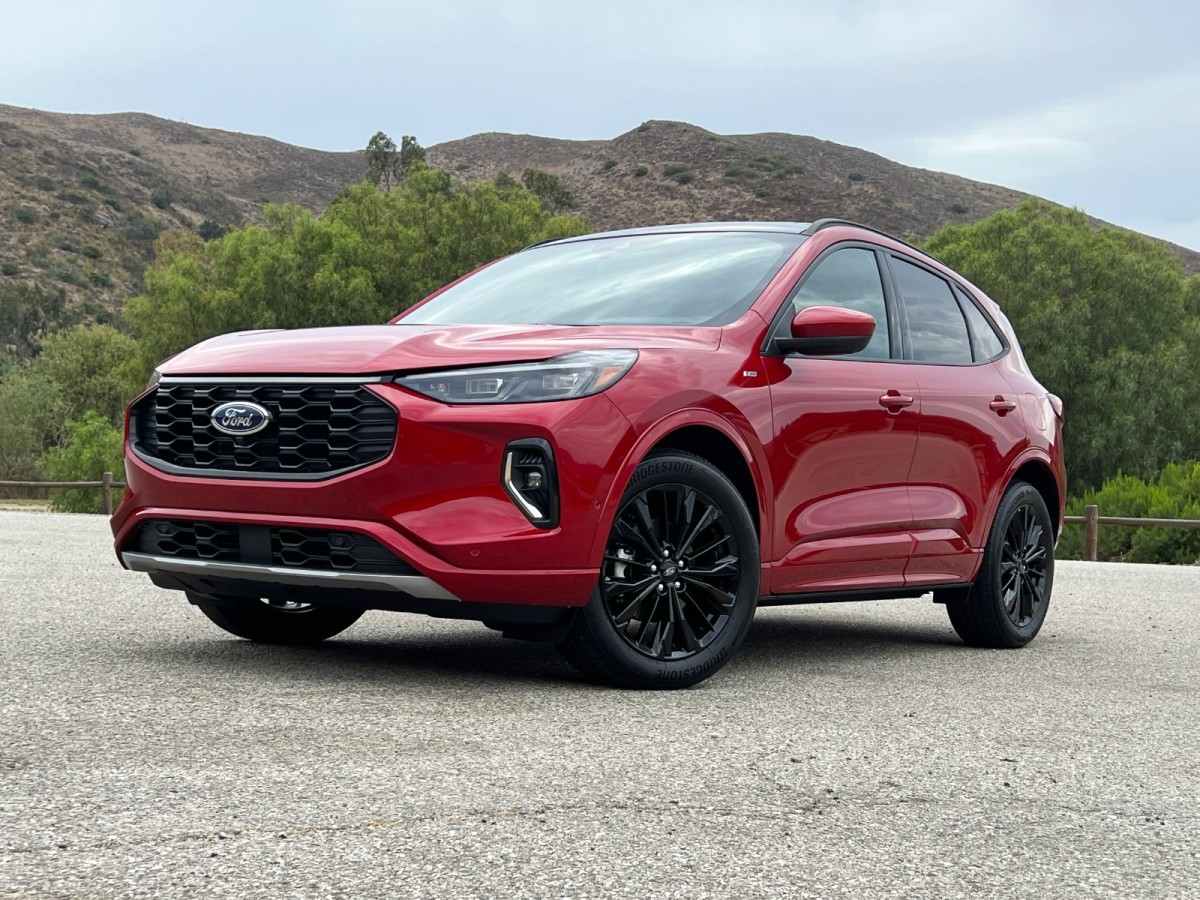
The 2024 Ford Escape received a significant facelift, with Ford aiming to rejuvenate its appeal. The front end was restyled to present a more aggressive look, replacing the previous model's wide-eyed, toothless smile. Despite these changes, the rest of the SUV maintained a soft and generically appealing appearance. The updates included new wheel designs, a revamped trim lineup, and enhanced technology with next-generation infotainment and safety features. In Canada, the 2024 Escape was available in several trims, including Active, ST-Line, ST-Line Select, Platinum, ST-Line Elite, and Plug-in Hybrid, with prices ranging from $33,049 to $46,999, excluding additional fees. The ST-Line Elite trim, which we tested, featured extra-cost Rapid Red paint, black 19-inch wheels, and a Panoramic Vista Roof, bringing the total price to $49,924. The interior, while initially appearing upscale with diamond-stitched, perforated leather, revealed excessively glossy surfaces and stiff upholstery, raising questions about its value.
The 2027 Chevrolet Bolt returned with a familiar look, with slight styling changes that made the front end resemble a conventional gas-powered car more than an EV. The 2027 model continued from where the 2023 version left off, offering only the EUV body style, which straddled the line between a large hatchback and a subcompact SUV. The Bolt's tall and narrow stance prioritized utility and interior space over a sporty appearance. The RS model added gloss black exterior trim for a touch of flair. Inside, the Bolt underwent a more dramatic makeover, featuring a larger digital instrument panel and infotainment touchscreen. The push-button gear selector was moved to the steering column, freeing up storage space in the centre console. While the cabin was dominated by hard plastic surfaces, the elbow touch points had thin padding. The RS trim upgraded to Evotex synthetic leather with red stitching, but the rear seating area lacked padding for the door armrests.
The 2024 Ford Escape ST-Line Elite offered two powertrain options: a 192-horsepower hybrid expected to achieve 6.0 litres per 100 kilometres in combined driving, and a turbocharged 2.0-litre four-cylinder engine producing 250 horsepower and 280 pound-feet of torque. The latter averaged 8.4 L/100 km with AWD and 8.0 L/100 km with FWD. Our test vehicle featured the turbo engine paired with an eight-speed automatic transmission and AWD, standard in Canada from ST-Line Select and up. The AWD system included a driveline disconnect feature to improve fuel economy, and drivers could choose between Eco, Normal, Sport, and Slippery driving modes. The turbocharged engine provided quick acceleration, but the driving dynamics didn't match the sporty appearance. The ride was soft and compliant, with nimble handling in typical driving situations, but the suspension allowed too much body motion. The brake pedal was responsive, but the steering felt sluggish and numb. The turbo engine seemed wasted in this application, and the hybrid powertrain was recommended for better fuel economy.
The 2027 Chevrolet Bolt featured a new 65-kilowatt-hour lithium-iron phosphate battery pack, reducing costs and requiring fewer rare earth minerals. A new motor from Chevy's Equinox EV delivered 210 horsepower and 169 pound-feet of torque to the front wheels, with a 0-100 km/h time similar to the previous Bolt EV, usually in the low seven-second range. While this acceleration might seem slow by EV standards, it was quick compared to gas-powered subcompact SUVs. One-pedal driving was available, with medium or high levels of brake regeneration. The ride was firm but not overly stiff, and road noise was more noticeable due to the absence of an internal combustion engine. The Bolt's low centre of gravity, thanks to the heavy battery in the floor, contributed to its agility on curvy roads. On a full charge, the 2027 Bolt offered up to 422 kilometres of range, an improvement over previous models. The Bolt also featured a Tesla-derived North American Charging Standard (NACS) charge port, with adapters available for CCS and J1772 connectors, and increased charging speed from 55 kilowatts to 150 kW.
The 2024 Ford Escape ST-Line offered a black interior with cloth inserts and artificial leather bolsters, accented by red stitching. Leather was optional with the ST-Line Elite trim, but it was not recommended due to its uncomfortable feel. The test model included ambient interior lighting, dual-zone automatic climate control, power-adjustable front seats, heated front seats, and a heated steering wheel. The front seats were large and soft, providing good support, while the back seat was comfortable when slid into its rearmost position. Interior storage was generous in the front, but rear passengers had less accommodation. Cargo volume measured 1,061 litres behind the back seat (974 litres for the hybrid), expanding to 1,852 litres (1,721 litres in the hybrid) with the rear seat folded down. The test vehicle featured deep storage areas on either side of the cargo load floor and a handy grocery bag hook.
The 2027 Chevrolet Bolt offered an upright driving position with ample space for larger occupants. Taller drivers might have wished for more telescopic extension from the steering wheel. The rear seats were also upright, with plenty of headroom and adequate thigh support. The Bolt's floor was flat, reducing the penalty for centre-seat passengers. Cargo capacity was 459 litres behind the rear seats, which was small for the class but still sufficient for most users. A large bin underneath the floor could be slid into to provide more luggage space. The release latches for the rear seatbacks were easy to reach from the cargo area, and the seats folded flat with the cargo floor in its upper position. While there was no frunk, the Bolt offered ample storage for personal items up front, including a large bin with movable dividers, a big floor tray, and a deep centre armrest bin.
The 2024 Ford Escape featured digital instrumentation, with lower trims having an 8-inch display and upper trims, like the ST-Line Elite, boasting a 12.3-inch display. The test vehicle's 13.2-inch Sync 4 infotainment system was presented in a landscape format, which was less distracting. However, the colour theme made the display appear washed out, and the thin fonts were difficult to reference at a glance. The dual-zone automatic climate controls were integrated into the screen, which was not preferable. Lower trims had an 8-inch display with wireless Apple CarPlay and Android Auto, SiriusXM 360L satellite radio, and FordPass Connect services. The larger touchscreen added a one-year subscription to connected navigation. The test vehicle had a Bang & Olufsen premium sound system, but the speakers were damaged. The voice recognition system was excellent, but there was a lag time between inputs and response. The test vehicle also had an optional head-up display (HUD) and Active Park Assist 2.0, which worked well but was impractical in busy areas.
The 2027 Chevrolet Bolt came with an 11-inch digital instrument panel and an 11.3-inch centre touchscreen, shared with the Chevy Colorado midsize truck. The infotainment system ran on a Google-based operating system, meaning Apple CarPlay and standalone Android Auto were not supported. The test vehicle included the optional Technology package, adding a surround-view camera system, a digital rear-view mirror, additional safety features, and a wireless charging pad. The infotainment system was easy to use, with logical menus, sharp graphics, and quick responses. Separate physical climate controls reduced distraction, and the navigation system could help drivers find charging stations along the route. The Bolt was capable of vehicle-to-load charging, allowing it to serve as a backup power source for a home.
The 2024 Ford Escape featured a standard post-collision automatic braking system and Ford Co-Pilot360, a collection of driving assistance systems. Highlights included forward-collision warning with pedestrian detection, automatic emergency braking, lane-departure warning, lane-keeping assist, blind-spot monitoring, rear cross-traffic alert, and automatic high-beam headlights. The ST-Line Elite also had adaptive cruise control with stop-and-go capability, evasive steering assist, lane-centring assist, and a 360-degree surround-view camera system. The lane-keeping systems displayed inconsistent behaviour, and the predictive speed assist slowed the SUV too much for upcoming curves. On highways, the Co-Pilot360 technology was more effective. The NHTSA gave the 2024 Escape favourable marks, with five-star ratings across the board, except for a four-star rollover resistance rating. The IIHS had not rated the 2024 Escape at the time of writing.
The 2027 Chevrolet Bolt's crash test results were not available at the time of writing, but it was expected to achieve high scores based on the 2023 Bolt EUV's performance. Standard advanced safety features included forward-collision warning with automatic emergency braking, adaptive cruise control, lane-keep assist, blind-spot monitors with active steering assist, and a safety alert seat. The optional Technology package added a surround-view camera system, a digital rear-view mirror, rain-sensing wipers, rear pedestrian alert, and traffic-sign recognition. All features operated smoothly during testing. GM's Super Cruise hands-free automated highway driving system was available for an additional cost.
CarGurus highlights
According to CarGurus experts, the overall rating for the 2024 Ford Escape is 6.2 out of 10, while the 2027 Chevrolet Bolt scores 6.3 out of 10. Based on these ratings, the 2027 Chevrolet Bolt is the recommended choice, offering a slightly higher overall score and the benefits of an electric powertrain with advanced technology features.
Choose the 2024 Ford Escape if:
- You prefer a vehicle with a more aggressive and updated exterior design.
- You value a variety of trim options and configurations, including a hybrid powertrain.
- You appreciate a spacious interior with generous cargo capacity.


Choose the 2027 Chevrolet Bolt if:
- You want an electric vehicle with a familiar design and improved range.
- You prioritize advanced technology features, including vehicle-to-load charging capability.
- You seek a budget-friendly EV with agile handling and a low centre of gravity.


CarGurus highlights
According to CarGurus experts, the overall rating for the 2024 Ford Escape is 6.2 out of 10, while the 2027 Chevrolet Bolt scores 6.3 out of 10. Based on these ratings, the 2027 Chevrolet Bolt is the recommended choice, offering a slightly higher overall score and the benefits of an electric powertrain with advanced technology features.
Choose the 2024 Ford Escape if:
Shop Now- You prefer a vehicle with a more aggressive and updated exterior design.
- You value a variety of trim options and configurations, including a hybrid powertrain.
- You appreciate a spacious interior with generous cargo capacity.
Choose the 2027 Chevrolet Bolt if:
Shop Now- You want an electric vehicle with a familiar design and improved range.
- You prioritize advanced technology features, including vehicle-to-load charging capability.
- You seek a budget-friendly EV with agile handling and a low centre of gravity.

By: CarGurus + AI
At CarGurus, our team of experienced automotive writers remain at the heart of our content operation, conducting hands-on car tests and writing insightful guides that are backed by years of industry experience. To complement this, we are harnessing AI to make our content offering more diverse and more helpful to shoppers than ever. To achieve this, our AI systems are based exclusively on CarGurus content, ratings and data, so that what we produce is both unique to CarGurus, and uniquely helpful to car shoppers.
