Ford Escape vs Hyundai IONIQ 9
Overview | |
Years produced2001-Present | Years produced2026-Present |
MSRP$28,000 | MSRP$58,995 |
Listings2449 | Listings179 |
Ratings & Reviews | |
User Reviews | User Reviews |
Expert reviews6.2 out of 10 | Expert reviews7.3 out of 10 |
Pros
Cons
| Pros
Cons
|
Reviews SummaryReportedly, Ford will discontinue the Escape at the end of the current fourth-generation run. Once among the most popular vehicles in its class, Ford recently zigged with the Escape’s design and positioning when the market zagged. Boxy, rugged-looking crossovers are what people want, not soft and sophisticated pseudo-cars like the current Escape. Fortunately, Ford has the Bronco Sport in its lineup, which is getting all of the automaker’s attention. Meanwhile, the 2024 Ford Escape receives no major changes following a substantial makeover in 2023, though it appears the Base trim is canceled. | |
Reviews SummaryAlthough the 2026 Hyundai Ioniq 9 isn’t the first three-row electric SUV through the door, it may be the best choice for most shoppers. With a starting price of $59,999 before fees and qualifying for EV rebates where they still exist, it’s much more affordable than a Tesla Model X or a Rivian R1S. And its standard 110.3-kWh battery pack provides a long range compared to a base-model Kia EV9. Verdict: The Hyundai Ioniq 9 isn’t a perfect vehicle, but it offers terrific passenger space, good tech, and family-friendly features. Shoppers may find its design polarizing — you could easily say the same about the Hyundai Ioniq 5 or the Ioniq 6 — but families interested in electric vehicles will do well to test drive this new option. | |
No video found | |
Popular Features & Specs | |
Engine1.5L 180 hp I3 | Engine215 hp Electric |
DrivetrainFWD | DrivetrainRWD |
Seating Capacity5 | Seating Capacity7 |
Horsepower180 hp @ 6000 rpm | Horsepower |
EV Battery Capacity | EV Battery Capacity110 kWh |
MPG City27 | MPG City103 |
MPG Highway34 | MPG Highway81 |
Battery Charge Time (120V) | Battery Charge Time (120V)93 hours |
Battery Charge Time (240V) | Battery Charge Time (240V)9.7 hours |
Engine | |
Engine Name1.5L 180 hp I3 | Engine Name215 hp Electric |
Torque199 lb-ft @ 3000 rpm | Torque |
Horsepower180 hp @ 6000 rpm | Horsepower |
Battery Charge Time (120V) | Battery Charge Time (120V)93 hours |
Battery Charge Time (240V) | Battery Charge Time (240V)9.7 hours |
DrivetrainFWD | DrivetrainRWD |
Fuel Economy | |
EV Battery Capacity | EV Battery Capacity110 kWh |
MPG City27 | MPG City103 |
MPG Highway34 | MPG Highway81 |
Interior | |
Seating Capacity5 | Seating Capacity7 |
Key Features | |
Navigation System | Navigation SystemStandard |
Safety | |
Front Crash Overall5 | Front Crash Overall5 |
Side Crash Overall5 | Side Crash Overall5 |
Dimensions & Capacity | |
Cargo Space37.5 cu ft | Cargo Space21.9 cu ft |
Curb Weight3291 lbs | Curb Weight5507 lbs |
Height66.0 in | Height70.5 in |
Length180.1 in | Length199.2 in |
Width85.6 in | Width78.0 in |
Wheelbase106.7 in | Wheelbase123.2 in |
Maximum Payload | Maximum Payload1393 lbs |
Number of doors4 | Number of doors4 |
Maximum Towing Capacity2000 lbs | Maximum Towing Capacity3500 lbs |
Overview | ||
Years produced | 2001-Present | 2026-Present |
MSRP | $28,000 | $58,995 |
Listings | ||
Ratings & Reviews | ||
User reviews | ||
Expert reviews | 6.2 out of 10Read full review | 7.3 out of 10Read full review |
Pros & cons | Pros
Cons
| Pros
Cons
|
Summary | Reportedly, Ford will discontinue the Escape at the end of the current fourth-generation run. Once among the most popular vehicles in its class, Ford recently zigged with the Escape’s design and positioning when the market zagged. Boxy, rugged-looking crossovers are what people want, not soft and sophisticated pseudo-cars like the current Escape. Fortunately, Ford has the Bronco Sport in its lineup, which is getting all of the automaker’s attention. Meanwhile, the 2024 Ford Escape receives no major changes following a substantial makeover in 2023, though it appears the Base trim is canceled. | Although the 2026 Hyundai Ioniq 9 isn’t the first three-row electric SUV through the door, it may be the best choice for most shoppers. With a starting price of $59,999 before fees and qualifying for EV rebates where they still exist, it’s much more affordable than a Tesla Model X or a Rivian R1S. And its standard 110.3-kWh battery pack provides a long range compared to a base-model Kia EV9. Verdict: The Hyundai Ioniq 9 isn’t a perfect vehicle, but it offers terrific passenger space, good tech, and family-friendly features. Shoppers may find its design polarizing — you could easily say the same about the Hyundai Ioniq 5 or the Ioniq 6 — but families interested in electric vehicles will do well to test drive this new option. |
Video | No video found | |
Popular Features & Specs | ||
Engine | 1.5L 180 hp I3 | 215 hp Electric |
Drivetrain | FWD | RWD |
Seating Capacity | 5 | 7 |
Horsepower | 180 hp @ 6000 rpm | |
EV Battery Capacity | 110 kWh | |
MPG City | 27 | 103 |
MPG Highway | 34 | 81 |
Battery Charge Time (120V) | 93 hours | |
Battery Charge Time (240V) | 9.7 hours | |
Engine | ||
Engine Name | 1.5L 180 hp I3 | 215 hp Electric |
Torque | 199 lb-ft @ 3000 rpm | |
Horsepower | 180 hp @ 6000 rpm | |
Battery Charge Time (120V) | 93 hours | |
Battery Charge Time (240V) | 9.7 hours | |
Drivetrain | FWD | RWD |
Fuel Economy | ||
EV Battery Capacity | 110 kWh | |
MPG City | 27 | 103 |
MPG Highway | 34 | 81 |
Interior | ||
Seating Capacity | 5 | 7 |
Key Features | ||
Navigation System | Standard | |
Safety | ||
Front Crash Overall | 5 | 5 |
Side Crash Overall | 5 | 5 |
Dimensions & Capacity | ||
Cargo Space | 37.5 cu ft | 21.9 cu ft |
Curb Weight | 3291 lbs | 5507 lbs |
Height | 66.0 in | 70.5 in |
Length | 180.1 in | 199.2 in |
Width | 85.6 in | 78.0 in |
Wheelbase | 106.7 in | 123.2 in |
Maximum Payload | 1393 lbs | |
Number of doors | 4 | 4 |
Maximum Towing Capacity | 2000 lbs | 3500 lbs |
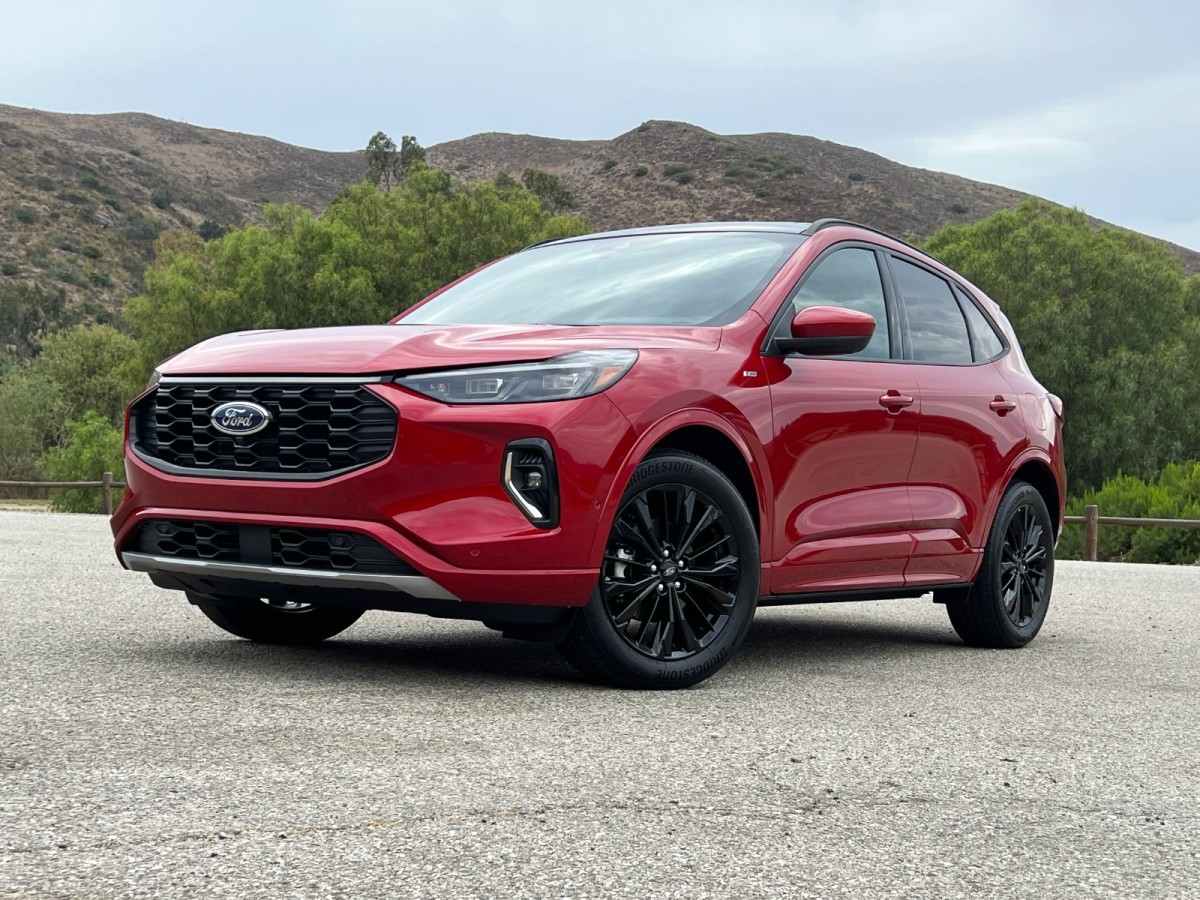
Ford's 2024 Escape received a significant facelift, carrying over the updates from the previous year. The SUV's front end was restyled to present a more aggressive appearance, replacing the previous model's wide-eyed, toothless smile. Despite these changes, the rest of the vehicle maintained its soft and generically appealing look. The 2024 Escape was available in several trims in Canada, including Active, ST-Line, ST-Line Select, Platinum, ST-Line Elite, and Plug-in Hybrid, with prices ranging from $33,049 to $46,999, excluding additional fees. Our test vehicle, an ST-Line Elite, featured premium options like Rapid Red paint and a Panoramic Vista Roof, bringing its price to $49,924. Inside, the Escape's upscale appearance was marred by excessively glossy surfaces and stiff upholstery, raising questions about its value.
The 2026 Hyundai Ioniq 9 showcased a distinctive design that polarized opinions. Inspired by smooth pebbles and midcentury modern sofas, the Ioniq 9 aimed for an aerodynamic shape to accommodate seven passengers comfortably. Measuring 5,060 millimetres in length with a 3,130 mm wheelbase, it offered impressive interior volume. Despite its size, the Ioniq 9 achieved a 0.27 drag coefficient, enhancing its aerodynamic efficiency. The design, however, was not universally praised, with its swooping roofline and stubby rear end drawing mixed reactions. The rear view, with LED taillights wrapping around the tail's circumference, was particularly recognizable. The Ioniq 9 was available in various trims and paint colours, with our test vehicle featuring a matte finish and 21-inch wheels. Inside, the Ioniq 9 boasted a spacious and airy interior, with flat floors and a sliding centre console, although some plastic elements felt underwhelming.
The 2024 Ford Escape offered two powertrain options for the ST-Line Elite trim: a 192-horsepower hybrid and a turbocharged 2.0-litre four-cylinder engine producing 250 horsepower and 280 pound-feet of torque. The turbo engine, paired with an eight-speed automatic transmission and all-wheel drive, delivered quick acceleration but lacked the sporty driving dynamics suggested by the ST badge. The ride was soft and compliant, with nimble handling in typical driving situations, but the suspension allowed too much body motion. The brake pedal was responsive, but the steering felt sluggish. The turbo engine's fuel economy fell short of expectations, averaging 9.8 L/100 km during testing. The Escape's towing capacity was 1,587 kilograms.
The 2026 Hyundai Ioniq 9 featured a 110.3-kWh battery pack on Hyundai's e-GMP platform. The base Essential trim had a single rear-mounted 160-kW motor producing 215 horsepower, while other trims had dual-motor AWD systems with varying power outputs. The Preferred AWD made 303 hp, and the Preferred AWD+ generated 422 hp. Despite its weight, the Ioniq 9 offered impressive energy efficiency, often exceeding its estimated 500-kilometre range. The ride was smooth and quiet, thanks to a softly sprung chassis and sound-absorbing features. The Ioniq 9's towing capacity was 1,587 kilograms for RWD and 2,268 kilograms for AWD models. Charging options included Tesla-style NACS superchargers and CCS-port Level 3 chargers, with fast charging times.
The 2024 Ford Escape ST-Line featured a black interior with cloth inserts and artificial leather bolsters, accented by red stitching. Leather seats were optional but not recommended due to their uncomfortable feel. The test model included ambient lighting, dual-zone climate control, power-adjustable front seats, and heated front seats and steering wheel. The Escape's front seats were large and supportive, while the back seat was comfortable when slid to its rearmost position. Interior storage was generous in the front, but rear passengers had less accommodation. Cargo volume was 1,061 litres behind the back seat, expanding to 1,852 litres with the rear seat folded.
The 2026 Hyundai Ioniq 9 focused on family-SUV practicality, seating seven with a middle-row bench or six with captain's chairs in the Ultimate Calligraphy Package. The sliding centre console improved access for middle-row passengers. The Ioniq 9 offered 1,086 millimetres of legroom in the middle row and 813 mm in the third row. The rear doors provided easy access, and dual-zone climate control with air vents in all rows was standard. Heated front seats were standard, with additional heating options available in higher trims. The driver's seat had limited adjustability, and the glove compartment was awkwardly positioned. Cargo space was 620 litres behind the third row, expanding to 2,462 litres with seats folded.
The 2024 Ford Escape featured digital instrumentation, with upper trims having a 12.3-inch display. The ST-Line Elite test vehicle had a 13.2-inch Sync 4 infotainment system with a landscape format, offering wireless Apple CarPlay and Android Auto. However, the display's colour theme appeared washed out, and climate controls were integrated into the screen. The system experienced lag, and the wireless charger overheated devices. The test vehicle also had a head-up display and Active Park Assist 2.0, which worked well but was impractical in busy areas.
The 2026 Hyundai Ioniq 9 had dual curved 12.3-inch displays, similar to other Hyundai models. The screens were visually appealing but prone to fingerprints and glare. Standard features included SiriusXM, wireless Android Auto and Apple CarPlay, and a wireless charging pad, although the latter struggled to keep up with device demands. The Ioniq 9 had six USB-C ports for charging. The test car's 14-speaker Bose audio system delivered impressive sound quality, rivaling higher-end systems.
The 2024 Ford Escape came with Ford Co-Pilot360, offering features like forward-collision warning, automatic emergency braking, lane-keeping assist, and blind-spot monitoring. The ST-Line Elite added adaptive cruise control, evasive steering assist, and a 360-degree camera system. The lane-keeping systems were inconsistent, and the predictive speed assist caused issues. The Escape received favourable crash-test ratings from NHTSA, with five-star ratings except for a four-star rollover resistance rating.
The 2026 Hyundai Ioniq 9 had not yet been rated by NHTSA or IIHS. It included advanced driver assistance systems like collision avoidance, lane-guidance, driver attention warning, and Highway Driving Assist 2. The latter combined lane-keeping assist with adaptive cruise control for supervised hands-free driving. The Luxury package and Preferred AWD+ trims added a surround-view monitor and blind-spot view monitor.
CarGurus highlights
According to CarGurus experts, the overall rating for the 2024 Ford Escape is 6.2 out of 10, while the 2026 Hyundai Ioniq 9 scores 7.3 out of 10. Based on these ratings, the Hyundai Ioniq 9 is the recommended choice, offering a more advanced and spacious electric SUV experience with superior technology and comfort features.
Choose the 2026 Hyundai IONIQ 9 if:
- You want a spacious and futuristic electric SUV with impressive range.
- You prioritize advanced technology and a quiet, smooth ride.
- You need a family-friendly vehicle with flexible seating and cargo options.


Choose the 2024 Ford Escape if:
- You prefer a more traditional SUV design with a sporty appearance.
- You value a variety of trim options and configurations.
- You seek a vehicle with a proven track record and favourable safety ratings.


CarGurus highlights
According to CarGurus experts, the overall rating for the 2024 Ford Escape is 6.2 out of 10, while the 2026 Hyundai Ioniq 9 scores 7.3 out of 10. Based on these ratings, the Hyundai Ioniq 9 is the recommended choice, offering a more advanced and spacious electric SUV experience with superior technology and comfort features.
Choose the 2026 Hyundai IONIQ 9 if:
Shop Now- You want a spacious and futuristic electric SUV with impressive range.
- You prioritize advanced technology and a quiet, smooth ride.
- You need a family-friendly vehicle with flexible seating and cargo options.
Choose the 2024 Ford Escape if:
Shop Now- You prefer a more traditional SUV design with a sporty appearance.
- You value a variety of trim options and configurations.
- You seek a vehicle with a proven track record and favourable safety ratings.

By: CarGurus + AI
At CarGurus, our team of experienced automotive writers remain at the heart of our content operation, conducting hands-on car tests and writing insightful guides that are backed by years of industry experience. To complement this, we are harnessing AI to make our content offering more diverse and more helpful to shoppers than ever. To achieve this, our AI systems are based exclusively on CarGurus content, ratings and data, so that what we produce is both unique to CarGurus, and uniquely helpful to car shoppers.
