2024 Ford Escape Reviews, Pricing & Specs


Pros & cons
What we like
Multiple powertrain options
Comfortable
Impressive technology
What to consider
Interior materials feel cheap
Uncompetitive cargo space
Poor value for money
Expert review
One of the original compact crossovers, the Ford Escape, might be nearing the end of its life.
Reportedly, Ford will discontinue the Escape at the end of the current fourth-generation run. Once among the most popular vehicles in its class, Ford recently zigged with the Escape’s design and positioning when the market zagged. Boxy, rugged-looking crossovers are what people want, not soft and sophisticated pseudo-cars like the current Escape. Fortunately, Ford has the Bronco Sport in its lineup, which is getting all of the automaker’s attention. Meanwhile, the 2024 Ford Escape receives no major changes following a substantial makeover in 2023, though it appears the Base trim is canceled.
out of 10 expert review
Look & feel
Ford tried to give the Escape a new lease on life in 2023. The company restyled the compact crossover’s front end, added new wheel designs, revamped the trim lineup, and updated the technology with next-generation infotainment and enhanced safety features.
The updates carry over into the 2024 Escape and make the SUV dramatically more appealing. The wide-eyed, toothless smile of the previous model is gone, replaced by a more aggressive look. However, the rest of the SUV remains largely the same, retaining a soft and generically appealing overall appearance.
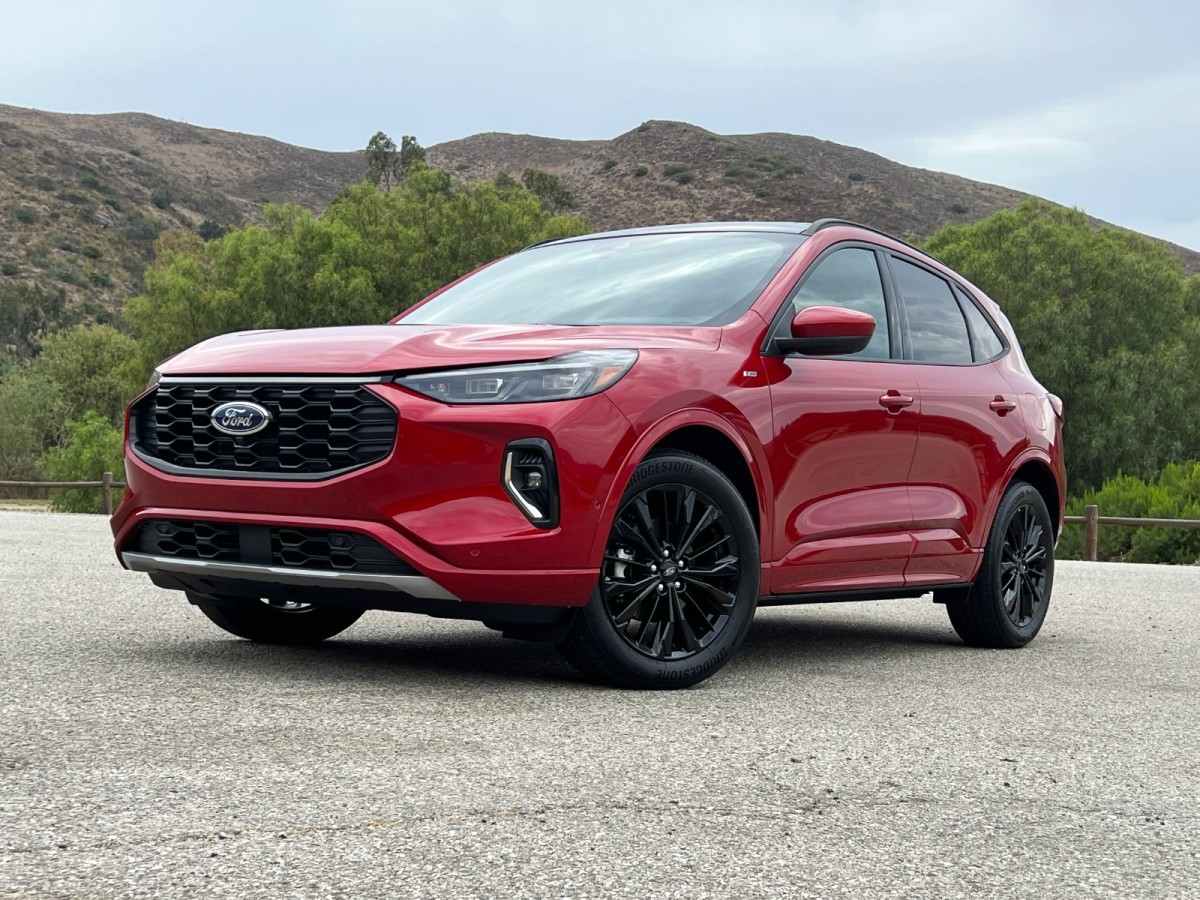
As of this writing, Ford offers the 2024 Escape in Canada in Active, ST-Line, ST-Line Select, Platinum, ST-Line Elite, and Plug-in Hybrid trim levels. Ford appears to have dropped the Base trim this year, so prices range from $33,049 to $46,999, not including the $2,195 charge for destination and other dealer fees. Our test vehicle arrived in ST-Line Elite trim, equipped with extra-cost Rapid Red paint, black 19-inch wheels, the Premium Technology Package, and a Panoramic Vista Roof. The price for this setup in Canada comes to $49,924, including the destination charge.
As a loaded Escape, our test vehicle’s interior featured diamond-stitched, perforated leather and all of the tech upgrades. At first, the interior looks upscale. But then you notice the excessively glossy surfaces and feel the unusually stiff and dry upholstery, and you wonder how the Escape ST-Line Elite can cost so much money.
Ford could resolve this with a little bit of added attention to detail, but given the Escape’s rumoured upcoming demise, we don’t think that’s gonna happen.
Performance
When you shop for a 2024 Escape ST-Line Elite, you can choose between a 192-horsepower hybrid powertrain expected to get 6.0 litres per 100 kilometres in combined driving (covered as a separate model on CarGurus). Or you can get a turbocharged 2.0-litre four-cylinder cranking out 250 horsepower and 280 pound-feet of torque that averages 8.4 L/100 km in combined driving when equipped with all-wheel drive (AWD; 8.0 L/100 km with front-wheel drive (FWD), which is standard on the two lowest trims).
Our test vehicle had the turbo paired with an eight-speed automatic transmission and all-wheel drive (AWD), which is standard in Canada from ST-Line Select and up. The AWD system has a driveline disconnect feature to help improve fuel economy, and drivers can select between Eco, Normal, Sport, and Slippery driving modes. Tellingly, there isn’t an Off-Road mode. With the turbocharged engine, the 2024 Escape can tow up to 1,587 kilograms (3,500 pounds).
The Escape ST-Line Elite (like the ST-Line Select) is the sporty version of the SUV, but that describes the appearance more than it does the driving dynamics. Yes, the turbocharged engine supplies quick acceleration, especially for the class. But otherwise, the driving character doesn’t match the promise of the ST badge.
The ST-Line’s ride is soft and compliant when you might expect firm and connected. Handling feels nimble in typical driving situations, but the suspension allows too much unwanted body motion the majority of the time. The brake pedal is responsive and easy to modulate, but the steering feels sluggish and numb in your hands.
For most people, most of the time, the Escape ST-Line provides a sporty look and comfortable, isolated driving dynamics that make commuting, kid shuttling, and errand running bearable. But you can sense that the Escape could be something more to people who like to drive with, you guessed it, a little more attention to detail.
Since the turbo engine is wasted in this application, we suggest skipping the 2.0-litre-powered ST-Line Select, ST-Line Elite, and Platinum, and either paying for the hybrid powertrain or picking a lower-tier Escape. The Escape Active and Escape ST-Line (not to be confused with the ST-Line Select or ST-Line Elite) employ a 1.5-litre turbocharged three-cylinder engine rated for 180 horsepower and 199 pound-feet of torque. Available with either FWD or AWD and paired to the same eight-speed automatic, this powertrain should feel competitive with most of the Escape's segment, without demonstrating so significant a gap between power and performance.
While the hybrid won’t be as quick as a 250-hp Escape, you can bet it will save you more money over time. Our turbocharged ST-Line Elite averaged 9.8 L/100 km on the testing route, coming up short of the official Natural Resources Canada fuel economy rating of 8.4 L/100 km.
Form & function
If you buy a 2024 Ford Escape ST-Line, we hope you like black because that’s the only interior colour available. The standard upholstery features cloth inserts with artificial leather bolsters, and Ford adds red stitching to emphasize the ST-Line’s sportiness. Leather is optional with ST-Line Elite trim, but we don’t recommend it. Sure, the perforations and diamond-stitched pattern look fancy, but it feels awful. Save your money.
In addition to the leather seats, our test model had ambient interior lighting, dual-zone automatic climate control, a 10-way power-adjustable driver’s seat, a six-way power-adjustable front passenger’s seat, heated front seats, and a heated steering wheel. It did not have ventilated front seats, which would have been nice considering the heatwave occurring during the week we test-drove the Escape.
The Escape’s front seats feel large and soft for the compact crossover SUV segment. In addition, they provide good support over time, and a height-adjustable front passenger’s seat is somewhat rare in the segment. Similarly, the Escape’s back seat is comfortable when you slide it into its rearmost position. As is true of most compact crossover SUVs, it’s easy to get into and out of all four of the Escape’s doors.
Interior storage is generous in front, but rear passengers are not as well accommodated. Cargo volume measures 1,061 litres behind the back seat (974 litres for the hybrid), and when you fold the rear seat down, you get 1,852 litres (1,721 litres in the hybrid). Our test vehicle offered deep storage areas on either side of the cargo load floor, plus a handy grocery bag hook.
Technology
Digital instrumentation is standard on the 2024 Escape. In lower trims, the SUV has an 8-inch display. Upper trims feature a 12.3-inch display. Our ST-Line Elite test vehicle had the larger display with pleasing graphics and plenty of data. However, we were more impressed with the test vehicle’s 13.2-inch Sync 4 infotainment system. Ford presents this next-generation technology in a preferable landscape format, which is less distracting than a portrait-mounted screen. The content is also well organized, with an intuitive layout.
Unfortunately, the company continues to use a colour theme that makes the display appear washed out and has thin fonts that are difficult to reference at a glance. In addition, Ford integrates the dual-zone automatic climate controls into the screen in a narrow strip at the bottom of the display. That is not preferable. In lower trim levels, Sync 4 employs a smaller 8-inch display and features wireless Apple CarPlay and Android Auto, SiriusXM 360L satellite radio, and FordPass Connect services, including access to a Wi-Fi hotspot. The larger 13.2-inch touchscreen version adds a complimentary one-year subscription to connected navigation. A Bang & Olufsen premium sound system is also available, and the test vehicle had it, but the speakers were damaged, so we could not assess sound quality.
While using Sync 4, we observed a lag time between inputs and response, and the wireless smartphone charger heated an iPhone to an alarming temperature. However, the voice recognition system is excellent, and it’s easy to switch between Apple CarPlay and the native environment.
Oddly, Ford places the engine start/stop button where a stereo volume knob usually is. There is a volume knob, but Ford puts it where a radio tuning knob usually is. There is no tuning knob, so don’t bother looking for it.
Our test vehicle also had an optional head-up display (HUD). Unlike most examples of this technology, the Escape’s HUD doesn’t project data onto the windshield. Instead, a clear piece of plastic rises from the top of the dashboard and shows the information to the driver. We didn’t find it dramatically additive to the digital gauges and infotainment system, but Ford includes it in the optional Premium Technology Package with leather, the Bang & Olufsen sound system, and Active Park Assist 2.0. So, if you want that stuff, then you’re getting the HUD.
Active Park Assist 2.0 is a semi-autonomous parking assistance technology that takes control of the vehicle to place the Escape in a parallel or perpendicular parking space. In addition, the system can help you to exit tight parking situations. The driver remains behind the steering wheel at all times, ready to take control if necessary. We’ve used this system on other Ford products, and it works well but is impractical on busy streets or in parking lots full of pedestrians and other motorists.
Safety
In addition to a standard post-collision automatic braking system, which brings the SUV to a stop as soon as possible following a crash, the 2024 Escape has a standard Ford Co-Pilot360 collection of driving assistance systems.
Highlights include forward-collision warning with pedestrian detection, automatic emergency braking, lane-departure warning, lane-keeping assist, blind-spot monitoring, rear cross-traffic alert, and automatic high-beam headlights. Our ST-Line Elite also featured adaptive cruise control with stop-and-go capability and predictive speed assist, evasive steering assist, lane-centring assist, and a 360-degree surround-view camera system.
The Escape’s lane-keeping systems displayed inconsistent behaviour on our test drive, and the predictive speed assist slowed the SUV too much for upcoming curves. That caused irritation in other motorists, so we pulled over and turned the feature off. Both the adaptive cruise control and lane-centring systems mysteriously shut down at one point, with Co-Pilot360 telling me to take control.
On highways, the Co-Pilot360 technology was better, proving more effective and pleasing to use. In this environment, the lane-keeping systems appeared more sure of themselves, and the adaptive cruise control was smooth in stop-and-go traffic and when other vehicles cut into the gap ahead.
With regard to crash-test ratings, the National Highway Traffic Safety Administration (NHTSA) gives the 2024 Escape favourable marks. The SUV earns five-star ratings across the board, aside from a four-star rollover resistance rating. (Note: The Plug-in Hybrid version also gets a four-star rating for driver protection in a frontal-impact collision.)
As of this writing, the Insurance Institute for Highway Safety (IIHS) has not rated the 2024 Escape. However, in 2023, the SUV earned Good ratings from the IIHS except for a Marginal score in a new side-impact safety test.
Cost-effectiveness
Rated to return as little as 6.0 L/100 km in combined driving, the Ford Escape Hybrid makes a good case for purchase if cost-effectiveness is important to you.
Unfortunately, you need to upgrade to ST-Line trim to get the hybrid powertrain, and before you add a single option, the manufacturer’s suggested retail price (MSRP) rises past $40,000 for a front-drive model. A Toyota RAV4 LE Hybrid with AWD starts at just under $40,000. Over at the Kia store, a Sportage Hybrid EX has standard AWD and starts at roughly the same price.
But what about the turbocharged gas-engine Escapes? Our test vehicle cost almost $50,000, which is a lot of money for a little crossover SUV. The Ford can’t touch a Hyundai Tucson for overall value. But the Hyundai isn’t the only alternative in the class offering a stronger value proposition.
That brings us to the Escape Plug-in Hybrid. It comes only with FWD but offers lots of standard equipment and 60 kilometres of electric-only driving range. There aren’t many alternatives to the Escape PHEV, either. But those that exist offer more range, more power, or all-wheel drive. And sometimes, all three. Again, Kia is the one to beat, the turbocharged 261-hp Sportage Plug-in Hybrid providing 55 kilometres of electric range and standard AWD for less than the 192-hp, front-drive Ford.
Simply put, the 2024 Ford Escape doesn’t strike us as a compelling value in the segment.
Note: Images show a US model.

What owners say
This Car Is A Good Value This Is Missing Not A Thing
February 10, 2026Trims & specs
Base MSRP $28,000 | Seating 5 |
Engine 1.5L 180 hp I3 | Cargo Capacity 37.5 cu ft |
Combined MPG 30 | Drivetrain FWD |
Base MSRP $29,500 | Seating 5 |
Engine 1.5L 180 hp I3 | Cargo Capacity 37.5 cu ft |
Combined MPG 29 | Drivetrain AWD |
Base MSRP $29,495 | Seating 5 |
Engine 1.5L 180 hp I3 | Cargo Capacity 37.5 cu ft |
Combined MPG 30 | Drivetrain FWD |
Base MSRP $30,490 | Seating 5 |
Engine 1.5L 180 hp I3 | Cargo Capacity 37.5 cu ft |
Combined MPG 30 | Drivetrain FWD |
Base MSRP $32,660 | Seating 5 |
Engine 1.5L 180 hp I3 | Cargo Capacity 37.5 cu ft |
Combined MPG 29 | Drivetrain AWD |
Base MSRP $31,665 | Seating 5 |
Engine 1.5L 180 hp I3 | Cargo Capacity 37.5 cu ft |
Combined MPG 29 | Drivetrain AWD |
Base MSRP $37,465 | Seating 5 |
Engine 2.0L 250 hp I4 | Cargo Capacity 37.5 cu ft |
Combined MPG 27 | Drivetrain AWD |
Base MSRP $34,040 | Seating 5 |
Engine 2.0L 250 hp I4 | Cargo Capacity 37.5 cu ft |
Combined MPG 27 | Drivetrain AWD |
Base MSRP $38,460 | Seating 5 |
Engine 2.0L 250 hp I4 | Cargo Capacity 37.5 cu ft |
Combined MPG 27 | Drivetrain AWD |


Pricing trends
MSRP range
$28,000 - $38,460
Current avg. market price
$27,926
Trending down by 2.0% this month
May 2026 - October 2026