2024 Volkswagen Atlas vs 2024 Chevrolet Blazer EV

Overview | |
MSRP$37,995 | MSRP$48,800 |
Listings239 | Listings155 |
Ratings & Reviews | |
User Reviews | User Reviews |
Expert reviews7.3 out of 10 | Expert reviews6.3 out of 10 |
Pros
Cons
| Pros
Cons
|
2024 Volkswagen Atlas Reviews SummaryLaunched for the 2018 model year, the Volkswagen Atlas is engineered specifically for the United States market. It's a three-row midsize crossover SUV, big for a VW, but targeting a popular market segment that already includes the Chevrolet Traverse, Ford Explorer, Hyundai Palisade, Kia Telluride, Nissan Pathfinder, Subaru Ascent, and Toyota Highlander. To keep up in such a competitive segment, the Atlas gets a major refresh for the 2024 model year. The 2024 Volkswagen Atlas is essentially the same vehicle as before, but it gets key updates like different styling and more standard features. It also loses its six-cylinder engine option, but the remaining turbocharged four-cylinder engine gets more horsepower and torque. The 2024 Atlas lineup includes SE, SE with Technology, SEL, and SEL Premium R-Line trim levels, plus a new-for-2024 Peak Edition treatment available on the SE with Technology and SEL trim levels. For this review, we tested an Atlas SEL Premium R-Line, representing the top of the range. | |
2024 Chevrolet Blazer EV Reviews SummaryIt may share a name with the gasoline-powered Blazer crossover SUV, but the Chevy Blazer EV is in fact a new vehicle based on the General Motors Ultium electric vehicle (EV) component set. It’s Chevy’s belated answer to the crosstown rival Ford Mustang Mach-E and other electric SUVs like the Hyundai Ioniq 5, the Kia EV6, and the Tesla Model Y. Verdict: The Blazer EV offers unique style and impressive technology, but it doesn’t really move the needle when it comes to range, fast charging, or interior packaging. It’s also priced at the higher end of the segment in its launch form. | |
No video found | |
Popular Features & Specs | |
Engine2.0L 269 hp I4 | Engine288 hp Electric |
Drive TrainFWD | Drive TrainAWD |
Seating Capacity7 | Seating Capacity5 |
EV Battery Capacity | EV Battery Capacity85 kWh |
MPG City20 | MPG City103 |
MPG Highway27 | MPG Highway88 |
Engine | |
Engine Name2.0L 269 hp I4 | Engine Name288 hp Electric |
DrivetrainFWD | DrivetrainAWD |
Fuel Economy | |
EV Battery Capacity | EV Battery Capacity85 kWh |
MPG City20 | MPG City103 |
MPG Highway27 | MPG Highway88 |
Interior | |
Seating Capacity7 | Seating Capacity5 |
Key Features | |
Navigation System | Navigation SystemStandard |
Safety | |
Front Crash Overall4 | Front Crash Overall5 |
Side Crash Overall5 | Side Crash Overall5 |
Dimensions & Capacity | |
Cargo Space20.6 cu ft | Cargo Space25.5 cu ft |
Curb Weight4343 lbs | Curb Weight5337 lbs |
Height70.4 in | Height65.0 in |
Length200.7 in | Length192.2 in |
Width88.5 in | Width86.5 in |
Wheelbase117.3 in | Wheelbase121.8 in |
Maximum Payload1091 lbs | Maximum Payload1167 lbs |
Number of doors4 | Number of doors4 |
Maximum Towing Capacity2000 lbs | Maximum Towing Capacity1500 lbs |
Overview | ||
MSRP | $37,995 | $48,800 |
Listings | ||
Ratings & Reviews | ||
User reviews | ||
Expert reviews | 7.3 out of 10Read full review | 6.3 out of 10Read full review |
Pros & cons | Pros
Cons
| Pros
Cons
|
Summary | Launched for the 2018 model year, the Volkswagen Atlas is engineered specifically for the United States market. It's a three-row midsize crossover SUV, big for a VW, but targeting a popular market segment that already includes the Chevrolet Traverse, Ford Explorer, Hyundai Palisade, Kia Telluride, Nissan Pathfinder, Subaru Ascent, and Toyota Highlander. To keep up in such a competitive segment, the Atlas gets a major refresh for the 2024 model year. The 2024 Volkswagen Atlas is essentially the same vehicle as before, but it gets key updates like different styling and more standard features. It also loses its six-cylinder engine option, but the remaining turbocharged four-cylinder engine gets more horsepower and torque. The 2024 Atlas lineup includes SE, SE with Technology, SEL, and SEL Premium R-Line trim levels, plus a new-for-2024 Peak Edition treatment available on the SE with Technology and SEL trim levels. For this review, we tested an Atlas SEL Premium R-Line, representing the top of the range. | It may share a name with the gasoline-powered Blazer crossover SUV, but the Chevy Blazer EV is in fact a new vehicle based on the General Motors Ultium electric vehicle (EV) component set. It’s Chevy’s belated answer to the crosstown rival Ford Mustang Mach-E and other electric SUVs like the Hyundai Ioniq 5, the Kia EV6, and the Tesla Model Y. Verdict: The Blazer EV offers unique style and impressive technology, but it doesn’t really move the needle when it comes to range, fast charging, or interior packaging. It’s also priced at the higher end of the segment in its launch form. |
Video | No video found | |
Popular Features & Specs | ||
Engine | 2.0L 269 hp I4 | 288 hp Electric |
Drive Train | FWD | AWD |
Seating Capacity | 7 | 5 |
EV Battery Capacity | 85 kWh | |
MPG City | 20 | 103 |
MPG Highway | 27 | 88 |
Engine | ||
Engine Name | 2.0L 269 hp I4 | 288 hp Electric |
Drivetrain | FWD | AWD |
Fuel Economy | ||
EV Battery Capacity | 85 kWh | |
MPG City | 20 | 103 |
MPG Highway | 27 | 88 |
Interior | ||
Seating Capacity | 7 | 5 |
Key Features | ||
Navigation System | Standard | |
Safety | ||
Front Crash Overall | 4 | 5 |
Side Crash Overall | 5 | 5 |
Dimensions & Capacity | ||
Cargo Space | 20.6 cu ft | 25.5 cu ft |
Curb Weight | 4343 lbs | 5337 lbs |
Height | 70.4 in | 65.0 in |
Length | 200.7 in | 192.2 in |
Width | 88.5 in | 86.5 in |
Wheelbase | 117.3 in | 121.8 in |
Maximum Payload | 1091 lbs | 1167 lbs |
Number of doors | 4 | 4 |
Maximum Towing Capacity | 2000 lbs | 1500 lbs |
The 2024 Volkswagen Atlas had an impressive styling refresh that enhanced its sheet metal with new lighting elements. Originally rooted in the Volkswagen CrossBlue concept from 2013, the Atlas received distinctive light-up VW logos, similar to the recent update of the ID.4 electric crossover. The front logo gleamed white, while the rear logo shined red. To bolster its new look, VW added a front light bar connecting to new LED headlights reminiscent of those found on the Ford Expedition. These modifications gave the Atlas a markedly different "face," blending American swagger with the European aesthetic. From the rear, the taillights seamlessly integrated into a full-width light bar that housed the illuminated logo.
All trim levels of the Atlas received new wheel designs for 2024. The base SE model rode on 18-inch alloy wheels, with most other trims upgrading to 20-inch wheels. The top-tier SEL Premium R-Line featured 21-inch wheels and sportier styling elements. Additionally, the Atlas introduced the Peak Edition, infusing an outdoorsy flavor into VW's mid-size SUV. This variant boasted black 18-inch wheels with all-terrain tires, a unique front fascia, silver body cladding, blacked-out exterior trim, and two exclusive colors: Avocado Green and Pure Gray.
The interior saw a revamp concentrated around the center of the cabin. The infotainment touchscreen was repositioned, standing free from the dashboard, while a redesigned shifter was reduced to a tiny toggle, freeing up space for a storage area underneath. VW also aimed to make the interior more upscale, with enhanced fake wood trim and a new weaved plastic trim simulating carbon fiber. Standard leatherette seats could be upgraded to leather upholstery with contrast stitching in SEL models. The SEL Premium R-Line even featured diamond stitching, giving it a premium feel despite some areas, like the center console, appearing less refined.
The 2024 Chevrolet Blazer EV represented a bold new chapter for the long-standing Blazer nameplate. Originally a truck-based off-roader, the Blazer evolved into a car-based crossover in 2019. The Blazer EV adopted basic styling elements from that model but on a new EV-specific platform. Built around the General Motors Ultium component set, the Blazer EV's wheelbase length was determined by the battery modules it housed. The larger battery pack was identical to that in the Cadillac Lyriq, resulting in a shared 121.8-inch wheelbase. However, the Blazer EV’s proportions made it appear like a stretch limo.
The vehicle featured a tall hood, a reconfigured scowling front end from the gasoline Blazer, and boomerang-shaped taillights, giving it a bold attitude. Unlike the aerodynamic styles of the Ford Mustang Mach-E and Kia EV6, the Blazer EV looked like a proper SUV, measuring around 7 inches longer and 4 inches wider than its rivals.
The Blazer EV launched in LT and RS trims, each with unique styling elements. The base LT had a color-coordinated front fascia, resembling an early 2000s Apple product in white paint, while the RS trim had a blacked-out front fascia and exterior accents. The LT featured 19-inch wheels, and the RS rolled on 21-inch wheels. A forthcoming Blazer EV SS promised unique front fascia, a black roof, and 22-inch wheels.
RS and SS models boasted a sporty interior with large round air vents similar to those in the gasoline Blazer and Camaro, complemented by a flat-bottom steering wheel. Optional red leather upholstery and other stylish elements created a fun ambiance contrasting with the more mundane cabins of the Mach-E and EV6. Nonetheless, some interior parts, such as the turn-signal and shifter stalks, felt flimsy. Overall, the cabin mostly avoided using piano-black plastic that other brands inexplicably favored.


The 2024 Volkswagen Atlas relied solely on a 2.0-liter turbocharged inline four-cylinder engine, as the previous VR6 option was discontinued. This turbo-four engine produced 269 horsepower and 273 pound-feet of torque on regular fuel, improving upon the old VR6's 276 hp and 266 lb-ft of torque and the previous version's 235 hp and 258 lb-ft. This engine iteration, part of VW's EA888 lineup, was a staple in various models, from rental-spec Jettas to the Golf R hot hatchback.
Connected to an eight-speed automatic transmission, the Atlas offered standard front-wheel drive (FWD) or optional all-wheel drive (AWD). With enhanced torque that peaked lower than the VR6 (1,550 rpm versus 3,600 rpm), VW claimed the 2024 Atlas accelerated faster than its six-cylinder predecessor. The FWD model achieved a zero-to-60 mph time in an estimated eight seconds, while the AWD model took 8.3 seconds.
Despite these improvements, the Atlas was still primarily a family hauler, prioritizing comfort and efficiency over performance. The engine provided smooth yet moderately noisy acceleration, and while ride quality remained unchanged from the pre-refresh Atlas, it was still less comfortable compared to rivals. However, the 2024 model's overall material quality and refinement levels were more suitable for a base model than a top-tier variant.
The Atlas Peak Edition included all-terrain tires and an Offroad driving mode but lacked substantial underbody protection. Volkswagen's 4Motion AWD system, which could send up to 50% of torque to front or rear axles, decoupled the rear axle to save fuel under light loads. Thus, the system was more tailored for pavement rather than rugged terrain. Maximum towing capacity remained at 5,000 pounds for most models, except for the base SE, which could tow up to 2,000 pounds.
The 2024 Chevrolet Blazer EV offered versatile powertrain options, starting with single-motor rear-wheel drive (RWD) and dual-motor all-wheel drive (AWD) in the LT and RS trims. The RWD models delivered 340 horsepower and 325 pound-feet of torque, powered by a 102-kilowatt-hour battery pack. Conversely, AWD models produced 288 hp and 333 lb-ft of torque with an 85-kWh pack, a unique configuration where the dual-motor powertrain had a lower output than the single-motor option.
Chevy also planned to offer a single-motor front-wheel drive (FWD) powertrain from the 2025 model year onwards, anticipated to be the most affordable and highest-volume variant. Additionally, a Blazer EV SS performance model with a dual-motor AWD powertrain was set to debut, producing 557 hp and 648 lb-ft of torque, achieving zero-to-60 mph in under four seconds with its Wide Open Watts (WOW) launch mode.
During test drives of the RWD and AWD versions of the Blazer EV RS, both demonstrated strong acceleration, although the AWD version offered superior traction and pulling power. While the Blazer EV shared dimensions with the Cadillac Lyriq, its driving experience differed significantly. It excelled in handling, offering precise steering on twisty roads, but compromised ride comfort with its stiff suspension. However, cabin noise was relatively low, with minor wind noise at highway speeds.
The Blazer EV featured a steering-wheel paddle for regenerative braking, allowing transitioning from minimal regen to one-pedal driving. This feature, derived from the Chevy Bolt EV, added a level of driver engagement and adaptability to different driving styles and conditions.
The 2024 Volkswagen Atlas gained more standard features for 2024, enhancing comfort and convenience. The base SE trim level included a heated steering wheel and ventilated front seats. The SE with Technology trim added a power liftgate, while the SEL trim level upgraded to standard leather upholstery and heated second-row seats.
The Atlas could accommodate seven passengers, with a 60/40 split-fold second-row bench that could recline up to 14 degrees and slide fore and aft up to 7.7 inches. This bench could hold three child seats side by side and tilt and slide even with the seats in place. Second-row captain’s chairs were an option on SE with Technology and higher trims, reducing seating capacity to six. The third-row bench was a standard 50/50 split-folding setup.
Passenger space in the Atlas was competitive across all three rows, with excellent headroom and legroom in the first and third rows. The second row provided slightly less room but was still accommodating. Cargo capacity, a crucial factor for family vehicles, was generous. With the second and third rows folded, the Atlas offered a substantial 96.6 cubic feet of cargo space. This shrank to 55.5 cubic feet with only the third row folded and 20.6 cubic feet with all seats in place, surpassing nearly all rivals, except the Chevy Traverse.
The 2024 Chevrolet Blazer EV, while resembling a traditional SUV, had an interior that closely matched the sleeker Ford Mustang Mach-E and Kia EV6 in terms of headroom and legroom. The Blazer EV didn’t offer the elevated driving position typical of conventional SUVs. Visibility was decent, but the high side sills and a deep dashboard created a sensation akin to wearing a trench coat with a high, turned-up collar.
The Blazer EV provided 25.5 cubic feet of cargo space with the second row in place and 59.1 cubic feet with those seats folded, falling short of the gasoline Blazer's capacity but surpassing the Kia EV6's space. Ford's Mustang Mach-E offered a bit more cargo room at 29.7 cubic feet with its rear seats up and 59.7 cubic feet with them down, along with an additional frunk—something the Blazer EV lacked. The Blazer EV did feature a “presence activated” liftgate that automatically opened when the key fob was nearby.
The heavily stylized interior of the Blazer EV managed to incorporate expected small-item storage, such as a large, secure spot for phones, a usable center console storage bin, and door pockets. However, some climate controls and headlight buttons were touchscreen-based, necessitating an adjustment period.
The 2024 Volkswagen Atlas enhanced its tech offerings for 2024. A 12-inch touchscreen and a 10.25-inch digital instrument cluster were now standard, alongside wireless phone charging and wireless Apple CarPlay and Android Auto (previously only available on upgraded models).
The Atlas came with six standard USB-C ports, expandable to eight on higher trims, including a dash cam port on SE with Technology and higher, simplifying dash cam installation. A head-up display was standard on the SEL trim and above. VW switched from Fender to Harman Kardon for its premium audio system, with a 12-speaker setup available on higher trims, upgrading from the basic six-speaker system.
The infotainment system felt user-friendly, with the map view feature in the now-standard digital instrument cluster being particularly appreciated for road trips. The interface was sharp yet easy to read. However, the use of haptic touchpads for functions like audio volume and headlights was a drawback, as it made these controls harder to use compared to traditional buttons, despite their high-tech appearance.
The 2024 Chevrolet Blazer EV introduced a new Google-based infotainment system, set to be standard in all future Chevy EVs. This system featured built-in Google apps, including Google Maps and Google Assistant, but notably excluded standalone Android Auto and Apple CarPlay, leaving iOS users with basic Bluetooth connectivity.
Instead, Chevy equipped the Blazer EV with large, high-resolution screens: a 17.7-inch touchscreen and an 11-inch digital instrument cluster. The infotainment system incorporated built-in route planning to locate charging stations and pre-condition the battery en route. Chevy promised frequent over-the-air (OTA) updates to add new features.
While the user experience was mostly positive, the angled touchscreen could be inconvenient for front-seat passengers and awkward to reach for the driver. Physical switches were preferred over the touchscreen-based headlight controls and other functions.
A notable innovation was the Blazer EV’s hands-free start sequence—it could be driven as long as the key fob was inside, starting simply by pressing the brake pedal. This feature marked a significant shift from Chevy's earlier EV designs, focusing on a high-tech driving experience.
The 2024 Volkswagen Atlas earned a five-star overall safety rating from the National Highway Traffic Safety Administration (NHTSA), scoring five stars in side crash tests and four stars in frontal and rollover tests. While the Insurance Institute for Highway Safety (IIHS) hadn't released ratings for the 2024 model, the structurally similar 2023 model received the highest “Good” score in most crash tests and a “Marginal” rating in the updated moderate overlap front test.
For 2024, more driver-assist features became standard. The IQ.Drive package included forward collision warning, automatic emergency braking, blind-spot monitoring, rear cross-traffic alert, lane-keep assist, and adaptive cruise control. Travel Assist combined adaptive cruise control and lane-keep assist for highway driving. Predictive adaptive cruise control was standard on SEL trims and above, while park assist and a surround-view camera system were exclusive to the SEL Premium R-Line.
Volkswagen also offered emergency features like automatic post-collision braking, a crash response system that managed various safety protocols after a crash, and an emergency assist feature designed to stop the car if the driver was incapacitated.
The 2024 Chevrolet Blazer EV lacked crash-test ratings from the NHTSA and IIHS at the time of publication, a common occurrence for new vehicles. However, it included an array of standard safety features: automatic emergency braking with pedestrian detection, forward collision warning, a following-distance indicator, lane-keep assist, lane-departure warning, and automatic high beams. Optional aids included reverse automatic braking, park assist, and the Super Cruise hands-free driver-assist system, which maintained speed, following distance, and lane-centered position using detailed maps and a driver-monitoring system.
CarGurus highlights
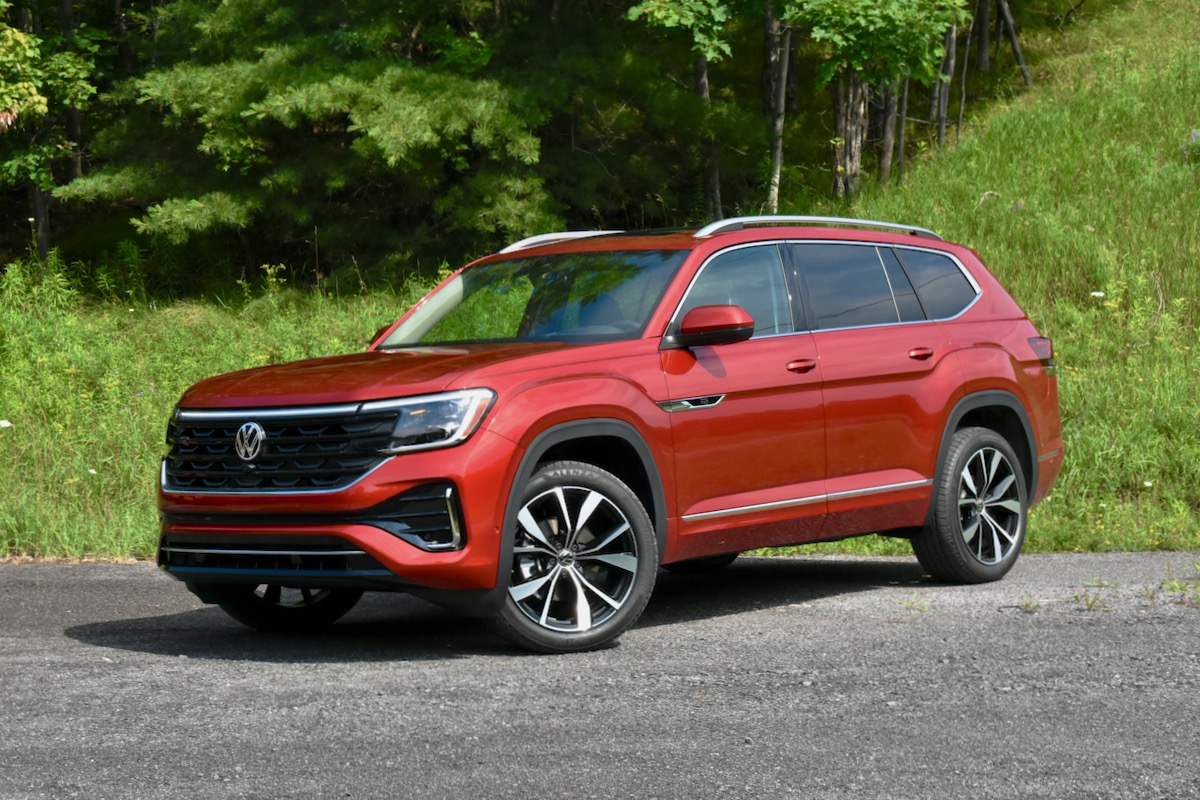
According to CarGurus experts, the overall rating for the 2024 Volkswagen Atlas is 7.3 out of 10, while the 2024 Chevrolet Blazer EV scores 6.3 out of 10. Based on these ratings, the Volkswagen Atlas emerges as the recommended choice. It offers superior cargo space, spacious passenger accommodations, and comprehensive safety features, making it a better-rounded family vehicle compared to the Blazer EV. While the Blazer EV brings innovative technology and electric powertrain benefits, it falls short in areas crucial for everyday practicality. The Atlas’ higher rating reflects its all-around appeal for consumers looking for a reliable and versatile mid-size SUV.
Choose the 2024 Volkswagen Atlas if:
- You need ample cargo space: With up to 96.6 cubic feet, the Atlas offers more cargo room than nearly all rivals.
- You value passenger room: The Atlas provides competitive headroom and legroom across all three rows.
- Advanced safety features are a priority: The Atlas includes standard driver-assist features like forward collision warning and adaptive cruise control.


Choose the 2024 Chevrolet Blazer EV if:
- You prefer an EV-specific platform: The Blazer EV benefits from GM's Ultium component set for optimized battery performance.
- You want a high-tech infotainment system: The new Google-based system offers built-in apps and large, high-resolution displays.
- Regenerative braking control matters: The Blazer EV features steering-wheel paddles to adjust regen levels, enhancing driver engagement.


CarGurus highlights
According to CarGurus experts, the overall rating for the 2024 Volkswagen Atlas is 7.3 out of 10, while the 2024 Chevrolet Blazer EV scores 6.3 out of 10. Based on these ratings, the Volkswagen Atlas emerges as the recommended choice. It offers superior cargo space, spacious passenger accommodations, and comprehensive safety features, making it a better-rounded family vehicle compared to the Blazer EV. While the Blazer EV brings innovative technology and electric powertrain benefits, it falls short in areas crucial for everyday practicality. The Atlas’ higher rating reflects its all-around appeal for consumers looking for a reliable and versatile mid-size SUV.
Choose the 2024 Volkswagen Atlas if:
Shop Now- You need ample cargo space: With up to 96.6 cubic feet, the Atlas offers more cargo room than nearly all rivals.
- You value passenger room: The Atlas provides competitive headroom and legroom across all three rows.
- Advanced safety features are a priority: The Atlas includes standard driver-assist features like forward collision warning and adaptive cruise control.
Choose the 2024 Chevrolet Blazer EV if:
Shop Now- You prefer an EV-specific platform: The Blazer EV benefits from GM's Ultium component set for optimized battery performance.
- You want a high-tech infotainment system: The new Google-based system offers built-in apps and large, high-resolution displays.
- Regenerative braking control matters: The Blazer EV features steering-wheel paddles to adjust regen levels, enhancing driver engagement.

By: CarGurus + AI
At CarGurus, our team of experienced automotive writers remain at the heart of our content operation, conducting hands-on car tests and writing insightful guides that are backed by years of industry experience. To complement this, we are harnessing AI to make our content offering more diverse and more helpful to shoppers than ever. To achieve this, our AI systems are based exclusively on CarGurus content, ratings and data, so that what we produce is both unique to CarGurus, and uniquely helpful to car shoppers.

