2024 Subaru Forester vs 2025 Toyota 4Runner

Overview | |
Listings137 | Listings72 |
Ratings & Reviews | |
User Reviews | User Reviews |
Expert reviews | Expert reviews7.7 out of 10 |
Pros
Cons
| |
2024 Subaru Forester Reviews Summary | |
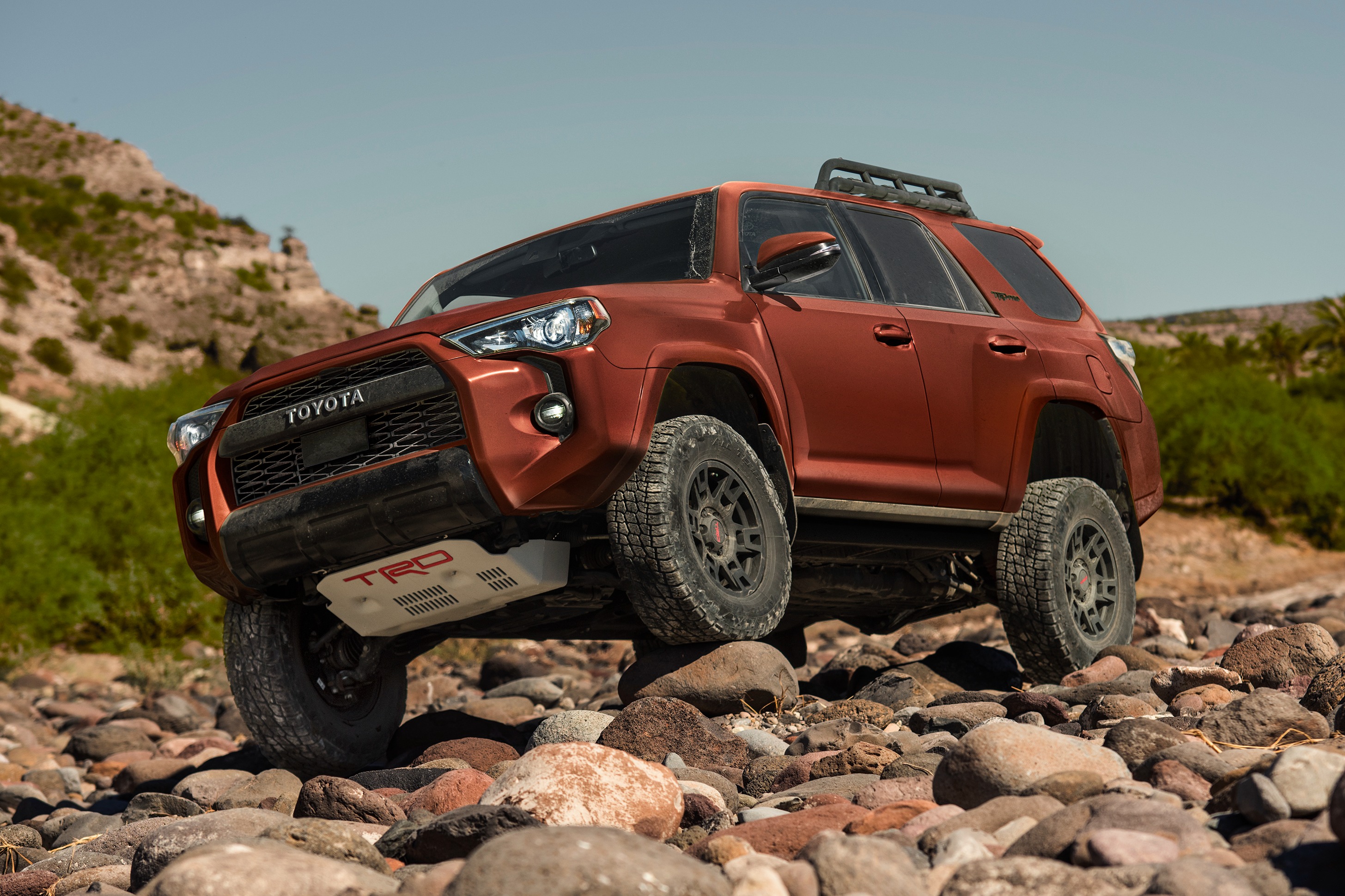
2025 Toyota 4Runner Reviews SummaryAfter a very long 15 years, we’ve finally got a new Toyota 4Runner with more capabilities, power, comfort, and technology. It's also more efficient thanks to a new hybrid option and more composed on pavement, but it remains a solid all-terrain vehicle to extend your adventures further. Verdict: Toyota doesn't throw out the formula with its newly redesigned 4Runner. Instead, the 2025 model keeps many of the features shoppers have loved for over a decade, while also adding a more contemporary selection of four-cylinder powertrains. | |
No video found | |
Popular Features & Specs | |
Engine2.5L 182 hp H4 | Engine2.4L 278 hp I4 |
DrivetrainAWD | Drivetrain4X2 |
Seating Capacity5 | Seating Capacity7 |
Horsepower182 hp @ 5800 rpm | Horsepower278 hp @ 6000 rpm |
Fuel Economy (City)9.0 L(e)/100 km | Fuel Economy (City)11.8 L(e)/100 km |
Fuel Economy (Highway)7.1 L(e)/100 km | Fuel Economy (Highway)9.0 L(e)/100 km |
Engine | |
Engine Name2.5L 182 hp H4 | Engine Name2.4L 278 hp I4 |
Torque176 lb-ft @ 4400 rpm | Torque317 lb-ft @ 1700 rpm |
Horsepower182 hp @ 5800 rpm | Horsepower278 hp @ 6000 rpm |
DrivetrainAWD | Drivetrain4X2 |
Fuel Economy | |
Fuel Economy (City)9.0 L(e)/100 km | Fuel Economy (City)11.8 L(e)/100 km |
Fuel Economy (Highway)7.1 L(e)/100 km | Fuel Economy (Highway)9.0 L(e)/100 km |
Interior | |
Seating Capacity5 | Seating Capacity7 |
Safety | |
Front Crash Overall5 | Front Crash Overall4 |
Side Crash Overall5 | Side Crash Overall5 |
Dimensions & Capacity | |
Cargo Space818 L | Cargo Space1371 L |
Curb Weight1567 kg | Curb Weight2021 kg |
Height1715 mm | Height1844 mm |
Length4641 mm | Length4950 mm |
Width2055 mm | Width1981 mm |
Wheelbase2670 mm | Wheelbase2850 mm |
Maximum Payload652 kg | Maximum Payload406 kg |
Number of doors4 | Number of doors4 |
Maximum Towing Capacity680 kg | Maximum Towing Capacity2722 kg |
Standard Towing Capacity | Standard Towing Capacity2722 kg |
Overview | ||
Listings | ||
Ratings & Reviews | ||
User reviews | ||
Expert reviews | 7.7 out of 10Read full review | |
Pros & cons | Pros
Cons
| |
Summary | After a very long 15 years, we’ve finally got a new Toyota 4Runner with more capabilities, power, comfort, and technology. It's also more efficient thanks to a new hybrid option and more composed on pavement, but it remains a solid all-terrain vehicle to extend your adventures further. Verdict: Toyota doesn't throw out the formula with its newly redesigned 4Runner. Instead, the 2025 model keeps many of the features shoppers have loved for over a decade, while also adding a more contemporary selection of four-cylinder powertrains. | |
Video | No video found | |
Popular Features & Specs | ||
Engine | 2.5L 182 hp H4 | 2.4L 278 hp I4 |
Drivetrain | AWD | 4X2 |
Seating Capacity | 5 | 7 |
Horsepower | 182 hp @ 5800 rpm | 278 hp @ 6000 rpm |
Fuel Economy (City) | 9.0 L(e)/100 km | 11.8 L(e)/100 km |
Fuel Economy (Highway) | 7.1 L(e)/100 km | 9.0 L(e)/100 km |
Engine | ||
Engine Name | 2.5L 182 hp H4 | 2.4L 278 hp I4 |
Torque | 176 lb-ft @ 4400 rpm | 317 lb-ft @ 1700 rpm |
Horsepower | 182 hp @ 5800 rpm | 278 hp @ 6000 rpm |
Drivetrain | AWD | 4X2 |
Fuel Economy | ||
Fuel Economy (City) | 9.0 L(e)/100 km | 11.8 L(e)/100 km |
Fuel Economy (Highway) | 7.1 L(e)/100 km | 9.0 L(e)/100 km |
Interior | ||
Seating Capacity | 5 | 7 |
Safety | ||
Front Crash Overall | 5 | 4 |
Side Crash Overall | 5 | 5 |
Dimensions & Capacity | ||
Cargo Space | 818 L | 1371 L |
Curb Weight | 1567 kg | 2021 kg |
Height | 1715 mm | 1844 mm |
Length | 4641 mm | 4950 mm |
Width | 2055 mm | 1981 mm |
Wheelbase | 2670 mm | 2850 mm |
Maximum Payload | 652 kg | 406 kg |
Number of doors | 4 | 4 |
Maximum Towing Capacity | 680 kg | 2722 kg |
Standard Towing Capacity | 2722 kg | |
2024 Subaru Forester for Sale


2025 Toyota 4Runner for Sale


By: CarGurus + AI
At CarGurus, our team of experienced automotive writers remain at the heart of our content operation, conducting hands-on car tests and writing insightful guides that are backed by years of industry experience. To complement this, we are harnessing AI to make our content offering more diverse and more helpful to shoppers than ever. To achieve this, our AI systems are based exclusively on CarGurus content, ratings and data, so that what we produce is both unique to CarGurus, and uniquely helpful to car shoppers.
