2021 Toyota 4Runner vs 2021 Acura RDX
Overview | |
MSRP$38,400 | MSRP$36,765 |
Listings111 | Listings196 |
Ratings & Reviews | |
User Reviews | User Reviews |
Expert reviews8.2 out of 10 | Expert reviews6.2 out of 10 |
Pros
Cons
| Pros
Cons
|
2021 Acura RDX Reviews SummaryWhen Acura last redesigned the RDX for the 2019 model year, the company began a transformation that is now accelerating with the debut of the all-new 2021 TLX sedan and soon-to-arrive 2022 MDX SUV. Adopting the company’s latest exterior styling and interior design philosophies, as well as the completely rethought True Touch Interface infotainment system, the third-generation RDX confirmed Acura’s intent to return to the performance ethos that guided the brand during its early years. Now, according to Acura, the RDX is the bestselling model in its segment and one of the bestselling luxury vehicles in America. It is deserving of this stature. | |
2021 Toyota 4Runner Reviews SummaryDespite its design age, poor fuel economy, rough ride, iffy handling, and marginal safety ratings, the current-generation Toyota 4Runner remains a popular choice in a midsize SUV. Why? Its reputation for reliability and resale value, coupled with its undeniable utility, rugged image, and go-anywhere and do-anything capability, are the selling points. And if that's why you want a 2021 Toyota 4Runner, it won't disappoint you as long as you accept its shortcomings. | |
No video found | |
Popular Features & Specs | |
Engine2.0L 272 hp I4 | Engine4.0L 270 hp V6 |
Drive TrainFWD | Drive Train4X2 |
Seating Capacity5 | Seating Capacity7 |
Horsepower272 hp @ 6500 rpm | Horsepower270 hp @ 5600 rpm |
MPG City22 | MPG City16 |
MPG Highway28 | MPG Highway19 |
Engine | |
Engine Name2.0L 272 hp I4 | Engine Name4.0L 270 hp V6 |
Torque280 lb-ft @ 1600 rpm | Torque278 lb-ft @ 4400 rpm |
Horsepower272 hp @ 6500 rpm | Horsepower270 hp @ 5600 rpm |
DrivetrainFWD | Drivetrain4X2 |
Fuel Economy | |
MPG City22 | MPG City16 |
MPG Highway28 | MPG Highway19 |
Interior | |
Seating Capacity5 | Seating Capacity7 |
Key Features | |
Sunroof/MoonroofStandard | Sunroof/Moonroof |
Safety | |
Front Crash Overall4 | Front Crash Overall4 |
Side Crash Overall5 | Side Crash Overall5 |
Dimensions & Capacity | |
Cargo Space29.5 cu ft | Cargo Space47.2 cu ft |
Curb Weight3783 lbs | Curb Weight4400 lbs |
Height65.7 in | Height71.5 in |
Length186.6 in | Length190.2 in |
Width74.8 in | Width75.8 in |
Wheelbase108.3 in | Wheelbase109.8 in |
Maximum Payload1001 lbs | Maximum Payload1700 lbs |
Number of doors4 | Number of doors4 |
Maximum Towing Capacity1500 lbs | Maximum Towing Capacity5000 lbs |
Standard Towing Capacity | Standard Towing Capacity5000 lbs |
Overview | ||
MSRP | $38,400 | $36,765 |
Listings | ||
Ratings & Reviews | ||
User reviews | ||
Expert reviews | 8.2 out of 10Read full review | 6.2 out of 10Read full review |
Pros & cons | Pros
Cons
| Pros
Cons
|
Summary | When Acura last redesigned the RDX for the 2019 model year, the company began a transformation that is now accelerating with the debut of the all-new 2021 TLX sedan and soon-to-arrive 2022 MDX SUV. Adopting the company’s latest exterior styling and interior design philosophies, as well as the completely rethought True Touch Interface infotainment system, the third-generation RDX confirmed Acura’s intent to return to the performance ethos that guided the brand during its early years. Now, according to Acura, the RDX is the bestselling model in its segment and one of the bestselling luxury vehicles in America. It is deserving of this stature. | Despite its design age, poor fuel economy, rough ride, iffy handling, and marginal safety ratings, the current-generation Toyota 4Runner remains a popular choice in a midsize SUV. Why? Its reputation for reliability and resale value, coupled with its undeniable utility, rugged image, and go-anywhere and do-anything capability, are the selling points. And if that's why you want a 2021 Toyota 4Runner, it won't disappoint you as long as you accept its shortcomings. |
Video | No video found | |
Popular Features & Specs | ||
Engine | 2.0L 272 hp I4 | 4.0L 270 hp V6 |
Drive Train | FWD | 4X2 |
Seating Capacity | 5 | 7 |
Horsepower | 272 hp @ 6500 rpm | 270 hp @ 5600 rpm |
MPG City | 22 | 16 |
MPG Highway | 28 | 19 |
Engine | ||
Engine Name | 2.0L 272 hp I4 | 4.0L 270 hp V6 |
Torque | 280 lb-ft @ 1600 rpm | 278 lb-ft @ 4400 rpm |
Horsepower | 272 hp @ 6500 rpm | 270 hp @ 5600 rpm |
Drivetrain | FWD | 4X2 |
Fuel Economy | ||
MPG City | 22 | 16 |
MPG Highway | 28 | 19 |
Interior | ||
Seating Capacity | 5 | 7 |
Key Features | ||
Sunroof/Moonroof | Standard | |
Safety | ||
Front Crash Overall | 4 | 4 |
Side Crash Overall | 5 | 5 |
Dimensions & Capacity | ||
Cargo Space | 29.5 cu ft | 47.2 cu ft |
Curb Weight | 3783 lbs | 4400 lbs |
Height | 65.7 in | 71.5 in |
Length | 186.6 in | 190.2 in |
Width | 74.8 in | 75.8 in |
Wheelbase | 108.3 in | 109.8 in |
Maximum Payload | 1001 lbs | 1700 lbs |
Number of doors | 4 | 4 |
Maximum Towing Capacity | 1500 lbs | 5000 lbs |
Standard Towing Capacity | 5000 lbs | |
In 2021, the Acura RDX, particularly with its optional A-Spec Package, captured the essence of sporty sophistication without venturing into the realm of excessive performance design. Unlike many crossovers attempting to disguise themselves as rugged off-roaders, the RDX embraced its true character, avoiding oversized skid plates and exaggerated fender flares. The RDX's styling choices were subtle yet undeniably effective, conveying a sense of sportiness suited for daily driving and long road trips.
Pricing for the base model of the RDX started at $38,200. The hierarchy progressed through the Technology Package at $41,100, the A-Spec Package at $44,100, and the Advance Package at $46,000. For those who sought additional capability, the SH-AWD system added another $2,000. A fully equipped RDX A-Spec SH-AWD, with the premium Platinum White paint, brought the total to $47,625, including the destination charge.
Inside, the A-Spec package transformed the cabin into a sporty haven with front sport seats featuring simulated suede inserts, a distinctive sport steering wheel, black headliner, dark brushed aluminum trim, and unique gauges with red markings that, while stylish, posed a readability issue. This setup wasn't typical of compact crossover SUV interiors, where form often follows function. However, the distinctive red ambient lighting, red exposed stitching, and the option to choose black or red upholstery enhanced the sporty feel of the RDX's interior.
The 2021 Toyota 4Runner struck a very different chord. The 4Runner, last redesigned 12 years before, maintained a rugged, old-school utility. Its design featured a robust, two-box body with flared fenders and trapezoidal wheel arches, ensuring balanced proportions and timeless styling. The chrome-festooned 4Runner Limited deviated somewhat from this rugged visage, but the overall effect remained solid and dependable.
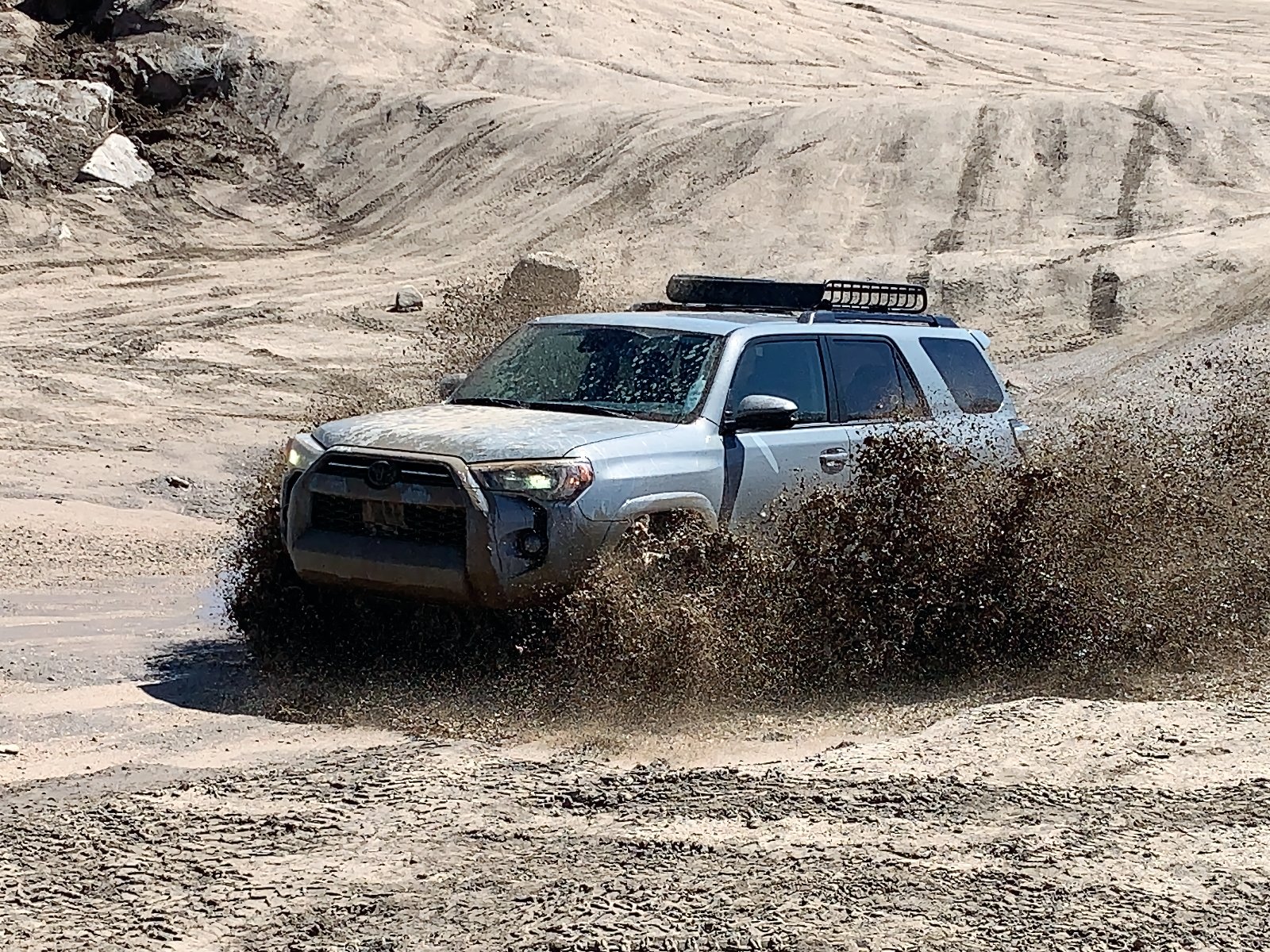
Toyota's trim selection for the 4Runner ranged from the SR5 at $36,950 to the TRD Pro at $50,570. Our test vehicle, the Trail Special Edition, priced affordably at $38,565 for the RWD model and $43,729 including 4WD and additional features like a premium audio upgrade. The exclusive limited-run Trail Special Edition was adorned in colors like white, black, Cement (gray), and Army Green, with dark gray TRD Off-Road wheels and a Yakima RoadWarrior rooftop cargo basket.
The interior of the 4Runner Trail Special Edition continued the rugged theme with black cloth upholstery and tan stitching, all-weather floor mats, a practical sliding rear cargo tray, and an exclusive 40-quart cooler. Hard plastics dominated the interior, in keeping with the SUV's utilitarian mission. The dashboard featured large knobs and buttons with a manual air conditioning system, and a traditional key twist start, endearing the 4Runner to fans of simplicity and durability.


The 2021 Acura RDX universally featured a turbocharged 2.0-liter four-cylinder engine producing 272 horsepower at 6,500 rpm and 280 pound-feet of torque from 1,600 to 4,500 rpm. Despite its sporty A-Spec packaging, there was no enhancement to the performance metrics. The powertrain included a 10-speed automatic transmission with paddle shifters, defaulting to front-wheel drive unless upgraded to the SH-AWD system. This system could direct up to 70% of the engine's output to the rear wheels and distribute 100% of that share to either rear wheel, immensely enhancing handling.
Drivers could switch between Snow, Comfort, Sport, and Sport+ driving modes using the Integrated Dynamics System. These modes adjusted powertrain response, steering, and adaptive-damping suspension firmness in models equipped with the Advance Package. While the A-Spec benefited from exclusive Shark Gray 20-inch alloy wheels with larger, lower-profile tires, it did not include adaptive dampers, sacrificing some road handling on less-than-perfect surfaces.
Additionally, while it didn't offer a rev-matching feature for the 10-speed automatic transmission or summer performance tires, the RDX A-Spec remained rewarding to drive. The engine's broad torque curve, predictable handling, and precise steering, combined with SH-AWD and competent brakes, provided an engaging driving experience. Sport+ mode further heightened the driving dynamics with a more aggressive engine note.
Conversely, the 2021 Toyota 4Runner showcased its rugged capability during an off-road excursion at Hungry Valley State Vehicular Recreational Area. Equipped with a 4.0-liter V6 engine delivering 270 horsepower at 5,600 rpm and 278 pound-feet of torque at 4,400 rpm, the 4Runner's performance metrics were complemented by a five-speed automatic transmission. The part-time 4WD system facilitated serious off-roading, with the Trail Special Edition leveraging the A-Trac off-road traction control system effectively.
Tackling challenging terrains, the 4Runner demonstrated its prowess, especially with additional off-road-ready features in higher trims like a locking rear differential, Multi-Terrain Select, and Crawl Control. However, during typical on-road driving, the 4Runner felt cumbersome, slow, and heavy. Its steering and brake response were less refined, reflecting the SUV's age and truck-like build.
The 4Runner’s off-road excellence came at the cost of fuel efficiency, averaging 16.8 mpg in combined driving, including off-road use. Despite its performance prowess on rough terrains, the 4Runner's truck-like characteristics made urban driving less appealing.
While the 2021 Acura RDX fell within the compact SUV category, its interior provided spacious passenger and cargo accommodations, making it an excellent value. The front seats were exceptionally comfortable, featuring 12-way power adjustments, heating, and ventilation in the A-Spec trim. However, rear-seat comfort was compromised due to the design aimed at maximizing cargo utility, resulting in an uncomfortable slouch for passengers.
Official cargo volume behind the rear seats was 29.5 cubic feet, expanding to 58.9 cubic feet with the rear seats folded. Despite these modest figures, the trunk space appeared accommodating, enhanced by a deep storage well and additional compartments under the cargo floor, useful for organizing smaller items.
In contrast, the 2021 Toyota 4Runner emphasized off-road utility throughout its interior design. Its higher stance could pose a challenge for shorter individuals, while the available running boards added convenience. Inside, the 4Runner offered generous legroom and visibility in the rear seats, with supportive seating and modern amenities like air conditioning vents and USB charging ports.
The 4Runner's configurable cargo space was notable, measuring up to 47.2 cubic feet behind the rear seats and 89.7 cubic feet with seats folded, combined with the Trail Special Edition's roof rack. Interior storage was practical, accommodating a variety of items for various adventures. Additionally, the sliding cargo deck, despite taking up some space, proved beneficial for lifestyle-oriented functionalities.
Acura's True Touchpad Interface (TTI) characterized the 2021 RDX, offering a unique approach to infotainment without a touchscreen. The pad mirrored screen positions for inputs but required an adjustment period from users, often causing distractions due to its unconventional operation method. Acura attempted to mitigate these issues by providing traditional physical knobs and integrating key convenience features like Apple CarPlay, Android Auto, Amazon Alexa, and a robust voice-recognition system. The A-Spec trim included a premium 16-speaker Acura/ELS Studio 3D audio system, providing an exceptional auditory experience.
In contrast, the 2021 Toyota 4Runner’s Trail Special Edition featured basic but functional technology. It included a windshield wiper de-icer system and a 120-volt AC power outlet in the cargo area. The standard 8-inch touchscreen infotainment system encompassed all expected modern features, including connectivity options like Apple CarPlay and Android Auto. The premium audio upgrade added navigation and enhanced voice recognition. Despite its old-school appearance, the infotainment system's responsive and user-friendly nature made it effective and practical.
Safety was a priority for the 2021 Acura RDX, equipped with the AcuraWatch package. It included adaptive cruise control, lane-keep assist, forward-collision warning, and automatic emergency braking. However, blind-spot warning and rear cross-traffic alert were available only with the Technology Package. The RDX earned stellar safety ratings, including the IIHS "Top Safety Pick+" and a five-star overall NHTSA rating, contributing to its reputation for occupant protection.
The 2021 Toyota 4Runner came with Toyota Safety Sense P (TSS-P), covering basics like adaptive cruise control, forward-collision warning, and lane departure warning. However, the system lacked advanced features and essential technologies like blind-spot warning and rear cross-traffic alert. The 4Runner showcased mixed safety ratings due to its age, with a lower NHTSA frontal-impact and small overlap frontal-impact rating from the IIHS.
CarGurus highlights

According to CarGurus experts, the overall rating for the 2021 Acura RDX was 8.2 out of 10, while the 2021 Toyota 4Runner scored 6.2 out of 10. Given these ratings, the Acura RDX emerges as the more recommended vehicle, praised for its blend of sporty aesthetics, advanced technology, and robust safety features. The 4Runner excels in off-road capability and rugged utility, but for a more balanced and versatile driving experience, the RDX stands out as the superior choice.
Choose the 2021 Toyota 4Runner if:
- Off-road adventures and rugged durability are at the top of your list.
- You appreciate the simplicity and reliability of a tried-and-true SUV design.
- Generous cargo space and practical interior features are essential for your lifestyle needs.


Choose the 2021 Acura RDX if:
- You value a sporty, sophisticated design that stands out in the compact SUV market.
- Advanced infotainment technology and superior audio quality are top priorities.
- You seek high safety ratings and extensive driver assistance systems for peace of mind.


CarGurus highlights
According to CarGurus experts, the overall rating for the 2021 Acura RDX was 8.2 out of 10, while the 2021 Toyota 4Runner scored 6.2 out of 10. Given these ratings, the Acura RDX emerges as the more recommended vehicle, praised for its blend of sporty aesthetics, advanced technology, and robust safety features. The 4Runner excels in off-road capability and rugged utility, but for a more balanced and versatile driving experience, the RDX stands out as the superior choice.
Choose the 2021 Toyota 4Runner if:
Shop Now- Off-road adventures and rugged durability are at the top of your list.
- You appreciate the simplicity and reliability of a tried-and-true SUV design.
- Generous cargo space and practical interior features are essential for your lifestyle needs.
Choose the 2021 Acura RDX if:
Shop Now- You value a sporty, sophisticated design that stands out in the compact SUV market.
- Advanced infotainment technology and superior audio quality are top priorities.
- You seek high safety ratings and extensive driver assistance systems for peace of mind.

By: CarGurus + AI
At CarGurus, our team of experienced automotive writers remain at the heart of our content operation, conducting hands-on car tests and writing insightful guides that are backed by years of industry experience. To complement this, we are harnessing AI to make our content offering more diverse and more helpful to shoppers than ever. To achieve this, our AI systems are based exclusively on CarGurus content, ratings and data, so that what we produce is both unique to CarGurus, and uniquely helpful to car shoppers.

