2021 Acura RDX Reviews, Pricing & Specs




Expert review
A compact luxury crossover SUV, the popular 2021 Acura RDX blends size, utility, quality, safety, technology, performance, and value in an appealing overall package.
When Acura last redesigned the RDX for the 2019 model year, the company began a transformation that is now accelerating with the debut of the all-new 2021 TLX sedan and 2022 MDX SUV. Adopting the company’s latest exterior styling and interior design philosophies, as well as the completely rethought True Touch Interface infotainment system, the third-generation RDX confirmed Acura’s intent to return to the performance ethos that guided the brand during its early years. Now, the RDX is selling well in Canada relative to its segment.
out of 10 expert review
Look & feel
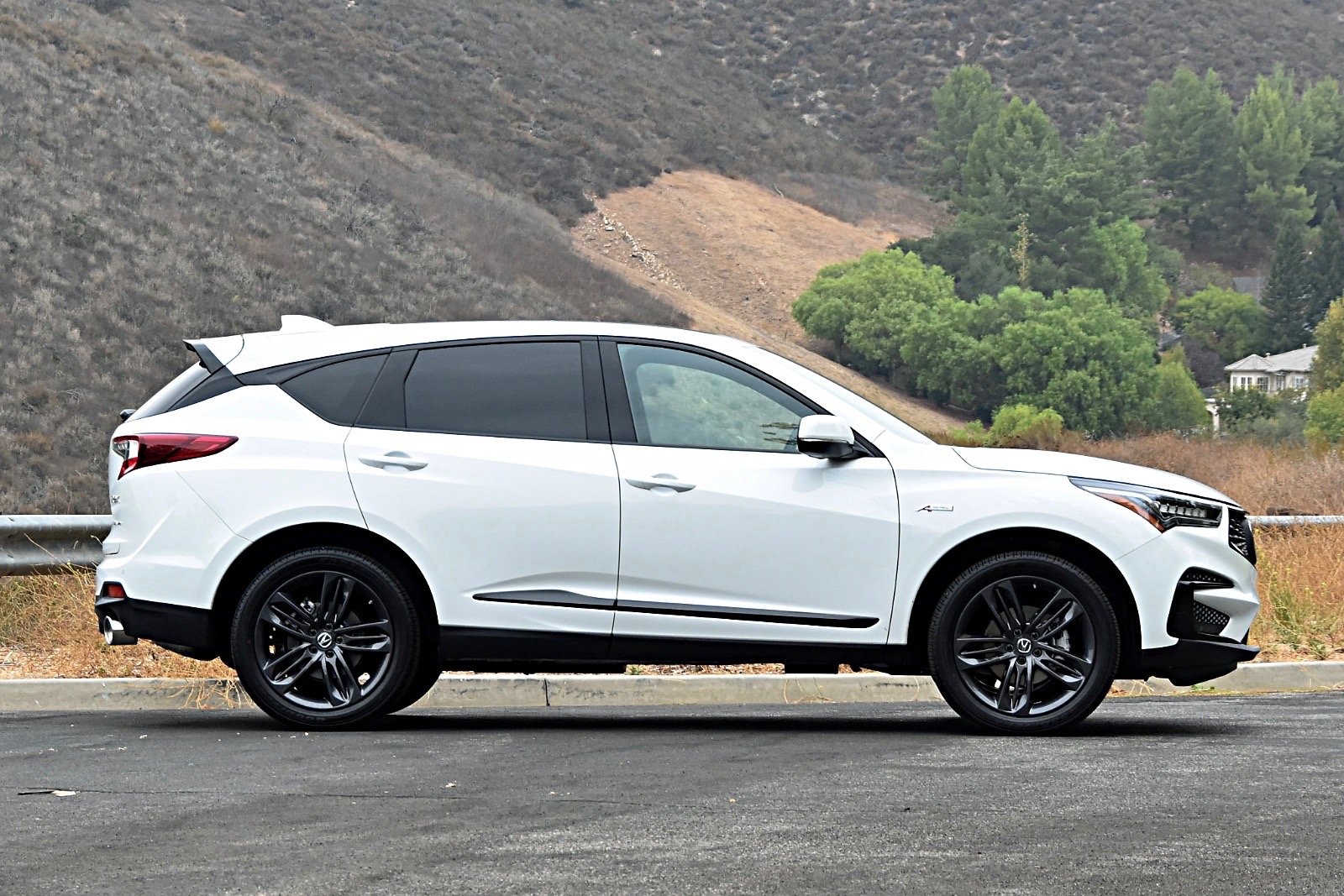
Especially in the A-Spec trim, the 2021 Acura RDX is a good looking SUV. Without going overboard on blacked-out trim or traditional performance design cues, the Acura RDX A-Spec’s styling changes are subtle yet effective, conveying sportiness without overpromising in the outright acceleration and handling departments.
Better yet, Acura doesn’t try to make the RDX look like a boulder-basher—because it isn’t one. You won’t find oversized skid plates, bulging fender flares, or other off-roading frippery on this SUV because, like almost every other crossover, it’s meant for daily driving and road-tripping, not rock-hopping.
The RDX A-Spec resides in the middle of the trim-level hierarchy. Base pricing for the RDX starts at $44,505 (a $2,375 destination charge is extra). From here, you can upgrade to the Tech trim, which raises the window sticker to $47,805. The A-Spec trim builds on this, bringing the MSRP to $50,305. The Elite grade comes with fewer styling amendments and is priced slightly lower at $50,005, and the top-of-the-line Platinum Elite rings up at $54,505. All trims come with standard Super Handling All-wheel Drive (SH-AWD); a drivetrain that integrates front-wheel drive (FWD) is not offered in Canada. Equipped with extra-cost Platinum White paint, our RDX A-Spec came to $60,371 including fees (Canadian, estimated).
With the A-Spec Package, the RDX’s interior adds front sport seats with simulated suede inserts and special piping, a sport steering wheel, a black headliner, dark brushed aluminum trim, sport pedals, red exposed stitching, red nighttime illumination, red ambient cabin lighting, and unique gauges. You can get the seats in black or red, though a light gray sure would be nice as an alternative.
As is true of the RDX A-Spec’s exterior, the interior delivers a sporty look and feel. From the quality materials and the thick-rimmed steering wheel to the form-over-function approach to some of the controls, the RDX doesn’t have a typical compact crossover SUV cabin.
If there’s anything to complain about, aside from the True Touchpad Interface (TTI) infotainment system (as we’ll cover below), it’s the gauge cluster. Instead of the clear white-on-black markings, you’ll find in other examples of the RDX, the A-Spec employs red markings on a brushed silver background, and they are quite hard to read, except at night.
Performance
All 2021 Acura RDX models get a 2.0-litre four-cylinder turbocharged engine making 272 horsepower at 6,500 rpm and 280 pound-feet of torque from 1,600 rpm to 4,500 rpm, so the A-Spec Package doesn’t provide anything extra in the way of performance.
A 10-speed automatic transmission with paddle shifters is standard, as is the torque-vectoring SH-AWD system, which can deliver up to 70% of total engine output to the RDX’s rear wheels and then put 100% of that share to either of the rear wheels. The result is a noticeable improvement in handling that makes the RDX genuinely fun to drive.
Using the silver knob that dominates the middle of the dashboard, drivers can use the Integrated Dynamics System to choose between Snow, Comfort, Sport, and Sport+ driving modes. They calibrate powertrain character and response, steering effort level and response, and in the RDX Platinum Elite, the firmness of the adaptive-damping suspension. Even the engine note changes, the RDX sounding more aggressive in Sport and Sport+ modes.
A-Spec models sit on exclusive Shark Gray 20-inch alloy wheels wearing larger and lower-profile 255/45 performance all-season tires. If there is a handling benefit to this version of the RDX, you can chalk it up to the slightly more aggressive rubber.
It sure would be nice if Acura offered the adaptive dampers on the A-Spec, which suffers a hint too much body motion when you’re whipping it down a favourite back road. After all, few roads are perfectly smooth, so added help dealing with the humps, dips, heaves, and holes the A-Spec encounters on its journey would undoubtedly come in handy.
Additionally, it would be nice if, when placed in Sport or Sport+ mode, the 10-speed automatic transmission matched revs when the driver is working the paddle shifters. A summer performance tire option would be swell, too.
Nevertheless, as it stands, the RDX A-Spec is rewarding to drive thanks to the turbo engine's broad torque curve, predictable handling characteristics, SH-AWD, precise and communicative steering, and fade-resistant brakes that are easy to modulate. And when you switch to Sport+ mode, the RDX exhibits more eager and aggressive behaviour in addition to a delightful (if artificial) engine sound.
Acura is preparing new Type S performance variants of the TLX sedan and MDX SUV. The RDX SUV also deserves the Type S treatment.
Form & function
Though priced and positioned as a compact SUV, the Acura RDX is anything but. It offers remarkable passenger and cargo space in a tidy package, and, in part because of this packaging, it is an extraordinary value.
Better yet, the front seats are mighty comfortable—an Acura hallmark. With A-Spec trim Alcantara and leather seats are included, and in this trim and most others, they offer 12-way power adjustment, are heated as standard and ventilated on A-Spec and Platinum Elite, and do an excellent job of holding you in place when ripping around corners and curves. If you want a heated steering wheel, you’ll need to spring for the A-Spec trim or higher.
As is often the case with SUVs, the Acura RDX’s need to maximize utility compromises rear-seat comfort. When you fold the rear seatbacks down, they rest on the back seat’s bottom cushion. Therefore, the lower and flatter the rear cushion is, the lower and flatter the resulting cargo floor is. In the RDX, this low and flat cushion results in a lack of rear passenger leg support. In combination with too much rear seatback recline angle, you wind up slouching in an uncomfortable and unsupported manner.
Storage space could be better, too. There is a huge tray under the dramatic centre console panel containing the TTI and transmission controls, but it’s not easily accessible while driving. If Acura redesigned its infotainment system, it could add more storage forward of the cupholders.
By the official numbers, cargo volume fails to impress, but the trunk is quite accommodating. It measures 835 litres behind the rear seat, and Acura provides a deep storage well to the left of the load floor, perfect for carrying jugs of milk, bottles of wine, or other items you’d rather didn’t roll around. Lift the cargo floor, and you’ll find three separate storage compartments that are quite useful for organizing the things you regularly carry with you, such as grocery shopping bags.
Fold the rear seats, and the RDX accommodates a standard rating of 1,668 litres of cargo, which is competitive but not class-leading. Still, the resulting area certainly looks large enough to handle most tasks. And there could be some room for interpretation of that latter modest measurement.
You see, Acura also quotes a maximum value of 2,260 litres, which it says is the number best used for comparison purposes with other compact SUVs. However, Acura bases this volume on moving the front seats all of the way forward and packing cargo on the floor behind them. Nobody loads an SUV that way, so ignore that figure unless you can confirm that companies like Audi, BMW, Cadillac, Infiniti, Lexus, Lincoln, Mercedes-Benz, and Volvo are basing their cargo measurements on the same methodology.
Technology
When Acura last redesigned the RDX, it introduced its True Touchpad Interface infotainment system with standard satellite radio, Bluetooth, and Wi-Fi tethering and an available on-board navigation system. It does not use a touchscreen. Instead, drivers use a touch-sensing pad on the centre console. Think of the touchpad on your laptop computer, and you’ll get the idea.
With the TTI, Acura tried to learn a lesson from Lexus, which also tried and, in some models, still uses, the same approach. At first, Lexus provided a physical mouse-type controller with haptic feedback. Then it transitioned to a touchpad that worked exactly like the one on a laptop. Now it’s phasing that out in favour of touchscreen control.
The trouble with the Lexus system was that the driver always needed to look at the screen to establish where the cursor was and then move it via fingertip to perform whatever command the driver wished to execute. It was, and is, terribly distracting.
Acura decided that its touchpad would mirror the screen. In other words, if the driver touches the lower left part of the pad, the action corresponds to the lower-left portion of the screen, placing control right where the driver intends. Once you retrain your brain to expect this behaviour from a touchpad, this is a better solution than the Lexus approach. But, especially if you regularly use a computer touchpad, this process of rewiring yourself is a lengthy one.
Also, TTI still doesn’t eliminate distraction because it remains easy to input a command mistakenly, and you must always confirm that your fingertip movement on the pad results in the desired action on the screen. Also, if your front passenger isn’t familiar with how TTI works, that adds an extra layer of unnecessary distraction.
Anyone who can afford to buy an Acura RDX likely owns a smartphone. They know how to swipe, scroll, pinch, spread, and tap on a glass display. At this point, there is no reason to rewrite this particular user-experience rulebook, even if TTI does represent an improvement over the Lexus approach.
Generally speaking, the ways to limit driver distraction are to:
- Separate the stereo and climate controls from the display using physical knobs and buttons
- Offer smartphone projection in the form of Apple CarPlay and Android Auto
- Integrate home voice assistant technology including Amazon Alexa and Google Home
- Develop faultless integrated voice-recognition technology that responds to natural voice commands as widely variable as “close the front windows” and “turn on the seat heaters” to “change temperature to 21” and “I want to listen to reggae music” (yes, there are some of us out there)
Acura gets many of these things right. After a week of driving this Acura, we were finally getting used to the TTI and remembering right off the bat that it works differently than both a Lexus and a MacBook Pro touchpad.
But it still isn’t ideal.
Ending this section on a high note, the A-Spec includes the same 16-speaker Acura/ELS Studio 3D premium audio system that comes with the Platinum Elite trim, and it sounds terrific.
Safety
Acura equips every 2021 RDX with a collection of safety features that includes all of the now-common features, such as adaptive cruise control, lane-keeping assist, lane-departure warning, forward-collision warning and automatic emergency braking, but not a blind-spot warning system and rear cross-traffic alert. For those, you’ll need to upgrade to the Tech trim at a minimum. That’s a shame because the RDX lease special is the base trim, and studies show that blind-spot warning is one of the most useful and effective modern safety technologies.
The RDX’s version of this suite is not as comprehensive as the package the automaker installs in the new TLX sedan. It lacks pedestrian detection, traffic-sign recognition, and Traffic Jam Assist, each of which is standard for the new TLX.
Nevertheless, in terms of their operational sophistication, the RDX’s systems are smoother, more accurate, and more refined than what the company offers in the outgoing third-generation MDX. As a result, you’re more likely to use them than to shut them off.
Should a collision occur, know that the Acura RDX does a great job of protecting its occupants. The SUV earned a 2020 calendar-year “Top Safety Pick+” rating from the Insurance Institute for Highway Safety (IIHS), and it gets a five-star overall rating from the National Highway Traffic Safety Administration (NHTSA). Note, however, that the SUV earns four-star frontal-impact and four-star rollover resistance crash-test ratings from the NHTSA.
Cost-effectiveness
With the 2021 Acura RDX, you get more for less. Depending on the competitive analysis, that could be related to size, equipment, power, or performance. Sometimes, it’s all four.
Mix in the RDX’s deftly penned design, quality interior materials, standard and available technologies, and high safety ratings, and it’s hard to go wrong with this Acura unless you want some of the customer pampering that comes with the purchase of a new Genesis or Lincoln.
Just keep in mind that you’ll need to get used to how the TTI works, and if you’re a serious driving enthusiast, you’ll want to hang tight to see if Honda and Acura will create an RDX Type S any time soon.

What owners say
"Overall, owners are quite pleased with the 2021 Acura RDX, praising its fantastic value, comfort, and fun driving experience. Many highlight the spacious interior and stylish design. However, some drivers expressed disappointment in the fuel economy and the audio system's performance, particularly how the noise canceling technology affects sound quality. A few also mentioned minor handling issues, but overall, the RDX is well-received."
Confident, quick, and clean — the right move I bought a 2021 Acura RDX A-Spec after a long stretch of research, quotes, and test drives. Came from a 2015 Mazda6—solid, efficient—but I was ready for something with more presence and power. The RDX gave me that without stepping into overpriced territory. The turbo delivers. Paired with the 10-speed, it moves when I need it, cruises when I don’t. Sport mode plus paddles gives just enough edge without trying too hard. The ride feels tight and grounded, and the A-Spec trim looks clean and confident—no chrome, no fluff. Inside, it’s a clear step up. Ultrasuede, ambient lighting, panoramic roof—it feels elevated, not loud. The ELS Studio sound system is better than I expected, no exaggeration. Fuel economy is lower than my old Mazda. I’m averaging 23–24 mpg mixed, which is fair for an AWD turbo, but it’s a drop. I expected it, but it’s worth noting. The button shifter is fine, but the tray underneath it is a catch-and-forget zone. I’ve left my phone in there more than once because of how tucked away it is. Not a flaw, just an adjustment. Same with the seat moving back when I shut the car off. Lighting fades, dash does a little goodbye animation. I’ve never had a car do all that before. It’s subtle, but now I notice. No issues with the infotainment or CarPlay. I plug in, it works. I’m not paying extra for AcuraLink remote start when the fob does the job just fine. Overall, this RDX feels like a clean step forward. It’s fast when I want it, quiet when I need it, and doesn’t feel like it’s trying to impress anyone. It just handles its business. I’d buy it again.
October 23, 2025Great pick up speed and acceleration for an SUV, love the AWD
April 10, 2026This car gets high marks for interior design, efficient use of space and comfort. On the other hand fuel economy is pretty poor considering vehicle size and throttle response. What is really disappointing is the impact of the noise canceling technology on the ability of the paying customer to control the sound of the audio system. If you want more bass tones you are out of luck. The more you turn the bass up the more the system cancels it out and the worse it sounds. Acura should just build a quiet car to begin with and not rely on electronic mumbo jumbo.
April 3, 2021What owners say
Confident, quick, and clean — the right move I bought a 2021 Acura RDX A-Spec after a long stretch of research, quotes, and test drives. Came from a 2015 Mazda6—solid, efficient—but I was ready for something with more presence and power. The RDX gave me that without stepping into overpriced territory. The turbo delivers. Paired with the 10-speed, it moves when I need it, cruises when I don’t. Sport mode plus paddles gives just enough edge without trying too hard. The ride feels tight and grounded, and the A-Spec trim looks clean and confident—no chrome, no fluff. Inside, it’s a clear step up. Ultrasuede, ambient lighting, panoramic roof—it feels elevated, not loud. The ELS Studio sound system is better than I expected, no exaggeration. Fuel economy is lower than my old Mazda. I’m averaging 23–24 mpg mixed, which is fair for an AWD turbo, but it’s a drop. I expected it, but it’s worth noting. The button shifter is fine, but the tray underneath it is a catch-and-forget zone. I’ve left my phone in there more than once because of how tucked away it is. Not a flaw, just an adjustment. Same with the seat moving back when I shut the car off. Lighting fades, dash does a little goodbye animation. I’ve never had a car do all that before. It’s subtle, but now I notice. No issues with the infotainment or CarPlay. I plug in, it works. I’m not paying extra for AcuraLink remote start when the fob does the job just fine. Overall, this RDX feels like a clean step forward. It’s fast when I want it, quiet when I need it, and doesn’t feel like it’s trying to impress anyone. It just handles its business. I’d buy it again.
October 23, 2025Great pick up speed and acceleration for an SUV, love the AWD
April 10, 2026This car gets high marks for interior design, efficient use of space and comfort. On the other hand fuel economy is pretty poor considering vehicle size and throttle response. What is really disappointing is the impact of the noise canceling technology on the ability of the paying customer to control the sound of the audio system. If you want more bass tones you are out of luck. The more you turn the bass up the more the system cancels it out and the worse it sounds. Acura should just build a quiet car to begin with and not rely on electronic mumbo jumbo.
April 3, 2021We decided between Lexus and Acura. Though Lexus scores just above in reliability and ease of tech features we chose the Acura RDX. The Lexus RX was too big and the NX too small for our needs and the Acura RDX was just the right in between size of those two cars. It has very good trunk space with even more storage underneath. There are levers in the trunk to let down the seats (a feature missing on the Lexus, if you are not tall you have to go to the backseat to let them down.) The seats also lay flat as opposed to quite an angle on the Lexus. The passenger seat on the Acura has all the same power comfort adjustments as the driver seat, we couldn’t find one Lexus with that, not even on the luxury trim. Acura also makes is easy to know what is in the car because all their trim levels have a sameset of features so looking for a used car was much easier than Lexus because though Lexus has trim levels customers can add on individual features that don’t come on the trim so you never know if what you are looking for is on the car . Even at the luxury level we could not find an NX with 360 view or Heads-up. I am sure they are out there just pretty hard to find. On the Acura we knew the Advanced package always had those features so it made looking easier. I also like that Acura has left the dead space underneath the console open for a bit more storage space, you can fit a small purse there. Dead space on the Lexus. So for those reasons we chose the Acura over the Lexus. However they are both very nice cars and I will say all the Lexus Dealerships we went to were superior in their customer service! We just liked the Acura car better.
February 18, 2024Great car so far. Very comfortable. Very fun to drive. Good acceleration. Good features. Acura did a great job with the RDX. I got the A spec which has a good color contrast. Seats 5 people comfortably. Decent room in the back. Great room with the back seats down. Would recommend the RDX.
February 23, 2022This car is amazing! Drives like a dream, roomy, and amazing styling.
May 6, 2021Great options. Fantastic safety features. This vehicle is very safe.
May 1, 2024The best car I owned. Acura RDX is the best luxury SUV in the market .
February 15, 2023The ASpec trim purchased has all features but a couple that the top Advanced trim has. The available incentives dropped the price right into my comfort zone. Looked at slightly pricier FPace and Corsair. Neither could approach the Acura value .
March 30, 2021Fantastic car. It is exactly the car & features I want. The RDX SH AWD is without a doubt the best car value in its class.
March 9, 2021Trims & specs
Base MSRP $41,300 | Seating 5 |
Engine 2.0L 272 hp I4 | Cargo Capacity 29.5 cu ft |
Combined MPG 25 | Drivetrain FWD |
Base MSRP $44,300 | Seating 5 |
Engine 2.0L 272 hp I4 | Cargo Capacity 29.5 cu ft |
Combined MPG 24 | Drivetrain FWD |
Base MSRP $46,300 | Seating 5 |
Engine 2.0L 272 hp I4 | Cargo Capacity 29.5 cu ft |
Combined MPG 23 | Drivetrain AWD |
Base MSRP $48,200 | Seating 5 |
Engine 2.0L 272 hp I4 | Cargo Capacity 29.5 cu ft |
Combined MPG 24 | Drivetrain AWD |
Base MSRP N/A | Seating N/A |
Engine N/A | Cargo Capacity N/A |
Combined MPG N/A | Drivetrain N/A |
Base MSRP $43,300 | Seating 5 |
Engine 2.0L 272 hp I4 | Cargo Capacity 29.5 cu ft |
Combined MPG 24 | Drivetrain AWD |
Base MSRP $40,400 | Seating 5 |
Engine 2.0L 272 hp I4 | Cargo Capacity 29.5 cu ft |
Combined MPG 24 | Drivetrain AWD |
Base MSRP $38,400 | Seating 5 |
Engine 2.0L 272 hp I4 | Cargo Capacity 29.5 cu ft |
Combined MPG 25 | Drivetrain FWD |
Base MSRP $46,200 | Seating 5 |
Engine 2.0L 272 hp I4 | Cargo Capacity 29.5 cu ft |
Combined MPG 25 | Drivetrain FWD |
Base MSRP $51,000 | Seating 5 |
Engine 2.0L 272 hp I4 | Cargo Capacity 29.5 cu ft |
Combined MPG 24 | Drivetrain AWD |


Pricing trends
MSRP range
$38,400 - $51,000
Current avg. market price
$32,826
Trending down by 0.5% this month
May 2026 - October 2026

