2020 Toyota Highlander vs 2021 Toyota RAV4

Overview | |
MSRP$34,600 | MSRP$26,350 |
Listings75 | Listings292 |
Ratings & Reviews | |
User Reviews | User Reviews |
Expert reviews7.2 out of 10 | Expert reviews7.3 out of 10 |
Pros
Cons
| |
2020 Toyota Highlander Reviews SummaryMidsize three-row SUVs are all spacious and powerful, but only the Toyota Highlander reaches the premium threshold for passenger comfort. Redesigned for 2020, the Highlander's revised styling and technology are secondary to its silent operation, soft ride, and cosseting interior. The upper trims feel and drive just like a Lexus, without the upcharge. There is nothing exciting about a Highlander, and yet, there is no other SUV in the $40,000 to $55,000 range that feels so effortless and tranquil. | |
2021 Toyota RAV4 Reviews SummarySince its launch in 1997, the Toyota RAV4 has ridden a wave of crossover SUV popularity to become one of Toyota’s bestselling models. Introduced for the 2019 model year, the current-generation RAV4 tries to offer the rugged style of a traditional SUV, but underneath it’s still a car-based crossover pitched against the likes of the Ford Escape, Honda CR-V, Hyundai Tucson, Kia Sportage, Nissan Rogue, Subaru Forester, and Volkswagen Tiguan. Because it’s only in its third model year, this fifth-generation RAV4 doesn’t get many updates for 2021. The biggest news is the addition of the RAV4 Prime plug-in hybrid to the lineup, but that model actually went on sale last year. Toyota offers compact SUV buyers more choices than most competitors. The Toyota RAV4 LE, XLE, and Limited trim levels are available with hybrid and non-hybrid powertrains. Toyota also offers the gasoline-only Premium package for the XLE grade and the RAV4 Trail grade with available TRD Off-Road package, plus the RAV4 Hybrid XSE. The RAV4 Prime is also available in two trim levels—SE and XSE. This review will focus on the gasoline RAV4. Our test car was a RAV4 Trail with the TRD Off-Road package, which joined the lineup for the 2020 model year and is the first RAV4 model tuned by Toyota Racing Development, the automaker’s North American performance division. | |
No video found | |
Popular Features & Specs | |
Engine3.5L 295 hp V6 | Engine2.5L 203 hp I4 |
Drive TrainFWD | Drive TrainFWD |
Seating Capacity8 | Seating Capacity5 |
Horsepower295 hp @ 6600 rpm | Horsepower |
MPG City20 | MPG City28 |
MPG Highway28 | MPG Highway35 |
Engine | |
Engine Name3.5L 295 hp V6 | Engine Name2.5L 203 hp I4 |
Torque263 lb-ft @ 4700 rpm | Torque |
Horsepower295 hp @ 6600 rpm | Horsepower |
DrivetrainFWD | DrivetrainFWD |
Fuel Economy | |
MPG City20 | MPG City28 |
MPG Highway28 | MPG Highway35 |
Interior | |
Seating Capacity8 | Seating Capacity5 |
Safety | |
Front Crash Overall4 | Front Crash Overall4 |
Side Crash Overall5 | Side Crash Overall5 |
Dimensions & Capacity | |
Cargo Space16.0 cu ft | Cargo Space37.6 cu ft |
Curb Weight4145 lbs | Curb Weight3370 lbs |
Height68.1 in | Height67.0 in |
Length194.9 in | Length180.9 in |
Width76.0 in | Width73.0 in |
Wheelbase112.2 in | Wheelbase105.9 in |
Maximum Payload1685 lbs | Maximum Payload1240 lbs |
Number of doors4 | Number of doors4 |
Maximum Towing Capacity5000 lbs | Maximum Towing Capacity1500 lbs |
Overview | ||
MSRP | $34,600 | $26,350 |
Listings | ||
Ratings & Reviews | ||
User reviews | ||
Expert reviews | 7.2 out of 10Read full review | 7.3 out of 10Read full review |
Pros & cons | Pros
Cons
| |
Summary | Midsize three-row SUVs are all spacious and powerful, but only the Toyota Highlander reaches the premium threshold for passenger comfort. Redesigned for 2020, the Highlander's revised styling and technology are secondary to its silent operation, soft ride, and cosseting interior. The upper trims feel and drive just like a Lexus, without the upcharge. There is nothing exciting about a Highlander, and yet, there is no other SUV in the $40,000 to $55,000 range that feels so effortless and tranquil. | Since its launch in 1997, the Toyota RAV4 has ridden a wave of crossover SUV popularity to become one of Toyota’s bestselling models. Introduced for the 2019 model year, the current-generation RAV4 tries to offer the rugged style of a traditional SUV, but underneath it’s still a car-based crossover pitched against the likes of the Ford Escape, Honda CR-V, Hyundai Tucson, Kia Sportage, Nissan Rogue, Subaru Forester, and Volkswagen Tiguan. Because it’s only in its third model year, this fifth-generation RAV4 doesn’t get many updates for 2021. The biggest news is the addition of the RAV4 Prime plug-in hybrid to the lineup, but that model actually went on sale last year. Toyota offers compact SUV buyers more choices than most competitors. The Toyota RAV4 LE, XLE, and Limited trim levels are available with hybrid and non-hybrid powertrains. Toyota also offers the gasoline-only Premium package for the XLE grade and the RAV4 Trail grade with available TRD Off-Road package, plus the RAV4 Hybrid XSE. The RAV4 Prime is also available in two trim levels—SE and XSE. This review will focus on the gasoline RAV4. Our test car was a RAV4 Trail with the TRD Off-Road package, which joined the lineup for the 2020 model year and is the first RAV4 model tuned by Toyota Racing Development, the automaker’s North American performance division. |
Video | No video found | |
Popular Features & Specs | ||
Engine | 3.5L 295 hp V6 | 2.5L 203 hp I4 |
Drive Train | FWD | FWD |
Seating Capacity | 8 | 5 |
Horsepower | 295 hp @ 6600 rpm | |
MPG City | 20 | 28 |
MPG Highway | 28 | 35 |
Engine | ||
Engine Name | 3.5L 295 hp V6 | 2.5L 203 hp I4 |
Torque | 263 lb-ft @ 4700 rpm | |
Horsepower | 295 hp @ 6600 rpm | |
Drivetrain | FWD | FWD |
Fuel Economy | ||
MPG City | 20 | 28 |
MPG Highway | 28 | 35 |
Interior | ||
Seating Capacity | 8 | 5 |
Safety | ||
Front Crash Overall | 4 | 4 |
Side Crash Overall | 5 | 5 |
Dimensions & Capacity | ||
Cargo Space | 16.0 cu ft | 37.6 cu ft |
Curb Weight | 4145 lbs | 3370 lbs |
Height | 68.1 in | 67.0 in |
Length | 194.9 in | 180.9 in |
Width | 76.0 in | 73.0 in |
Wheelbase | 112.2 in | 105.9 in |
Maximum Payload | 1685 lbs | 1240 lbs |
Number of doors | 4 | 4 |
Maximum Towing Capacity | 5000 lbs | 1500 lbs |
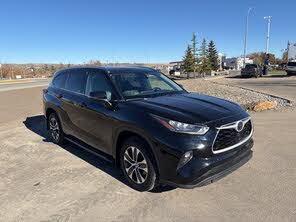
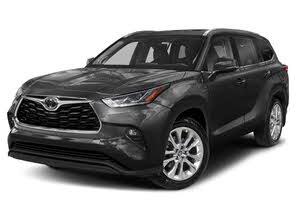
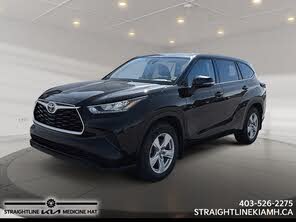
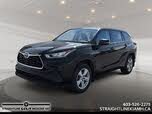
The 2020 Toyota Highlander presented a design that was subtle yet refined, with its trapezoidal theme evident in various elements like the tailgate's license plate cutout and the slimmer headlights. The vehicle's exterior, while not overly exciting, was complemented by new paint colours such as the attractive Blueprint. Inside, the Highlander boasted a cabin where quality fit and finish were paramount. The interior featured silver-painted accents and a multi-layered dash with an 8-inch touchscreen. The Limited trim offered a three-tone interior with rich textures, making it one of the nicest in its class, rivalled only by the Kia Telluride.
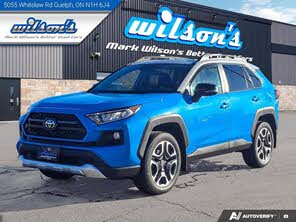
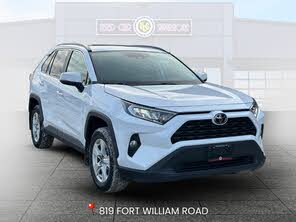
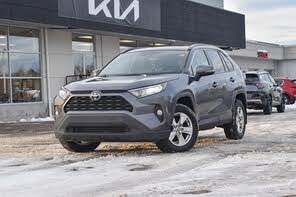
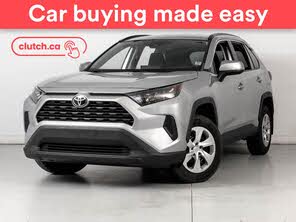
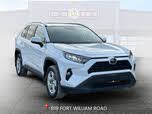
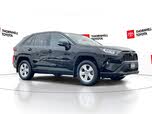
The 2021 Toyota RAV4, on the other hand, embraced a rugged SUV look with boxy fender flares and chiseled taillights, setting it apart from other compact crossovers. Despite its aggressive exterior, the RAV4 was built on the TNGA platform, shared with other Toyota models, which provided a solid foundation. The RAV4 Trail model added unique styling elements like an Ice Edge roof and orange interior accents, while the TRD Off-Road package included matte black wheels and all-terrain tires. The interior featured functional touches like large rubberized knobs, but material quality didn't elevate with higher trims, and real leather wasn't an option.


The 2020 Toyota Highlander was powered by a 3.5-litre V6 engine, delivering 295 horsepower and 263 pound-feet of torque. This engine, shared with the Lexus RX, provided smooth and brisk acceleration, though the eight-speed automatic transmission required a heavy foot for kickdown. The Highlander's steering was loose, and its soft suspension led to a floaty ride, but it offered a calming driving experience. Fuel efficiency was commendable, with the FWD model rated at 11.9 L/100 km in the city and 8.3 on the highway. The AWD version had slightly different figures, and the hybrid variant achieved an impressive 6.7 L/100 km combined.
The 2021 Toyota RAV4 featured a 2.5-litre four-cylinder engine producing 203 horsepower and 184 pound-feet of torque. While the engine was efficient, achieving 40% thermal efficiency, the transmission struggled to keep up, leading to a less dynamic driving experience. The RAV4's steering was responsive but lacked feel, and the Sport mode only added weight to the steering. On the highway, the RAV4 was quieter and more comfortable, but its off-road capabilities were more notable, with torque-vectoring AWD and a 3,500-pound towing capacity on certain models.
The 2020 Toyota Highlander offered seating for eight or seven with captain's chairs, with versatile second-row seats providing ample legroom. The vehicle's ergonomics were excellent, with easy ingress and egress. Cargo space was generous, with up to 2,378 litres available when seats were folded. The Highlander featured practical storage solutions, though the wireless charging pad could obstruct access to the centre armrest cubby.
The 2021 Toyota RAV4 provided competitive headroom and good visibility, but legroom was slightly behind competitors. The rear seats were less comfortable for long trips, and the cargo space, while above average, was not class-leading. The RAV4's interior featured oversized knobs and easy-to-use controls, but storage space on the console was limited, and the vehicle lacked large cupholders.
The 2020 Toyota Highlander's infotainment system was outdated, with low-resolution screens and a lack of onboard apps. However, it included Apple CarPlay and Android Auto, and the Platinum trim featured a 10-inch head-up display and a 7-inch instrument cluster display. The semi-automated driving system was effective, and the JBL audio system was decent.
The 2021 Toyota RAV4 offered standard Apple CarPlay and Android Auto, with screen sizes varying by trim. The infotainment system was user-friendly but not particularly advanced. The RAV4 lacked a head-up display on gasoline models, and while it didn't offer much for tech enthusiasts, it provided a straightforward interface for most users.
The 2020 Toyota Highlander came with Toyota Safety Sense 2.0, including features like automatic emergency braking and lane-keeping assist. It received a five-star overall safety rating from NHTSA and a 2020 Top Safety Pick from IIHS.
The 2021 Toyota RAV4 also featured Toyota Safety Sense 2.0, with additional features like road-sign recognition and Lane Tracing Assist. It earned a Top Safety Pick rating from IIHS and a five-star overall rating from NHTSA, though it missed the Top Safety Pick+ due to mixed headlight scores.
CarGurus highlights

According to CarGurus experts, the overall rating for the 2020 Toyota Highlander is 7.2 out of 10, while the 2021 Toyota RAV4 scores 7.3 out of 10. Based on these ratings, the 2021 Toyota RAV4 is recommended for its slightly higher overall score, offering a good mix of style, functionality, and off-road capability.
Choose the 2020 Toyota Highlander if:
- You prioritize a spacious and versatile interior with excellent ergonomics.
- You value a smooth and calming driving experience with good fuel efficiency.
- You seek a high level of interior quality and finish.





Choose the 2021 Toyota RAV4 if:
- You prefer a rugged SUV look with off-road capabilities.
- You want a straightforward and user-friendly infotainment system.
- You need a vehicle with a good balance of on-road comfort and off-road potential.






CarGurus highlights
According to CarGurus experts, the overall rating for the 2020 Toyota Highlander is 7.2 out of 10, while the 2021 Toyota RAV4 scores 7.3 out of 10. Based on these ratings, the 2021 Toyota RAV4 is recommended for its slightly higher overall score, offering a good mix of style, functionality, and off-road capability.
Choose the 2020 Toyota Highlander if:
Shop Now- You prioritize a spacious and versatile interior with excellent ergonomics.
- You value a smooth and calming driving experience with good fuel efficiency.
- You seek a high level of interior quality and finish.





Choose the 2021 Toyota RAV4 if:
Shop Now- You prefer a rugged SUV look with off-road capabilities.
- You want a straightforward and user-friendly infotainment system.
- You need a vehicle with a good balance of on-road comfort and off-road potential.









By: CarGurus + AI
At CarGurus, our team of experienced automotive writers remain at the heart of our content operation, conducting hands-on car tests and writing insightful guides that are backed by years of industry experience. To complement this, we are harnessing AI to make our content offering more diverse and more helpful to shoppers than ever. To achieve this, our AI systems are based exclusively on CarGurus content, ratings and data, so that what we produce is both unique to CarGurus, and uniquely helpful to car shoppers.