2021 Toyota RAV4 Reviews, Pricing & Specs


Expert review
The Toyota RAV4 is one of the longer-running crossovers available to Canadian buyers. Is this 2021 model worth considering?
Since its launch in 1997, the Toyota RAV4 has ridden a wave of crossover SUV popularity to become one of Toyota’s bestselling models. Introduced for the 2019 model year, the current-generation RAV4 tries to offer the rugged style of a traditional SUV, but underneath it’s still a car-based crossover pitched against the likes of the Ford Escape, Honda CR-V, Hyundai Tucson, Kia Sportage, Nissan Rogue, Subaru Forester, and Volkswagen Tiguan.
Because it’s only in its third model year, this fifth-generation RAV4 doesn’t get many updates for 2021. The biggest news is the addition of the RAV4 Prime plug-in hybrid to the lineup, but that model actually went on sale last year.
Toyota offers compact SUV buyers more choices than most competitors. The Toyota RAV4 LE, XLE, and Limited trim levels are available with hybrid and non-hybrid powertrains. Toyota also offers the gasoline-only Premium package for the XLE grade and the RAV4 Trail grade with available TRD Off-Road package, plus the RAV4 Hybrid XSE. The RAV4 Prime is also available in two trim levels—SE and XSE.
This review will focus on the gasoline RAV4. Our test car was a RAV4 Trail with the TRD Off-Road package, which joined the lineup for the 2020 model year and is the first RAV4 model tuned by Toyota Racing Development, the automaker’s North American performance division.
out of 10 expert review
Look & feel
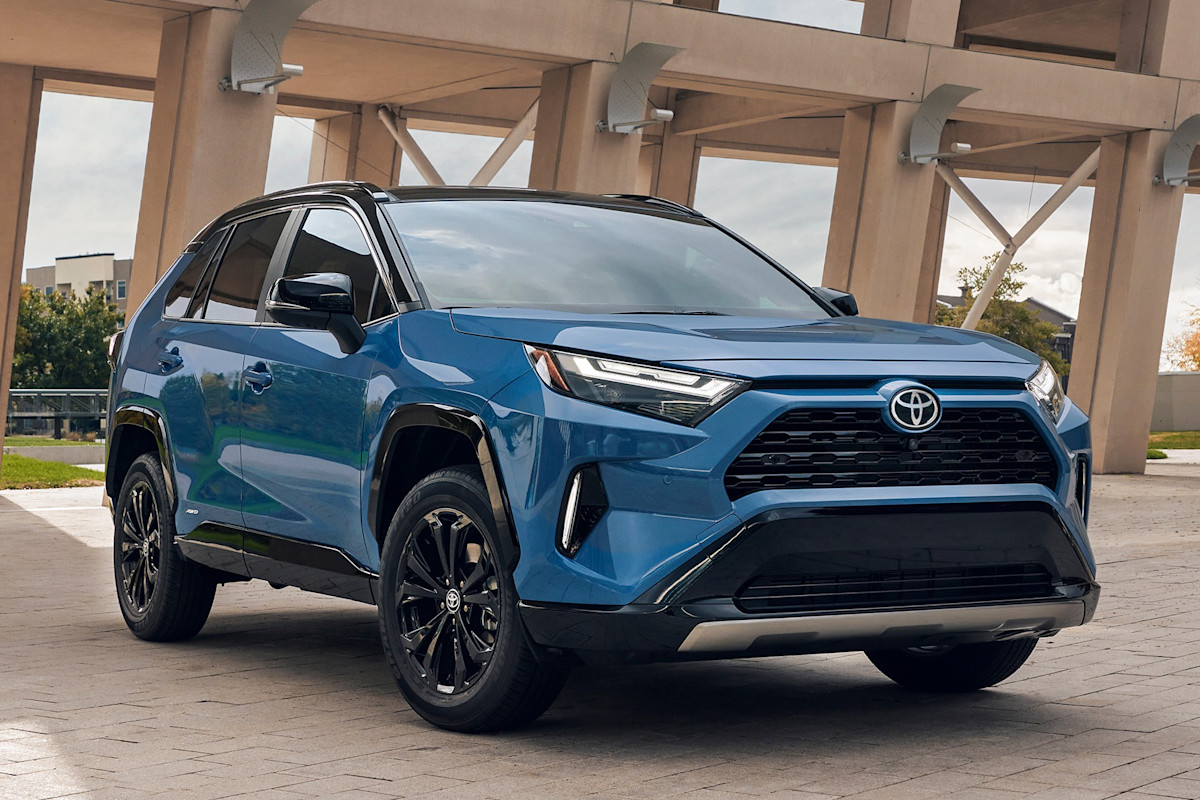
Toyota knows that one of the major reasons buyers choose crossovers over conventional cars is styling, so it gave the RAV4 the rugged-looking exterior of a traditional SUV. The boxy fender flares, chiseled taillights, and scowling front end sharply contrast the more approachable look of previous RAV4 generations, as well as most other compact crossovers on the market today. The exterior is fairly aggressive looking for a family car, but stands out against the competition and adds to the perception that the RAV4 is more than just an ordinary vehicle.
Under the sheet metal, however, the RAV4 is just an ordinary vehicle. It’s based on the Toyota New Global Architecture (TNGA) platform used by most of the automaker’s other models. TNGA is a well-engineered platform that’s served as a solid foundation for sedans, hatchbacks, and the Toyota Sienna minivan, so that’s not a bad thing. It just means that, while the styling says 4Runner, the mechanical bits say Camry.
Toyota provides a few options to jazz up the gasoline RAV4 even further. The RAV4 Trail model adds an Ice Edge (white) roof for a retro look, plus orange interior accent stitching and trim. (Note the white roof is offered in Canada, but the exact colour combination on the U.S. model pictured is not available.) The TRD Off-Road package adds matte black 18-inch alloy wheels (19-inch wheels are available on some trim levels as well), LED fog lights, red interior accents, and the TRD front skid plate.
The interior gets a few rugged styling touches as well, including large rubberized knobs and door handles. Those are functional touches that also help distinguish the RAV4 cabin from those of other Toyota models. Material quality is fairly good on lower trim levels but doesn’t get elevated in step with the price of the highest trims. Our TRD Off-Road test car had SofTex upholstery, which Toyota claims is lighter than leather and fairly durable. That seemed like a good fit for the outdoorsy TRD Off-Road, but you can’t equip real leather at all, even on the range-topping Toyota RAV4 Limited trim level.
Performance
The gasoline RAV4 is available with only one engine. The 2.5-litre four-cylinder engine produces 203 horsepower and 184 pound-feet of torque, and is coupled exclusively to an eight-speed automatic transmission, with standard front-wheel drive (FWD) or optional all-wheel drive (AWD). If you want more power, check out the 219-hp RAV4 Hybrid or 302-hp RAV4 Prime plug-in hybrid.
The inline-four is not the kind of engine you’d normally expect to find in a compact crossover. It achieves 40% thermal efficiency, according to Toyota, a level of efficiency normally found only in racing engines. Like a racing engine, it also loves to rev (power peaks at 6,600 rpm; redline is 6,750 rpm), and output is impressive for a naturally aspirated four-cylinder engine.
It’s too bad the rest of the RAV4 isn’t as, err, dynamic as the engine. On the road, the transmission just couldn’t keep up, hesitating to shift and taking its time when it actually decided to change gears. The steering responded quickly to even small inputs, but the lack of feel made for a videogame-like experience. Toyota did include a “Sport” driving mode, but the only discernible effect was added weight in the steering, which ruined that responsiveness.
So what you’re left with is a buzzy engine straining at its leash in an otherwise ordinary compact crossover. It was unlikely that the RAV4 would dethrone the Mazda CX-5 as the driving enthusiast’s choice, but the difference in character between the powertrain and chassis is still jarring. That’s why it might be worth upgrading to the RAV4 Hybrid or RAV4 Prime, which offer greater levels of refinement, as well as more power and better fuel efficiency.
On the highway, the RAV4 was more in its element. Cabin noise levels seemed impressively low for a non-luxury vehicle, and the suspension soaked up road imperfections nicely. That’s more relevant to the way most people will use a RAV4, but with the four-cylinder engine and TNGA platform, Toyota has the makings of something more fun, if only it would take things a little bit further.
Instead of upgrading the RAV4’s on-road driving dynamics, Toyota decided to focus on off-road capability. The RAV4 doesn’t have a two-speed transfer case, locking differentials, or low range like traditional off-roaders, but Trail grade and TRD Off-Road package models do get torque-vectoring all-wheel drive and a respectable 21.7 centimetres of ground clearance. The TRD Off-Road also gets model-specific suspension tuning and all-terrain tires. The RAV4 Trail and TRD Off-Road also have a 3,500-pound towing capacity, compared to 1,500 pounds for other RAV4 models.
The added ground clearance, all-terrain tires, and AWD drivetrain should allow the TRD Off-Road to handle rougher stuff than the average crossover, but its relative lack of suspension articulation and shallow approach, departure, and breakover angles might be a liability on real off-road trails.
Form & function
The RAV4’s tall, upright roof provides a competitive amount of headroom in both rows, plus a decent amount of glass for good outward visibility. Legroom in both rows is a bit behind many competitors, however. While we found the front seats in our RAV4 Trail TRD Off-Road tester extremely comfortable, with a form-fitting shape, the rear seats had flat, hard bottom cushions. A long road trip in those seats seemed like an unattractive prospect.
A 60/40 split-folding bench rear seat is standard, but it doesn’t slide fore and aft like the rear seats of the Ford Escape or Nissan Rogue. At 1,059 litres with the rear seats in place and 1,977 litres with them folded, cargo space is above average, but still behind the segment-leading Honda CR-V. A wide aperture makes loading cargo easier, but the lip of the cargo area is a bit higher than in the Honda.
The oversized knobs and steering-wheel controls were easy to use—even with gloves on. The centre-console storage bin was fairly large, as was the space ahead of the shifter designed for holding smartphones (wireless charging is available), but they seemed to squeeze out storage space on the console itself. Like the old school SUVs the RAV4’s styling emulates, you don’t get large cupholders or a place to throw loose change, but you do get a larger shift lever and other vehicle controls (in this case a drive-mode knob and buttons).
Technology
All RAV4 models get standard Apple CarPlay and Android Auto smartphone connectivity. Most trim levels get a 7-inch touchscreen as standard equipment, but Trail and Limited models get an 8-inch screen, while the Toyota RAV4 Prime plug-in hybrid is available with a 9-inch screen. Up to five USB ports are available, including three for the front row and two for the back row. A JBL premium audio system and SiriusXM satellite radio with a three-month trial are also available.
As with other Toyota models, the infotainment system is easy to use, but not a standout feature. The touchscreen was well positioned on a perch atop the dashboard, with graphics that were easy to read while driving and shortcut buttons for important functions like navigation, Bluetooth, and audio. However, the system isn’t very flashy, and the gasoline RAV4 doesn’t get the head-up display (HUD) available on the RAV4 Prime model.
Toyota doesn’t offer much to excite tech-savvy shoppers, but for everyone else, the RAV4 offers a simple interface that makes in-car infotainment less of a chore.
Safety
The Insurance Institute for Highway Safety (IIHS) gave the 2021 Toyota RAV4 a “Top Safety Pick” rating, with top “Good” scores in all crash tests, and the top “Superior” rating for front-crash prevention tech. The RAV4 missed out on the highest “Top Safety Pick+” rating because of mixed headlight scores, with headlights on certain trim levels getting “Marginal” or “Poor” ratings.
The National Highway Traffic Safety Administration (NHTSA) gave the 2021 RAV4 a five-star overall rating, with four stars in frontal and rollover crash tests, and five stars in side crash tests.
The standard Toyota Safety Sense 2.0 bundle of safety features includes forward-collision warning with pedestrian detection, adaptive cruise control, lane-departure warning with steering assist, automatic high beams, road-sign recognition, and Lane Tracing Assist, which provides automated lane centring. Blind spot monitoring with rear cross-traffic alert is also standard. That’s a decent array of standard features, although competitors like the Honda CR-V and Subaru Forester offer comparable feature content. A 360-degree camera system is also available as part of certain option packages.
Cost-effectiveness
Front-wheel drive RAV4s average 7.9 litres per 100 kilometres combined (8.8 city, 6.8 hwy), according to Natural Resources Canada. The available engine stop-start feature saves 0.2 L/100 km. All-wheel drive RAV4s range from the most efficient LE grade at 7.9 L/100 km combined (8.7 city, 6.9 hwy) to the Trail TRD Off-road’s 8.5 L/100 km combined (9.5 city, 7.4 hwy). We averaged 10.2 L/100 km over a week of driving, according to the car’s trip computer.
Toyota offers a three-year, 60,000 km basic warranty and a five-year, 100,000 km powertrain warranty. The warranty terms are pretty standard for this market segment, although Hyundai and Kia offer longer terms. New-car buyers also get three years of 24-hour roadside assistance with unlimited kilometres.
Pricing for the 2021 Toyota RAV4 starts at an MSRP of $28,590 Canadian for the base FWD LE model before fees and an $1,860 destination charge, climbing to $41,690 for the range-topping Limited AWD. Our Trail TRD Off-Road tester was priced highest of all the gas-only models, with a $43,450 base MSRP. Keep in mind that you’ll spend even more for the Toyota RAV4 Hybrid or RAV4 Prime, the latter easily cresting $50,000 fully loaded.
In the overcrowded compact-crossover segment, the RAV4 isn’t the best at anything. It’s not the most spacious, or the most fun to drive, and doesn’t have any standout tech features. However, it’s a solid performer in all of the important categories, with a distinctive design and Toyota’s legendary reputation for reliability. That should earn it a place on your shopping list.
Note: Images show a US model.

What owners say
"Overall, drivers are quite pleased with the 2021 Toyota RAV4, praising its reliability, comfort, and fuel efficiency. Many appreciate the spacious interior and safety features, as well as its good handling and value for money. However, some noted concerns about the small display controls, a lack of certain features, and the high asking price for used models."
It was great and i enjoy driving it, very smooth but is a normal RAV4, everything works great and nothing is missing
November 21, 2025I drive the RAV4, and my wife drives its toughest competitor, the Honda CR-V. Between these 2 great small SUVs, the RAV4 is the winner. With it's acceleration, great handling and solid feel, it's a lot more fun to drive. Has more features than I need or will actually use, but it's great knowing they're available to me. Some drivers don't like the "growl" of the engine when accelerating hard. I myself like that sporty "growl" that reminds me that I'm not driving something weak and timid. So, what don't I like about the RAV4??? The price..........,but keep in mind the resale value will also be high. Afterall, it's a Toyota and that's a great thing!!
April 29, 2025Mostly all the bells And whistles. Great value. Missing homelink (garage opener), missing heated seats.
June 19, 2026What owners say
It was great and i enjoy driving it, very smooth but is a normal RAV4, everything works great and nothing is missing
November 21, 2025I drive the RAV4, and my wife drives its toughest competitor, the Honda CR-V. Between these 2 great small SUVs, the RAV4 is the winner. With it's acceleration, great handling and solid feel, it's a lot more fun to drive. Has more features than I need or will actually use, but it's great knowing they're available to me. Some drivers don't like the "growl" of the engine when accelerating hard. I myself like that sporty "growl" that reminds me that I'm not driving something weak and timid. So, what don't I like about the RAV4??? The price..........,but keep in mind the resale value will also be high. Afterall, it's a Toyota and that's a great thing!!
April 29, 2025Mostly all the bells And whistles. Great value. Missing homelink (garage opener), missing heated seats.
June 19, 2026Very smooth ride and plenty of cargo space. Great on gas as well.
July 17, 2023its good on gas , good on resale value . excellent.
April 25, 2023Best met our criteria for a good value which included excellent reliability track record, relatively low maintenance costs, high safety standards, great standard options, good option choices, very stylish, handles well, rides nice, adequate acceleration power, good gas mileage, roomy interior, comfortable seats, not too many complicated interior control features, a manufacturers rebate and an overall fair price.
April 9, 2021Great car, no complaints. Very affordable and plenty of space.
April 9, 2024Excellent car for a good price . Im hooked on this car .
June 6, 2022You cant beat Toyota engineering and reliability Excellent car. Versitle and fun to drive
November 16, 2021This car is comparable to a Subaru Forester or Honda CRV.
September 22, 2021Trims & specs
Base MSRP $26,350 | Seating 5 |
Engine 2.5L 203 hp I4 | Cargo Capacity 37.5 cu ft |
Combined MPG 31 | Drivetrain FWD |
Base MSRP $27,750 | Seating 5 |
Engine 2.5L 203 hp I4 | Cargo Capacity 37.5 cu ft |
Combined MPG 30 | Drivetrain AWD |
Base MSRP $29,045 | Seating 5 |
Engine 2.5L 203 hp I4 | Cargo Capacity 37.5 cu ft |
Combined MPG 29 | Drivetrain AWD |
Base MSRP $33,455 | Seating 5 |
Engine 2.5L 203 hp I4 | Cargo Capacity 37.5 cu ft |
Combined MPG 29 | Drivetrain AWD |
Base MSRP $36,080 | Seating 5 |
Engine 2.5L 203 hp I4 | Cargo Capacity 37.5 cu ft |
Combined MPG 28 | Drivetrain AWD |
Base MSRP $27,645 | Seating 5 |
Engine 2.5L 203 hp I4 | Cargo Capacity 37.5 cu ft |
Combined MPG 31 | Drivetrain FWD |
Base MSRP $30,350 | Seating 5 |
Engine 2.5L 203 hp I4 | Cargo Capacity 37.5 cu ft |
Combined MPG 31 | Drivetrain FWD |
Base MSRP $31,750 | Seating 5 |
Engine 2.5L 203 hp I4 | Cargo Capacity 37.5 cu ft |
Combined MPG 29 | Drivetrain AWD |
Base MSRP N/A | Seating N/A |
Engine N/A | Cargo Capacity N/A |
Combined MPG N/A | Drivetrain N/A |
Base MSRP $36,280 | Seating 5 |
Engine 2.5L 203 hp I4 | Cargo Capacity 37.5 cu ft |
Combined MPG 29 | Drivetrain AWD |
Base MSRP $34,880 | Seating 5 |
Engine 2.5L 203 hp I4 | Cargo Capacity 37.5 cu ft |
Combined MPG 31 | Drivetrain FWD |


Pricing trends
MSRP range
$26,350 - $36,280
Current avg. market price
$29,868
Trending down by 1.2% this month
May 2026 - October 2026