2020 Toyota Highlander Reviews, Pricing & Specs


Pros & cons
What we like
Standard advanced safety features
Spacious
What to consider
Poor handling
Uninspired styling
Expert review
The Toyota Highlander is thw most comfortable midsize SUV – and it's all-new for 2020.
Midsize three-row SUVs are all spacious and powerful, but only the Toyota Highlander reaches the premium threshold for passenger comfort. Redesigned for 2020, the Highlander's revised styling and technology are secondary to its silent operation, soft ride, and cosseting interior. The upper trims feel and drive just like a Lexus, without the upcharge. There is nothing exciting about a Highlander, and yet, there is no other SUV in the $40,000 to $55,000 range that feels so effortless and tranquil.
out of 10 expert review
Look & feel
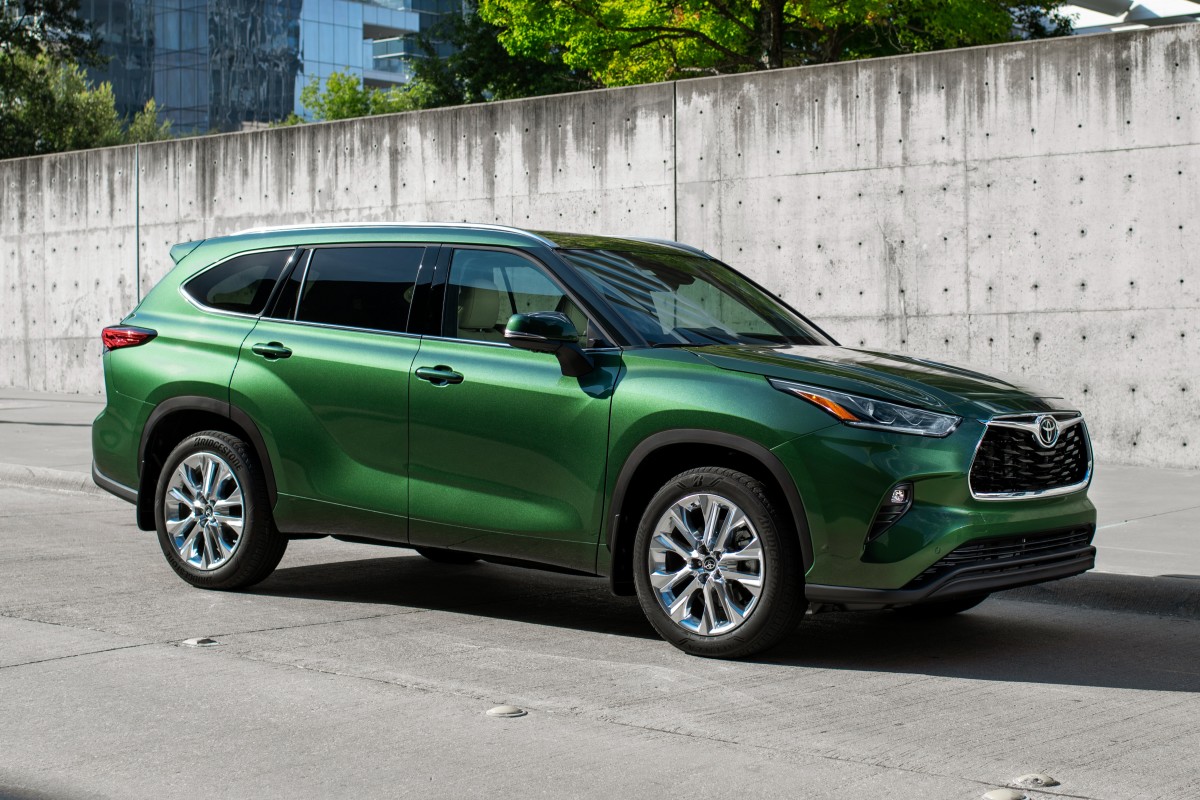
From the side, a Highlander could be anything. Compared to the previous model year, the tailgate glass is slanted a few more degrees and the body panels have more exaggerated creases that trace wide arcs around the front and rear fenders. The Toyota theme is trapezoidal, a shape that defines the tailgate's license plate cutout, the rear bumper with the optional silver-painted section, the slimmer headlights, the grille, and lower front bumper. Every trim has projector-beam LED headlights, while prettier LED running lamps are for the higher trims: Limited and Platinum. Big 20-inch alloy wheels are also new for the Highlander, and only on those top two trims. Some new paint colours, like the Blueprint on our Limited test car, are the most attractive part of the entire vehicle. Bad? Never, just boring.
Toyota put time and attention into the Highlander's cabin, where quality fit and finish rule the day. Silver-painted accents running along the armrests, three-spoke steering wheel, and chunky gear selector highlight the curves and angles, while an 8-inch touchscreen and climate controls finished in polished black plastic appear to float above the multi-layered dash. The colour palettes are pleasing, even on the L trim's fabric seats. The Limited has a three-tone interior. Our test car had brown on the upper dash, lower dash, and door panels; beige on the seats, centre console, and middle dash; and black on the steering wheel and footwells. Padded surfaces and rich textures are everywhere except the middle portions of the door panels, but take note: You won't find this level of detail and quality in any of the Highlander's competitors, such as the Ford Explorer or Honda Pilot. The only interior this nice is in the Kia Telluride. The SofTex leatherette has a perforated texture within the shelves below the air vents, and on the Platinum, the seat backrests have diamond quilting. It'd be nice if the exterior styling were as inviting as this interior—hence a slightly lower score—but the Highlander is really nice where it counts.
Performance
The Highlander comes with a 3.5-litre V6 engine in either front-wheel drive (FWD) or all-wheel drive (AWD). Unlike competitors that have turbochargers and four-cylinder engines with smaller displacements, this large V6 delivers brisk acceleration without any labour. It's also the powertrain in the Lexus RX, so that means it's smooth and practically silent at idle. The eight-speed automatic transmission makes full use of the engine's power specs of 295 horsepower and 263 pound-feet of torque, though it takes a heavy foot to initiate a kickdown. It's a lazy lump, just like a Mercedes V6, but when prompted it'll hustle to speed.
What knocks the Highlander down a couple pegs are loose steering that requires adjustments to centre the car at highway speeds and a soft suspension with too much rebound. This is what most Highlander buyers want, but we expected better control since this Highlander is on a brand-new chassis (shared with the Toyota RAV4) that is stiffer and stronger. We also expected Toyota, which has far more experience tuning a chassis than Kia had with its rival Telluride, to dial in the suspension's dampening and provide even a modicum of steering feel. As such, the Highlander bobs and floats like an older Buick at speed. Its size and weight are always apparent, which doesn't inspire confidence when tasked with shuttling around five or six other people. (Loading down the vehicle with more people and cargo would probably help the ride in this regard.)
The benefit, so long as you're conscious of the Highlander's limitations, is the ability to drive the vehicle with no more than a feather's touch. Every input is muted, including the long-travel brake pedal, and every output is muted even more. It's a wonderfully isolating experience that calms you down on long road trips and allows you to arrive refreshed. That's the Lexus way, and this cushy Toyota will at least inspire you to stay in the right-hand lane and calmly cruise at 100.
On the Limited and Platinum trims, Toyota includes AWD with torque vectoring on the rear axle that can tighten the car's trajectory around turns. It also includes selectable driving modes that alter the response of the throttle, transmission, and steering and includes two off-road modes for sand and mud, not that a Highlander on street tires would do well in either situation. Selecting Sport does help with the Highlander's vague on-centre feel, but not enough to make this the default mode.
Fuel efficiency is very good for such a large vehicle. The Highlander L FWD is rated by Natural Resources Canada at 11.9 litres per 100 kilometres in the city, 8.3 on the highway, and 10.3 combined. With the AWD drivetrain, the numbers change slightly to 11.7 L/100 km city, 8.6 hwy, and 10.3 combined. The Highlander hybrid, which is reviewed separately, can achieve fuel consumption as low as 6.7 L/100 km combined—also stellar. Helping matters is an auto stop-start that won't shut the engine off when you're light on the brake pedal and has a customizable setting that lets you extend the time by turning down the climate control. Having this choice is rare and it's very good in practice.
Form & function
The Highlander seats eight, or seven with the second-row captain's chairs standard on Platinum trims. In any configuration, the second row seats are supremely versatile, with generous fore/aft and reclining adjustments. The amount of legroom is kingly. Pull a lever on either the backrest or on the cushion to move and fold the seat partially for easy access to third row seats—easy, that is, if you're well under six feet. Pull another lever and the seat folds flat. The rear doors open very wide. Ingress and egress are exceptional. The front-seat height and the rear-seat height allow everyone to slide into place without stepping up or ducking down. If you or your family has weak knees, you'll appreciate the Highlander's ergonomics.
Three-zone automatic climate control is standard from the Highlander LE grade. Upper trims have a 120-volt outlet for the rear, plus side window shades. Limited and Platinum come with the large panoramic moonroof, and only the Platinum includes heated second-row seats. Cargo space is generous, too, with 453 litres behind the third row, 1,359 litres behind the second, and 2,378 litres when both are folded. Six tie-down hooks help secure loose items, while the Toyota Highlander Hybrid has a second 120-volt outlet in the cargo area.
The eight cupholders and four bottle holders are great, but better are the two shelves integrated into the dash. The centre shelf can fit large phones and has a pass-through to route cables below so they don't get in the driver's way. The only downside on Highlander models with wireless charging is that the pad blocks the cubby under the centre armrest. Whenever you want to reach inside, you have to move this bulky chunk of plastic out of the way, and any phone placed on it.
Controls are simple and very legible, including analog buttons and dials surrounding the standard touchscreen. The infotainment interface is also simple to use and quick to respond, though it could use a software overhaul.
Technology
Even though this is a new Highlander, Toyota still hasn't run its infotainment system through the wash in what feels like a decade. The maps aren't as detailed as competitors, there are no onboard apps (you have to use a connected phone in a slow, convoluted process), and the screen and 360-degree cameras are low-resolution. This criticism goes for the 12.3-inch touchscreen that is standard on the Highlander Platinum. You can never use the full 12.3 inches to show maps or adjust vehicle options. Instead, the climate and info about fuel efficiency and driving modes are always present, whether you want them or not. That means the big screen has no more of a usable area than the 8-inch touchscreen. Apple CarPlay and Android Auto integration come standard. Look at how GM, Fiat Chrysler, and Hyundai structure their menus and design their interfaces—it makes the Toyota system look bad by a long shot.
The features that save the Highlander on Platinum are the large 10-inch head-up display and another large 7-inch display in the instrument cluster that are both crisp and full of useful information to augment the main display. The semi-automated driving system is also very good at tracking marked highway lanes and slowing for traffic. Adaptive cruise control and automatic high beams come standard. The JBL audio system on Limited and Platinum has 11 speakers and is decent, but not sensational. SiriusXM satellite radio, HD radio, WiFi, and four USB-A ports are standard, along with a one-year trial for Safety Connect, which includes a stolen vehicle locator and emergency crash notifications to a 24/7 call centre. Trims with factory navigation have three years of included traffic data and the ability to monitor the Highlander's location and control certain features, like the remote engine start, from a smartphone or smartwatch.
Safety
A suite of electronic assists and safety features, called Toyota Safety Sense 2.0, is standard. It includes automatic emergency braking with pedestrian detection and cyclist detection, lane-keeping assist, adaptive cruise control, and automatic high beams. Blind-spot monitoring, rear cross-traffic alert, parking sensors, and rear emergency braking are optional. A driver's knee airbag and a special cushion airbag for the front passenger are standard.
The National Highway Traffic Safety Administration (NHTSA) gives the 2020 Highlander a five-star overall safety rating. The Insurance Institute for Highway Safety (IIHS) awarded it a 2020 Top Safety Pick for scoring the top rating in all six crash tests, the optional headlights, and for emergency braking when tested against cars and pedestrians.
Cost-effectiveness
The 2020 Highlander starts at an MSRP of $39,990 for the base L with FWD. Of the five trim levels, the Toyota Highlander XLE is the best value at $45,990. Highlander Limited grade vehicles, like our tester, are priced at $51,690. Fully loaded, the Highlander tops out at $53,990—a very sound value considering how it drives and feels like a Lexus 100 percent of the time. Fees are $2,354 extra. While the Highlander should handle better for a brand-new SUV, its quality, breadth of technology, and comfort more than make up for its shortcomings.
Note: Images show a US model.

What owners say
"Overall, owners of the 2020 Toyota Highlander appreciate its smooth ride, advanced features, and spacious interior, making it a favorite for families. Many drivers are particularly impressed with the safety features and handling. However, some reviewers express disappointment with the comfort of the front seats and quality of materials inside, noting instances where seats feel shallow or materials seem cheap."
It’s well-equipped, comfortable, and family-friendly SUV with strong safety tech, a smooth ride, and premium touches (thanks to the platinum trim) like a panoramic moonroof, leather seating, and 12” touchscreen. Its V6 offers solid power and decent fuel efficiency for a 3-row SUV, and overall it feels modern, quiet, and refined. It’s a great value if you want a reliable, upscale daily driver! The main thing it’s missing is more usable third-row and cargo space. The 3rd row is tight for adults and cargo behind it is limited. Otherwise, it’s a strong all-around pick and fits exactly what I was looking for. I would compare this to the Kia Telluride, Hyundai Palisade, Honda Pilot, and the Ford Explorer.
December 7, 2025Most comfortable riding vehicle that we have ever purchased. Great features and a great looking vehicle as well.
November 8, 2020Absolutely love this car. Great comfortable family vehicle with plenty of space, and features
May 22, 2023What owners say
It’s well-equipped, comfortable, and family-friendly SUV with strong safety tech, a smooth ride, and premium touches (thanks to the platinum trim) like a panoramic moonroof, leather seating, and 12” touchscreen. Its V6 offers solid power and decent fuel efficiency for a 3-row SUV, and overall it feels modern, quiet, and refined. It’s a great value if you want a reliable, upscale daily driver! The main thing it’s missing is more usable third-row and cargo space. The 3rd row is tight for adults and cargo behind it is limited. Otherwise, it’s a strong all-around pick and fits exactly what I was looking for. I would compare this to the Kia Telluride, Hyundai Palisade, Honda Pilot, and the Ford Explorer.
December 7, 2025Most comfortable riding vehicle that we have ever purchased. Great features and a great looking vehicle as well.
November 8, 2020Absolutely love this car. Great comfortable family vehicle with plenty of space, and features
May 22, 2023The ride was smooth, the Highlander is quick and very quiet. I loved many of the features it had, like the posted speed limit on the instrument cluster. What really disappointed me was the passenger seat comfort. The seat bottom only adjusts fron-to-rear, not up or down so I wasn’t as comfortable in it as I was the Hyundai Palisade or the Kia Telluride. It’s still a really good vehicle.
February 28, 2020The 2020 Toyota Highlander XLE drives great!! Very smooth ride and great acceleration. I loved how it could turn tight corners, like when pulling out onto a 4-lane road. A lot of great features. The sound system was ok, but realized it wasnt that great after comparing it to the 2021 Limited with JBL speakers. Wish it had the nicer sound system. There were two things I was very disappointed in. The seats seemed rather shallow, compared to the seats in my 2012 Limited Highlander. My friend and I both felt like we were sliding off the edge of the front seats. Does Toyota think that Americans are getting smaller? The other thing was that the visors were not long enough to come all the way out to the edge of the windshield. There was at least a two inch gap between the outside edge of the visor and the outside edge of the windshield!! What the heck were they thinking! Driving toward the sun in the late afternoon was terrible because the sun was in my eyes and there was nothing I could do about it. Again, my 2012 Highlander has this one beat because the visor is plenty long enough. What a stupid place to try to save a buck! Those two things have me looking at other vehicles because I dont want to settle for something that is uncomfortable, and when you pay 40K for a vehicle, it better be good in every aspect!
March 11, 2024Just picked one up Saturday! Absolutely love it, love the features, everything about it. Love the 3 row seats for all the grandkids. Had a Lexus RX350, feel there very similar just a little more room in the Highlander. Levy’s very smooth driving though.
November 22, 2022We have a 2011 highlander with 203k miles and love it. The 2020 seems to be very solid, handled great, quiet ride etc but the view out the rear is greatly reduced. But a great car.
August 2, 2023I love the safety features. I compared the Highlander to a few other midsize SUV’s and hands down the Toyota Highlander was the best value.
April 21, 2020Smooth ride, futuristic features, and sporty handling in the new Highlander.
February 13, 2020internals are plasticky and 3.6 liter engine lacks turbo power
September 2, 2020Trims & specs
Base MSRP $36,800 | Seating 8 |
Engine 3.5L 295 hp V6 | Cargo Capacity 16.0 cu ft |
Combined MPG 24 | Drivetrain FWD |
Base MSRP $34,600 | Seating 8 |
Engine 3.5L 295 hp V6 | Cargo Capacity 16.0 cu ft |
Combined MPG 24 | Drivetrain FWD |
Base MSRP $41,200 | Seating 8 |
Engine 3.5L 295 hp V6 | Cargo Capacity 16.0 cu ft |
Combined MPG 23 | Drivetrain AWD |
Base MSRP $48,800 | Seating 7 |
Engine 3.5L 295 hp V6 | Cargo Capacity 16.0 cu ft |
Combined MPG 23 | Drivetrain AWD |
Base MSRP $43,650 | Seating 8 |
Engine 3.5L 295 hp V6 | Cargo Capacity 16.0 cu ft |
Combined MPG 24 | Drivetrain FWD |
Base MSRP $39,600 | Seating 8 |
Engine 3.5L 295 hp V6 | Cargo Capacity 16.0 cu ft |
Combined MPG 24 | Drivetrain FWD |
Base MSRP $46,850 | Seating 7 |
Engine N/A | Cargo Capacity 16.0 cu ft |
Combined MPG N/A | Drivetrain N/A |
Base MSRP $45,600 | Seating 8 |
Engine 3.5L 295 hp V6 | Cargo Capacity 16.0 cu ft |
Combined MPG 23 | Drivetrain AWD |
Base MSRP $38,400 | Seating 8 |
Engine 3.5L 295 hp V6 | Cargo Capacity 16.0 cu ft |
Combined MPG 23 | Drivetrain AWD |
Base MSRP $46,850 | Seating 7 |
Engine 3.5L 295 hp V6 | Cargo Capacity 16.0 cu ft |
Combined MPG 24 | Drivetrain FWD |
Base MSRP $36,200 | Seating 8 |
Engine 3.5L 295 hp V6 | Cargo Capacity 16.0 cu ft |
Combined MPG 23 | Drivetrain AWD |
Base MSRP $48,800 | Seating 7 |
Engine 3.5L 295 hp V6 | Cargo Capacity 16.0 cu ft |
Combined MPG 23 | Drivetrain AWD |


Pricing trends
MSRP range
$34,600 - $48,800
Current avg. market price
$35,129
Trending up by 0.6% this month
May 2026 - October 2026