2020 Toyota Camry vs 2021 BMW 3 Series
Overview | |
MSRP$24,425 | MSRP$41,250 |
Listings198 | Listings209 |
Ratings & Reviews | |
User Reviews | User Reviews |
Expert reviews7.5 out of 10 | Expert reviews6.8 out of 10 |
Pros
Cons
| Pros
Cons
|
2020 Toyota Camry Reviews SummaryIf you can't beat them, join them. That seems to be Toyota's philosophy in updating the eighth generation of the Camry for the 2020 model year. This latest version of the perennial best seller debuted in 2017 as a 2018 model—and promptly lost its sales crown to Toyota's own RAV4 crossover SUV. As buyers continue to defect from cars, Toyota hopes to entice more shoppers to stick with its midsize sedan by offering all-wheel drive on the Camry for the first time since 1991. Also new for 2020 is the Camry TRD, a sportier version with a 301-horsepower V6 engine that makes its case to a buyer who might never have considered a Camry. | |
2021 BMW 3 Series Reviews SummaryEarly generations of the BMW 3 Series redefined what a luxury car could be, justifying their prestige badge with sporty driving dynamics and impeccable engineering. BMW changed the luxury-car paradigm, proving that nimble sports sedans could be just as desirable as wood-encrusted land yachts. The 3 Series spawned a number of imitators, including the Audi A4, Mercedes-Benz C-Class, and Lexus IS. Those sedans, along with the Acura TLX, Alfa Romeo Giulia, Cadillac CT4, and Infiniti Q50 (which wear more recently-introduced nameplates) still form the 3 Series’ competitive set, but the car itself has changed. Introduced for the 2019 model year, the current-generation 3 Series (codenamed G20) feels more like a traditional luxury sedan, with a greater emphasis on comfort and convenience than previous generations. The manual transmission is gone, as are the wagon and 3 Series GT hatchback body styles. The 3 Series coupe and convertible were re-badged as the 4 Series beginning with the 2014 model year. The biggest change for the 2021 BMW 3 Series is the addition of the 330e plug-in hybrid model to the lineup, so that’s what we test drove for this review. BMW also offers 330i and M340i versions, and there’s an M3 performance model on the way. | |
No video found | No video found |
Popular Features & Specs | |
Engine2.5L 203 hp I4 | Engine2.0L 255 hp I4 |
Drive TrainFWD | Drive TrainRWD |
Seating Capacity5 | Seating Capacity5 |
Horsepower | Horsepower255 hp @ 5000 rpm |
MPG City29 | MPG City26 |
MPG Highway41 | MPG Highway36 |
Engine | |
Engine Name2.5L 203 hp I4 | Engine Name2.0L 255 hp I4 |
Torque | Torque295 lb-ft @ 1450 rpm |
Horsepower | Horsepower255 hp @ 5000 rpm |
DrivetrainFWD | DrivetrainRWD |
Fuel Economy | |
MPG City29 | MPG City26 |
MPG Highway41 | MPG Highway36 |
Interior | |
Seating Capacity5 | Seating Capacity5 |
Key Features | |
Navigation System | Navigation SystemStandard |
Sunroof/Moonroof | Sunroof/MoonroofStandard |
Safety | |
Front Crash Overall5 | Front Crash Overall5 |
Side Crash Overall5 | Side Crash Overall5 |
Dimensions & Capacity | |
Cargo Space14.1 cu ft | Cargo Space13.0 cu ft |
Curb Weight3241 lbs | Curb Weight3589 lbs |
Height56.9 in | Height56.8 in |
Length192.1 in | Length185.7 in |
Width72.4 in | Width81.4 in |
Wheelbase111.2 in | Wheelbase112.2 in |
Maximum Payload925 lbs | Maximum Payload |
Number of doors4 | Number of doors4 |
Overview | ||
MSRP | $24,425 | $41,250 |
Listings | ||
Ratings & Reviews | ||
User reviews | ||
Expert reviews | 7.5 out of 10Read full review | 6.8 out of 10Read full review |
Pros & cons | Pros
Cons
| Pros
Cons
|
Summary | If you can't beat them, join them. That seems to be Toyota's philosophy in updating the eighth generation of the Camry for the 2020 model year. This latest version of the perennial best seller debuted in 2017 as a 2018 model—and promptly lost its sales crown to Toyota's own RAV4 crossover SUV. As buyers continue to defect from cars, Toyota hopes to entice more shoppers to stick with its midsize sedan by offering all-wheel drive on the Camry for the first time since 1991. Also new for 2020 is the Camry TRD, a sportier version with a 301-horsepower V6 engine that makes its case to a buyer who might never have considered a Camry. | Early generations of the BMW 3 Series redefined what a luxury car could be, justifying their prestige badge with sporty driving dynamics and impeccable engineering. BMW changed the luxury-car paradigm, proving that nimble sports sedans could be just as desirable as wood-encrusted land yachts. The 3 Series spawned a number of imitators, including the Audi A4, Mercedes-Benz C-Class, and Lexus IS. Those sedans, along with the Acura TLX, Alfa Romeo Giulia, Cadillac CT4, and Infiniti Q50 (which wear more recently-introduced nameplates) still form the 3 Series’ competitive set, but the car itself has changed. Introduced for the 2019 model year, the current-generation 3 Series (codenamed G20) feels more like a traditional luxury sedan, with a greater emphasis on comfort and convenience than previous generations. The manual transmission is gone, as are the wagon and 3 Series GT hatchback body styles. The 3 Series coupe and convertible were re-badged as the 4 Series beginning with the 2014 model year. The biggest change for the 2021 BMW 3 Series is the addition of the 330e plug-in hybrid model to the lineup, so that’s what we test drove for this review. BMW also offers 330i and M340i versions, and there’s an M3 performance model on the way. |
Video | No video found | No video found |
Popular Features & Specs | ||
Engine | 2.5L 203 hp I4 | 2.0L 255 hp I4 |
Drive Train | FWD | RWD |
Seating Capacity | 5 | 5 |
Horsepower | 255 hp @ 5000 rpm | |
MPG City | 29 | 26 |
MPG Highway | 41 | 36 |
Engine | ||
Engine Name | 2.5L 203 hp I4 | 2.0L 255 hp I4 |
Torque | 295 lb-ft @ 1450 rpm | |
Horsepower | 255 hp @ 5000 rpm | |
Drivetrain | FWD | RWD |
Fuel Economy | ||
MPG City | 29 | 26 |
MPG Highway | 41 | 36 |
Interior | ||
Seating Capacity | 5 | 5 |
Key Features | ||
Navigation System | Standard | |
Sunroof/Moonroof | Standard | |
Safety | ||
Front Crash Overall | 5 | 5 |
Side Crash Overall | 5 | 5 |
Dimensions & Capacity | ||
Cargo Space | 14.1 cu ft | 13.0 cu ft |
Curb Weight | 3241 lbs | 3589 lbs |
Height | 56.9 in | 56.8 in |
Length | 192.1 in | 185.7 in |
Width | 72.4 in | 81.4 in |
Wheelbase | 111.2 in | 112.2 in |
Maximum Payload | 925 lbs | |
Number of doors | 4 | 4 |
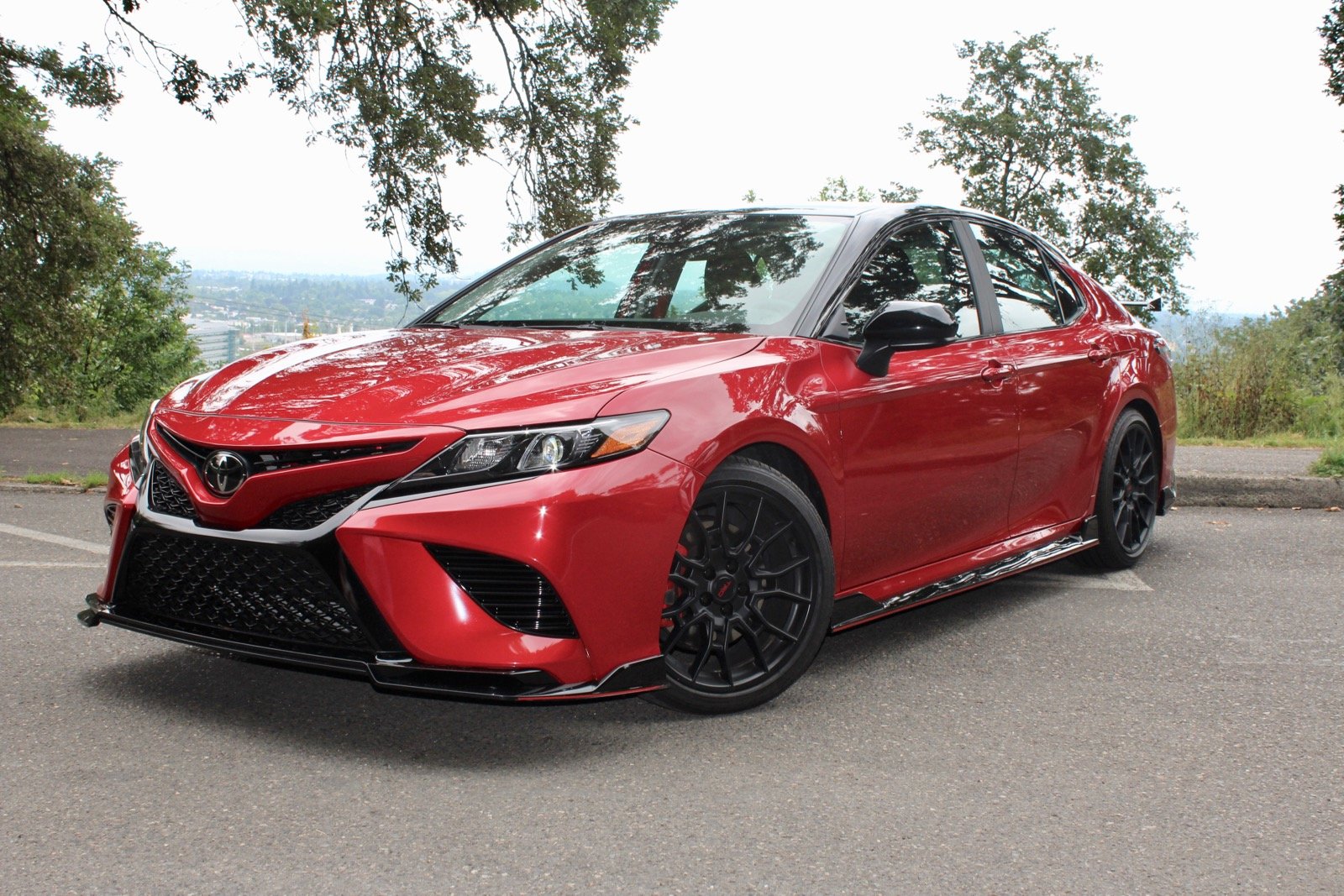
The 2020 Toyota Camry had evolved significantly in its design, leading to a renaissance of style and substance. With a generation that emphasized a newfound attention to detail and an expressive, bold styling, the Camry distinguished itself from its predecessors. The front fascia of the Camry was striking and imbued with taut lines, providing a sporty appeal that was evident even without the TRD model's extravagant wing and aerodynamic body kit. Design elements such as the character line that extended across the doors and the upturned kink of the C-pillar hinted at influences from BMW's sporty sedans of the past. Available in 14 exterior colors, some with a black roof option, the Camry projected an air of fashionable sophistication.
The interior of the Camry exuded a sense of luxury, with high-quality materials and a driver-focused dashboard design. Even the more basic trims felt upscale, while the TRD variant boasted red trim accents and seatbelts, reminiscent of high-performance sports cars. Despite its mainstream segment, the top trims of the Camry showcased leather and wood materials that nearly reached the level of an entry-level Lexus, offering a premium feel at a more accessible price point.
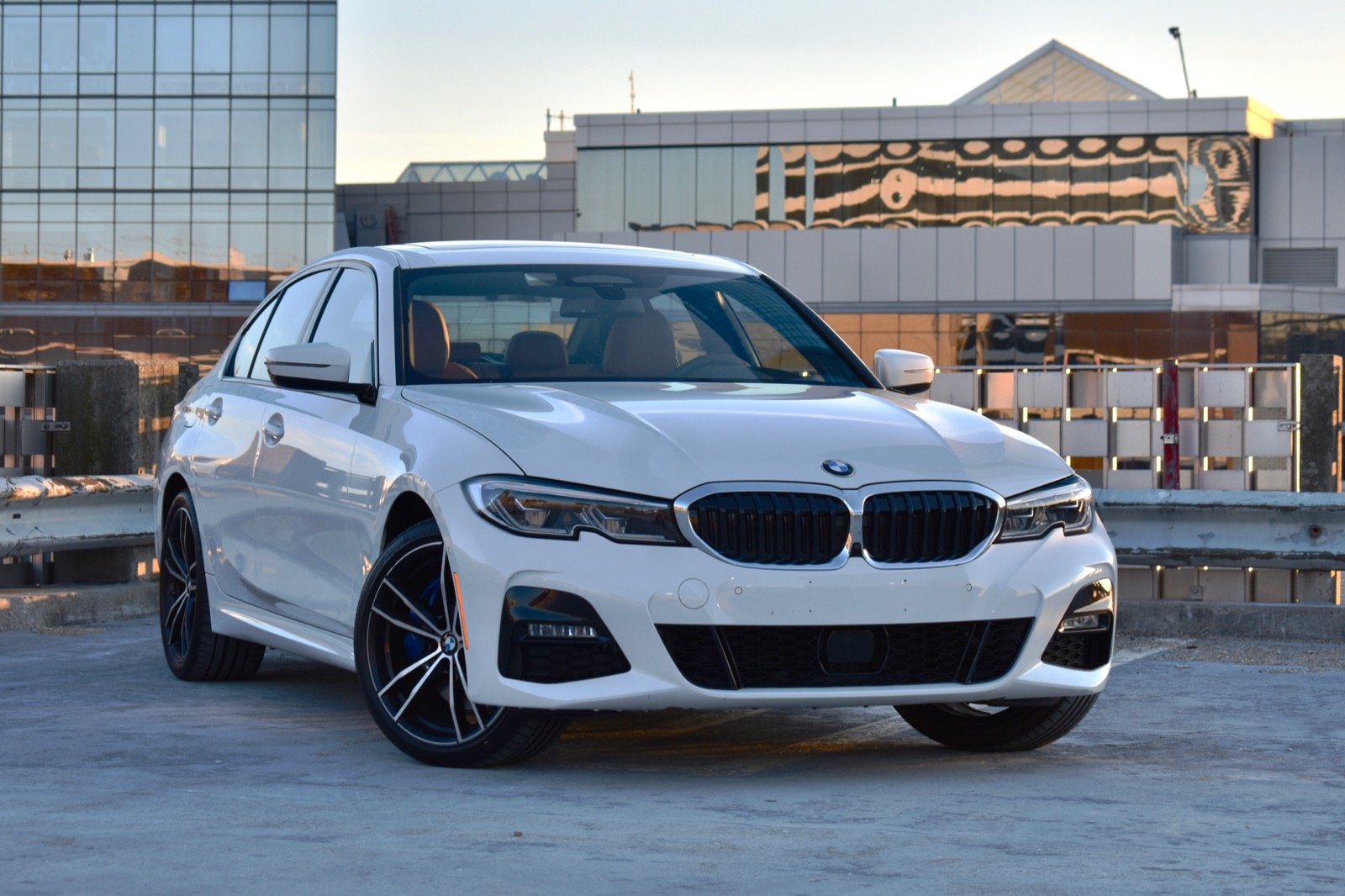
In contrast, the 2021 BMW 3 Series adopted a more traditional familial design approach, akin to its predecessor E30 3 Series, echoing similarities with its larger siblings, the 5 Series and 7 Series. Despite this, the grille design on the 3 Series appeared oversized for the smaller sedan, giving it a somewhat stuffy appearance. The overall styling lacked distinctiveness, save for the badge on the hood which remained a point of attraction for most customers.
Our test car boasted M 19-inch wheels and blue-painted brake calipers, part of the optional M Sport trim package, which added a touch of flare. The interior of the BMW, while nicely designed, was let down by unimpressive materials with an economy car's level of plastic. The optional Ash wood trim looked notably fake. Unlike the Camry, real leather upholstery was optional, with synthetic Sensatec material being the standard.


The 2020 Toyota Camry offered a broad array of powertrains. The 3.5-liter V6 engine, producing 301 horsepower, was smooth and powerful, paired with an eight-speed automatic transmission. This engine excelled in luxury aspirations but fell short on sportiness in the TRD model. The 2.5-liter four-cylinder engine, delivering only 203 hp (206 hp in XSE trim), was notably agile, with a lighter front end that enhanced steering and provided a spirited driving experience, especially in the XSE trim. AWD technology stemming from the RAV4 allowed the Camry to handle slippery conditions confidently while aiming to minimize the typical AWD fuel-economy penalty. The front-drive Camry maintained an EPA combined fuel economy rating of 31 mpg (28 mpg with AWD), whereas the V6 models managed 26 mpg (25 mpg for TRD).
The 2021 BMW 3 Series offered powerful engine options. The base 330i featured a 2.0-liter turbocharged four-cylinder engine with 255 horsepower and 295 pound-feet of torque. The 330e plug-in hybrid combined a less-powerful version of that engine with electric assistance for a total of 288 hp and 310 lb-ft of torque, alongside a limited electric range. The top-tier M340i packed a turbo inline-six, producing 382 hp and 369 lb-ft. The performance was strong across the board, with the M340i capable of sprinting from zero to 60 mph in just 4.2 seconds. However, the 330e, despite matching the 330i's acceleration times, suffered from a clunky transition between electric and gasoline power.
The handling of the 3 Series reflected BMW's engineering prowess, providing a solid and precise ride. But the engagement levels had dipped compared to earlier models, with some of the driving excitement lost, leaving drivers feeling somewhat disconnected.
The 2020 Toyota Camry was user-friendly, with intuitive controls and added front legroom and hip room compared to its predecessor. The rear seat space had shrunk slightly, and the trunk offered 15.1 cubic feet of cargo space, which could feel limiting against growing competitors. The AWD addition didn’t further compromise trunk space.
Conversely, the 2021 BMW 3 Series excelled in maximizing interior space for a small luxury sedan. It led the segment in rear headroom and provided ample front headroom. Legroom was average but could feel cramped with taller passengers in the front. The trunk of gasoline 3 Series models was generous at 17 cubic feet, but the 330e hybrid’s battery pack reduced it to 13.2 cubic feet. The trunk’s design required an awkward reach to fully utilize space, yet the 40/20/40 split-folding rear seat added flexibility.
Where the driving experience in the Camry was familiar yet elevated, the BMW 3 Series centered on driving ease, with strategically positioned touchscreens, a low hood line, and abundant side glass for good visibility.
The 2020 Toyota Camry finally included Android Auto alongside Apple CarPlay and Amazon Alexa compatibility, addressing a long-standing gap. The infotainment system, albeit functional and quick, felt dated compared to modern standards, with a small 7-inch standard screen and an optional 8-inch upgrade. The system featured hard buttons, enhancing user ergonomics, and a single USB-A port, with additional charging options but no USB-C ports. Optional features included a Qi wireless charging pad, WiFi Connect, and Remote Connect for some trims.
The 2021 BMW 3 Series sported a more premium infotainment experience with its standard iDrive system and 8.8-inch touchscreen. Gasoline models featured both Apple CarPlay and Android Auto, whereas the 330e only supported CarPlay. The optional Live Cockpit Professional upgrade provided a digital instrument cluster and HUD. The graphics were high-quality, and the system was intuitive to use, enhanced by various control options, including traditional iDrive knobs, steering wheel controls, a voice assistant, and gesture controls. These features, while occasionally feeling gimmicky, offered flexibility in user interaction.
The 2020 Toyota Camry came equipped with a basic yet comprehensive version of Toyota's Safety Sense technologies, including emergency braking, adaptive cruise control, lane-departure warning, and automatic high beams. A one-year trial of Safety Connect was included, and higher trims offered an optional Bird's Eye View camera system. The Camry earned top safety ratings: a five-star rating from NHTSA and a Top Safety Pick+ from IIHS. However, a recall for leaking engine coolant affected some models.
The 2021 BMW 3 Series secured a Top Safety Pick award from IIHS but with mixed headlight scores and a lower rating for its optional advanced driver-assist system. NHTSA hadn’t rated the 2021 model at the time of review. BMW’s advanced safety features, like adaptive cruise control and lane-keep assist, required an additional Driving Assistant Professional Package, which also included side collision avoidance and Traffic Jam Assistant. Standard features included forward-collision warning and automatic emergency braking, with additional packages offering blind-spot monitoring and a 360-degree camera system.
CarGurus highlights

According to CarGurus experts, the overall rating for the 2020 Toyota Camry was 7.5 out of 10, while the 2021 BMW 3 Series scored 6.8 out of 10. Given these scores, the Toyota Camry surpasses the BMW 3 Series in our final recommendation. The Camry's blend of stylish design, improved performance, user-friendly technology, and robust safety features at a more accessible price point makes it the better overall vehicle choice in this comparison.
Choose the 2020 Toyota Camry if:
- You seek a car with an expressive design and comfortable, high-quality interior materials.
- You prefer a variety of powertrain options, including AWD and a robust V6 engine.
- You value affordable yet comprehensive safety features and top safety ratings.
Choose the 2021 BMW 3 Series if:
- You desire a sedan with a luxurious driving experience and advanced infotainment options.
- You prefer high-performance engine choices and excellent handling capabilities.
- You seek a premium brand with an array of advanced safety technology, albeit often at an extra cost.
CarGurus highlights

According to CarGurus experts, the overall rating for the 2020 Toyota Camry was 7.5 out of 10, while the 2021 BMW 3 Series scored 6.8 out of 10. Given these scores, the Toyota Camry surpasses the BMW 3 Series in our final recommendation. The Camry's blend of stylish design, improved performance, user-friendly technology, and robust safety features at a more accessible price point makes it the better overall vehicle choice in this comparison.
Choose the 2020 Toyota Camry if:
Shop Now- You seek a car with an expressive design and comfortable, high-quality interior materials.
- You prefer a variety of powertrain options, including AWD and a robust V6 engine.
- You value affordable yet comprehensive safety features and top safety ratings.
Choose the 2021 BMW 3 Series if:
Shop Now- You desire a sedan with a luxurious driving experience and advanced infotainment options.
- You prefer high-performance engine choices and excellent handling capabilities.
- You seek a premium brand with an array of advanced safety technology, albeit often at an extra cost.

By: CarGurus + AI
At CarGurus, our team of experienced automotive writers remain at the heart of our content operation, conducting hands-on car tests and writing insightful guides that are backed by years of industry experience. To complement this, we are harnessing AI to make our content offering more diverse and more helpful to shoppers than ever. To achieve this, our AI systems are based exclusively on CarGurus content, ratings and data, so that what we produce is both unique to CarGurus, and uniquely helpful to car shoppers.