2019 Toyota Camry vs 2020 Toyota Corolla
Overview | |
MSRP$24,095 | MSRP$19,600 |
Listings169 | Listings159 |
Ratings & Reviews | |
User Reviews | User Reviews |
Expert reviews7.8 out of 10 | Expert reviews7.0 out of 10 |
Pros
Cons
| Pros
Cons
|
2019 Toyota Camry Reviews SummaryBlame the Toyota Avalon for the Toyota Camry’s flaws. In order to put daylight between itself and Toyota’s larger full-size sedan, the midsize Camry is now smaller than some of its competitors, while simultaneously offering fewer of the increasingly expected features in the segment. Still, there are several good reasons to consider a 2019 Camry, from its outstanding safety ratings to its free scheduled maintenance plan. It’s also one of a handful of family sedans that still offers a 6-cylinder engine. | |
2020 Toyota Corolla Reviews SummaryIf ever a car was to be described as an appliance, the Toyota Corolla was it. Cheap to buy, dependable as a sunrise, thrifty with fuel, and roomy enough for a frugal family, the Corolla faithfully delivered its owners to their destinations without a hint of fuss... or emotion. That changes with the redesigned 2020 Toyota Corolla, which adds a sense of style and a bit of thrill to its longstanding mission. | |
Popular Features & Specs | |
Engine2.5L 203 hp I4 | Engine1.8L 139 hp I4 |
Drive TrainFWD | Drive TrainFWD |
Seating Capacity5 | Seating Capacity5 |
MPG City29 | MPG City30 |
MPG Highway41 | MPG Highway38 |
Engine | |
Engine Name2.5L 203 hp I4 | Engine Name1.8L 139 hp I4 |
DrivetrainFWD | DrivetrainFWD |
Fuel Economy | |
MPG City29 | MPG City30 |
MPG Highway41 | MPG Highway38 |
Interior | |
Seating Capacity5 | Seating Capacity5 |
Safety | |
Front Crash Overall5 | Front Crash Overall5 |
Side Crash Overall5 | Side Crash Overall5 |
Dimensions & Capacity | |
Cargo Space14.1 cu ft | Cargo Space13.1 cu ft |
Curb Weight3241 lbs | Curb Weight2910 lbs |
Height56.9 in | Height56.5 in |
Length192.1 in | Length182.3 in |
Width72.4 in | Width70.1 in |
Wheelbase111.2 in | Wheelbase106.3 in |
Maximum Payload925 lbs | Maximum Payload825 lbs |
Number of doors4 | Number of doors4 |
Overview | ||
MSRP | $24,095 | $19,600 |
Listings | ||
Ratings & Reviews | ||
User reviews | ||
Expert reviews | 7.8 out of 10Read full review | 7.0 out of 10Read full review |
Pros & cons | Pros
Cons
| Pros
Cons
|
Summary | Blame the Toyota Avalon for the Toyota Camry’s flaws. In order to put daylight between itself and Toyota’s larger full-size sedan, the midsize Camry is now smaller than some of its competitors, while simultaneously offering fewer of the increasingly expected features in the segment. Still, there are several good reasons to consider a 2019 Camry, from its outstanding safety ratings to its free scheduled maintenance plan. It’s also one of a handful of family sedans that still offers a 6-cylinder engine. | If ever a car was to be described as an appliance, the Toyota Corolla was it. Cheap to buy, dependable as a sunrise, thrifty with fuel, and roomy enough for a frugal family, the Corolla faithfully delivered its owners to their destinations without a hint of fuss... or emotion. That changes with the redesigned 2020 Toyota Corolla, which adds a sense of style and a bit of thrill to its longstanding mission. |
Video | ||
Popular Features & Specs | ||
Engine | 2.5L 203 hp I4 | 1.8L 139 hp I4 |
Drive Train | FWD | FWD |
Seating Capacity | 5 | 5 |
MPG City | 29 | 30 |
MPG Highway | 41 | 38 |
Engine | ||
Engine Name | 2.5L 203 hp I4 | 1.8L 139 hp I4 |
Drivetrain | FWD | FWD |
Fuel Economy | ||
MPG City | 29 | 30 |
MPG Highway | 41 | 38 |
Interior | ||
Seating Capacity | 5 | 5 |
Safety | ||
Front Crash Overall | 5 | 5 |
Side Crash Overall | 5 | 5 |
Dimensions & Capacity | ||
Cargo Space | 14.1 cu ft | 13.1 cu ft |
Curb Weight | 3241 lbs | 2910 lbs |
Height | 56.9 in | 56.5 in |
Length | 192.1 in | 182.3 in |
Width | 72.4 in | 70.1 in |
Wheelbase | 111.2 in | 106.3 in |
Maximum Payload | 925 lbs | 825 lbs |
Number of doors | 4 | 4 |
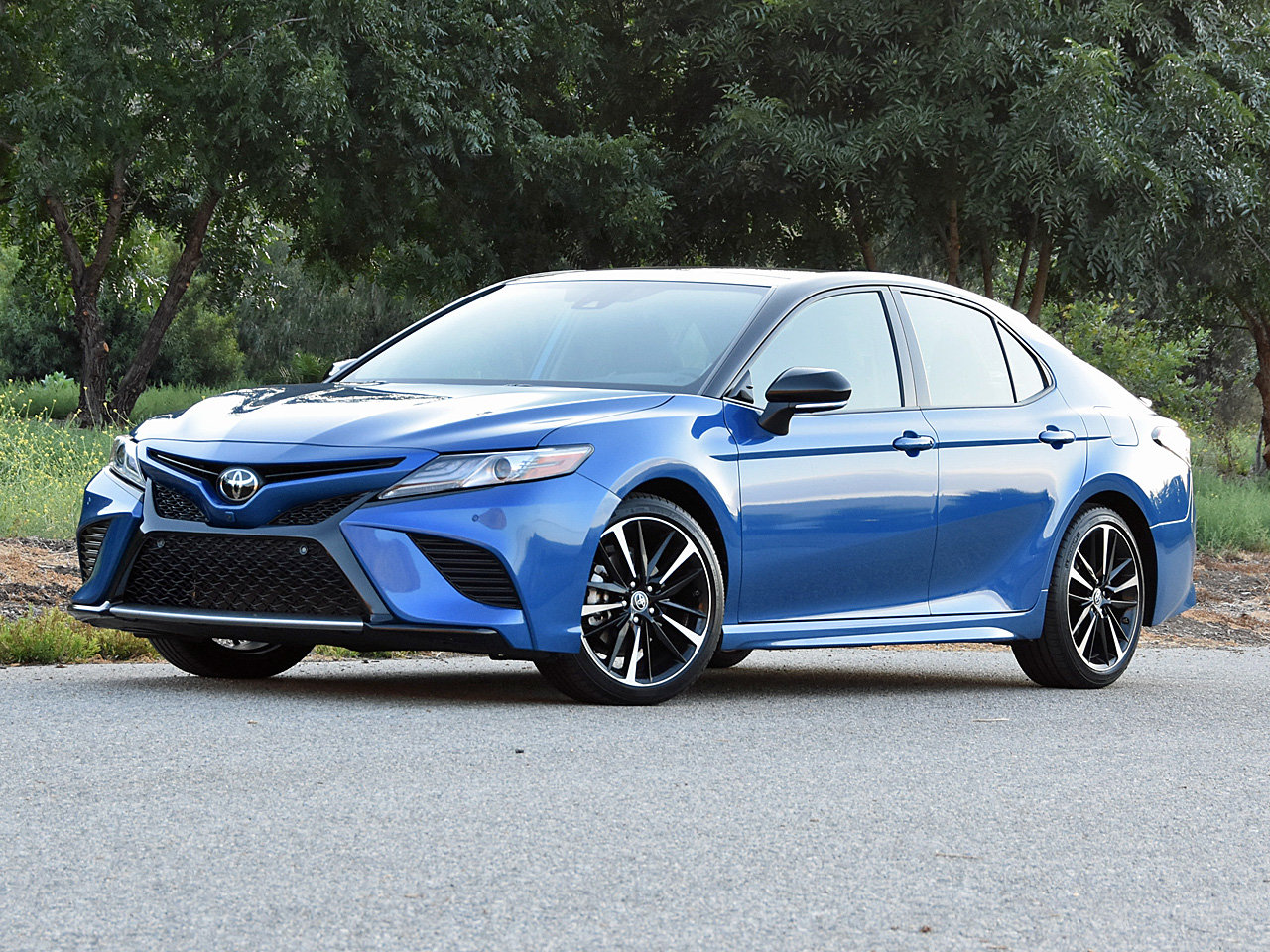
When people considered buying a 2019 Toyota Camry, they had to make decisions about styling and powertrain. The options included standard and sporty styling, along with choices among a 4-cylinder, a V6, and a hybrid powertrain. Trim levels varied, ranging from L, LE, XLE, SE, and XSE depending on engine selection. The review focused on the Camry XSE equipped with a V6 engine. The test car came with Toyota's Driver Assist package, carpeted floor mats, and a striking two-tone Blue Streak paint with a Midnight Black roof. All these additions brought the sticker price to $39,669, including a $955 destination charge.
Despite the Camry XSE V6 being quick and engaging to drive (by Camry standards), it wasn’t the recommended trim by CarGurus. The suggestion was to stick with the standard 2.5-liter 4-cylinder engine and choose LE trim at a minimum for the best value. I preferred the upscale XLE trim. Though the Hybrid version delivered excellent gas mileage, starting at $28,400 for an LE trim—$3,800 more than a comparable non-hybrid LE—it would take almost a decade to see any savings on fuel costs, assuming an annual driving distance of 12,000 miles and an average fuel price of $2.75 per gallon.
Regardless of which version buyers chose, the Camry’s styling appeared unresolved. In the XSE trim, the daring design represented a stark departure from the previously bland look but didn't achieve a cohesive result. Toyota applied similar design themes more successfully to longer and larger models like the Avalon, while the less expensive and less expressive 2020 Toyota Corolla looked particularly good in SE or XSE trim. Positioned between these models, the latest Camry never quite appealed aesthetically.
While washing the Camry, the front fascia and side mirrors creaked with even slight pressure, and the front doors produced a tinny noise when closed, denting the car’s perceived quality.
The 2020 Toyota Corolla, akin to many modern Toyotas, had a polarizing look. However, when equipped with SE or XSE trim and the attractive Celestite paint color, it stood out as quite a good-looking compact sedan. Even its front end was considered more palatable compared to other Toyota sedans. The interior quality saw significant improvements in the XSE version, with fewer cheap, hard plastics and more soft-touch surfaces that no longer glistened unnaturally.
Yet, the transmission shifter reminded drivers of the Corolla's economy car roots, lacking the solid feel found in competitors like Hyundai or Kia. The base price for the Corolla started at $19,600 plus a $955 destination charge. Trim upgrades included LE, XLE, SE, and XSE, with the sportier versions offering a more powerful engine and 18-inch aluminum wheels. The Hybrid Corolla LE promised excellent fuel economy at 52 mpg in combined driving. The fully loaded XSE trim, including top options and floor mats, brought the price tag to around $28,800.


In terms of performance, the 2019 Toyota Camry’s standard 2.5-liter 4-cylinder engine delivered 203 horsepower, suitable for daily driving. The available 301-hp, 3.5-liter V6 engine, offering 83 more pound-feet of torque, provided a thrilling experience for those seeking it. Despite the additional weight of the V6 over the car's front end, it didn’t hinder handling. With an 8-speed automatic transmission and paddle shifters in Sport mode, the XSE was a joy to drive.
The Camry XSE’s sport-tuned suspension, paired with exclusive 19-inch aluminum wheels and 235/40 tires, offered responsive handling without traditional sport-sedan stiffness, making it a comfortable daily driver and a competent canyon carver. The steering felt firm in normal mode and heavy in Sport mode but retained a natural feel.
During testing, the brakes performed well, but the pedal made an unpleasant "thunk" when released quickly, impacting the perception of refinement. On a hot testing day requiring frequent use of air conditioning, fuel efficiency dropped to 21.9 mpg, short of the EPA’s 26-mpg combined rating. However, the spirited driving experience partly accounted for this figure.
For the 2020 Toyota Corolla, the L, LE, and XLE trims came with a 1.8-liter 4-cylinder engine producing 139 horsepower and a CVT driving the front wheels. This setup sounded unexciting. The SE and XSE trims, however, featured a 169-hp, 2.0-liter 4-cylinder engine with a more sophisticated CVT and styling upgrades, including 18-inch aluminum wheels. The SE trim even offered a 6-speed manual gearbox, adding to its sporty appeal.
The Corolla XSE’s driving dynamics were finely tuned, striking a balance between comfort and handling. The switch to an independent rear suspension in 2020 gave the car a smooth and stable ride while ensuring confident handling despite not delivering much feedback through the steering. The brakes held up impressively, even under abuse on demanding roads.
However, the Corolla XSE lacked the power to match its sporty character, struggling with acceleration and passing maneuvers, especially on inclines. Despite this, the CVT performed quietly and efficiently in less demanding situations. Fuel economy for my test car was EPA-rated at 31 mpg city, 38 highway, and 34 combined, though my testing loop averaged 29.8 mpg due to dynamic driving conditions.
The interior of the 2019 Toyota Camry featured ample storage options, including a large center console bin and a hidden compartment under the wireless charging pad. However, the glove box was small and the door-panel pockets narrow. The Camry’s trunk, measuring 15.1 cubic feet, was smaller than expected for a midsize car and compared unfavorably to competitors like the Honda Accord. Loading a full-size suitcase and a stroller posed a challenge, and the trunk lid lacked a grab handle.
Both front seats in the test car offered 8-way power adjustment and heating but lacked ventilation. Despite some shortcomings, driver comfort was prioritized with a padded center armrest and door panels. Rear-seat passengers faced a snug environment, with narrow door openings and a low seating position making entry and exit difficult. Rear air-conditioning vents were only available in higher trims.
The 2020 Toyota Corolla, although compact, provided sufficient space for a family of four during summer trips. However, the rear seats, especially with dark SofTex leatherette, and the absence of rear air-conditioning vents, USB ports, and privacy-tinted rear glass led to discomfort. The lack of a front seat height adjuster made the car less appealing to adult passengers as well.
Despite this, the driver’s seat in the Corolla XSE was comfortable, and the cloth seat inserts helped counteract SofTex’s sweat-trapping tendency. The single-zone automatic climate control was effective, and the heated front seats added to the comfort.
Both the Camry and Corolla lacked significant rear storage, but the Camry’s rear seat was more comfortable despite being slightly smaller overall. The Corolla’s storage bins and cubbies were minimal, though cupholders functioned adequately for typical drinks.
In terms of cargo capacity, the Camry offered a slightly larger trunk at 15.1 cubic feet compared to the Corolla’s 13.1 cubic feet. Despite this, the Corolla’s trunk was still versatile enough to accommodate a couple of suitcases and additional small items.
For 2019, the Toyota Camry featured the Entune 3.0 infotainment system, with a touchscreen interface that was easy to use. Apple CarPlay was included, but Android Auto was notably absent. The test car provided a 6-month/2GB WiFi Connect service subscription, a wireless smartphone charging pad that secured the phone reliably, and a functional navigation system that occasionally lagged when loading traffic data. The 9-speaker JBL premium sound system, however, produced a bass-heavy performance that lacked clarity.
A 10-inch head-up display (HUD) was available, remaining visible even when wearing polarized sunglasses. This visibility feature set it apart, as not all HUD systems achieved this.
The 2020 Corolla included the next-generation Entune 3.0 system, which was user-friendly and positioned the touchscreen for easy access. Apple CarPlay compatibility was a key addition, while Android Auto remained unavailable. The system incorporated Amazon Alexa compatibility, Siri Eyes Free, and multiple trial subscriptions for various connected services.
The Corolla LE and up trims featured an 8-inch touchscreen instead of a base 7-inch screen, and the XSE trim tested included advanced features like HD Radio, SiriusXM, and a JBL premium sound system. Despite the extensive features and trial subscriptions, the system's complexity could be overwhelming for some users.
Android users would find themselves at a disadvantage, although iPhone users could still make use of the system's full capabilities.
The 2019 Toyota Camry set a high standard for safety, earning 5-star ratings from the National Highway Traffic Safety Administration (NHTSA) in every test, including rollover resistance. It also received a Top Safety Pick+ rating from the Insurance Institute for Highway Safety (IIHS), missing only the highest headlight performance rating in lower trim levels.
While equipped with Toyota Safety Sense, the Camry didn't feature the latest 2.0 version but still included key advanced driver-assistance systems (ADAS) such as adaptive cruise control, forward-collision warning, automatic emergency braking, lane-departure warning, lane-keeping assist, and automatic high-beam headlights. A standard 3-year Safety Connect subscription included emergency and roadside assistance services.
The 2020 Toyota Corolla came standard with Toyota Safety Sense 2.0, enhanced with low-light pedestrian detection, daytime cyclist detection, road-sign recognition, and Lane Tracing Assist. This updated suite operated with refinement and accuracy, although the lane-departure warning's audio alert was less than ideal.
The lane-centering assist feature worked well during typical testing but proved less effective during tiring late-night drives. The addition of blind-spot monitoring was standard for higher trims and optional for others, further enhancing safety.
Ratings from the NHTSA awarded the Corolla sedan a 5-star frontal-impact protection rating, but side-impact testing was incomplete. The IIHS named the Corolla a Top Safety Pick for 2019.
CarGurus highlights

According to CarGurus experts, the overall rating for the 2019 Toyota Camry was 7.8 out of 10, while the 2020 Toyota Corolla scored 7.0 out of 10. Given these ratings, the 2019 Toyota Camry emerged as the better choice, offering superior safety credentials, a more powerful engine option, and a more substantial, high-quality interior.
Choose the 2019 Toyota Camry if:
- You prioritize safety and want a car with top NHTSA and IIHS safety ratings.
- You desire a spacious midsize car despite the smaller-than-expected trunk.
- You prefer a powerful V6 engine and the option of sportier trims for engaging daily driving.
Choose the 2020 Toyota Corolla if:
- You need a compact sedan with modern safety features, including Toyota Safety Sense 2.0.
- You prefer a well-designed interior with improved materials and comfort.
- You want a more affordable car with advanced technology like Apple CarPlay and a user-friendly infotainment system.
CarGurus highlights

According to CarGurus experts, the overall rating for the 2019 Toyota Camry was 7.8 out of 10, while the 2020 Toyota Corolla scored 7.0 out of 10. Given these ratings, the 2019 Toyota Camry emerged as the better choice, offering superior safety credentials, a more powerful engine option, and a more substantial, high-quality interior.
Choose the 2019 Toyota Camry if:
Shop Now- You prioritize safety and want a car with top NHTSA and IIHS safety ratings.
- You desire a spacious midsize car despite the smaller-than-expected trunk.
- You prefer a powerful V6 engine and the option of sportier trims for engaging daily driving.
Choose the 2020 Toyota Corolla if:
Shop Now- You need a compact sedan with modern safety features, including Toyota Safety Sense 2.0.
- You prefer a well-designed interior with improved materials and comfort.
- You want a more affordable car with advanced technology like Apple CarPlay and a user-friendly infotainment system.

By: CarGurus + AI
At CarGurus, our team of experienced automotive writers remain at the heart of our content operation, conducting hands-on car tests and writing insightful guides that are backed by years of industry experience. To complement this, we are harnessing AI to make our content offering more diverse and more helpful to shoppers than ever. To achieve this, our AI systems are based exclusively on CarGurus content, ratings and data, so that what we produce is both unique to CarGurus, and uniquely helpful to car shoppers.


