2021 Nissan Altima vs 2020 Toyota Camry

Overview | |
MSRP$24,425 | MSRP$24,550 |
Listings216 | Listings219 |
Ratings & Reviews | |
User Reviews | User Reviews |
Expert reviews7.5 out of 10 | Expert reviews7.2 out of 10 |
Pros
Cons
| Pros
Cons
|
2020 Toyota Camry Reviews SummaryIf you can't beat them, join them. That seems to be Toyota's philosophy in updating the eighth generation of the Camry for the 2020 model year. This latest version of the perennial best seller debuted in 2017 as a 2018 model—and promptly lost its sales crown to Toyota's own RAV4 crossover SUV. As buyers continue to defect from cars, Toyota hopes to entice more shoppers to stick with its midsize sedan by offering all-wheel drive on the Camry for the first time since 1991. Also new for 2020 is the Camry TRD, a sportier version with a 301-horsepower V6 engine that makes its case to a buyer who might never have considered a Camry. | |
2021 Nissan Altima Reviews SummaryThe 2021 Nissan Altima is a popular midsize sedan now in the third year of its sixth generation of production. The Altima debuted as a 1993 model and has spent the decades nudged from the spotlight by the Toyota Camry and Honda Accord, despite continuous evolution and improvement over the years. Don’t feel bad for the Altima—it has a lot of fans, and some innovative features it hopes will allow it to take center stage someday. | |
No video found | No video found |
Popular Features & Specs | |
Engine2.5L 203 hp I4 | Engine2.5L 182 hp I4 |
Drive TrainFWD | Drive TrainFWD |
Seating Capacity5 | Seating Capacity5 |
Horsepower | Horsepower182 hp @ 6000 rpm |
MPG City29 | MPG City28 |
MPG Highway41 | MPG Highway39 |
Engine | |
Engine Name2.5L 203 hp I4 | Engine Name2.5L 182 hp I4 |
Torque | Torque178 lb-ft @ 3600 rpm |
Horsepower | Horsepower182 hp @ 6000 rpm |
DrivetrainFWD | DrivetrainFWD |
Fuel Economy | |
MPG City29 | MPG City28 |
MPG Highway41 | MPG Highway39 |
Interior | |
Seating Capacity5 | Seating Capacity5 |
Safety | |
Front Crash Overall5 | Front Crash Overall4 |
Side Crash Overall5 | Side Crash Overall5 |
Dimensions & Capacity | |
Cargo Space14.1 cu ft | Cargo Space15.4 cu ft |
Curb Weight3241 lbs | Curb Weight3207 lbs |
Height56.9 in | Height56.7 in |
Length192.1 in | Length192.9 in |
Width72.4 in | Width72.9 in |
Wheelbase111.2 in | Wheelbase111.2 in |
Maximum Payload925 lbs | Maximum Payload1121 lbs |
Number of doors4 | Number of doors4 |
Overview | ||
MSRP | $24,425 | $24,550 |
Listings | ||
Ratings & Reviews | ||
User reviews | ||
Expert reviews | 7.5 out of 10Read full review | 7.2 out of 10Read full review |
Pros & cons | Pros
Cons
| Pros
Cons
|
Summary | If you can't beat them, join them. That seems to be Toyota's philosophy in updating the eighth generation of the Camry for the 2020 model year. This latest version of the perennial best seller debuted in 2017 as a 2018 model—and promptly lost its sales crown to Toyota's own RAV4 crossover SUV. As buyers continue to defect from cars, Toyota hopes to entice more shoppers to stick with its midsize sedan by offering all-wheel drive on the Camry for the first time since 1991. Also new for 2020 is the Camry TRD, a sportier version with a 301-horsepower V6 engine that makes its case to a buyer who might never have considered a Camry. | The 2021 Nissan Altima is a popular midsize sedan now in the third year of its sixth generation of production. The Altima debuted as a 1993 model and has spent the decades nudged from the spotlight by the Toyota Camry and Honda Accord, despite continuous evolution and improvement over the years. Don’t feel bad for the Altima—it has a lot of fans, and some innovative features it hopes will allow it to take center stage someday. |
Video | No video found | No video found |
Popular Features & Specs | ||
Engine | 2.5L 203 hp I4 | 2.5L 182 hp I4 |
Drive Train | FWD | FWD |
Seating Capacity | 5 | 5 |
Horsepower | 182 hp @ 6000 rpm | |
MPG City | 29 | 28 |
MPG Highway | 41 | 39 |
Engine | ||
Engine Name | 2.5L 203 hp I4 | 2.5L 182 hp I4 |
Torque | 178 lb-ft @ 3600 rpm | |
Horsepower | 182 hp @ 6000 rpm | |
Drivetrain | FWD | FWD |
Fuel Economy | ||
MPG City | 29 | 28 |
MPG Highway | 41 | 39 |
Interior | ||
Seating Capacity | 5 | 5 |
Safety | ||
Front Crash Overall | 5 | 4 |
Side Crash Overall | 5 | 5 |
Dimensions & Capacity | ||
Cargo Space | 14.1 cu ft | 15.4 cu ft |
Curb Weight | 3241 lbs | 3207 lbs |
Height | 56.9 in | 56.7 in |
Length | 192.1 in | 192.9 in |
Width | 72.4 in | 72.9 in |
Wheelbase | 111.2 in | 111.2 in |
Maximum Payload | 925 lbs | 1121 lbs |
Number of doors | 4 | 4 |
When the 2020 Toyota Camry aimed to restore its former glory, it did so with an emphasis on quality and appeal. The generation before had felt cheaper and outdated compared to its competitors like the Honda Accord and Hyundai Sonata. But with renewed attention to detail, the Camry established itself anew. The styling of the 2020 version was expressive, with a bold front fascia and taut lines that provided a sporty look, even without the TRD model's wing and aerodynamic body kit. It borrowed elements from BMW's design, like the character line across the doors and the upturned kink of the C-pillar, offering a sense of sportiness.
The material quality inside was impressive, especially with uniformly nice materials and a driver-focused dashboard. The TRD model featured red trim accents, including seatbelts that invoked the sports car feel of a Porsche or a Ferrari. The higher trims, with their leather and wood, aimed to provide an experience on par with an entry-level Lexus. Despite these luxuries, the Camry was reasonably priced, starting at $25,380.
In contrast, the 2021 Nissan Altima showcased a strong family design identity with its V-Motion grille, which varied between chrome and dark chrome depending on the trim. The Altima's overall shape was attractive with a sloping, coupe-like roofline, giving it a sleek profile. The design relied more on folds than curves, imparting a taut essence to the body. Although some might have found its proportions a bit old-fashioned, modern elements like standard LED lighting and alloy wheels from 16-19 inches kept the look fresh.
Interior quality in the Altima was exceptional, particularly the paint and chrome details. With nine exterior colors, each with descriptive names like "Scarlet Ember Tinticoat" and "Sunset Drift ChromaFlair," the Altima allowed for personalized styling. The dash was laid out intelligently with an 8-inch touchscreen on most models, while base models got a 5-inch screen. Stitching on higher trims added a touch of luxury, enhancing the overall feel of the cabin.


The 2020 Toyota Camry offered four powertrains: a 2.5-liter four-cylinder with FWD or AWD, a 3.5-liter V6 with FWD, and a hybrid powertrain. The 3.5-liter V6 delivered 301 hp and was well-paired with an eight-speed automatic transmission, providing a smooth and powerful driving experience. The 2.5-liter four-cylinder delivered 203 hp (206 hp in XSE trim), and its lighter front end contributed to a more engaging driving dynamic, particularly in the sporty XSE trim.
The Camry TRD featured a specially-tuned suspension and beefed up brakes, catering to those seeking a firmer, more responsive drive. AWD models, borrowing technology from the RAV4, could send up to 50% of torque to the rear wheels under slippery conditions. This didn’t compromise trunk space or passenger volume, a thoughtful redesign that balanced performance with practicality. Fuel economy was competitive, especially for the four-cylinder models, with a combined rating of 31 mpg for FWD and 28 mpg for AWD.
On the 2021 Nissan Altima, two key powertrain options defined its performance. Most trims came with a 2.5-liter four-cylinder engine producing 182 hp and 178 lb-ft of torque, paired with an Xtronic CVT. This setup offered good fuel efficiency, rated at 32 mpg combined for FWD and 29 mpg combined for AWD. The AWD system, which was front-biased but could send up to 50% torque to the rear wheels, improved traction under less optimal road conditions.
The standout engine was the VC-Turbo, available only on the SR VC-Turbo trim. This 2.0-liter turbocharged four-cylinder engine offered 248 hp and 273 lb-ft of torque, with the ability to adapt compression ratios dynamically. This resulted in a lively performance while maintaining efficiency, with a combined fuel economy rating of 29 mpg. The Altima’s lightweight construction and sport-tuned suspension made it an engaging drive, though the difference between standard and sport suspensions wasn't significantly noticeable in everyday driving.
The 2020 Toyota Camry excelled in user-friendly design. Legroom and hip room in the front increased from its predecessor, making it comfortable for the driver and front passenger. Most controls were logically placed, including a pair of cupholders, a cell phone tray, and a reasonably sized storage bin in the center console. However, rear-seat legroom reduced, offering less space compared to rivals like the Honda Accord. The trunk, at 15.1 cubic feet, was smaller than many competitors, providing just enough space for daily needs but less flexibility for larger items.
The 2021 Nissan Altima featured Nissan’s Zero Gravity front seats, known for their comfort on long drives. Higher trim levels offered power adjustments, memory functions, leather upholstery, and seat heating. The cabin provided ample storage options, including a large glovebox, center console storage bin, cupholders, and door pockets. The rear seat was spacious enough for two adults or even three for shorter distances, with a 60/40 split folding to maximize cargo flexibility. The trunk provided 15.4 cubic feet of space, slightly larger than the Camry, giving it an edge in cargo capacity.
In 2020, Toyota enhanced the Camry's tech features, adding Android Auto to its lineup to complement existing Apple CarPlay support. Though the standard infotainment system felt somewhat dated, it was functional with a quick and responsive touchscreen. Hard buttons provided easy access to key functions, making it user-friendly. The standard screen size was 7 inches, with an optional upgrade to an 8-inch screen. Most models included USB-A ports for charging and an optional Qi wireless charging pad, though USB-C was notably absent.
The 2021 Nissan Altima included robust tech features across its lineup. Standard equipment on all models included Nissan Intelligent Key with pushbutton start, Bluetooth, cruise control, home-link, rear-view camera, Siri Eyes Free, and Google Assistant Voice Recognition. Apple CarPlay and Android Auto were standard on all trims except the base S. The Altima's infotainment system featured a 7-inch screen on the base model and an 8-inch NissanConnect touchscreen on others. Higher trims offered multiple USB ports, including USB-C, and a premium Bose audio system. Nissan Door to Door Navigation with a five-year trial of Premium Traffic was standard on the Platinum and optional on other trims. The inclusion of Active Noise Cancellation further improved cabin comfort for models with the VC-Turbo engine.
CarGurus highlights
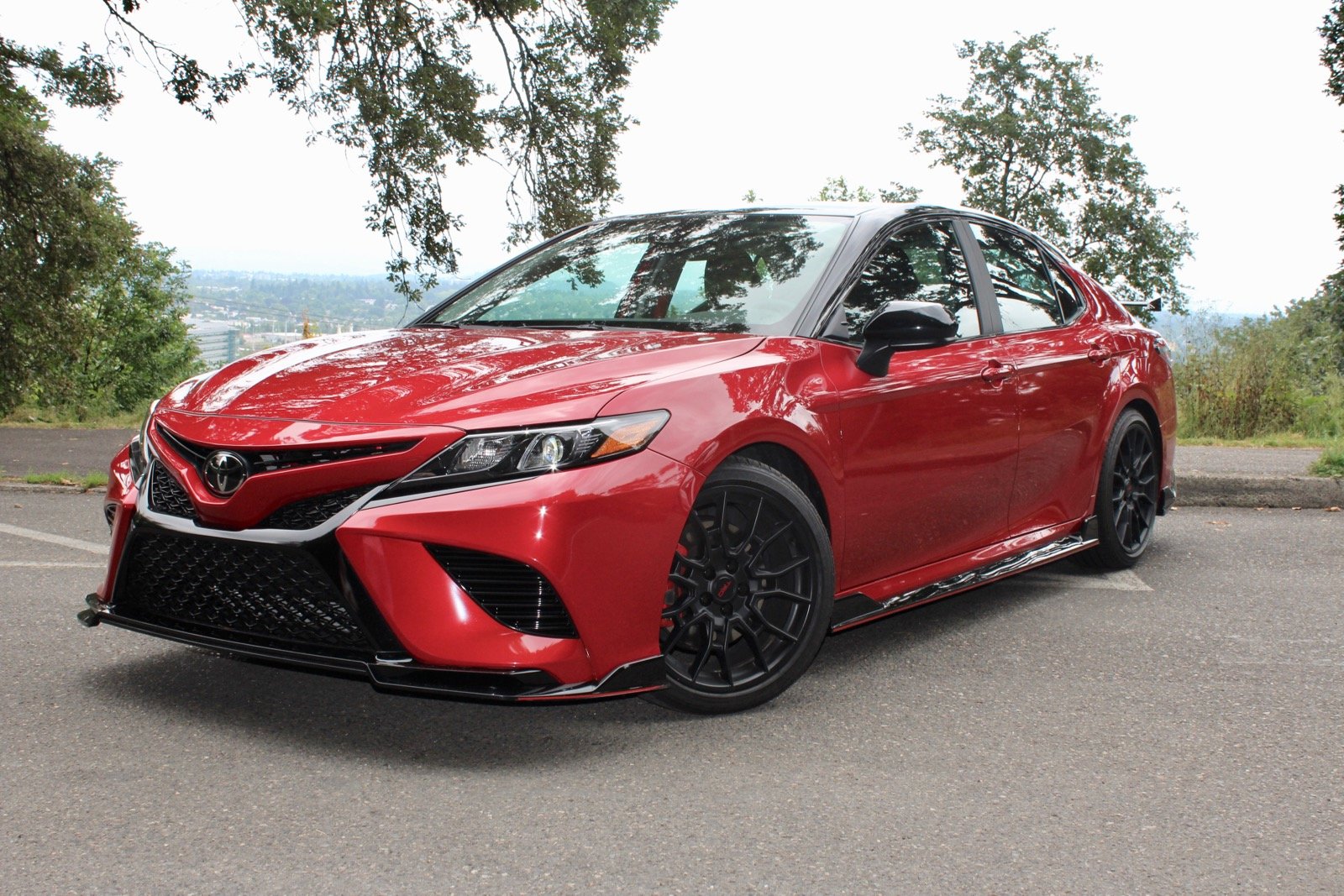
According to CarGurus experts, the overall rating for the 2020 Toyota Camry is 7.5 out of 10, while the 2021 Nissan Altima scores 7.2 out of 10. Both vehicles offer compelling attributes, but the Camry edges out slightly with its higher score. With its expressive styling, diverse powertrain options, and high safety ratings, the 2020 Toyota Camry stands out as the more well-rounded choice in this comparison. If you’re in the market for a midsize sedan that balances sporty design, performance, and advanced safety features, the Camry is the more highly recommended vehicle.
Choose the 2021 Nissan Altima if:
- Comfort on long drives is a priority, thanks to the Zero Gravity front seats.
- You prefer a sleek, modern design with advanced technology and connectivity options.
- Safety features like ProPilot Assist and a comprehensive suite in higher trims are crucial for your peace of mind.


Choose the 2020 Toyota Camry if:
- You value a sporty look combined with a driver-focused, luxurious interior.
- You want multiple engine options, including a robust V6 and AWD.
- High safety ratings and a comprehensive set of standard features are important to you.


CarGurus highlights
According to CarGurus experts, the overall rating for the 2020 Toyota Camry is 7.5 out of 10, while the 2021 Nissan Altima scores 7.2 out of 10. Both vehicles offer compelling attributes, but the Camry edges out slightly with its higher score. With its expressive styling, diverse powertrain options, and high safety ratings, the 2020 Toyota Camry stands out as the more well-rounded choice in this comparison. If you’re in the market for a midsize sedan that balances sporty design, performance, and advanced safety features, the Camry is the more highly recommended vehicle.
Choose the 2021 Nissan Altima if:
Shop Now- Comfort on long drives is a priority, thanks to the Zero Gravity front seats.
- You prefer a sleek, modern design with advanced technology and connectivity options.
- Safety features like ProPilot Assist and a comprehensive suite in higher trims are crucial for your peace of mind.
Choose the 2020 Toyota Camry if:
Shop Now- You value a sporty look combined with a driver-focused, luxurious interior.
- You want multiple engine options, including a robust V6 and AWD.
- High safety ratings and a comprehensive set of standard features are important to you.

By: CarGurus + AI
At CarGurus, our team of experienced automotive writers remain at the heart of our content operation, conducting hands-on car tests and writing insightful guides that are backed by years of industry experience. To complement this, we are harnessing AI to make our content offering more diverse and more helpful to shoppers than ever. To achieve this, our AI systems are based exclusively on CarGurus content, ratings and data, so that what we produce is both unique to CarGurus, and uniquely helpful to car shoppers.

