2020 Mazda CX-5 vs 2020 Ford Edge
Overview | |
MSRP$31,100 | MSRP$25,190 |
Listings133 | Listings80 |
Ratings & Reviews | |
User Reviews | User Reviews |
Expert reviews8.0 out of 10 | Expert reviews7.7 out of 10 |
Pros
Cons
| Pros
Cons
|
2020 Ford Edge Reviews SummaryThe Ford Edge isn’t exactly memorable, which isn’t a bad thing. It isn’t a good thing either. Cars can be remembered for attractive design, fun driving dynamics, or being a solid value. They can also be remembered in a negative light for a polarizing design, poor build quality, or being unsafe to the point of scandal. But the 2020 Ford Edge is just... there. It is a midsize two-row SUV that doesn’t offend, but also doesn’t “wow.” But just as critically, the Edge is getting long in the tooth. In the SUV segment, constant iteration is necessary for survival, and the Edge is in need of a redesign. But in lieu of new blood, Ford has done well to keep the Edge fitted with the latest infotainment and safety technology. It also offers a performance variant, called the Edge ST. This is something that you won’t find in the Edge’s competitors, the Nissan Murano and Honda Passport. But is it enough to keep the Edge relevant against its more contemporary rivals? Read on to find out. | |
2020 Mazda CX-5 Reviews SummaryAccording to a Harvard Business Review marketing study, there is such a thing as too much choice. And when the marketplace presents consumers with too much choice, there is a chance they won’t buy anything at all. For the 2020 model year, there are more than 40 small or compact SUVs available, half of them sold by luxury brands. Small and scrappy Mazda offers three of them: the CX-3, the CX-30, and the CX-5. However, in a marketplace awash in Chevys, Fords, Hondas, and Toyotas, Mazda has trouble standing apart from the established crowd. What’s the solution? Move upscale into “premium” territory. Premium is where Buick, Fiat, GMC, Jeep, Mini, and Volkswagen play to varying levels of success. Combining the value inherent in a mainstream brand with the design, materials, and technology common to luxury brands, these premium vehicles attempt to provide more than mainstream for less than luxury. At the same time, less is more. Because the 2020 Mazda CX-5 has but four similarly sized competitors in the premium class, that makes it easier for a consumer to choose, and more likely that a consumer will buy. The trick is convincing people that Mazda is a premium brand, and the automaker is taking a pragmatic approach to this emotionally charged solution. | |
No video found | No video found |
Popular Features & Specs | |
Engine2.0L 250 hp I4 | Engine2.5L 187 hp I4 |
DrivetrainFWD | DrivetrainFWD |
Seating Capacity5 | Seating Capacity5 |
Horsepower250 hp @ 5500 rpm | Horsepower187 hp @ 6000 rpm |
MPG City21 | MPG City25 |
MPG Highway29 | MPG Highway31 |
Engine | |
Engine Name2.0L 250 hp I4 | Engine Name2.5L 187 hp I4 |
Torque280 lb-ft @ 3000 rpm | Torque186 lb-ft @ 4000 rpm |
Horsepower250 hp @ 5500 rpm | Horsepower187 hp @ 6000 rpm |
DrivetrainFWD | DrivetrainFWD |
Fuel Economy | |
MPG City21 | MPG City25 |
MPG Highway29 | MPG Highway31 |
Interior | |
Seating Capacity5 | Seating Capacity5 |
Safety | |
Front Crash Overall5 | Front Crash Overall5 |
Side Crash Overall5 | Side Crash Overall5 |
Dimensions & Capacity | |
Cargo Space39.2 cu ft | Cargo Space30.9 cu ft |
Curb Weight4027 lbs | Curb Weight3541 lbs |
Height68.3 in | Height66.2 in |
Length188.8 in | Length179.1 in |
Width85.8 in | Width83.3 in |
Wheelbase112.2 in | Wheelbase106.2 in |
Maximum Payload1243 lbs | Maximum Payload1034 lbs |
Number of doors4 | Number of doors4 |
Maximum Towing Capacity1500 lbs | Maximum Towing Capacity2000 lbs |
Overview | ||
MSRP | $31,100 | $25,190 |
Listings | ||
Ratings & Reviews | ||
User reviews | ||
Expert reviews | 8.0 out of 10Read full review | 7.7 out of 10Read full review |
Pros & cons | Pros
Cons
| Pros
Cons
|
Summary | The Ford Edge isn’t exactly memorable, which isn’t a bad thing. It isn’t a good thing either. Cars can be remembered for attractive design, fun driving dynamics, or being a solid value. They can also be remembered in a negative light for a polarizing design, poor build quality, or being unsafe to the point of scandal. But the 2020 Ford Edge is just... there. It is a midsize two-row SUV that doesn’t offend, but also doesn’t “wow.” But just as critically, the Edge is getting long in the tooth. In the SUV segment, constant iteration is necessary for survival, and the Edge is in need of a redesign. But in lieu of new blood, Ford has done well to keep the Edge fitted with the latest infotainment and safety technology. It also offers a performance variant, called the Edge ST. This is something that you won’t find in the Edge’s competitors, the Nissan Murano and Honda Passport. But is it enough to keep the Edge relevant against its more contemporary rivals? Read on to find out. | According to a Harvard Business Review marketing study, there is such a thing as too much choice. And when the marketplace presents consumers with too much choice, there is a chance they won’t buy anything at all. For the 2020 model year, there are more than 40 small or compact SUVs available, half of them sold by luxury brands. Small and scrappy Mazda offers three of them: the CX-3, the CX-30, and the CX-5. However, in a marketplace awash in Chevys, Fords, Hondas, and Toyotas, Mazda has trouble standing apart from the established crowd. What’s the solution? Move upscale into “premium” territory. Premium is where Buick, Fiat, GMC, Jeep, Mini, and Volkswagen play to varying levels of success. Combining the value inherent in a mainstream brand with the design, materials, and technology common to luxury brands, these premium vehicles attempt to provide more than mainstream for less than luxury. At the same time, less is more. Because the 2020 Mazda CX-5 has but four similarly sized competitors in the premium class, that makes it easier for a consumer to choose, and more likely that a consumer will buy. The trick is convincing people that Mazda is a premium brand, and the automaker is taking a pragmatic approach to this emotionally charged solution. |
Video | No video found | No video found |
Popular Features & Specs | ||
Engine | 2.0L 250 hp I4 | 2.5L 187 hp I4 |
Drivetrain | FWD | FWD |
Seating Capacity | 5 | 5 |
Horsepower | 250 hp @ 5500 rpm | 187 hp @ 6000 rpm |
MPG City | 21 | 25 |
MPG Highway | 29 | 31 |
Engine | ||
Engine Name | 2.0L 250 hp I4 | 2.5L 187 hp I4 |
Torque | 280 lb-ft @ 3000 rpm | 186 lb-ft @ 4000 rpm |
Horsepower | 250 hp @ 5500 rpm | 187 hp @ 6000 rpm |
Drivetrain | FWD | FWD |
Fuel Economy | ||
MPG City | 21 | 25 |
MPG Highway | 29 | 31 |
Interior | ||
Seating Capacity | 5 | 5 |
Safety | ||
Front Crash Overall | 5 | 5 |
Side Crash Overall | 5 | 5 |
Dimensions & Capacity | ||
Cargo Space | 39.2 cu ft | 30.9 cu ft |
Curb Weight | 4027 lbs | 3541 lbs |
Height | 68.3 in | 66.2 in |
Length | 188.8 in | 179.1 in |
Width | 85.8 in | 83.3 in |
Wheelbase | 112.2 in | 106.2 in |
Maximum Payload | 1243 lbs | 1034 lbs |
Number of doors | 4 | 4 |
Maximum Towing Capacity | 1500 lbs | 2000 lbs |
The 2020 Ford Edge, introduced in 2006, was based on the Ford Fusion sedan platform, offering a car-like ride and spacious cabin. By 2015, the second generation arrived, with a styling update in 2019 that carried over to 2020. Despite its fresh look, the Edge's design lagged behind competitors like Honda and Toyota, who frequently updated their models. The Edge's exterior resembled a crossover version of the Fusion, featuring angular headlights and a large grille. Inside, the layout showed its age, with awkwardly arranged controls and a mix of soft-touch materials and hard plastics. The Edge was available in SE, SEL, Titanium, and ST trims, each offering various features, from the basic SYNC 3 infotainment system to the performance-oriented ST with a powerful engine.
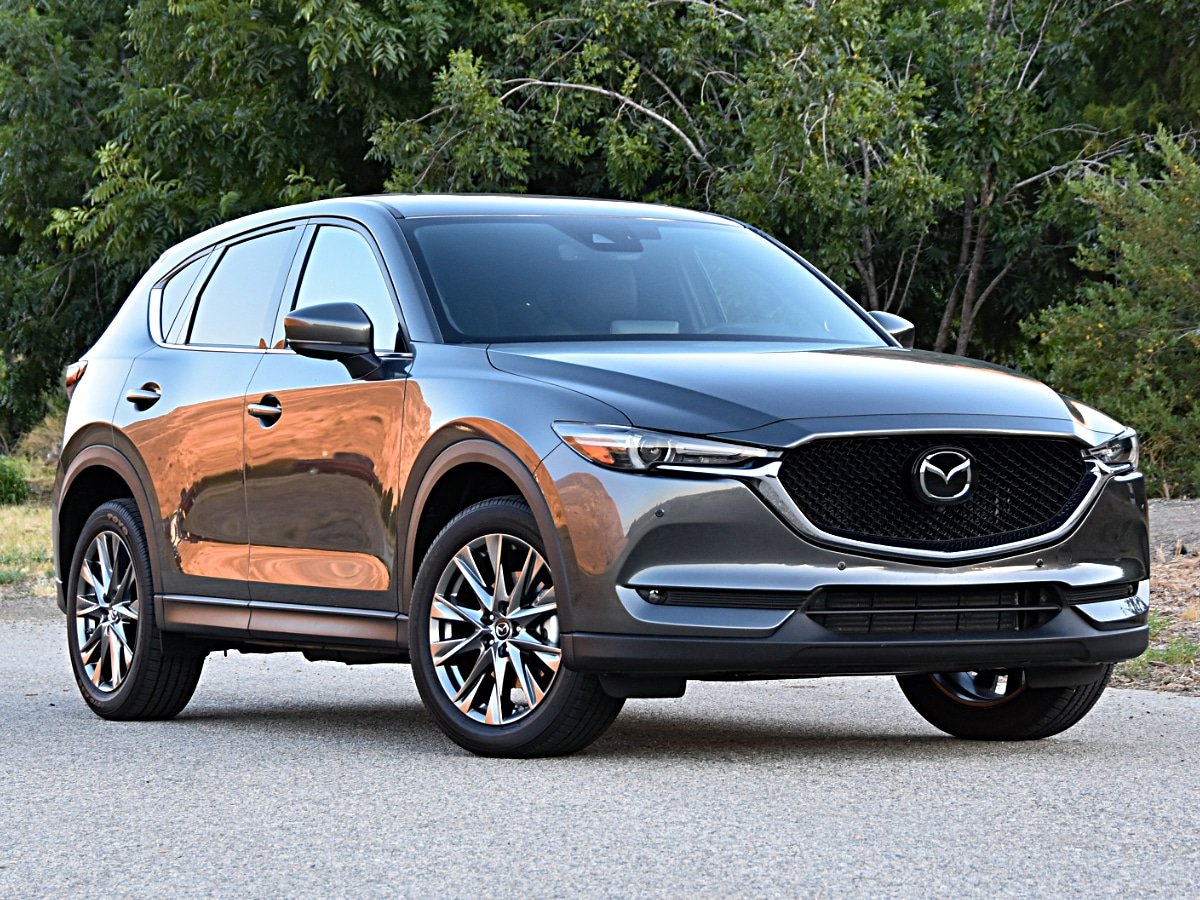
The 2020 Mazda CX-5 aimed to deliver a premium experience with captivating style and substance. It featured more standard equipment, improved cabin aesthetics, and reduced noise and vibration. The CX-5's design, rooted in Mazda's "Kodo" styling, remained appealing and upscale. Inside, the Signature trim boasted Nappa leather, real wood, and a luxurious feel, though the Caturra Brown leather lacked contrast. The CX-5's interior was stylish, but its cramped space compared to competitors like the Honda CR-V and Toyota RAV4 was a drawback. Mazda focused on upscale features to offset this, offering heated seats, dual-zone climate control, and more in higher trims.


The 2020 Ford Edge came with a standard 2.0-litre turbocharged four-cylinder engine, producing 250 horsepower and 275 pound-feet of torque. It offered front-wheel drive or optional all-wheel drive, paired with an eight-speed automatic transmission. The engine provided solid low-end acceleration, though it struggled at higher speeds. The Edge's suspension handled rough roads well, offering a refined and engaging drive. The sporty Edge ST variant featured a 2.7-litre twin-turbo EcoBoost V6, delivering 335 horsepower and 380 pound-feet of torque with standard AWD. The ST excelled in performance, with heavy steering and excellent cornering, enhanced by a Sport mode and available performance brake package.
The 2020 Mazda CX-5 offered a 2.5-litre four-cylinder engine with 187 horsepower and 186 pound-feet of torque in GX, GS, and GT trims, using a six-speed automatic transmission. Front-wheel drive was standard, with optional AWD. The GT Turbo and Signature trims featured a turbocharged engine, producing 250 horsepower and 320 pound-feet of torque on premium fuel. The turbo engine provided strong acceleration despite the CX-5's weight, though it was less efficient. The CX-5's G-Vectoring Control Plus technology enhanced driving engagement, but excessive body motions affected its handling. The steering and brakes were responsive, making it enjoyable in typical driving situations.
The 2020 Ford Edge excelled in cabin layout, offering a commanding road view and ample storage. The spacious second row provided plenty of head- and legroom, with no need to adjust front seats for comfort. The Edge offered 1,110 litres of cargo space behind the rear seats, expanding to 2,078 litres with the seats folded. This was more than a Jeep Grand Cherokee but slightly less than a Honda Passport. Higher trims featured a hands-free power liftgate.
The 2020 Mazda CX-5 focused on an upscale cabin with stylish design and quality materials. Heated front seats were standard, with higher trims adding features like a power-adjustable driver's seat, heated steering wheel, and ventilated front seats. The Signature trim offered Nappa leather and wood trim. Despite its style, the CX-5's interior was cramped compared to competitors, with limited rear legroom. Cargo space measured 875 litres, expanding to 1,687 litres with the rear seats folded. A power liftgate was available on higher trims.
The 2020 Ford Edge featured the SYNC 3 infotainment system with an 8-inch touchscreen, offering easy navigation with icons for audio, phone, and settings. Apple CarPlay and Android Auto were standard, allowing smartphone integration without extra cost. The Edge included two smart-charging USB ports and a rearview camera. A semi-digital instrument panel was available on higher trims.
The 2020 Mazda CX-5 used the Mazda Connect infotainment system, similar to luxury brands. It featured a 7-inch touchscreen, usable only when stationary, with Bluetooth, HD Radio, and internet radio apps. Apple CarPlay and Android Auto were standard. Higher trims added SiriusXM, a Bose sound system, and navigation. The system required acclimation, with controls on the centre console and steering wheel. Voice recognition was limited, and a new version was expected in 2021.
The 2020 Ford Edge included front and side-impact airbags, traction control, and a tire pressure monitoring system. The Ford Co-Pilot360 safety suite was standard, offering automatic emergency braking, lane departure warning, and blind-spot monitoring. The SEL trim offered an upgraded Co-Pilot360 Assist+ package with adaptive cruise control and lane centring. The Edge received a "Top Safety Pick" from IIHS and a five-star NHTSA rating.
The 2020 Mazda CX-5 featured standard ADAS, including automatic emergency braking, blind-spot monitoring, and rear cross-traffic alert. Higher trims added adaptive cruise control, forward collision warning, and lane-keep assist. LED headlights and rain-sensing wipers were standard, with adaptive headlights on higher trims. The CX-5 earned a Top Safety Pick+ from IIHS and a five-star NHTSA rating, excelling in crash tests.
CarGurus highlights

According to CarGurus experts, the overall rating for the 2020 Ford Edge is 8.0 out of 10, while the 2020 Mazda CX-5 scores 7.7 out of 10. Based on these ratings, the Ford Edge is recommended for its higher overall score, offering a balance of space, performance, and technology.
Choose the 2020 Mazda CX-5 if:
- You desire a premium interior with upscale materials.
- You appreciate engaging driving dynamics with advanced technology.
- You prioritize top safety ratings and standard safety features.


Choose the 2020 Ford Edge if:
- You need more cargo space and a spacious interior.
- You prefer a performance-oriented variant like the Edge ST.
- You value a user-friendly infotainment system with standard smartphone integration.


CarGurus highlights
According to CarGurus experts, the overall rating for the 2020 Ford Edge is 8.0 out of 10, while the 2020 Mazda CX-5 scores 7.7 out of 10. Based on these ratings, the Ford Edge is recommended for its higher overall score, offering a balance of space, performance, and technology.
Choose the 2020 Mazda CX-5 if:
Shop Now- You desire a premium interior with upscale materials.
- You appreciate engaging driving dynamics with advanced technology.
- You prioritize top safety ratings and standard safety features.
Choose the 2020 Ford Edge if:
Shop Now- You need more cargo space and a spacious interior.
- You prefer a performance-oriented variant like the Edge ST.
- You value a user-friendly infotainment system with standard smartphone integration.

By: CarGurus + AI
At CarGurus, our team of experienced automotive writers remain at the heart of our content operation, conducting hands-on car tests and writing insightful guides that are backed by years of industry experience. To complement this, we are harnessing AI to make our content offering more diverse and more helpful to shoppers than ever. To achieve this, our AI systems are based exclusively on CarGurus content, ratings and data, so that what we produce is both unique to CarGurus, and uniquely helpful to car shoppers.
