2021 Toyota Venza vs 2020 Mazda CX-5
Overview | |
MSRP$25,190 | MSRP$32,670 |
Listings164 | Listings34 |
Ratings & Reviews | |
User Reviews | User Reviews |
Expert reviews7.7 out of 10 | Expert reviews8.3 out of 10 |
Pros
Cons
| Pros
Cons
|
2020 Mazda CX-5 Reviews SummaryAccording to a Harvard Business Review marketing study, there is such a thing as too much choice. And when the marketplace presents consumers with too much choice, there is a chance they won’t buy anything at all. For the 2020 model year, there are more than 40 small or compact SUVs available, half of them sold by luxury brands. Small and scrappy Mazda offers three of them: the CX-3, the CX-30, and the CX-5. However, in a marketplace awash in Chevys, Fords, Hondas, and Toyotas, Mazda has trouble standing apart from the established crowd. What’s the solution? Move upscale into “premium” territory. Premium is where Buick, Fiat, GMC, Jeep, Mini, and Volkswagen play to varying levels of success. Combining the value inherent in a mainstream brand with the design, materials, and technology common to luxury brands, these premium vehicles attempt to provide more than mainstream for less than luxury. At the same time, less is more. Because the 2020 Mazda CX-5 has but four similarly sized competitors in the premium class, that makes it easier for a consumer to choose, and more likely that a consumer will buy. The trick is convincing people that Mazda is a premium brand, and the automaker is taking a pragmatic approach to this emotionally-charged solution. | |
2021 Toyota Venza Reviews SummaryAt first glance, the 2021 Toyota Venza looks more like a Lexus than a typical Toyota, which is fitting, because the Venza is anything but typical. The new Venza blends a new approach to in-car technology with fresh exterior and interior design. Like the Nissan Murano, Honda Passport, Ford Edge, and Chevrolet Blazer, the Venza is a two-row SUV meant to be more sophisticated than the family-friendly Nissan Rogue, Honda CR-V, Chevrolet Equinox, and Toyota RAV4. There is no three-row Venza option. It also comes only with a hybrid powertrain—for better or worse—something that its competition is lacking. All-wheel drive is also standard. That's also offered by the competition, but only as a costly upgrade. The Venza’s $32,470 starting price is slightly higher than the Murano and Blazer, but it comes with the traditionally-more-expensive hybrid powertrain. Is the hybrid worth shelling out a little more for? | |
No video found | |
Popular Features & Specs | |
Engine2.5L 187 hp I4 | Engine2.5L 219 hp I4 Hybrid |
Drive TrainFWD | Drive TrainAWD |
Seating Capacity5 | Seating Capacity5 |
Horsepower187 hp @ 6000 rpm | Horsepower |
EV Battery Capacity | EV Battery Capacity0.93 kWh |
MPG City25 | MPG City40 |
MPG Highway31 | MPG Highway37 |
Engine | |
Engine Name2.5L 187 hp I4 | Engine Name2.5L 219 hp I4 Hybrid |
Torque186 lb-ft @ 4000 rpm | Torque |
Horsepower187 hp @ 6000 rpm | Horsepower |
DrivetrainFWD | DrivetrainAWD |
Fuel Economy | |
EV Battery Capacity | EV Battery Capacity0.93 kWh |
MPG City25 | MPG City40 |
MPG Highway31 | MPG Highway37 |
Interior | |
Seating Capacity5 | Seating Capacity5 |
Safety | |
Front Crash Overall5 | Front Crash Overall4 |
Side Crash Overall5 | Side Crash Overall5 |
Dimensions & Capacity | |
Cargo Space30.9 cu ft | Cargo Space28.8 cu ft |
Curb Weight3541 lbs | Curb Weight3847 lbs |
Height66.2 in | Height65.9 in |
Length179.1 in | Length186.6 in |
Width83.3 in | Width73.0 in |
Wheelbase106.2 in | Wheelbase105.9 in |
Maximum Payload1034 lbs | Maximum Payload900 lbs |
Number of doors4 | Number of doors4 |
Maximum Towing Capacity2000 lbs | Maximum Towing Capacity |
Overview | ||
MSRP | $25,190 | $32,670 |
Listings | ||
Ratings & Reviews | ||
User reviews | ||
Expert reviews | 7.7 out of 10Read full review | 8.3 out of 10Read full review |
Pros & cons | Pros
Cons
| Pros
Cons
|
Summary | According to a Harvard Business Review marketing study, there is such a thing as too much choice. And when the marketplace presents consumers with too much choice, there is a chance they won’t buy anything at all. For the 2020 model year, there are more than 40 small or compact SUVs available, half of them sold by luxury brands. Small and scrappy Mazda offers three of them: the CX-3, the CX-30, and the CX-5. However, in a marketplace awash in Chevys, Fords, Hondas, and Toyotas, Mazda has trouble standing apart from the established crowd. What’s the solution? Move upscale into “premium” territory. Premium is where Buick, Fiat, GMC, Jeep, Mini, and Volkswagen play to varying levels of success. Combining the value inherent in a mainstream brand with the design, materials, and technology common to luxury brands, these premium vehicles attempt to provide more than mainstream for less than luxury. At the same time, less is more. Because the 2020 Mazda CX-5 has but four similarly sized competitors in the premium class, that makes it easier for a consumer to choose, and more likely that a consumer will buy. The trick is convincing people that Mazda is a premium brand, and the automaker is taking a pragmatic approach to this emotionally-charged solution. | At first glance, the 2021 Toyota Venza looks more like a Lexus than a typical Toyota, which is fitting, because the Venza is anything but typical. The new Venza blends a new approach to in-car technology with fresh exterior and interior design. Like the Nissan Murano, Honda Passport, Ford Edge, and Chevrolet Blazer, the Venza is a two-row SUV meant to be more sophisticated than the family-friendly Nissan Rogue, Honda CR-V, Chevrolet Equinox, and Toyota RAV4. There is no three-row Venza option. It also comes only with a hybrid powertrain—for better or worse—something that its competition is lacking. All-wheel drive is also standard. That's also offered by the competition, but only as a costly upgrade. The Venza’s $32,470 starting price is slightly higher than the Murano and Blazer, but it comes with the traditionally-more-expensive hybrid powertrain. Is the hybrid worth shelling out a little more for? |
Video | No video found | |
Popular Features & Specs | ||
Engine | 2.5L 187 hp I4 | 2.5L 219 hp I4 Hybrid |
Drive Train | FWD | AWD |
Seating Capacity | 5 | 5 |
Horsepower | 187 hp @ 6000 rpm | |
EV Battery Capacity | 0.93 kWh | |
MPG City | 25 | 40 |
MPG Highway | 31 | 37 |
Engine | ||
Engine Name | 2.5L 187 hp I4 | 2.5L 219 hp I4 Hybrid |
Torque | 186 lb-ft @ 4000 rpm | |
Horsepower | 187 hp @ 6000 rpm | |
Drivetrain | FWD | AWD |
Fuel Economy | ||
EV Battery Capacity | 0.93 kWh | |
MPG City | 25 | 40 |
MPG Highway | 31 | 37 |
Interior | ||
Seating Capacity | 5 | 5 |
Safety | ||
Front Crash Overall | 5 | 4 |
Side Crash Overall | 5 | 5 |
Dimensions & Capacity | ||
Cargo Space | 30.9 cu ft | 28.8 cu ft |
Curb Weight | 3541 lbs | 3847 lbs |
Height | 66.2 in | 65.9 in |
Length | 179.1 in | 186.6 in |
Width | 83.3 in | 73.0 in |
Wheelbase | 106.2 in | 105.9 in |
Maximum Payload | 1034 lbs | 900 lbs |
Number of doors | 4 | 4 |
Maximum Towing Capacity | 2000 lbs | |
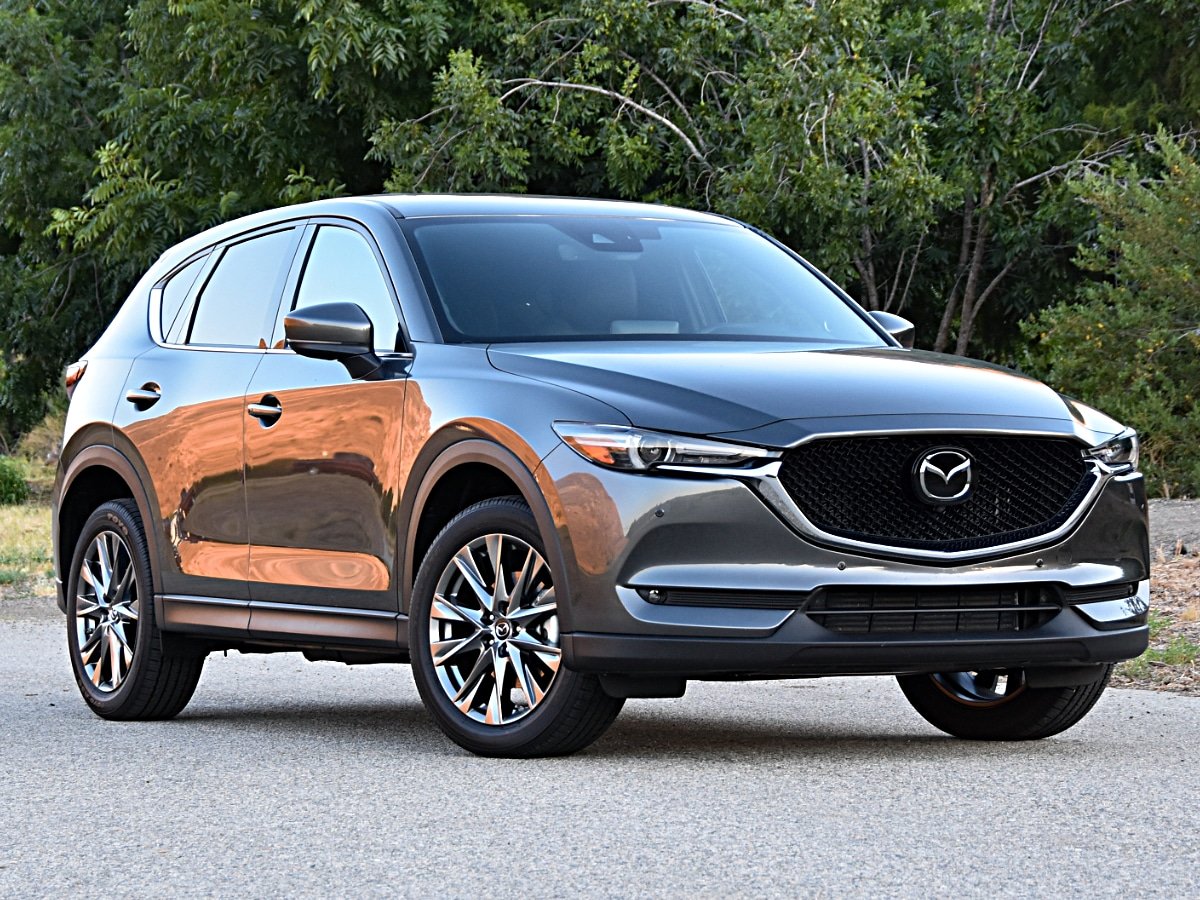
Mazda executed the concept of premium better than its competitors with the 2020 CX-5. This model year, the CX-5 featured more standard equipment, revised instrumentation, and control markings to enhance the cabin's appearance. Modifications were made to reduce noise, vibration, and harshness, and the turbocharged engine saw an increase in torque output. AWD versions gained a new off-road traction assistance feature. Prices ranged from $25,190 to $37,155, with the test vehicle in Signature trim costing $38,680, including destination charges. The CX-5's "Kodo" styling themes made it look appealing, distinctive, and upscale, a feat many automakers struggled to achieve.
Inside, the CX-5, especially in Signature trim, exuded luxury with premium Nappa leather upholstery, real wood, and a black headliner. However, the Caturra Brown leather was almost indistinguishable from the black cabin, reducing the contrast that often makes a vehicle seem premium. Despite this, the interior reflected style and good taste, with classy-looking gauges and elegant metallic accents.
The 2021 Toyota Venza, shorter and closer to the ground than the RAV4, blurred the line between Toyota and Lexus with its design. Critics noted its resemblance to the Lexus LF-1 Limitless concept. Toyota offered the Venza in three trim levels: LE, XLE, and Limited, with seven paint color options. Standard equipment included dual chrome-tipped exhaust, LED headlights and taillights, automatic high beams, puddle lights, and 18-inch alloy wheels. The base LE model featured a wireless charging pad, 4.2-inch driver’s information display, leather-trimmed steering wheel, Bluetooth, dual-zone automatic climate control, fabric-trimmed seats, and more.
Upgrading to the XLE trim added black bumper garnishes, silver roof rails, 19-inch alloy wheels, LED projector headlights, and other premium features. The top-tier Limited trim included a digital rearview mirror with Homelink, illuminated footwells, a backup camera washer, and a 12.3-inch infotainment screen. The Star Gaze panoramic roof was an optional feature. The test vehicle was a fully loaded Venza Limited.


The 2020 Mazda CX-5 came standard with a 2.5-liter four-cylinder engine producing 187 horsepower and 186 pound-feet of torque, paired with a six-speed automatic transmission with a Sport mode. FWD was standard, with AWD optional. The Grand Touring Reserve and Signature trims featured a turbocharged version of the engine, generating 250 hp and 320 lb-ft of torque on premium fuel, or 227 hp and 310 lb-ft on regular fuel. The turbocharged engine, paired with AWD, provided a healthy amount of power for a compact crossover SUV, though it was less efficient, rated at 24 mpg combined compared to 26 mpg for the naturally-aspirated engine with AWD.
The CX-5 Signature, despite its 3,825-pound curb weight, accelerated with authority. The G-Vectoring Control Plus (GVC Plus) technology enhanced the driving experience by stabilizing the SUV during cornering. However, the CX-5's excessive body motions when hustling down a back road detracted from the driving experience. An adaptive-damping suspension could have improved this. Despite this, the steering and brakes were up to the task, making the CX-5 enjoyable in typical driving situations.
The 2021 Toyota Venza featured a 2.5-liter four-cylinder gasoline engine paired with a lithium-ion battery pack and electric motors, resulting in a combined 219 horsepower and 163 pound-feet of torque. The hybrid system, with an electronically-controlled continuously-variable transmission (eCVT), provided smooth acceleration, though it was noisy. The Venza's handling inspired confidence, driving like a typical Toyota. It excelled in fuel economy, achieving an EPA-estimated 40 mpg on the highway, 37 mpg in the city, and 39 mpg combined, outperforming competitors like the Murano, Passport, and Blazer.
Toyota backed the Venza's hybrid powertrain with a 10-year/150,000-mile hybrid battery warranty and an eight-year/100,000-mile Hybrid System warranty.
The 2020 Mazda CX-5's interior was more cramped compared to competitors like the Honda CR-V and Toyota RAV4. However, Mazda focused on an upscale cabin and generous standard equipment to offset this. The interior reflected style and good taste, with classy gauges and elegant metallic accents. Touring trim added dual-zone automatic climate control, heated front seats, and rear air conditioning vents. Grand Touring trim included a power height-adjustable front passenger seat, while Grand Touring Reserve added ventilated front seats, heated rear seats, and a heated steering wheel. The Signature trim featured Nappa leather, genuine wood trim, and more.
The CX-5 Signature's front seats were comfortable, though rear passengers might find legroom lacking. Cargo space behind the rear seat measured 30.9 cubic feet, expanding to 59.6 cubic feet with the rear seat folded. A power liftgate with a programmable height limit was standard on Grand Touring trim and higher.
The 2021 Toyota Venza's interior took a unique approach, with premium appointments in the center stack. The deep center console featured resizable cup holders, a traditional stick shifter, drive mode buttons, an electronic parking brake button, USB and AUX ports, a wireless charging pad, heated and ventilated seat buttons, and push-button ignition. The padded upholstery on the console looked and felt luxurious in the most premium trim level.
The Venza's front seats were accommodating, and two adults could comfortably fit in the rear. The Venza had more headroom, slightly less legroom up front, and nearly equal shoulder and hip room compared to the RAV4. The Venza's maximum cargo space was 55.1 cubic feet, less than the RAV4 but sufficient for daily driving needs. The quick-flip releases on the 60/40 split-folding rear seatbacks made arranging the cargo space easy.
The 2020 Mazda CX-5 featured the Mazda Connect infotainment system, which conveyed an upscale impression but could be frustrating to use. The Sport trim had a 7-inch touchscreen display, responding to touch only when the vehicle was stationary. Bluetooth, HD Radio, text messaging support, integrated internet radio apps, and E911 emergency notification were included. The Touring trim added Apple CarPlay and Android Auto. The Grand Touring trim featured an 8-inch touchscreen, satellite radio, and a 10-speaker Bose premium sound system. The Signature trim included a navigation system, a surround-view camera system, and a SiriusXM data subscription.
Interacting with Mazda Connect involved using the touchscreen (when stationary), center console controls, steering wheel controls, or voice-recognition technology. The voice-recognition technology was not ideal, often failing to interpret commands or provide feedback. For 2021, Mazda planned to update the system, removing the touchscreen but introducing a wider, more modern display.
The 2021 Toyota Venza LE and XLE had an 8-inch infotainment system, while the Limited trim featured a 12.3-inch touchscreen. The Entune infotainment system, though improved, was not the best in the industry. The larger screen had good response time but was not easy to use, requiring multiple menu trips for simple functions. Toyota included Apple CarPlay, Android Auto, and Amazon Alexa as standard across all trim levels, along with AM/FM/HD Radio, hands-free phone capability, Bluetooth, and a six-speaker audio system.
All trim levels had a Wi-Fi hot spot, with a free 2-gigabyte/three-month trial period. The Venza XLE and Limited offered a nine-speaker JBL premium audio system. Toyota connected services included a one-year trial of Safety Connect, a roadside-assistance service, and Remote Connect, an app-based system for accessing vehicle functionalities. A 10-year trial of Service Connect provided maintenance and service data. Dynamic navigation, using cloud-based technology, was available on models with the larger infotainment screen.
The 2020 Mazda CX-5 featured the i-Activsense package, including adaptive cruise control with stop-and-go capability, forward collision warning with pedestrian detection, automatic emergency braking, blind-spot monitoring, rear cross-traffic alert, lane departure warning, and lane-keep assist. Standard LED headlights and rain-sensing wipers were included, with adaptive headlights available on Grand Touring trim. The CX-5 earned a Top Safety Pick+ rating from the IIHS and a five-star overall rating from the NHTSA, with high marks in individual testing parameters.
The 2021 Toyota Venza included the Toyota Safety Sense 2.0 suite, with eight airbags, a rearview camera, hill start assist, parking distance sensors, tire pressure monitoring system, and adjustable front seatbelt anchors. The suite added a pre-collision warning system with pedestrian detection and automatic emergency braking, lane-departure alert with steering assist, lane-tracing assist, automatic high beams, adaptive cruise control, and road sign assist. Blind-spot monitoring with rear cross-traffic alert was standard, with an upgrade to similar technology with automatic braking available on the XLE and Limited trims. The Venza had two full sets of LATCH connections on the rear outboard seats. The safety features performed as expected, though the lane-keeping and lane-tracing assists kept the SUV further to the right within the lane.
CarGurus highlights

According to CarGurus experts, the overall rating for the 2020 Mazda CX-5 is 7.7 out of 10, while the 2021 Toyota Venza scores 8.3 out of 10. Based on these ratings, the 2021 Toyota Venza is the recommended choice, offering better fuel economy, a more spacious interior, and a higher overall rating.
Choose the 2021 Toyota Venza if:
- You seek superior fuel economy in a hybrid SUV.
- You prefer a more spacious and comfortable interior for passengers.
- You want a comprehensive suite of standard safety and driver assistance features.


Choose the 2020 Mazda CX-5 if:
- You prioritize a luxurious interior with premium materials.
- You enjoy a more engaging driving experience.
- You value a high safety rating with advanced driver assistance systems.


CarGurus highlights
According to CarGurus experts, the overall rating for the 2020 Mazda CX-5 is 7.7 out of 10, while the 2021 Toyota Venza scores 8.3 out of 10. Based on these ratings, the 2021 Toyota Venza is the recommended choice, offering better fuel economy, a more spacious interior, and a higher overall rating.
Choose the 2021 Toyota Venza if:
Shop Now- You seek superior fuel economy in a hybrid SUV.
- You prefer a more spacious and comfortable interior for passengers.
- You want a comprehensive suite of standard safety and driver assistance features.
Choose the 2020 Mazda CX-5 if:
Shop Now- You prioritize a luxurious interior with premium materials.
- You enjoy a more engaging driving experience.
- You value a high safety rating with advanced driver assistance systems.

By: CarGurus + AI
At CarGurus, our team of experienced automotive writers remain at the heart of our content operation, conducting hands-on car tests and writing insightful guides that are backed by years of industry experience. To complement this, we are harnessing AI to make our content offering more diverse and more helpful to shoppers than ever. To achieve this, our AI systems are based exclusively on CarGurus content, ratings and data, so that what we produce is both unique to CarGurus, and uniquely helpful to car shoppers.

