2020 Toyota Camry vs 2019 Toyota Camry
Overview | |
MSRP$24,095 | MSRP$24,425 |
Listings204 | Listings210 |
Ratings & Reviews | |
User Reviews | User Reviews |
Expert reviews7.8 out of 10 | Expert reviews7.5 out of 10 |
Pros
Cons
| Pros
Cons
|
2019 Toyota Camry Reviews SummaryBlame the Toyota Avalon for the Toyota Camry’s flaws. In order to put daylight between itself and Toyota’s larger full-size sedan, the midsize Camry is now smaller than some of its competitors, while simultaneously offering fewer of the increasingly expected features in the segment. Still, there are several good reasons to consider a 2019 Camry, from its outstanding safety ratings to its free scheduled maintenance plan. It’s also one of a handful of family sedans that still offers a 6-cylinder engine. | |
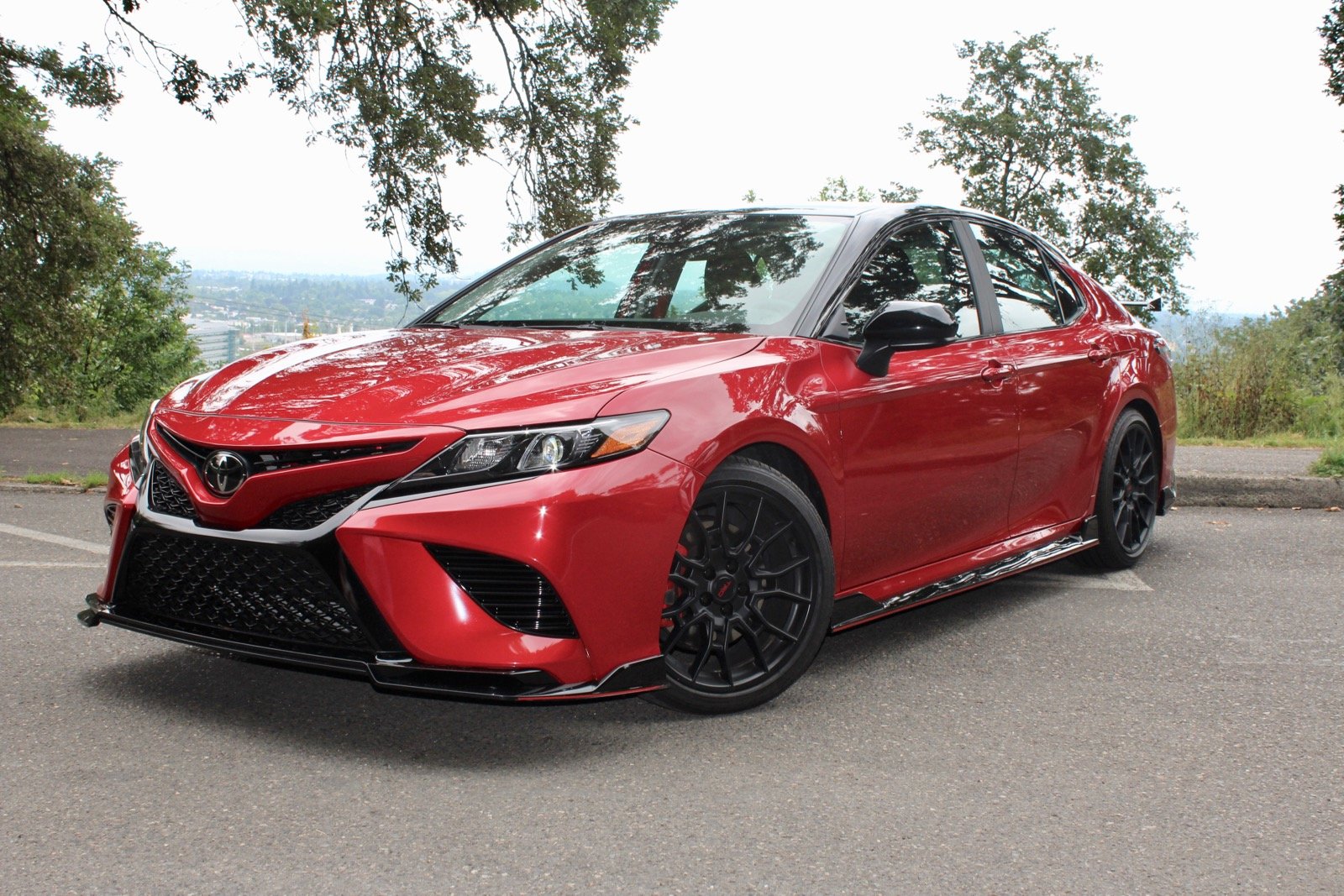
2020 Toyota Camry Reviews SummaryIf you can't beat them, join them. That seems to be Toyota's philosophy in updating the eighth generation of the Camry for the 2020 model year. This latest version of the perennial best seller debuted in 2017 as a 2018 model—and promptly lost its sales crown to Toyota's own RAV4 crossover SUV. As buyers continue to defect from cars, Toyota hopes to entice more shoppers to stick with its midsize sedan by offering all-wheel drive on the Camry for the first time since 1991. Also new for 2020 is the Camry TRD, a sportier version with a 301-horsepower V6 engine that makes its case to a buyer who might never have considered a Camry. | |
No video found | |
Popular Features & Specs | |
Engine2.5L 203 hp I4 | Engine2.5L 203 hp I4 |
Drive TrainFWD | Drive TrainFWD |
Seating Capacity5 | Seating Capacity5 |
MPG City29 | MPG City29 |
MPG Highway41 | MPG Highway41 |
Engine | |
Engine Name2.5L 203 hp I4 | Engine Name2.5L 203 hp I4 |
DrivetrainFWD | DrivetrainFWD |
Fuel Economy | |
MPG City29 | MPG City29 |
MPG Highway41 | MPG Highway41 |
Interior | |
Seating Capacity5 | Seating Capacity5 |
Safety | |
Front Crash Overall5 | Front Crash Overall5 |
Side Crash Overall5 | Side Crash Overall5 |
Dimensions & Capacity | |
Cargo Space14.1 cu ft | Cargo Space14.1 cu ft |
Curb Weight3241 lbs | Curb Weight3241 lbs |
Height56.9 in | Height56.9 in |
Length192.1 in | Length192.1 in |
Width72.4 in | Width72.4 in |
Wheelbase111.2 in | Wheelbase111.2 in |
Maximum Payload925 lbs | Maximum Payload925 lbs |
Number of doors4 | Number of doors4 |
Overview | ||
MSRP | $24,095 | $24,425 |
Listings | ||
Ratings & Reviews | ||
User reviews | ||
Expert reviews | 7.8 out of 10Read full review | 7.5 out of 10Read full review |
Pros & cons | Pros
Cons
| Pros
Cons
|
Summary | Blame the Toyota Avalon for the Toyota Camry’s flaws. In order to put daylight between itself and Toyota’s larger full-size sedan, the midsize Camry is now smaller than some of its competitors, while simultaneously offering fewer of the increasingly expected features in the segment. Still, there are several good reasons to consider a 2019 Camry, from its outstanding safety ratings to its free scheduled maintenance plan. It’s also one of a handful of family sedans that still offers a 6-cylinder engine. | If you can't beat them, join them. That seems to be Toyota's philosophy in updating the eighth generation of the Camry for the 2020 model year. This latest version of the perennial best seller debuted in 2017 as a 2018 model—and promptly lost its sales crown to Toyota's own RAV4 crossover SUV. As buyers continue to defect from cars, Toyota hopes to entice more shoppers to stick with its midsize sedan by offering all-wheel drive on the Camry for the first time since 1991. Also new for 2020 is the Camry TRD, a sportier version with a 301-horsepower V6 engine that makes its case to a buyer who might never have considered a Camry. |
Video | No video found | |
Popular Features & Specs | ||
Engine | 2.5L 203 hp I4 | 2.5L 203 hp I4 |
Drive Train | FWD | FWD |
Seating Capacity | 5 | 5 |
MPG City | 29 | 29 |
MPG Highway | 41 | 41 |
Engine | ||
Engine Name | 2.5L 203 hp I4 | 2.5L 203 hp I4 |
Drivetrain | FWD | FWD |
Fuel Economy | ||
MPG City | 29 | 29 |
MPG Highway | 41 | 41 |
Interior | ||
Seating Capacity | 5 | 5 |
Safety | ||
Front Crash Overall | 5 | 5 |
Side Crash Overall | 5 | 5 |
Dimensions & Capacity | ||
Cargo Space | 14.1 cu ft | 14.1 cu ft |
Curb Weight | 3241 lbs | 3241 lbs |
Height | 56.9 in | 56.9 in |
Length | 192.1 in | 192.1 in |
Width | 72.4 in | 72.4 in |
Wheelbase | 111.2 in | 111.2 in |
Maximum Payload | 925 lbs | 925 lbs |
Number of doors | 4 | 4 |
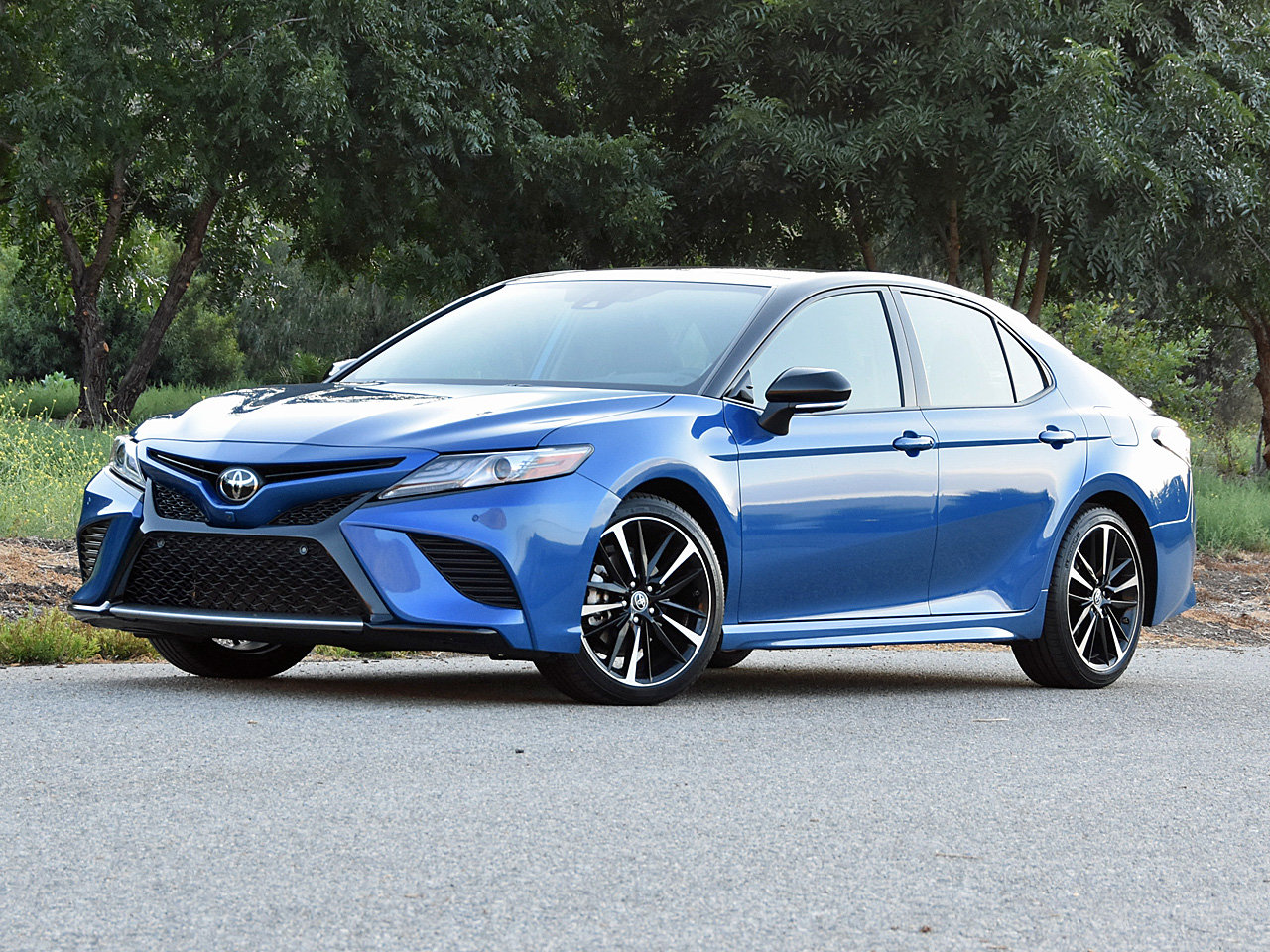
In 2019, the Toyota Camry offered buyers a choice between standard and sporty styling. Drivers had to decide between a 4-cylinder, a V6, and a hybrid powertrain, with trim levels including L, LE, XLE, SE, and XSE. The XSE V6, in particular, was equipped with Toyota's Driver Assist package, carpeted floor mats, and a distinctive two-tone Blue Streak paint with a Midnight Black roof. Despite being quick and entertaining for a Camry, the XSE trim wasn't the most recommended; the 2.5-liter 4-cylinder LE trim offered better value. The hybrid version, though fuel-efficient, had a higher initial cost, making it less economical over time for most drivers.
Stylistically, the 2019 Camry took a bold step away from its formerly bland designs, aiming for a daring look. Unfortunately, the aggressive design language didn’t translate into a cohesive aesthetic, making the proportions appear awkward. Even inside, while the Camry XSE featured many high-quality materials, some cheaper elements, like fabric-wrapped windshield pillars and switchgear borrowed from the Tacoma, detracted from its overall appeal.
In contrast, the 2020 Camry showcased a renewed attention to detail that elevated its styling and overall quality. This model was expressive in ways no previous Camry had been. Even without the TRD model’s dramatic wing and body kit, the front fascia and taut lines made it the sportiest Camry yet. The 2020 edition also borrowed some design elements from BMW, adding a fashionable edge with 14 exterior color options, including a black roof.
Inside, the 2020 model employed uniformly nice materials and had a driver-focused dashboard that gave every trim level a premium feel. Higher trims showcased leather and wood, suggesting an entry-level luxury experience close to that of a Lexus, even though the Camry wasn’t a luxury car.


The 2019 Toyota Camry was equipped with a standard 2.5-liter 4-cylinder engine producing 203 horsepower, which was sufficient for most drivers. However, the available 301-horsepower 3.5-liter V6 engine delivered a significant performance boost, making the driving experience thrilling for a Camry. Despite the additional weight of the V6, the car’s handling remained spirited, aided by an 8-speed automatic transmission and a sport-tuned suspension. The XSE trim with its 19-inch aluminum wheels provided a balance of responsive handling and a comfortable ride, though the steering effort felt more substantial in Sport mode and the brakes occasionally produced a disappointing “thunk” sound. Fuel economy for the V6 was subpar, recording just 21.9 mpg during testing, well below the EPA’s combined rating of 26 mpg.
In 2020, the Camry offered four distinct powertrains: a 2.5-liter four-cylinder with front-wheel or all-wheel drive, a 3.5-liter V6, and a hybrid powertrain. The 301-horsepower V6 engine, paired with an eight-speed automatic transmission, provided a luxurious driving experience particularly suited to the XLE trim. The 2.5-liter four-cylinder engine, while less powerful, was more agile due to a lighter front end, making the XSE trim nearly as fun as the TRD variant. The TRD model featured a tuned and lowered suspension, beefed-up brakes, and high-performance tires but was considerably firmer than the standard Camry, a trade-off for sportier handling.
Notable for 2020 was the addition of all-wheel drive, useful for improved traction in slippery conditions. Thanks to a disconnecting rear differential, the typical fuel economy penalty of AWD systems was minimized, resulting in 28 mpg combined for AWD models and 31 mpg for front-drive four-cylinder Camrys. V6 models managed around 25-26 mpg depending on the trim.
Toyota provided plenty of storage in the 2019 Camry’s cabin, including a large center console bin and a hidden compartment under the wireless charging pad. However, the glove box was small and far from the driver’s reach, and the door-panel storage pockets were narrow. The trunk was unexpectedly small for a midsize sedan at 15.1 cubic feet, lagging behind competitors like the Honda Accord. Front seats, both heated and providing 8-way power adjustments, were comfortable, though ventilated seats were not available. Rear seats were snug, making entry and exit challenging, though rear air-conditioning vents were a plus in upper trims.
The 2020 Camry retained ease of use, with familiar ergonomic features for long-time Camry drivers. An incongruous row of buttons on the lower dashboard and a well-designed center console shared space with a shifter, cupholders, a cell phone tray, and a storage bin. Front legroom and hip room had increased slightly, but rear legroom and passenger volume shrunk, as did the trunk space, comparable to a Honda Civic’s at 15.1 cubic feet. Fortunately, the addition of AWD didn’t further reduce cargo space or rear-seat room.
The 2019 Camry’s dashboard was dramatic yet user-friendly, with a touch-screen infotainment system featuring Toyota’s Entune 3.0. The system included Apple CarPlay and a 6-month subscription to WiFi Connect by Verizon but lacked Android Auto. An optional Qi wireless smartphone charging pad held devices securely, while the navigation system, although functioning well, occasionally lagged behind when loading current traffic data. The optional 9-speaker JBL premium sound system provided volume but fell short on clarity and richness.
For 2020, Toyota improved the Camry’s technology suite by adding Android Auto and expanding its features to include Amazon Alexa compatibility and a three-month trial of SiriusXM satellite radio. The system still felt somewhat dated, with low-resolution graphics and inferior navigation software, but its functionality and quick response to inputs were strong points. The standard 7-inch screen was small but upgradeable to an 8-inch version. Additional features included a trial of WiFi Connect, Remote Connect services like remote start, and optional enhancements such as a 10-inch head-up display and a 7-inch multi-information display in higher trims.
The 2019 Toyota Camry excelled in safety, earning 5-star ratings from the NHTSA and a Top Safety Pick+ from the IIHS. Standard safety features included a comprehensive suite of Toyota Safety Sense systems, such as adaptive cruise control, forward-collision warning, automatic emergency braking, lane-departure warning, lane-keeping assist, and automatic high beams. Additionally, a three-year subscription to Safety Connect provided emergency assistance services.
In 2020, the Camry continued to impress with safety, maintaining its five-star NHTSA rating and Top Safety Pick+ from IIHS. It included a pre-collision system with emergency braking, adaptive cruise control, lane-departure warning, lane-keeping assist, and automatic high beams. A one-year trial of Safety Connect was also included, with blind-spot monitoring and rear cross-traffic alert available as options. Higher trims featured Bird's Eye View, a 360-degree camera system to aid parking.
CarGurus highlights
According to CarGurus experts, the overall rating for the 2019 Toyota Camry was 7.8 out of 10, while the 2020 Toyota Camry scored 7.5 out of 10. Given these evaluations, the 2019 Toyota Camry emerges as the preferred choice based on its slightly higher rating across various categories. Both models boast strong safety features and decent performance, but the 2019 model edges out for better value and safety integration.
Choose the 2020 Toyota Camry if:
- You want the most up-to-date technology, including both Apple CarPlay and Android Auto.
- You need the option of all-wheel drive for better performance in slippery conditions.
- You appreciate a more stylish, sporty design with higher-quality interior materials.


Choose the 2019 Toyota Camry if:
- You prioritize value and are happy with the standard 2.5-liter four-cylinder engine.
- You’re looking for a model with very high safety ratings and don’t mind an outdated Android Auto compatibility.
- You can live with a smaller trunk, especially if cargo capacity isn't a top concern.


CarGurus highlights
According to CarGurus experts, the overall rating for the 2019 Toyota Camry was 7.8 out of 10, while the 2020 Toyota Camry scored 7.5 out of 10. Given these evaluations, the 2019 Toyota Camry emerges as the preferred choice based on its slightly higher rating across various categories. Both models boast strong safety features and decent performance, but the 2019 model edges out for better value and safety integration.
Choose the 2020 Toyota Camry if:
Shop Now- You want the most up-to-date technology, including both Apple CarPlay and Android Auto.
- You need the option of all-wheel drive for better performance in slippery conditions.
- You appreciate a more stylish, sporty design with higher-quality interior materials.
Choose the 2019 Toyota Camry if:
Shop Now- You prioritize value and are happy with the standard 2.5-liter four-cylinder engine.
- You’re looking for a model with very high safety ratings and don’t mind an outdated Android Auto compatibility.
- You can live with a smaller trunk, especially if cargo capacity isn't a top concern.

By: CarGurus + AI
At CarGurus, our team of experienced automotive writers remain at the heart of our content operation, conducting hands-on car tests and writing insightful guides that are backed by years of industry experience. To complement this, we are harnessing AI to make our content offering more diverse and more helpful to shoppers than ever. To achieve this, our AI systems are based exclusively on CarGurus content, ratings and data, so that what we produce is both unique to CarGurus, and uniquely helpful to car shoppers.

