Hyundai VENUE vs Volkswagen Atlas Cross Sport
Overview | |
Listings2325 | Listings1016 |
Ratings & Reviews | |
User Reviews | User Reviews |
Expert reviews5.3 out of 10 | Expert reviews7.2 out of 10 |
Pros
Cons
| Pros
Cons
|
Reviews SummaryAutomakers have traditionally had a hard time making money on entry-level subcompact cars because they have low profit margins. But North America has largely moved away from cars to crossover SUVs — and higher prices. That allows car companies to offer an entry-level subcompact SUV for thousands more than a similar sedan or hatchback. Such is the case with the Hyundai Venue, which costs more than its predecessor, the subcompact Accent that was dropped in Canada after the 2020 model year. While the price is higher, the advantage for buyers is a vehicle that generally has more cargo space and is more practical. We recently drove the 2026 Hyundai Venue to find out if a subcompact crossover is a better buy than a cheaper subcompact car. Verdict: The Hyundai Venue sacrifices refinement for a price point that isn’t as low as a comparable subcompact car. We’d be tempted to spend a little more for a slightly larger compact car with more power, features, and refinement. | |
Reviews SummaryUnless buyers want a luxury model, the herd of midsize two-row crossovers is thinning as buyers gravitate to three-rows. Like the Mazda CX-70 and Honda Passport, the Volkswagen Atlas Cross Sport is a two-row version of a more popular three-row crossover. However, its lowered roof and unique tail make it feel like a distinctive standalone model akin to the Nissan Murano or Chevrolet Blazer. Last refreshed for the 2024 model year, the Atlas Cross Sport is essentially unchanged for 2026 ahead of the arrival of a redesigned model for 2027. Verdict: The Atlas Cross Sport is a great value and well made, even if it's not enjoyable to drive. | |
No video found | No video found |
Popular Features & Specs | |
Seating Capacity5 | Seating Capacity5 |
Interior | |
Seating Capacity5 | Seating Capacity5 |
Safety | |
Front Crash Overall4 | Front Crash Overall4 |
Side Crash Overall5 | Side Crash Overall5 |
Dimensions & Capacity | |
Cargo Space530 L | Cargo Space1141 L |
Curb Weight1185 kg | Curb Weight1889 kg |
Height1565 mm | Height1730 mm |
Length4041 mm | Length4968 mm |
Width1770 mm | Width2248 mm |
Wheelbase2520 mm | Wheelbase2979 mm |
Maximum Payload525 kg | Maximum Payload500 kg |
Number of doors4 | Number of doors4 |
Maximum Towing Capacity | Maximum Towing Capacity907 kg |
Overview | ||
Listings | ||
Ratings & Reviews | ||
User reviews | ||
Expert reviews | 5.3 out of 10Read full review | 7.2 out of 10Read full review |
Pros & cons | Pros
Cons
| Pros
Cons
|
Summary | Automakers have traditionally had a hard time making money on entry-level subcompact cars because they have low profit margins. But North America has largely moved away from cars to crossover SUVs — and higher prices. That allows car companies to offer an entry-level subcompact SUV for thousands more than a similar sedan or hatchback. Such is the case with the Hyundai Venue, which costs more than its predecessor, the subcompact Accent that was dropped in Canada after the 2020 model year. While the price is higher, the advantage for buyers is a vehicle that generally has more cargo space and is more practical. We recently drove the 2026 Hyundai Venue to find out if a subcompact crossover is a better buy than a cheaper subcompact car. Verdict: The Hyundai Venue sacrifices refinement for a price point that isn’t as low as a comparable subcompact car. We’d be tempted to spend a little more for a slightly larger compact car with more power, features, and refinement. | Unless buyers want a luxury model, the herd of midsize two-row crossovers is thinning as buyers gravitate to three-rows. Like the Mazda CX-70 and Honda Passport, the Volkswagen Atlas Cross Sport is a two-row version of a more popular three-row crossover. However, its lowered roof and unique tail make it feel like a distinctive standalone model akin to the Nissan Murano or Chevrolet Blazer. Last refreshed for the 2024 model year, the Atlas Cross Sport is essentially unchanged for 2026 ahead of the arrival of a redesigned model for 2027. Verdict: The Atlas Cross Sport is a great value and well made, even if it's not enjoyable to drive. |
Video | No video found | No video found |
Popular Features & Specs | ||
Seating Capacity | 5 | 5 |
Interior | ||
Seating Capacity | 5 | 5 |
Safety | ||
Front Crash Overall | 4 | 4 |
Side Crash Overall | 5 | 5 |
Dimensions & Capacity | ||
Cargo Space | 530 L | 1141 L |
Curb Weight | 1185 kg | 1889 kg |
Height | 1565 mm | 1730 mm |
Length | 4041 mm | 4968 mm |
Width | 1770 mm | 2248 mm |
Wheelbase | 2520 mm | 2979 mm |
Maximum Payload | 525 kg | 500 kg |
Number of doors | 4 | 4 |
Maximum Towing Capacity | 907 kg | |
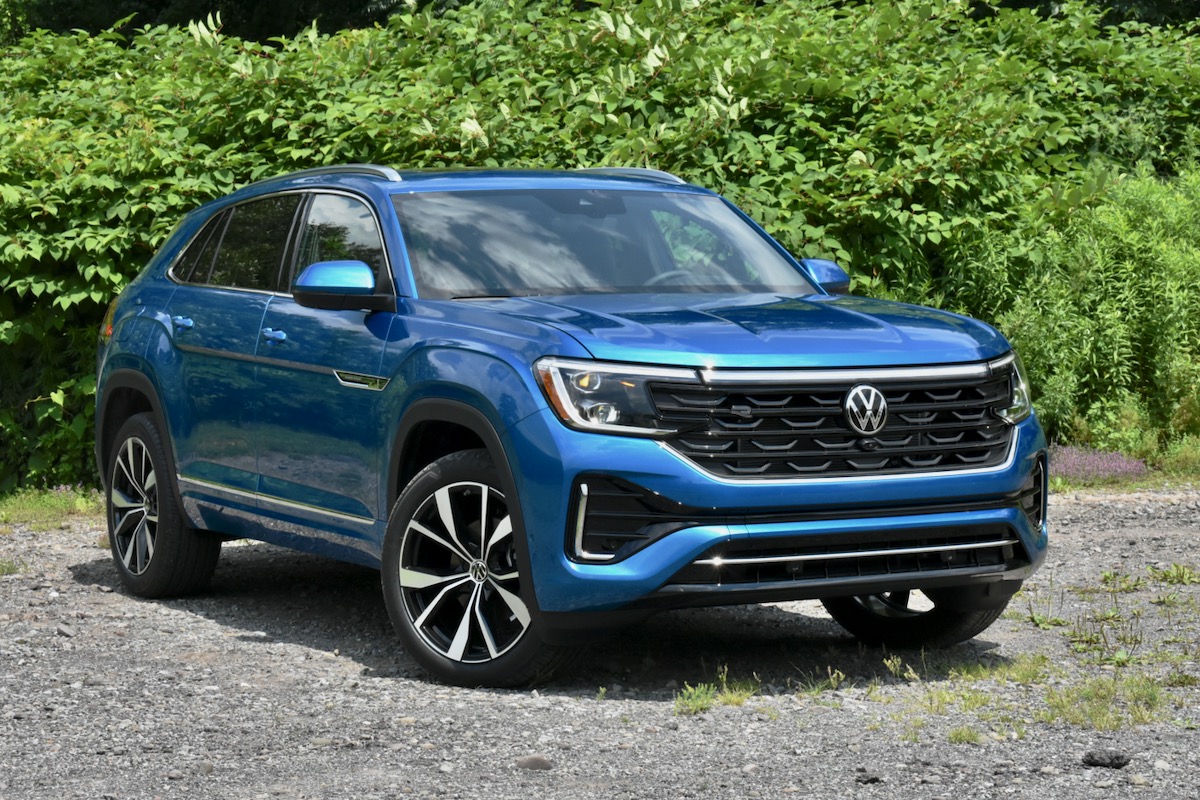
The 2026 Volkswagen Atlas Cross Sport presented a robust and distinctly North American aesthetic, despite its German origins. Its high-sided, slabby body panels, large wheels, and oversized fenders gave it a commanding presence, reminiscent of a pickup truck. The front fascia, shared with the larger Atlas, featured a wide, dark honeycomb grille with chrome trim that seamlessly integrated into the sleek, stacked headlights. The light bar with the illuminated VW logo added a touch of flair, making it more visually appealing than some competitors. The rear, however, was less striking, with busy LED lighting and chrome elements that seemed to age the design. The limited colour palette, including a lacklustre Pure Grey, did little to enhance its visual appeal.
Inside, the Atlas Cross Sport boasted a smart and upscale interior with high-quality materials. The single touchscreen, double-stacked air vents, and convincing aluminum-look trim contributed to a sophisticated cabin. The seats, with diamond-contrast stitching and carbon twill fabric, offered an upscale feel. Both rows were well-appointed, with plenty of soft-touch points, making it one of the most luxurious interiors in its class. Leatherette was standard, with real leather available on higher trims, although Canadian models offered limited upholstery options.
The 2026 Hyundai Venue, classified as a crossover SUV, leaned more towards a tall hatchback in appearance. Its design was compact and narrow, more suited to European streets than North American highways. The upright windshield and bluff nose gave it an SUV-like appearance, complemented by available roof rails. The Venue's high nose, lower headlights, and high-set daytime running lights contributed to its crossover look. Black wheel flares and a two-tone roof option added a touch of style, although the latter wasn't available on all trims in Canada.
Inside, the Venue's interior was simple and functional, with a digital instrument cluster adding a modern touch. However, the small touchscreen felt like an afterthought, resembling an iPad tacked onto the dash. The use of body-colour trim around the air vents and shifter attempted to bring some exterior flair inside. Despite its simplicity, the Venue's interior was practical, with comfortable seats and adequate headroom, although legroom was limited for taller occupants.

The 2026 Volkswagen Atlas Cross Sport was equipped with a turbocharged 2.0-litre inline-four-cylinder engine, delivering 269 horsepower and 273 pound-feet of torque. This power was transmitted through an eight-speed automatic transmission to a standard all-wheel-drive system, known as 4Motion. While its fuel economy was competitive, rated at 12.0 litres per 100 kilometres in the city, 9.2 on the highway, and 10.7 combined, the engine's performance was underwhelming. It struggled to provide sufficient power, especially when accelerating onto highways, and the steering felt light and lifeless. Despite these drawbacks, the transmission shifted smoothly, and the braking system offered solid pedal feel. However, the ride was rough, detracting from overall comfort.
In contrast, the 2026 Hyundai Venue was powered by a naturally aspirated 1.6-litre four-cylinder engine, producing a modest 121 horsepower and 113 pound-feet of torque. This power was directed to the front wheels via a continuously variable transmission (CVT). While the Venue wasn't quick, with a 0-100 km/h time of 8.5–8.8 seconds, its lightweight construction made it feel peppy in city traffic. However, highway performance was less impressive, with the transmission struggling to provide adequate power for passing. The Venue's handling benefited from its small size and low weight, making it agile in urban environments. Despite some body lean in corners, the steering was stable and direct, and the ride was generally comfortable, though the solid rear axle caused some jiggling on rough roads.
The 2026 Volkswagen Atlas Cross Sport offered generous interior space, with ample headroom and legroom, making it a compelling choice for those seeking a midsize crossover. The back seat was particularly spacious and supportive, with good sightlines despite the smaller rear windows. The infotainment interface was user-friendly, with a mix of physical switches and touch-sensitive buttons, although the lack of customization options for the display was a drawback. Heated and ventilated front seats were standard, with additional features available on higher trims. The Atlas Cross Sport also boasted a substantial towing capacity of 2,268 kilograms and ample cargo space, with 1,141 litres behind the rear seats and 2,197 litres with the rear seats folded.
The 2026 Hyundai Venue, while compact, offered a practical interior with comfortable cloth and synthetic leather seats. The front seats provided adequate comfort, although legroom was limited for taller occupants. The rear seat could accommodate average-sized adults, but space was tight for taller passengers. The Venue's cargo capacity was modest, with 528 litres available with the rear seats folded and 902 litres with the seats up. The interior featured hard black plastic surfaces, with limited soft-touch materials, reflecting its budget-friendly nature.
The 2026 Volkswagen Atlas Cross Sport came equipped with a 12-inch touchscreen and a 10.25-inch digital instrument cluster, along with wireless Apple CarPlay and Android Auto. However, the lack of built-in navigation on lower trims was a notable omission. Standard features included a hands-free power liftgate, remote start, and adaptive front headlights. The climate controls, integrated into the touchscreen, allowed for preset adjustments, while the proximity key worked at all four doors. The Atlas Cross Sport also offered four USB-C ports, a wireless charging pad, and remote connectivity via the myVW+ app.
The 2026 Hyundai Venue featured a simple 8-inch touchscreen for basic infotainment functions. While it lacked some advanced features like navigation and a Wi-Fi hotspot, it did offer wireless Apple CarPlay and Android Auto. The digital instrument cluster provided limited information, and the audio system was a basic six-speaker unit. Despite its simplicity, the Venue included a wireless charging pad as standard in Canada, adding a touch of premium convenience.
The 2026 Volkswagen Atlas Cross Sport received a five-star overall safety rating from the U.S. National Highway Traffic Safety Administration (NHTSA), with a four-star rating for frontal crashes and rollover tests. The Insurance Institute for Highway Safety (IIHS) named it a Top Safety Pick, with top ratings in crash tests and acceptable forward emergency braking performance. Standard safety features included automatic emergency braking, lane keep assist, blind spot monitoring, and adaptive cruise control. The Atlas Cross Sport also featured automatic post-collision braking and the Intelligent Crash Response System.
The 2026 Hyundai Venue, while budget-friendly, offered a good set of standard safety features, including forward collision warning, automatic emergency braking, and lane keep assist. However, it lacked adaptive cruise control. The Venue received a four-star safety rating from the NHTSA, with limited ratings available from the IIHS. The driver attention monitor was overly sensitive, but the safety systems generally performed well during testing.
CarGurus highlights

According to CarGurus experts, the overall rating for the 2026 Volkswagen Atlas Cross Sport was 7.2 out of 10, while the 2026 Hyundai Venue scored 5.3 out of 10. Based on these ratings, the Volkswagen Atlas Cross Sport emerged as the better choice, offering a more refined interior, advanced safety features, and greater overall value.
Choose the 2026 Hyundai VENUE if:
- You need a compact and agile vehicle for urban driving.
- You prefer a budget-friendly option with essential safety features.
- You appreciate the convenience of wireless smartphone integration.


Choose the 2026 Volkswagen Atlas Cross Sport if:
- You prioritize interior space and comfort for both passengers and cargo.
- You value advanced safety features and a strong safety rating.
- You seek a more upscale and luxurious interior design.


CarGurus highlights
According to CarGurus experts, the overall rating for the 2026 Volkswagen Atlas Cross Sport was 7.2 out of 10, while the 2026 Hyundai Venue scored 5.3 out of 10. Based on these ratings, the Volkswagen Atlas Cross Sport emerged as the better choice, offering a more refined interior, advanced safety features, and greater overall value.
Choose the 2026 Hyundai VENUE if:
Shop Now- You need a compact and agile vehicle for urban driving.
- You prefer a budget-friendly option with essential safety features.
- You appreciate the convenience of wireless smartphone integration.
Choose the 2026 Volkswagen Atlas Cross Sport if:
Shop Now- You prioritize interior space and comfort for both passengers and cargo.
- You value advanced safety features and a strong safety rating.
- You seek a more upscale and luxurious interior design.

By: CarGurus + AI
At CarGurus, our team of experienced automotive writers remain at the heart of our content operation, conducting hands-on car tests and writing insightful guides that are backed by years of industry experience. To complement this, we are harnessing AI to make our content offering more diverse and more helpful to shoppers than ever. To achieve this, our AI systems are based exclusively on CarGurus content, ratings and data, so that what we produce is both unique to CarGurus, and uniquely helpful to car shoppers.
