Hyundai VENUE vs Honda CR-V Hybrid
Overview | |
Listings2325 | Listings4726 |
Ratings & Reviews | |
User Reviews | User Reviews |
Expert reviews5.3 out of 10 | Expert reviews7.8 out of 10 |
Pros
Cons
| Pros
Cons
|
Reviews SummaryAutomakers have traditionally had a hard time making money on entry-level subcompact cars because they have low profit margins. But North America has largely moved away from cars to crossover SUVs — and higher prices. That allows car companies to offer an entry-level subcompact SUV for thousands more than a similar sedan or hatchback. Such is the case with the Hyundai Venue, which costs more than its predecessor, the subcompact Accent that was dropped in Canada after the 2020 model year. While the price is higher, the advantage for buyers is a vehicle that generally has more cargo space and is more practical. We recently drove the 2026 Hyundai Venue to find out if a subcompact crossover is a better buy than a cheaper subcompact car. Verdict: The Hyundai Venue sacrifices refinement for a price point that isn’t as low as a comparable subcompact car. We’d be tempted to spend a little more for a slightly larger compact car with more power, features, and refinement. | |
Reviews SummaryCompetition among small crossover SUVs is fierce. The 2026 Honda CR-V faces off against the Toyota RAV4, the Subaru Forester, the Hyundai Tucson, and at least one compact SUV from nearly every other automaker. On balance, the Honda CR-V has handled the competition well. But while it has thrived, Honda has found success with another name, too: TrailSport. This year, the two success stories finally met. Verdict: The CR-V is one of the best compact crossovers on the market, and the hybrid powertrain only makes it better. If serious adventure and off-road driving are your things, though, the CR-V TrailSport may not be the right choice. | |
No video found | |
Popular Features & Specs | |
Engine | Engine2.0L 204 hp I4 Hybrid |
Drivetrain | DrivetrainFWD |
Seating Capacity5 | Seating Capacity5 |
Horsepower | Horsepower204 hp @ 6100 rpm |
EV Battery Capacity | EV Battery Capacity1.06 kWh |
Fuel Economy (City) | Fuel Economy (City)5.5 L(e)/100 km |
Fuel Economy (Highway) | Fuel Economy (Highway)6.5 L(e)/100 km |
Engine | |
Engine Name | Engine Name2.0L 204 hp I4 Hybrid |
Horsepower | Horsepower204 hp @ 6100 rpm |
Drivetrain | DrivetrainFWD |
Fuel Economy | |
EV Battery Capacity | EV Battery Capacity1.06 kWh |
Fuel Economy (City) | Fuel Economy (City)5.5 L(e)/100 km |
Fuel Economy (Highway) | Fuel Economy (Highway)6.5 L(e)/100 km |
Interior | |
Seating Capacity5 | Seating Capacity5 |
Key Features | |
Sunroof/Moonroof | Sunroof/MoonroofStandard |
Safety | |
Front Crash Overall4 | Front Crash Overall4 |
Side Crash Overall5 | Side Crash Overall5 |
Dimensions & Capacity | |
Cargo Space530 L | Cargo Space1028 L |
Curb Weight1185 kg | Curb Weight1702 kg |
Height1565 mm | Height1681 mm |
Length4041 mm | Length4694 mm |
Width1770 mm | Width1867 mm |
Wheelbase2520 mm | Wheelbase2700 mm |
Maximum Payload525 kg | Maximum Payload |
Number of doors4 | Number of doors4 |
Maximum Towing Capacity | Maximum Towing Capacity454 kg |
Overview | ||
Listings | ||
Ratings & Reviews | ||
User reviews | ||
Expert reviews | 5.3 out of 10Read full review | 7.8 out of 10Read full review |
Pros & cons | Pros
Cons
| Pros
Cons
|
Summary | Automakers have traditionally had a hard time making money on entry-level subcompact cars because they have low profit margins. But North America has largely moved away from cars to crossover SUVs — and higher prices. That allows car companies to offer an entry-level subcompact SUV for thousands more than a similar sedan or hatchback. Such is the case with the Hyundai Venue, which costs more than its predecessor, the subcompact Accent that was dropped in Canada after the 2020 model year. While the price is higher, the advantage for buyers is a vehicle that generally has more cargo space and is more practical. We recently drove the 2026 Hyundai Venue to find out if a subcompact crossover is a better buy than a cheaper subcompact car. Verdict: The Hyundai Venue sacrifices refinement for a price point that isn’t as low as a comparable subcompact car. We’d be tempted to spend a little more for a slightly larger compact car with more power, features, and refinement. | Competition among small crossover SUVs is fierce. The 2026 Honda CR-V faces off against the Toyota RAV4, the Subaru Forester, the Hyundai Tucson, and at least one compact SUV from nearly every other automaker. On balance, the Honda CR-V has handled the competition well. But while it has thrived, Honda has found success with another name, too: TrailSport. This year, the two success stories finally met. Verdict: The CR-V is one of the best compact crossovers on the market, and the hybrid powertrain only makes it better. If serious adventure and off-road driving are your things, though, the CR-V TrailSport may not be the right choice. |
Video | No video found | |
Popular Features & Specs | ||
Engine | 2.0L 204 hp I4 Hybrid | |
Drivetrain | FWD | |
Seating Capacity | 5 | 5 |
Horsepower | 204 hp @ 6100 rpm | |
EV Battery Capacity | 1.06 kWh | |
Fuel Economy (City) | 5.5 L(e)/100 km | |
Fuel Economy (Highway) | 6.5 L(e)/100 km | |
Engine | ||
Engine Name | 2.0L 204 hp I4 Hybrid | |
Horsepower | 204 hp @ 6100 rpm | |
Drivetrain | FWD | |
Fuel Economy | ||
EV Battery Capacity | 1.06 kWh | |
Fuel Economy (City) | 5.5 L(e)/100 km | |
Fuel Economy (Highway) | 6.5 L(e)/100 km | |
Interior | ||
Seating Capacity | 5 | 5 |
Key Features | ||
Sunroof/Moonroof | Standard | |
Safety | ||
Front Crash Overall | 4 | 4 |
Side Crash Overall | 5 | 5 |
Dimensions & Capacity | ||
Cargo Space | 530 L | 1028 L |
Curb Weight | 1185 kg | 1702 kg |
Height | 1565 mm | 1681 mm |
Length | 4041 mm | 4694 mm |
Width | 1770 mm | 1867 mm |
Wheelbase | 2520 mm | 2700 mm |
Maximum Payload | 525 kg | |
Number of doors | 4 | 4 |
Maximum Towing Capacity | 454 kg | |
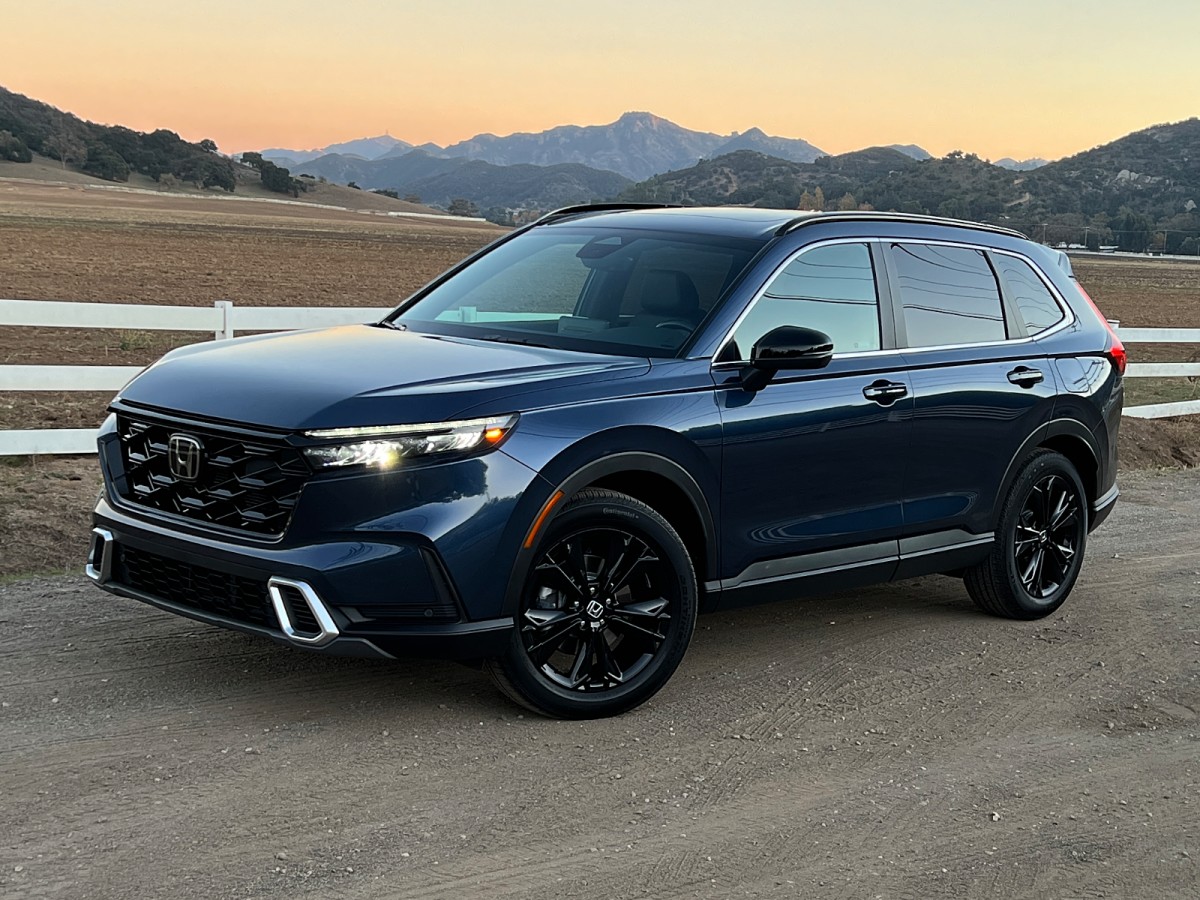
The 2026 Honda CR-V Hybrid, part of the sixth-generation lineup, received a subtle refresh, with the introduction of the new TrailSport trim being the highlight. The TrailSport trim added distinctive features such as orange badges, grey 18-inch wheels, and all-terrain tires, enhancing its rugged appeal. The exterior design largely carried over from the previous year, with minor updates to the interior, including orange contrast stitching and embroidered headrests in the TrailSport models. The CR-V Hybrid was available in six trim levels in Canada, with a variety of colour options, though most were not particularly exciting.
In contrast, the 2026 Hyundai Venue was classified as a crossover SUV, though its compact size and design leaned more towards a tall hatchback. It featured a high nose, lower headlights, and high-set daytime running lights, with black wheel flares and a two-tone roof option adding to its SUV-like appearance. The Venue's interior was simple and functional, with a digital instrument cluster and a small touchscreen that resembled an iPad. Despite its compact size, the Venue offered a practical design, though it lacked some of the premium touches found in larger SUVs.


The 2026 Honda CR-V Hybrid was powered by a 2.0-litre Atkinson-cycle engine paired with two electric motors, delivering a combined 204 horsepower and 247 lb-ft of torque. This setup provided a seamless transition between electric and gasoline power, with multiple regenerative braking settings and a one-pedal driving option. The CR-V Hybrid offered impressive fuel efficiency, with a combined rating of 6.4 L/100 km, and 6.7 L/100 km for the TrailSport trim. The all-wheel-drive system was enhanced for 2026, allowing up to 50% of torque to be sent to the rear axle. The CR-V Hybrid could tow up to 453 kg, making it suitable for light utility trailers.
In comparison, the 2026 Hyundai Venue was equipped with a 1.6-litre four-cylinder engine producing 121 horsepower and 113 lb-ft of torque. The power was delivered through a continuously variable transmission to the front wheels, with no all-wheel-drive option. The Venue's performance was modest, with a 0-100 km/h time of 8.5–8.8 seconds. Its lightweight design made it agile in city traffic, but the engine struggled at highway speeds. The Venue's handling benefited from its small size, though the ride could be jiggly on rough surfaces due to its solid rear axle.
The 2026 Honda CR-V Hybrid offered a spacious interior with 1,028 litres of cargo space, expanding to 2,030 litres with the rear seats folded. It featured comfortable seating with ample headroom and legroom, and a range of standard features including heated front seats and dual-zone climate control. The centre console housed physical controls for climate and drive modes, along with a wireless phone charging pad and USB-C ports.
The 2026 Hyundai Venue, on the other hand, provided a more compact interior with 528 litres of cargo space when the rear seats were folded. The seating was comfortable, with manual adjustments and standard front seat heating. However, legroom was limited for taller passengers. The Venue's interior was dominated by hard black plastic, with limited soft-touch surfaces, reflecting its budget-friendly nature.
The 2026 Honda CR-V Hybrid came equipped with a nine-inch touchscreen infotainment display, standard across all trims, and a 10.2-inch digital driver information display on higher trims. It supported wireless Android Auto and Apple CarPlay, with a physical phone-projection button for easy access. The Touring Hybrid trim featured Google built-in services, and a Wi-Fi hotspot was standard on hybrid trims. The audio system ranged from a basic four-speaker setup to a 12-speaker Bose premium system on the Touring Hybrid.
In contrast, the 2026 Hyundai Venue featured an eight-inch touchscreen with basic infotainment functions, including wireless Apple CarPlay and Android Auto. It lacked navigation and a Wi-Fi hotspot, but a wireless charging pad was standard in Canada. The audio system was a simple six-speaker unit, with no premium options available.
The 2026 Honda CR-V Hybrid had not been rated by the IIHS or NHTSA at the time of writing, but the 2025 model received high safety ratings. It came with the Honda Sensing suite of advanced driver assistance systems, including automatic emergency braking, lane-keeping assist, and adaptive cruise control. Front and rear parking sensors were standard on higher trims.
The 2026 Hyundai Venue offered a good set of standard safety features, including forward collision warning and lane keep assist. However, it lacked adaptive cruise control. The Venue received a four-star safety rating from the NHTSA, with mixed ratings from the IIHS for its headlights and crash tests.
CarGurus highlights

According to CarGurus experts, the overall rating for the 2026 Honda CR-V Hybrid is 7.8 out of 10, while the 2026 Hyundai Venue scores 5.3 out of 10. Based on these ratings, the Honda CR-V Hybrid is the recommended choice, offering superior performance, comfort, and safety features compared to the Hyundai Venue.
Choose the 2026 Honda CR-V Hybrid if:
- You prioritize fuel efficiency and seamless hybrid performance.
- You need ample cargo space and comfortable seating for long trips.
- You value advanced safety features and high safety ratings.




Choose the 2026 Hyundai VENUE if:
- You prefer a compact, budget-friendly vehicle for city driving.
- You want a simple infotainment system with wireless phone connectivity.
- You appreciate a lightweight design for agile handling in urban environments.


CarGurus highlights
According to CarGurus experts, the overall rating for the 2026 Honda CR-V Hybrid is 7.8 out of 10, while the 2026 Hyundai Venue scores 5.3 out of 10. Based on these ratings, the Honda CR-V Hybrid is the recommended choice, offering superior performance, comfort, and safety features compared to the Hyundai Venue.
Choose the 2026 Honda CR-V Hybrid if:
Shop Now- You prioritize fuel efficiency and seamless hybrid performance.
- You need ample cargo space and comfortable seating for long trips.
- You value advanced safety features and high safety ratings.
Choose the 2026 Hyundai VENUE if:
Shop Now- You prefer a compact, budget-friendly vehicle for city driving.
- You want a simple infotainment system with wireless phone connectivity.
- You appreciate a lightweight design for agile handling in urban environments.

By: CarGurus + AI
At CarGurus, our team of experienced automotive writers remain at the heart of our content operation, conducting hands-on car tests and writing insightful guides that are backed by years of industry experience. To complement this, we are harnessing AI to make our content offering more diverse and more helpful to shoppers than ever. To achieve this, our AI systems are based exclusively on CarGurus content, ratings and data, so that what we produce is both unique to CarGurus, and uniquely helpful to car shoppers.
