2024 Dodge Hornet vs 2024 Chevrolet Blazer EV

Overview | |
MSRP$31,400 | MSRP$48,800 |
Listings98 | Listings156 |
Ratings & Reviews | |
User Reviews | User Reviews |
Expert reviews7.2 out of 10 | Expert reviews6.3 out of 10 |
Pros
Cons
| Pros
Cons
|
2024 Dodge Hornet Reviews SummaryThere’s no V8 under the hood of a Dodge Hornet. Instead, this compact crossover (or compact utility vehicle, as Dodge calls it) comes equipped with a four-cylinder engine or, in the case of the 2024 R/T trim, a plug-in hybrid powertrain. As fuel-efficiency and low-emissions vehicles become more appealing to shoppers, the Hornet represents a major milestone for Dodge. If the company is going to remain relevant in an increasingly eco-conscious marketplace, this little crossover needs to be a hit. | |
2024 Chevrolet Blazer EV Reviews SummaryIt may share a name with the gasoline-powered Blazer crossover SUV, but the Chevy Blazer EV is in fact a new vehicle based on the General Motors Ultium electric vehicle (EV) component set. It’s Chevy’s belated answer to the crosstown rival Ford Mustang Mach-E and other electric SUVs like the Hyundai Ioniq 5, the Kia EV6, and the Tesla Model Y. Verdict: The Blazer EV offers unique style and impressive technology, but it doesn’t really move the needle when it comes to range, fast charging, or interior packaging. It’s also priced at the higher end of the segment in its launch form. | |
No video found | |
Popular Features & Specs | |
Engine2.0L 268 hp I4 | Engine288 hp Electric |
Drive TrainAWD | Drive TrainAWD |
Seating Capacity5 | Seating Capacity5 |
EV Battery Capacity | EV Battery Capacity85 kWh |
MPG City21 | MPG City103 |
MPG Highway29 | MPG Highway88 |
Engine | |
Engine Name2.0L 268 hp I4 | Engine Name288 hp Electric |
DrivetrainAWD | DrivetrainAWD |
Fuel Economy | |
EV Battery Capacity | EV Battery Capacity85 kWh |
MPG City21 | MPG City103 |
MPG Highway29 | MPG Highway88 |
Interior | |
Seating Capacity5 | Seating Capacity5 |
Key Features | |
Navigation System | Navigation SystemStandard |
Safety | |
Front Crash Overall | Front Crash Overall5 |
Side Crash Overall | Side Crash Overall5 |
Dimensions & Capacity | |
Cargo Space27.0 cu ft | Cargo Space25.5 cu ft |
Curb Weight3715 lbs | Curb Weight5337 lbs |
Height63.8 in | Height65.0 in |
Length178.3 in | Length192.2 in |
Width82.0 in | Width86.5 in |
Wheelbase103.8 in | Wheelbase121.8 in |
Maximum Payload1245 lbs | Maximum Payload1167 lbs |
Number of doors4 | Number of doors4 |
Maximum Towing Capacity2000 lbs | Maximum Towing Capacity1500 lbs |
Overview | ||
MSRP | $31,400 | $48,800 |
Listings | ||
Ratings & Reviews | ||
User reviews | ||
Expert reviews | 7.2 out of 10Read full review | 6.3 out of 10Read full review |
Pros & cons | Pros
Cons
| Pros
Cons
|
Summary | There’s no V8 under the hood of a Dodge Hornet. Instead, this compact crossover (or compact utility vehicle, as Dodge calls it) comes equipped with a four-cylinder engine or, in the case of the 2024 R/T trim, a plug-in hybrid powertrain. As fuel-efficiency and low-emissions vehicles become more appealing to shoppers, the Hornet represents a major milestone for Dodge. If the company is going to remain relevant in an increasingly eco-conscious marketplace, this little crossover needs to be a hit. | It may share a name with the gasoline-powered Blazer crossover SUV, but the Chevy Blazer EV is in fact a new vehicle based on the General Motors Ultium electric vehicle (EV) component set. It’s Chevy’s belated answer to the crosstown rival Ford Mustang Mach-E and other electric SUVs like the Hyundai Ioniq 5, the Kia EV6, and the Tesla Model Y. Verdict: The Blazer EV offers unique style and impressive technology, but it doesn’t really move the needle when it comes to range, fast charging, or interior packaging. It’s also priced at the higher end of the segment in its launch form. |
Video | No video found | |
Popular Features & Specs | ||
Engine | 2.0L 268 hp I4 | 288 hp Electric |
Drive Train | AWD | AWD |
Seating Capacity | 5 | 5 |
EV Battery Capacity | 85 kWh | |
MPG City | 21 | 103 |
MPG Highway | 29 | 88 |
Engine | ||
Engine Name | 2.0L 268 hp I4 | 288 hp Electric |
Drivetrain | AWD | AWD |
Fuel Economy | ||
EV Battery Capacity | 85 kWh | |
MPG City | 21 | 103 |
MPG Highway | 29 | 88 |
Interior | ||
Seating Capacity | 5 | 5 |
Key Features | ||
Navigation System | Standard | |
Safety | ||
Front Crash Overall | 5 | |
Side Crash Overall | 5 | |
Dimensions & Capacity | ||
Cargo Space | 27.0 cu ft | 25.5 cu ft |
Curb Weight | 3715 lbs | 5337 lbs |
Height | 63.8 in | 65.0 in |
Length | 178.3 in | 192.2 in |
Width | 82.0 in | 86.5 in |
Wheelbase | 103.8 in | 121.8 in |
Maximum Payload | 1245 lbs | 1167 lbs |
Number of doors | 4 | 4 |
Maximum Towing Capacity | 2000 lbs | 1500 lbs |
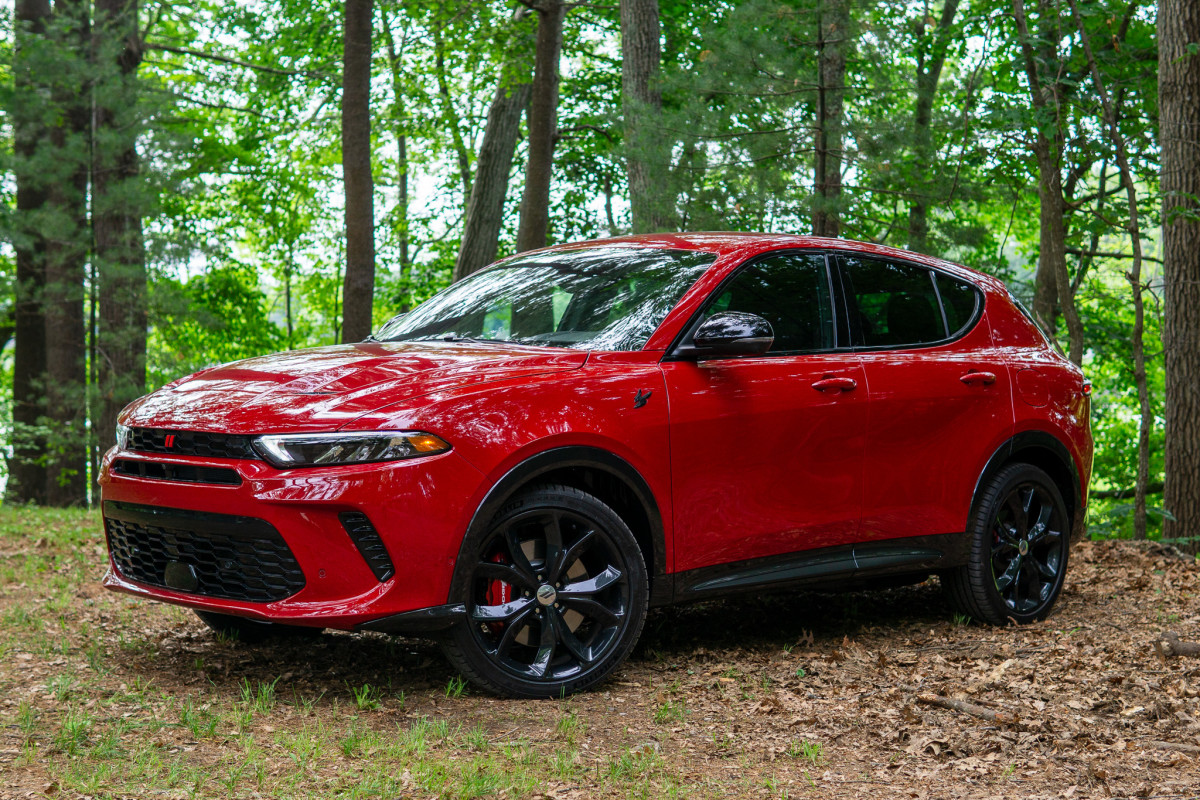
The 2024 Dodge Hornet showcased Dodge’s iconic muscle design ethos, even if it wasn’t a big V8 muscle car like the Charger or Challenger. The Hornet's robust front end, complete with integrated heat extractors on the hood, gave it a tough appearance. The aggressive fascia featured multiple grilles, including a sizeable lower grille, a mid-sized "mail slot" grille, and an upper section where a new logo, the Rhombi, was prominently placed—a symbol never before used on its own by Dodge.
The rear design included a tail lamp spanning the crossover’s width, illuminated by the Rhombi emblem at its center. Large tailpipes at the rear corners added to its rugged demeanor, reinforcing that the Hornet wasn't just any regular crossover but a Dodge with performance at its core. Dodge offered the Hornet in four trims: the GT, GT Plus, R/T, and R/T Plus, differentiated by their powertrains—regular gas for the GT trims and a plug-in hybrid PHEV system for the R/T trims. Our review vehicle was an R/T Plus with the optional Blacktop Package, adding black wheels and other dark accents for around $1,600.
Sitting on the same platform as the Alfa Romeo Tonale, the Hornet flaunted Italian design influences. However, the Hornet’s blunt nose gave it a distinct Dodge identity compared to the more streamlined Tonale. Inside, the crossover earned a modern feel, enhanced by the $2,595 Track Pack, which included Alcantara upholstery and a Rhombi logo on the seats. With elements like a slightly driver-angled center stack, physical climate control switches, and a widescreen infotainment display, the Hornet balanced sporty intentions with modern convenience. Even though some aspects, like the outdated feeling buttons on the steering wheel and the overly bolstered seats, could be improved, the Hornet's interior echoed the classic Dodge spirit with a contemporary twist.
The 2024 Chevrolet Blazer EV, meanwhile, marked a significant evolutionary leap for the veteran SUV nameplate. It carried over some styling elements from the 2019 gasoline model, blended into a new, EV-specific platform. With its underpinning built around the General Motors' Ultium battery pack system, the length of the Blazer EV's wheelbase varied based on the number of battery modules used. Sharing a wheelbase length with the Cadillac Lyriq, the Blazer EV's elongated dimensions made it reminiscent of a stretch limo compared to the more balanced Cadillac.
Sporting a tall hood, a modified version of the gasoline Blazer’s aggressive front end, and distinctive boomerang-shaped taillights, the Blazer EV certainly stood out. Unlike aerodynamic rivals like the Ford Mustang Mach-E and Kia EV6, the Blazer EV embraced a more robust SUV appearance, standing taller and broader than its competitors by several inches.
Chevy launched the Blazer EV in LT and RS trims, each with distinct styling cues—the LT came with a monochromatic front fascia while the RS featured a blacked-out front and 21-inch wheels. A forthcoming SS model would introduce an even bolder look with performance-oriented design elements. The RS and SS trims boasted sporty interiors with large, circular vents, a flat-bottom steering wheel, and optional red leather upholstery, making it more fun and lively than the relatively subdued cabins of the Mach-E and EV6. Despite its fresh, modern design, certain interior elements like flimsy turn-signal stalks somewhat detracted from the overall quality feel.


Dodge offered the 2024 Hornet with two powertrain options reflected in the GT and R/T trim levels, each having either the base or “Plus” iteration. The GT featured a 2.0-liter turbocharged four-cylinder engine producing an impressive 268 horsepower and 295 lb-ft of torque. This power was certainly a standout among compact crossovers. A nine-speed automatic transmission paired with standard all-wheel drive added to its appeal, although the requirement for premium fuel was a consideration for daily operating costs.
The R/T trim, as tested, was a plug-in hybrid variant combining a 1.3-liter turbocharged four-cylinder engine, a 15.5-kWh battery, and two electric motors to deliver 288 horsepower and 383 lb-ft of torque. This setup provided a notable edge over the GT in terms of power. AWD was also standard but employed an electric system in the R/T compared to the mechanical linkage in the GT. The R/T, despite being about 425 pounds heavier due to the battery, delivered quick and potent acceleration thanks to its heavy pedal and features like “Powershot” for an extra 30 horsepower burst.
The Hornet R/T’s driving dynamics were balanced; the suspension was soft enough to handle most road imperfections while retaining enough stiffness to limit body roll during cornering. However, the steering, although accurate, felt heavy. The Hornet R/T also offered around 30 miles of all-electric driving range, fairly efficient for plug-in hybrid standards, and multiple driving modes to prioritize battery usage, which worked well for short commutes.
The 2024 Chevrolet Blazer EV came with RWD and AWD powertrain options initially for the LT and RS trims, offering different driving experiences. The RWD models provided 340 horsepower and 325 lb-ft of torque with a 102-kilowatt-hour battery, while the AWD variants produced 288 horsepower and 333 lb-ft of torque with an 85-kWh battery. Interestingly, the dual-motor AWD variant had lower power output than the single-motor RWD.
Moreover, a future Blazer EV SS would bring a performance boost with 557 horsepower and 648 lb-ft of torque, utilizing a dual-motor AWD system. Featuring the WOW (Wide Open Watts) launch mode, the SS model could potentially achieve an exhilarating 0-60 mph time in under four seconds.
Driving the RWD and AWD Blazer EV RS models revealed robust acceleration with the AWD felt more confident off the line. The ride and handling reflected a balanced but firm stance, contrasting with the Lyriq’s luxury smoothness by focusing on sporty cornering abilities. Unfortunately, the sturdy suspension translated to rougher rides on less-than-perfect roads. The Blazer EV also offered adjustable regenerative braking, which allowed for a more engaging and adaptable driving experience, akin to downshifting in manual cars.
Inside the 2024 Dodge Hornet, front passengers benefitted from ample headroom and excellent visibility despite the car’s bold, muscular design. The back seats, however, felt less spacious due to a high beltline and dark interior. While headroom and legroom figures appeared sufficient—around 38 inches each—the rear felt somewhat confined.
The R/T’s PHEV battery reduced cargo space, providing 22.9 cubic feet behind the rear seats and 50.5 cubic feet with them folded, compared to the GT’s 27 and 54.7 cubic feet, respectively. Despite these figures, both versions lagged behind competitors like the Hyundai Tucson PHEV, which offered nearly 32 cubic feet behind the second row and almost 72 cubic feet with it folded.
The 2024 Chevrolet Blazer EV, though more SUV-like in design, didn't fully translate this into interior space benefits. Headroom and legroom in both rows were comparable to the more aerodynamic Ford Mustang Mach-E and Kia EV6, and it lacked a commanding driving position typically associated with SUVs. Visibility was generally fine, but the high sills and protruding dashboard created a slightly enclosed feeling. Cargo capacity measured at 25.5 cubic feet with the seats up and 59.1 cubic feet with them folded, falling short compared to gasoline models. Unlike the Mach-E, it also lacked a front trunk (frunk).
Despite the stylish interior, the Blazer EV managed practical small-item storage with large phone storage and decent center console space. However, some climate and vehicle controls were only accessible through the touchscreen, which might require some adjustments for users.
The 2024 Dodge Hornet excelled with a 12.3-inch digital driver display, customizable with three distinct zones, providing crisp and clear information. The 10.25-inch widescreen infotainment display impressed even more, seemingly fit for luxury cars. Running Dodge’s UConnect 5 system, it was user-friendly, customizable, and supported wireless Android Auto and Apple CarPlay. Despite occasional slow responses, likely due to the pre-production status of our test vehicle, subsequent interactions proved faster.
Our test vehicle also came with a premium Harman Kardon sound system and wireless phone charging. The latter was especially crucial due to the lack of good wired phone storage. UConnect 5’s personalization options, allowing dedicated user profiles and customizable widgets, rendered it a standout tech feature.
The 2024 Chevrolet Blazer EV introduced Chevy’s new Google-based infotainment system destined for future Chevy EVs. Similar to systems in cars from Volvo and Polestar, it offered built-in Google apps, replacing standalone Android Auto and Apple CarPlay. This setup favored Android users over iOS users, who had to rely on basic Bluetooth connectivity. The large 17.7-inch touchscreen and the 11-inch digital instrument cluster displayed sharp, clear graphics. The system’s built-in route planning optimized for charging station locations and battery pre-conditioning was a plus, and Chevy’s promise of frequent OTA updates added value.
Though positively received overall, the system had a few quirks. The touchscreen’s angle favored drivers but slightly inconvenient for front passengers. Additionally, some traditional controls were relocated to the touchscreen, sometimes complicating access. Notably, the Blazer EV pioneered Chevy’s hands-free start sequence, recognizing the key fob’s presence and allowing the brake pedal to initiate driving, setting a high-tech vehicle entry tone.
Safety ratings from NHTSA and IIHS were unavailable for both the 2024 Dodge Hornet and the 2024 Chevrolet Blazer EV at the time of this evaluation. Despite the lack of crash-test ratings, both vehicles offered robust safety features.
The Dodge Hornet came with a comprehensive suite of standard advanced driver assistance systems (ADAS), including automatic emergency braking, lane-departure warning, lane-keeping assist, blind-spot monitoring, rear cross-traffic alert, and adaptive cruise control. An enhanced adaptive cruise control system with traffic-sign recognition was available as an option. Additionally, certain level 2 autonomous driving functions were accessible via the Tech Pack, providing intelligent speed assist and lane-tracing capabilities.
Similarly, the Chevrolet Blazer EV included a strong array of standard safety features like automatic emergency braking with pedestrian detection, forward-collision warning, a following-distance indicator, lane-keep assist, lane-departure warning, and automatic high beams. Optional features encompassed reverse automatic braking, park assist, and GM’s Super Cruise system. Super Cruise offered a hands-free driving experience with speed and lane management, leveraging detailed maps and driver-monitoring systems.
CarGurus highlights
According to CarGurus experts, the overall rating for the 2024 Dodge Hornet is 7.2 out of 10, while the 2024 Chevrolet Blazer EV scores 6.3 out of 10. Based on these expert ratings, the Dodge Hornet edges out the Blazer EV in several key areas, combining muscular design, versatile powertrains, and advanced yet user-friendly technology. The Blazer EV, with its innovative tech features and promising electric performance, still has some ground to cover, particularly for those seeking more cargo space and traditional control interfaces. Therefore, we recommend the 2024 Dodge Hornet as the better choice for most consumers looking for a balanced, stylish, and powerful compact crossover.
Choose the 2024 Dodge Hornet if:
- You appreciate classic Dodge design aesthetics combined with modern touches.
- You seek robust engine performance with hybrid flexibility and all-wheel drive.
- Personalization and user-friendly technology are high on your priority list.




Choose the 2024 Chevrolet Blazer EV if:
- You want an electric SUV with the latest inbuilt Google-based infotainment and frequent OTA updates.
- Hands-free driving technology like Super Cruise is essential to you.
- A blend of robust SUV styling with electric performance appeals to you.


CarGurus highlights
According to CarGurus experts, the overall rating for the 2024 Dodge Hornet is 7.2 out of 10, while the 2024 Chevrolet Blazer EV scores 6.3 out of 10. Based on these expert ratings, the Dodge Hornet edges out the Blazer EV in several key areas, combining muscular design, versatile powertrains, and advanced yet user-friendly technology. The Blazer EV, with its innovative tech features and promising electric performance, still has some ground to cover, particularly for those seeking more cargo space and traditional control interfaces. Therefore, we recommend the 2024 Dodge Hornet as the better choice for most consumers looking for a balanced, stylish, and powerful compact crossover.
Choose the 2024 Dodge Hornet if:
Shop Now- You appreciate classic Dodge design aesthetics combined with modern touches.
- You seek robust engine performance with hybrid flexibility and all-wheel drive.
- Personalization and user-friendly technology are high on your priority list.
Choose the 2024 Chevrolet Blazer EV if:
Shop Now- You want an electric SUV with the latest inbuilt Google-based infotainment and frequent OTA updates.
- Hands-free driving technology like Super Cruise is essential to you.
- A blend of robust SUV styling with electric performance appeals to you.

By: CarGurus + AI
At CarGurus, our team of experienced automotive writers remain at the heart of our content operation, conducting hands-on car tests and writing insightful guides that are backed by years of industry experience. To complement this, we are harnessing AI to make our content offering more diverse and more helpful to shoppers than ever. To achieve this, our AI systems are based exclusively on CarGurus content, ratings and data, so that what we produce is both unique to CarGurus, and uniquely helpful to car shoppers.

