2020 Toyota Camry vs 2020 Nissan Versa

Overview | |
MSRP$14,830 | MSRP$24,425 |
Listings44 | Listings212 |
Ratings & Reviews | |
User Reviews | User Reviews |
Expert reviews7.2 out of 10 | Expert reviews7.5 out of 10 |
Pros
Cons
| Pros
Cons
|
2020 Nissan Versa Reviews SummaryWhen you're on a tight budget and need to replace a car, you often face a tough choice: Do you buy a new small car or something that’s pre-owned but has more space? For many years, if you were in the market for a new car, few came as cheaply as the Nissan Versa. Not only was it marketed as the least-expensive car in the United States, but it also had a plucky, underdog appeal to it. However, the charm of the Versa started to wear off as its shortcomings became more apparent. If you look at the “cheap” end of the market, you'll find some pretty unlovable cars, like the Mitsubishi Mirage and Chevrolet Spark. But there are also some bright spots. The Kia Rio and Hyundai Accent are both competent cars in their own ways, and the Honda Fit has always been a serious player. With the Fit, you never felt like you were seriously compromising to meet your budget. It seems as though Nissan has caught on to the realization that racing to the bottom works for only so long. Buyers have certainly caught on to the notion that you can have a small car that’s actually kind of good (See: Fit). In response, Nissan has rolled out the all-new 2020 Versa. It’s no longer the cheapest car in America, and in fact, it costs a couple of thousand dollars more than last year's version. But does that mean it’s more car, too? Read on to find out. | |
2020 Toyota Camry Reviews SummaryIf you can't beat them, join them. That seems to be Toyota's philosophy in updating the eighth generation of the Camry for the 2020 model year. This latest version of the perennial best seller debuted in 2017 as a 2018 model—and promptly lost its sales crown to Toyota's own RAV4 crossover SUV. As buyers continue to defect from cars, Toyota hopes to entice more shoppers to stick with its midsize sedan by offering all-wheel drive on the Camry for the first time since 1991. Also new for 2020 is the Camry TRD, a sportier version with a 301-horsepower V6 engine that makes its case to a buyer who might never have considered a Camry. | |
No video found | |
Popular Features & Specs | |
Engine1.6L 122 hp I4 | Engine2.5L 203 hp I4 |
Drive TrainFWD | Drive TrainFWD |
Seating Capacity5 | Seating Capacity5 |
Horsepower122 hp @ 6300 rpm | Horsepower |
MPG City27 | MPG City29 |
MPG Highway35 | MPG Highway41 |
Engine | |
Engine Name1.6L 122 hp I4 | Engine Name2.5L 203 hp I4 |
Torque114 lb-ft @ 4000 rpm | Torque |
Horsepower122 hp @ 6300 rpm | Horsepower |
DrivetrainFWD | DrivetrainFWD |
Fuel Economy | |
MPG City27 | MPG City29 |
MPG Highway35 | MPG Highway41 |
Interior | |
Seating Capacity5 | Seating Capacity5 |
Safety | |
Front Crash Overall5 | Front Crash Overall5 |
Side Crash Overall5 | Side Crash Overall5 |
Dimensions & Capacity | |
Cargo Space14.7 cu ft | Cargo Space14.1 cu ft |
Curb Weight2650 lbs | Curb Weight3241 lbs |
Height57.3 in | Height56.9 in |
Length177.0 in | Length192.1 in |
Width68.5 in | Width72.4 in |
Wheelbase103.1 in | Wheelbase111.2 in |
Maximum Payload955 lbs | Maximum Payload925 lbs |
Number of doors4 | Number of doors4 |
Overview | ||
MSRP | $14,830 | $24,425 |
Listings | ||
Ratings & Reviews | ||
User reviews | ||
Expert reviews | 7.2 out of 10Read full review | 7.5 out of 10Read full review |
Pros & cons | Pros
Cons
| Pros
Cons
|
Summary | When you're on a tight budget and need to replace a car, you often face a tough choice: Do you buy a new small car or something that’s pre-owned but has more space? For many years, if you were in the market for a new car, few came as cheaply as the Nissan Versa. Not only was it marketed as the least-expensive car in the United States, but it also had a plucky, underdog appeal to it. However, the charm of the Versa started to wear off as its shortcomings became more apparent. If you look at the “cheap” end of the market, you'll find some pretty unlovable cars, like the Mitsubishi Mirage and Chevrolet Spark. But there are also some bright spots. The Kia Rio and Hyundai Accent are both competent cars in their own ways, and the Honda Fit has always been a serious player. With the Fit, you never felt like you were seriously compromising to meet your budget. It seems as though Nissan has caught on to the realization that racing to the bottom works for only so long. Buyers have certainly caught on to the notion that you can have a small car that’s actually kind of good (See: Fit). In response, Nissan has rolled out the all-new 2020 Versa. It’s no longer the cheapest car in America, and in fact, it costs a couple of thousand dollars more than last year's version. But does that mean it’s more car, too? Read on to find out. | If you can't beat them, join them. That seems to be Toyota's philosophy in updating the eighth generation of the Camry for the 2020 model year. This latest version of the perennial best seller debuted in 2017 as a 2018 model—and promptly lost its sales crown to Toyota's own RAV4 crossover SUV. As buyers continue to defect from cars, Toyota hopes to entice more shoppers to stick with its midsize sedan by offering all-wheel drive on the Camry for the first time since 1991. Also new for 2020 is the Camry TRD, a sportier version with a 301-horsepower V6 engine that makes its case to a buyer who might never have considered a Camry. |
Video | No video found | |
Popular Features & Specs | ||
Engine | 1.6L 122 hp I4 | 2.5L 203 hp I4 |
Drive Train | FWD | FWD |
Seating Capacity | 5 | 5 |
Horsepower | 122 hp @ 6300 rpm | |
MPG City | 27 | 29 |
MPG Highway | 35 | 41 |
Engine | ||
Engine Name | 1.6L 122 hp I4 | 2.5L 203 hp I4 |
Torque | 114 lb-ft @ 4000 rpm | |
Horsepower | 122 hp @ 6300 rpm | |
Drivetrain | FWD | FWD |
Fuel Economy | ||
MPG City | 27 | 29 |
MPG Highway | 35 | 41 |
Interior | ||
Seating Capacity | 5 | 5 |
Safety | ||
Front Crash Overall | 5 | 5 |
Side Crash Overall | 5 | 5 |
Dimensions & Capacity | ||
Cargo Space | 14.7 cu ft | 14.1 cu ft |
Curb Weight | 2650 lbs | 3241 lbs |
Height | 57.3 in | 56.9 in |
Length | 177.0 in | 192.1 in |
Width | 68.5 in | 72.4 in |
Wheelbase | 103.1 in | 111.2 in |
Maximum Payload | 955 lbs | 925 lbs |
Number of doors | 4 | 4 |
The 2020 Nissan Versa marked a significant departure from its predecessor's "big car" styling, which featured oversized headlights and a somewhat awkward design. The new model adopted a more refined and handsome look, drawing inspiration from its larger siblings, the Maxima and Altima. This change resulted in a more cohesive and attractive exterior without borrowing the same-size headlights or grille. Inside, the Versa's cabin was straightforward yet stylish, featuring a two-tone theme with dark charcoal and grayish cream colors. The seats had a neat design, and the overall interior space was generous for a subcompact sedan, thanks to the Nissan V platform.
In contrast, the 2020 Toyota Camry aimed to reclaim its reputation for quality and reliability with a renewed attention to detail. The styling was more expressive than any previous Camry, with a bold front fascia and taut lines that gave it a sporty appearance. The interior featured uniformly nice materials and a driver-focused dashboard design, making even the lower trims feel upscale. The TRD model added red trim accents and bright red seatbelts, enhancing its sporty appeal. While the Camry wasn't a luxury car, the top trims offered leather and wood finishes that rivaled entry-level Lexus models.


The 2020 Nissan Versa was powered by a revised 1.6-liter 4-cylinder engine, producing 122 horsepower and 114 pound-feet of torque. This was an improvement over the previous generation's 109 horsepower and 107 pound-feet of torque. The engine was paired with either a 5-speed manual or a continuously variable automatic transmission (CVT). The CVT, standard on the SV and SR trims, managed power well and offered a Sport mode for livelier performance. Fuel economy was decent, with the manual transmission returning 27 mpg city, 35 highway, and 30 combined, while the CVT achieved 32/40/35 mpg.
The 2020 Toyota Camry offered four distinct powertrains: a 2.5-liter four-cylinder with front-wheel drive (FWD) or all-wheel drive (AWD), a 3.5-liter V6, and a hybrid powertrain. The 3.5-liter V6 produced 301 horsepower and was paired with an eight-speed automatic transmission, providing smooth and powerful performance. The 2.5-liter four-cylinder made 203 horsepower (206 in XSE trim) and was also paired with an eight-speed automatic. The AWD system could send up to half of the engine's 184 pound-feet of torque to the rear wheels when needed. Fuel economy for the FWD four-cylinder was 31 mpg combined, dropping to 28 mpg with AWD. The V6 models managed 26 mpg combined, except for the TRD, which was rated at 25 mpg.
The 2020 Nissan Versa retained its predecessor's 15-cubic-foot trunk, one of the largest in its class, with a large opening for easy loading. However, it lost 6 inches of rear legroom, making the backseat less spacious for adult passengers. The front seats offered ample legroom, even for taller drivers, making it a comfortable personal commuter car.
The 2020 Toyota Camry was easy to drive and featured a well-organized interior with most controls within easy reach. The front seats offered increased legroom and hip room compared to the previous generation. However, the rear seat legroom and overall passenger volume had decreased slightly, making it less spacious than some competitors. The trunk offered 15.1 cubic feet of cargo space, similar to the Honda Civic, but smaller than some rivals. The addition of AWD did not compromise the trunk or passenger space.
The 2020 Nissan Versa came standard with a 7-inch touchscreen, Bluetooth connectivity, Siri Eyes Free, and a hands-free text-messaging assistant. The SV trim added the NissanConnect system with Apple CarPlay and Android Auto, as well as an upgraded instrument panel with a digital screen. This screen provided various functions, including safety alerts, Bluetooth streaming audio, and fuel-economy stats, making it a highly functional and user-friendly system.
The 2020 Toyota Camry added Android Auto to its standard features, joining Apple CarPlay, Amazon Alexa compatibility, and a three-month trial of SiriusXM satellite radio. The standard infotainment system, while functional, felt dated with low-resolution graphics. The Camry offered an optional 8-inch screen and a three-month trial of WiFi Connect. Higher trims featured a 7-inch multi-information display and an optional 10-inch head-up display, enhancing the driver's experience.
The 2020 Nissan Versa included a range of standard driver-assistance features, such as automatic emergency braking, pedestrian detection, lane-departure warning, and automatic high beams. It also had a reversing camera, front- and side-impact airbags, and Nissan's Easy Fill Tire Alert system.
The 2020 Toyota Camry came with Toyota's Safety Sense suite, including a pre-collision system with emergency braking, dynamic radar adaptive cruise control, lane-departure warning with steering assist, and automatic high beams. It also offered a one-year trial of Safety Connect and optional blind-spot monitoring with rear cross-traffic alert. The Camry received a five-star rating from the NHTSA and a Top Safety Pick+ rating from the IIHS.
CarGurus highlights
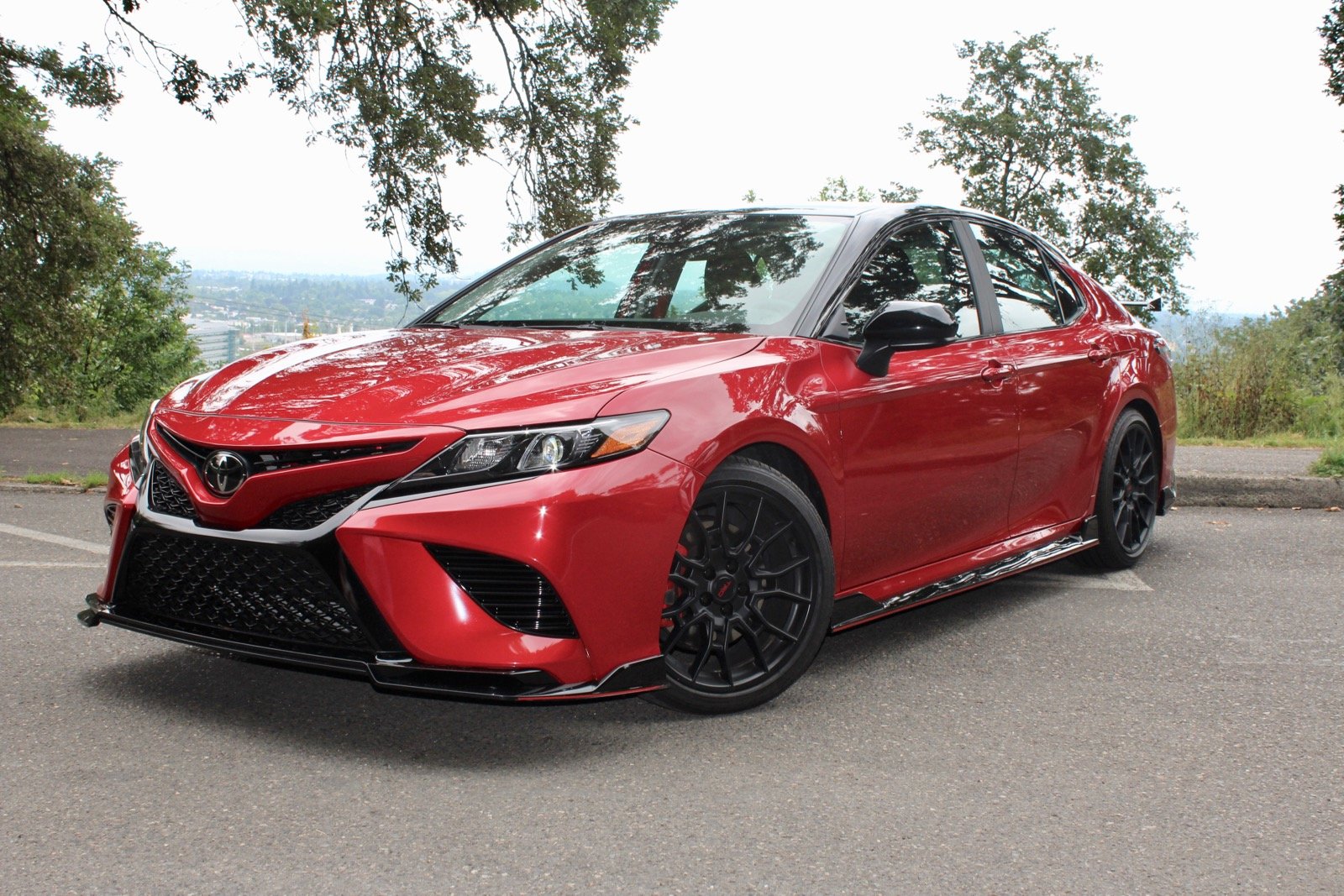
According to CarGurus experts, the overall rating for the 2020 Nissan Versa is 7.2 out of 10, while the 2020 Toyota Camry scores 7.5 out of 10. Based on these ratings, the 2020 Toyota Camry is the better choice, offering a more refined driving experience, a wider range of powertrains, and a higher level of safety and technology features.
Choose the 2020 Toyota Camry if:
- You seek a midsize sedan with a reputation for quality and reliability.
- You desire a sporty and expressive design with upscale interior materials.
- You need a car with multiple powertrain options, including AWD and a powerful V6.


Choose the 2020 Nissan Versa if:
- You need a budget-friendly car with a spacious trunk.
- You prefer a straightforward yet stylish interior with modern tech features.
- You want a subcompact sedan with good fuel economy and decent performance.


CarGurus highlights
According to CarGurus experts, the overall rating for the 2020 Nissan Versa is 7.2 out of 10, while the 2020 Toyota Camry scores 7.5 out of 10. Based on these ratings, the 2020 Toyota Camry is the better choice, offering a more refined driving experience, a wider range of powertrains, and a higher level of safety and technology features.
Choose the 2020 Toyota Camry if:
Shop Now- You seek a midsize sedan with a reputation for quality and reliability.
- You desire a sporty and expressive design with upscale interior materials.
- You need a car with multiple powertrain options, including AWD and a powerful V6.
Choose the 2020 Nissan Versa if:
Shop Now- You need a budget-friendly car with a spacious trunk.
- You prefer a straightforward yet stylish interior with modern tech features.
- You want a subcompact sedan with good fuel economy and decent performance.

By: CarGurus + AI
At CarGurus, our team of experienced automotive writers remain at the heart of our content operation, conducting hands-on car tests and writing insightful guides that are backed by years of industry experience. To complement this, we are harnessing AI to make our content offering more diverse and more helpful to shoppers than ever. To achieve this, our AI systems are based exclusively on CarGurus content, ratings and data, so that what we produce is both unique to CarGurus, and uniquely helpful to car shoppers.

