2022 Toyota Highlander Hybrid vs 2022 Genesis GV70

Overview | |
MSRP$41,500 | MSRP$39,555 |
Listings50 | Listings21 |
Ratings & Reviews | |
User Reviews | User Reviews |
Expert reviews8.3 out of 10 | Expert reviews6.0 out of 10 |
Pros
Cons
| |
2022 Genesis GV70 Reviews SummaryHave you heard of Genesis, the luxury off-shoot brand created by Hyundai Motor Group a little more than five years ago? Those who follow the automotive industry may be aware of the brand’s intentionally disruptive character. But it’s not a surprise if the name is new to you: Genesis launched somewhat quietly with a line-up of sedans including the Genesis G70 and Genesis G80, initially lacking in the luxury SUV options Canadian buyers crave. Now, those are starting to arrive, first with the mid-size Genesis GV80 launched last year, and now the new GV70, a compact two-row SUV that casually drops into Canada’s most competitive luxury segment. Genesis says it expects this vehicle to double its Canadian sales—and it might achieve that goal, provided it can get the attention of Canadians in a segment already overflowing with stiff competition. | |
2022 Toyota Highlander Hybrid Reviews SummaryThe Toyota Highlander Hybrid isn't particularly attractive, sporty, or luxurious. Compared to the performance and refinement of the best three-row SUVs, it's middling at best. The best selling points are its excellent fuel economy and accessible pricing, and in this manner, its nearly unequaled. | |
Popular Features & Specs | |
Engine2.5L 300 hp I4 | Engine2.5L 243 hp I4 Hybrid |
DrivetrainAWD | DrivetrainFWD |
Seating Capacity5 | Seating Capacity8 |
EV Battery Capacity | EV Battery Capacity1.9 kWh |
MPG City22 | MPG City36 |
MPG Highway28 | MPG Highway35 |
Engine | |
Engine Name2.5L 300 hp I4 | Engine Name2.5L 243 hp I4 Hybrid |
DrivetrainAWD | DrivetrainFWD |
Fuel Economy | |
EV Battery Capacity | EV Battery Capacity1.9 kWh |
MPG City22 | MPG City36 |
MPG Highway28 | MPG Highway35 |
Interior | |
Seating Capacity5 | Seating Capacity8 |
Key Features | |
Navigation SystemStandard | Navigation System |
Safety | |
Front Crash Overall | Front Crash Overall4 |
Side Crash Overall | Side Crash Overall5 |
Dimensions & Capacity | |
Cargo Space28.9 cu ft | Cargo Space16.0 cu ft |
Curb Weight4167 lbs | Curb Weight4330 lbs |
Height64.2 in | Height68.1 in |
Length185.6 in | Length194.9 in |
Width75.0 in | Width76.0 in |
Wheelbase113.2 in | Wheelbase112.2 in |
Maximum Payload1334 lbs | Maximum Payload1495 lbs |
Number of doors4 | Number of doors4 |
Maximum Towing Capacity3500 lbs | Maximum Towing Capacity3500 lbs |
Standard Towing Capacity3500 lbs | Standard Towing Capacity |
Overview | ||
MSRP | $41,500 | $39,555 |
Listings | ||
Ratings & Reviews | ||
User reviews | ||
Expert reviews | 8.3 out of 10Read full review | 6.0 out of 10Read full review |
Pros & cons | Pros
Cons
| |
Summary | Have you heard of Genesis, the luxury off-shoot brand created by Hyundai Motor Group a little more than five years ago? Those who follow the automotive industry may be aware of the brand’s intentionally disruptive character. But it’s not a surprise if the name is new to you: Genesis launched somewhat quietly with a line-up of sedans including the Genesis G70 and Genesis G80, initially lacking in the luxury SUV options Canadian buyers crave. Now, those are starting to arrive, first with the mid-size Genesis GV80 launched last year, and now the new GV70, a compact two-row SUV that casually drops into Canada’s most competitive luxury segment. Genesis says it expects this vehicle to double its Canadian sales—and it might achieve that goal, provided it can get the attention of Canadians in a segment already overflowing with stiff competition. | The Toyota Highlander Hybrid isn't particularly attractive, sporty, or luxurious. Compared to the performance and refinement of the best three-row SUVs, it's middling at best. The best selling points are its excellent fuel economy and accessible pricing, and in this manner, its nearly unequaled. |
Video | ||
Popular Features & Specs | ||
Engine | 2.5L 300 hp I4 | 2.5L 243 hp I4 Hybrid |
Drivetrain | AWD | FWD |
Seating Capacity | 5 | 8 |
EV Battery Capacity | 1.9 kWh | |
MPG City | 22 | 36 |
MPG Highway | 28 | 35 |
Engine | ||
Engine Name | 2.5L 300 hp I4 | 2.5L 243 hp I4 Hybrid |
Drivetrain | AWD | FWD |
Fuel Economy | ||
EV Battery Capacity | 1.9 kWh | |
MPG City | 22 | 36 |
MPG Highway | 28 | 35 |
Interior | ||
Seating Capacity | 5 | 8 |
Key Features | ||
Navigation System | Standard | |
Safety | ||
Front Crash Overall | 4 | |
Side Crash Overall | 5 | |
Dimensions & Capacity | ||
Cargo Space | 28.9 cu ft | 16.0 cu ft |
Curb Weight | 4167 lbs | 4330 lbs |
Height | 64.2 in | 68.1 in |
Length | 185.6 in | 194.9 in |
Width | 75.0 in | 76.0 in |
Wheelbase | 113.2 in | 112.2 in |
Maximum Payload | 1334 lbs | 1495 lbs |
Number of doors | 4 | 4 |
Maximum Towing Capacity | 3500 lbs | 3500 lbs |
Standard Towing Capacity | 3500 lbs | |
The 2022 Genesis GV70 stood out with its distinctive styling, a hallmark of Korean automotive brands. It diverged notably from the rest of the Genesis lineup, featuring the brand’s signature two-line lighting that created an illusion of a contiguous circle around the vehicle. This effect was slightly less pronounced than on the larger GV80 due to the absence of turn signal repeaters on the front quarter panels. The GV70 offered six grades in Canada, with the Sport and Sport Plus grades featuring a sculpted hood aligning with the Genesis crest-shaped logo. The vehicle's unique styling included a distinct shoulder line and undulating accent lines around the side windows. Dark chrome finishes and a cross-hatched matrix pattern on the Sport grades emphasized its sporty intent. Customers could choose from over 100 colour combinations, with some exclusive to certain trims. The interior featured an elliptical theme inspired by airplane wings, with options for genuine carbon fibre inserts and unique ambient lighting. While most surfaces were of high quality, some plastic elements were present in less frequently encountered areas.
In contrast, the 2022 Toyota Highlander Hybrid borrowed styling cues from the Tacoma pickup truck, giving it a rugged appearance popular among midsized SUVs. However, its design felt disjointed compared to more cohesive competitors like the Kia Telluride and Jeep Grand Cherokee. The interior featured an asymmetrical dash with a metallic styling element, creating a helpful storage tray. The infotainment touchscreen was positioned high on the dash for reduced distraction. The Highlander Hybrid Bronze Edition introduced 18-inch bronze alloy wheels and light grey fabric seat upholstery, which attracted dirt and stains easily. Other trims offered more conventional materials, with genuine leather available only on the top trims. The rear seating area had more hard plastics for durability, and the third row was less comfortable with unyielding armrests. While the Highlander Hybrid's appearance received mixed reviews, its materials quality was adequate for its class, and it remained one of the few hybrids available.


The 2022 Genesis GV70 offered two engine options, with the 2.5-litre turbocharged four-cylinder producing 300 horsepower and 311 pound-feet of torque. However, the test unit featured the 3.5-litre twin-turbocharged V6 engine, delivering 375 hp and 391 lb-ft of torque. This engine positioned the GV70 against mid-level performance competitors like the BMW X3 M40i and Audi SQ5, boasting higher power figures than some German counterparts. Fuel consumption was estimated at 11.6 L/100 km combined, with real-world testing showing slightly lower figures. The GV70 came with an eight-speed automatic transmission and standard all-wheel drive in Canada, prioritizing the rear axle for torque distribution. The Sport Plus grade included an electronic limited-slip differential, allowing up to 100% of torque to be sent to a single rear wheel. The GV70 featured Eco, Comfort, Sport, and Sport+ drive modes, with Sport+ delivering aggressive throttle response and partial traction control disabling. The electronically controlled suspension system provided a balance between comfort and road feedback, and the GV70's tight turning radius was advantageous in urban settings.
The 2022 Toyota Highlander Hybrid was powered by a 2.5-litre four-cylinder engine and hybrid system, producing 243 horsepower. It featured a continuously variable transmission (CVT) and standard all-wheel drive, with an electric motor powering the rear axle for additional traction. The Highlander Hybrid accelerated to 100 km/h in just over eight seconds, comparable to gasoline-only SUVs in its class. The hybrid powertrain provided a quick but tepid response from a standstill, with the gasoline engine supplying more power as speed increased. The CVT's lack of gear shifts resulted in an uninspired drone during acceleration, especially on hills. Braking was smooth, with regenerative braking seamlessly transitioning to physical brakes. The Highlander Hybrid offered a soft ride quality, with the suspension effectively smoothing over road imperfections. While not sporty, it provided adequate cornering confidence for a family vehicle. The cabin remained quiet on highways, contributing to a comfortable driving experience.
The 2022 Genesis GV70 prioritized driver-centric design, with a tall centre console separating the driver from the front passenger. Intuitive button and dial controls, including a dial-based gear selector, were within easy reach. The infotainment system was controlled by a raised dial, offering a more pleasant experience than the flat panel style in the GV80. Climate controls were configured under a single pane, providing haptic feedback for inputs. Standard features included heated front seats and a heated steering wheel, with ventilated front seats and heated outboard rear seats available on higher trims. The right rear passenger could adjust the front passenger seat for legroom, and a panoramic sunroof added natural light. However, second-row storage was limited, and the middle seat was less desirable due to a high floor rise and narrow shoulder space. Cargo volume behind the second row was 819 litres, expandable to 1,610 litres with the seats folded. The tonneau cover could be stowed under the rear load floor.
The 2022 Toyota Highlander Hybrid offered well-cushioned front seats with ample adjustments for drivers of all sizes. However, the driver's door armrest was slightly out of reach, requiring an awkward lean. The interior provided plenty of storage options, including a deep tray under the infotainment screen, a small shelf in front of the passenger, and a large centre armrest bin. The second-row seats were spacious, with captain’s chairs that slid and reclined for versatility. A second-row bench was available as a no-cost option, increasing passenger capacity to eight. The third row was less accommodating, with limited headroom and legroom, making it suitable for occasional use by children. Cargo space behind the third row was 453 litres, expanding to 1,370 litres with the seatbacks folded. The maximum cargo capacity with the second row stowed was 2,387 litres. Limited and Platinum trims included a hands-free power liftgate.
The 2022 Genesis GV70 impressed with its technology offerings, featuring a standard 14.5-inch high-definition LCD infotainment screen. While the system's response time was slower than average, the wide layout allowed for a split-screen display, accommodating in-car functions and Apple CarPlay or Android Auto. The premium Sport Plus grade included a 3D digital instrument cluster, providing a layered graphics display that followed the driver's eyes. The Blind View Monitor system projected camera views of blind spots onto the instrument cluster when turn signals were activated. The GV70 also introduced a fingerprint recognition system for keyless vehicle start. A nine-speaker audio system was standard, with an 18-speaker Lexicon surround sound system available on top grades. Two USB ports were provided for both the front and rear rows.
The 2022 Toyota Highlander Hybrid offered an 8-inch infotainment touchscreen as standard, with a 12.3-inch touchscreen available on the top trim. The larger display's glossy surface tended to reflect the front passenger seat, causing visibility issues in bright lighting. The infotainment system was quick to respond, with logically organized menus and physical shortcut buttons for common features. Apple CarPlay and Android Auto were standard across all trims, with wireless charging available on Limited and Platinum trims. Satellite radio and remote vehicle monitoring were included with limited trial periods. Navigation and an 11-speaker JBL premium audio system were standard on the Highlander Hybrid Limited and Platinum trims.
The 2022 Genesis GV70 came equipped with ten standard safety features and driver assist technologies, including blind spot collision avoidance assist, rear cross-traffic alert, lane departure warning, and lane-keeping assist. It also featured forward collision avoidance assist, automatic high beams, and a driver attention monitor. A new rear occupant alert system used radar to detect movement in the second row, notifying the driver through graphics and audible alerts. The Genesis Highway Driving Assist system included lane centring and automatic lane changing functions, though it required the driver's hands on the steering wheel. Safety ratings from the Insurance Institute for Highway Safety and National Highway Traffic Safety Administration were not available at the time of publication.
The 2022 Toyota Highlander Hybrid received a five-star overall safety rating from the National Highway Traffic Safety Administration, with four stars for frontal collision and rollover protection. The Insurance Institute for Highway Safety named it a Top Safety Pick+, with the highest "Good" scores across the board. Standard safety features included adaptive cruise control, automatic emergency braking with pedestrian detection, lane-keep assist, blind-spot monitor, rear cross-traffic alert, and automatic high beams. A surround view camera system and head-up display were available on the top Platinum trim. Rain-sensing wipers were included on Platinum and the Bronze Edition. While the safety systems generally performed well, the adaptive cruise control and lane-keep assist required some fine-tuning for smoother operation.
CarGurus highlights
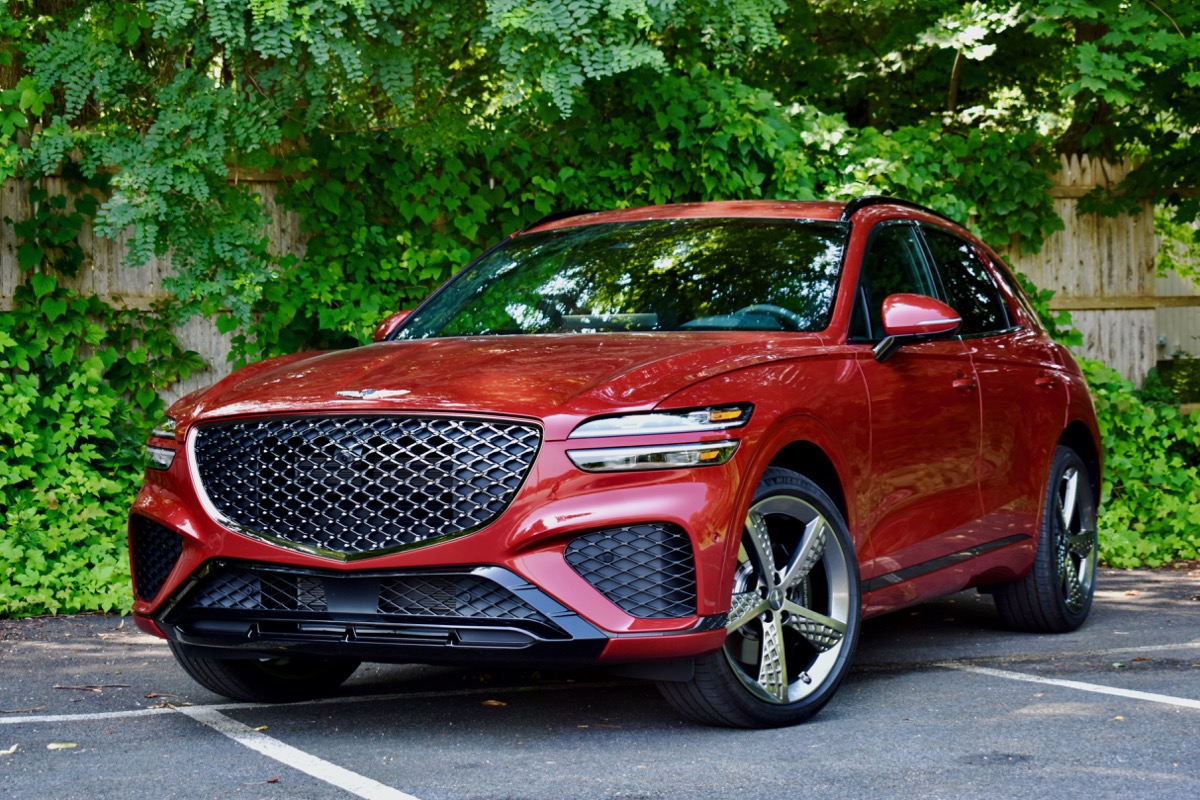
According to CarGurus experts, the overall rating for the 2022 Genesis GV70 was 8.3 out of 10, while the 2022 Toyota Highlander Hybrid scored 6.0 out of 10. Based on these ratings, the Genesis GV70 is the recommended choice for those seeking a luxurious and performance-oriented SUV with advanced technology and customization options.
Choose the 2022 Toyota Highlander Hybrid if:
- You need a spacious family SUV with ample cargo capacity and seating for up to eight passengers.
- You prefer a hybrid powertrain for improved fuel efficiency and reduced emissions.
- You prioritize safety, with top ratings from major safety organizations and a comprehensive suite of standard safety features.


Choose the 2022 Genesis GV70 if:
- You prioritize a luxurious and driver-focused interior with advanced technology features.
- You seek a performance-oriented SUV with powerful engine options and sporty handling.
- You value a wide range of customization options for exterior and interior colours.


CarGurus highlights
According to CarGurus experts, the overall rating for the 2022 Genesis GV70 was 8.3 out of 10, while the 2022 Toyota Highlander Hybrid scored 6.0 out of 10. Based on these ratings, the Genesis GV70 is the recommended choice for those seeking a luxurious and performance-oriented SUV with advanced technology and customization options.
Choose the 2022 Toyota Highlander Hybrid if:
Shop Now- You need a spacious family SUV with ample cargo capacity and seating for up to eight passengers.
- You prefer a hybrid powertrain for improved fuel efficiency and reduced emissions.
- You prioritize safety, with top ratings from major safety organizations and a comprehensive suite of standard safety features.
Choose the 2022 Genesis GV70 if:
Shop Now- You prioritize a luxurious and driver-focused interior with advanced technology features.
- You seek a performance-oriented SUV with powerful engine options and sporty handling.
- You value a wide range of customization options for exterior and interior colours.

By: CarGurus + AI
At CarGurus, our team of experienced automotive writers remain at the heart of our content operation, conducting hands-on car tests and writing insightful guides that are backed by years of industry experience. To complement this, we are harnessing AI to make our content offering more diverse and more helpful to shoppers than ever. To achieve this, our AI systems are based exclusively on CarGurus content, ratings and data, so that what we produce is both unique to CarGurus, and uniquely helpful to car shoppers.
