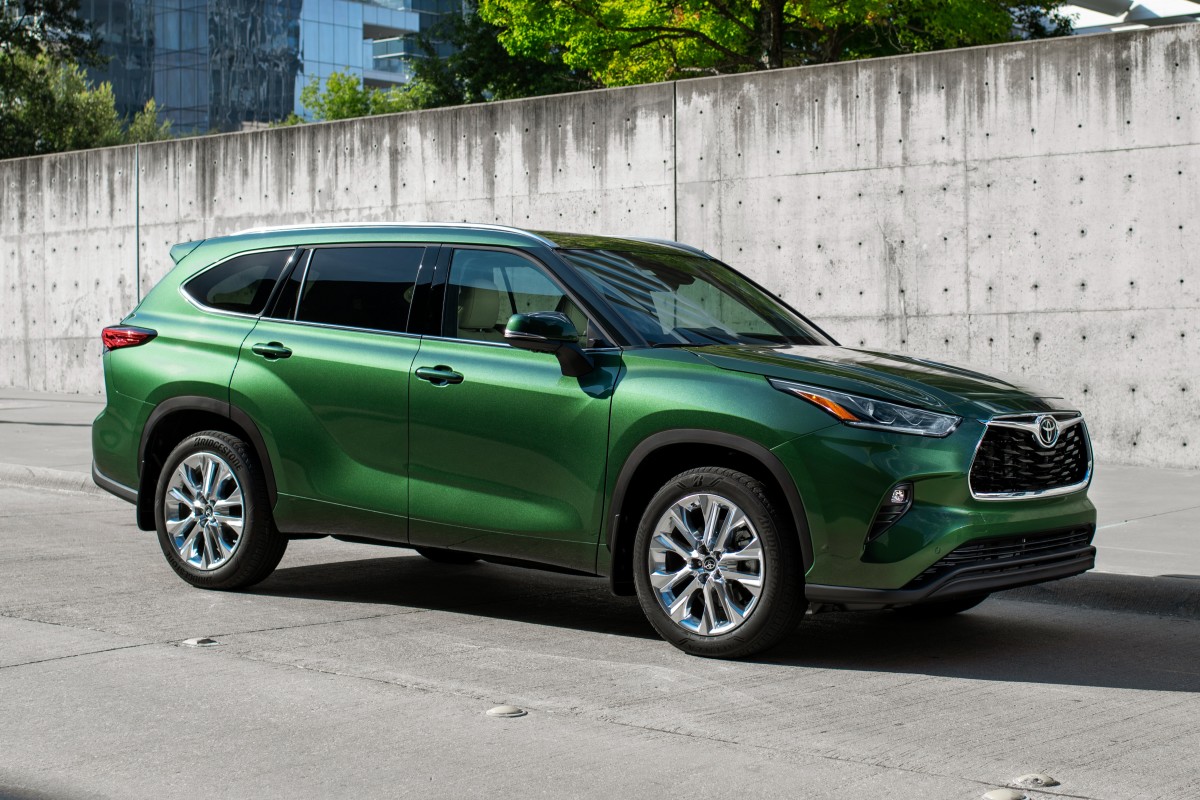
2022 Toyota Highlander Hybrid Reviews, Pricing & Specs


Pros & cons
What we like
Fuel-efficient
Comfortable
Excellent value for money
What to consider
Fairly pedestrian performance
Uninspired styling
Interior materials feel cheap
Expert review
The Toyota Highlander Hybrid makes up for a lack of excitement with a surplus of efficiency.
The Toyota Highlander Hybrid isn't particularly attractive, sporty, or luxurious. Compared to the performance and refinement of the best three-row SUVs, it's middling at best. The best selling points are its excellent fuel economy and accessible pricing, and in this manner, its nearly unequaled.
out of 10 expert review
Look & feel
As is the case with other Toyota SUVs, the Highlander Hybrid takes some styling cues from the company's Tacoma pickup truck, particularly in its trapezoidal grille and upright fascia. It lends the Highlander a rugged appearance that is popular among three-row midsized SUVs. From the side, however, the design introduces some softness with a character line that swoops from the bottom of the doors over the rear wheel arch.
It's an odd flourish that's also found on the Toyota Supra and Sienna, adding some unnecessary visual weight and making the Highlander look a bit bloated in the hips. The rear of the vehicle is more traditional and features an echo of the trapezoidal grille in the liftgate. All together, these disparate elements form a body that feels disjointed when compared to more cohesive designs found on the Kia Telluride, Jeep Grand Cherokee, or Honda Pilot.
The 2022 Highlander interior is also unconventional but much less jarring. The asymmetrical dash is interrupted by a metallic styling element that spans the passenger side and envelopes the infotainment pod in the centre. It breaks up any potential monotony while also creating a helpful tray for storage. The infotainment touchscreen is mounted high atop the dash, keeping it in the driver's sightline and reducing distraction when using it.
Our Highlander Hybrid Bronze Edition test vehicle (as shown in our review video above; photos depict a Platinum trim level) is new for 2022 and features 18-inch bronze alloy wheels, bronze door sills, and an odd choice of light grey fabric seat upholstery. It features an incomplete motif of triangles, suggesting a quilted or diamond-stitched pattern that seems more appropriate on a paper towel than in a car. The colour also tends to attract dirt and stains, which could be a durability concern for a growing family. The fabric is surrounded by Toyota's Softex synthetic leather substitute that looks and feels more like vinyl, which is disappointing when compared to more convincing alternatives.
Other Highlander trims don't feature that fabric pattern and are more conventional, but the Softex remains in the supporting Hybrid XLE trim. In order to get genuine leather, you'll have to upgrade to the top Highlander Limited and Highlander Platinum trims—or make the leap to a Lexus. The rear seating area has more hard plastics than up front, but that's typical of most family SUVs in order to improve durability. The third row suffers with even more plastic, evidenced by an unyielding armrest that is uncomfortable for even a few seconds.
Styling is subjective, of course, but we've yet to hear praise for the Highlander Hybrid's appearance. Materials quality is more objective and it trails other SUVs in this class, but not to the point that we'd consider it a deal-breaker. Then again, when you consider the Highlander is one of the few hybrids left in its class, Toyota does seem to have a captive audience.
Performance
Powering the Toyota Highlander Hybrid is a 2.5-litre four-cylinder engine and hybrid system that produce power specs of 243 horsepower. It's paired with a continuously variable transmission (CVT) and employs standard all-wheel drive (AWD; front-wheel drive (FWD) is not offered in Canada) in the form of a supplemental electric motor that powers the rear axle upon initial acceleration or when additional traction is needed. Toyota estimates it will reach 100 kilometres per hour in just over eight seconds, which is only marginally slower than gasoline-only SUVs in this class.
When accelerating from a standstill, the electric motors in the Highlander’s hybrid powertrain get the crossover moving for the first few feet with a quick but tepid response. At that point, the gasoline engine hums to life, supplying more adequate power to keep speed building. Under light or moderate pressure on the accelerator, the engine hum is fairly subtle. When prodded for more power, that hum becomes an uninspired drone since the CVT doesn't interrupt the power to shift gears. It's especially off-putting when ascending a hill, sounding more like a laboured groan.
Braking is much more traditional, at least on the surface. The brake pedal is appropriately soft for a family vehicle and there's no discernible transition from regenerative braking to physical brakes. When lifting off the throttle, brake regeneration switches the electric motors into generators that use the Highlander's momentum to recharge the hybrid batteries.
The ride quality is soft and the suspension does an admirable job of smoothing over bumps in the road. Thankfully, it's not overly soft, allowing the Highlander to corner with adequate confidence. It's certainly not sporty, but then again, handling performance isn't a priority for a large family vehicle like this, comfort is. Helping matters is a cabin that remains mostly free of wind and road noise on the highway. As a result, the Highlander Hybrid is one of the quieter midsize SUVs, so long as you're not asking much of the engine.
Form & function
The Highlander's front seats are well cushioned for comfort and there are plenty of adjustments to suit tall and short drivers alike. We really have only one minor complaint in regard to the driving position and it's the driver's door armrest that's just out of reach. It leaves us with an awkward lean to use it or resigned to having our elbow unsupported. On the plus side, there's plenty of storage for your personal effects. You have a deep tray just under the infotainment screen with a cord keeper and rubberized pad to keep your phone secured. There's also another tray that's also suitable for phones underneath, a small shelf in front of the passenger, and a large centre armrest bin. Combined with large door pockets, you should have no problem keeping things in their place on a road trip.
The second-row seats are positively spacious and able to accommodate six footers with ease thanks to the abundance of head- and legroom. The captain’s chairs also slide and recline to give you more versatility and comfort. A second-row bench is a no-cost option on models with standard captain’s chairs and increases passenger capacity to eight. From XLE, a power moonroof is equipped. Adding to the experience are built-in window shades, two USB charge ports and a household power outlet. Access to the third row is provided by either the wide pass-through between the seats or by sliding and folding the seats forward.
Many shoppers will consider the Highlander when their families have outgrown the smaller Toyota RAV4. Keep in mind, the third-row seat is decidedly less accommodating than the second-row seat, and it is intended for occasional use by children. Smaller adults could fit back there in a pinch, but the lack of headroom and legroom would dictate short trips only. There's also no thigh support as the seat cushions are mounted very low to the floor, making you feel as though you're squatting rather than sitting.
Behind the third row, you have 453 litres of cargo space, which is small for the class. Folding the seatbacks is easy and quick with a single latch on each side and expands the cargo area to 1,370 litres, which is large compared to other three-row SUVs. At it's maximum with the second row stowed gets you 2,387 litres, which is about average. On Limited and Platinum, a hands-free power liftgate is included.
Technology
In terms of technology features, the Highlander Hybrid meets, but doesn't exceed expectations. An 8-inch infotainment touchscreen is standard, but a bit small for the space it occupies. A 12.3-inch touchscreen is available, but only for the top trim. That larger display also has a glossy surface that tends to reflect the front passenger seat and can obscure the screen in harsh lighting conditions. The infotainment system is quick to respond and menus are logically organized. Operation is further helped by several physical shortcut buttons for commonly used features as well as a separate row of buttons and knobs for climate control.
Apple CarPlay and Android Auto connectivity are included on all trims, and Limited and Platinum trims come with a wireless charging pad. Also standard are limited trial periods for satellite radio and remote vehicle monitoring and control. Navigation and an 11-speaker JBL premium audio system are standard on the Highlander Hybrid Limited and Platinum trims.
Safety
In crash tests conducted by the National Highway Traffic Safety Administration (NHTSA), the Highlander Hybrid achieved an overall five out of five score, with four stars for frontal collision and rollover protection. The Insurance Institute for Highway Safety (IIHS) named the standard Highlander a Top Safety Pick+, its highest honour as it received the highest score of "Good" across the board.
Safety features equipped as standard features include adaptive cruise control, automatic emergency braking with pedestrian detection, lane-keep assist, a blind-spot monitor, rear cross-traffic alert, and automatic high beams. A surround view camera system and head-up display are only offered in the top Platinum trim. Rain-sensing wipers are included both on Platinum and the Bronze Edition.
In our experience with the Highlander Hybrid, these systems generally work as advertised but could use some fine-tuning. The adaptive cruise control tends to wait too long to slow, resulting in some rather abrupt stops. The lane-keep assist also creates a bit too much resistance in the steering wheel, forcing the driver to occasionally wrestle against it. The lane-departure warning is also prone to some false alarms, but that can be somewhat alleviated by digging through the driver menus to reduce the sensitivity.
Cost-effectiveness
Prices for the 2022 Toyota Highlander Hybrid start at $46,490 (not including $1,890 for destination charges) for the base Hybrid LE trim level and crests at an MSRP of $57,250 for the top Hybrid Platinum trim. Compared to the gasoline-only Highlander, the Hybrid costs $2,000 more on average. The Hybrid is estimated to return 6.7 litres per 100 kilometres in combined city/highway driving while the regular Highlander is rated at 10.3 L/100 km. Natural Resources Canada lists the annual fuel cost for hybrid models at $1,340 versus $2,060 for the non-hybrid Highlander, based on 20,000 kilometres of driving and a fuel cost of $1.00 per litre (which is a very low estimate by today’s standards). We expect the difference in cost could be recouped within 18 to 24 months for the average driver.
With this in mind, along with the knowledge that both Highlanders drive similarly, the decision is clearly in favour of the Hybrid. Within the lineup, the Highlander Hybrid XLE trim hits the sweet spot for shoppers on a budget. If your tastes lean more toward luxury and you budget is more generous, the Limited trim adds genuine leather and several other niceties to justify its price.
As far as the competition goes, there really aren't many hybrid SUVs as direct rivals. The Ford Explorer Hybrid is estimated to return a much higher 9.6 L/100 km combined and it's available only in the Limited trim for nearly $60,000. The Kia Sorento Hybrid is far more affordable, with a starting price in the $37,000 neighborhood, but it's quite a bit smaller and better suited to smaller families. Getting away from SUVs, the Chrysler Pacifica plug-in hybrid starts under $55,000 and qualifies for federal and provincial rebates, plus it delivers 51 kilometres of EV-only propulsion and is estimated to return 8.0 L/100 km combined in hybrid mode. It's great choice for larger families that are not averse to minivans.
The Toyota Highlander Hybrid may not be the most attractive or particularly fun to drive among three-row midsized SUVs, but it finds its beauty in fuel efficiency. From a purely pragmatic point of view, it's the most sensible and indeed, the only fuel sipper in its class.
Note: Images and video show a US model.

What owners say
Good features. Wish it had a remote start option. Surprised by how far Toyota has come with technology.
January 31, 2025Whats not to love about a full size SUV that you can get 35+ mpg out of? The ride is smoooooth and comfortable too! If you can find one, snag it!
July 10, 2023I had a 2012 Highlander Hybrid XLE….loved it!! Toyota and Lexus Hybrid models until a return to the re-design of this year’s beauty. I got the Highlander Hybrid Platinum. Great ride, fantastic gas mileage. Top quality interior, nothing cheap about the quality.
May 1, 2023What owners say
Good features. Wish it had a remote start option. Surprised by how far Toyota has come with technology.
January 31, 2025Whats not to love about a full size SUV that you can get 35+ mpg out of? The ride is smoooooth and comfortable too! If you can find one, snag it!
July 10, 2023I had a 2012 Highlander Hybrid XLE….loved it!! Toyota and Lexus Hybrid models until a return to the re-design of this year’s beauty. I got the Highlander Hybrid Platinum. Great ride, fantastic gas mileage. Top quality interior, nothing cheap about the quality.
May 1, 2023Comfortable, good responsive feel on the road, feature rich, great gas mileage. Moderate storage capacity for its size in comparison to a Jeep Grand Cherokee. Not a good choice for towing above 2500 lbs.
May 29, 2022Trims & specs
Base MSRP $46,180 | Seating 7 |
Engine 2.5L 243 hp I4 Hybrid | Cargo Capacity 16.0 cu ft |
Combined MPG 35 | Drivetrain AWD |
Base MSRP $44,580 | Seating 7 |
Engine 2.5L 243 hp I4 Hybrid | Cargo Capacity 16.0 cu ft |
Combined MPG 36 | Drivetrain FWD |
Base MSRP $51,460 | Seating 7 |
Engine 2.5L 243 hp I4 Hybrid | Cargo Capacity 16.0 cu ft |
Combined MPG 35 | Drivetrain AWD |
Base MSRP $49,510 | Seating 7 |
Engine 2.5L 243 hp I4 Hybrid | Cargo Capacity 16.0 cu ft |
Combined MPG 36 | Drivetrain FWD |
Base MSRP $41,155 | Seating 8 |
Engine 2.5L 243 hp I4 Hybrid | Cargo Capacity 16.0 cu ft |
Combined MPG 35 | Drivetrain AWD |
Base MSRP $39,555 | Seating 8 |
Engine 2.5L 243 hp I4 Hybrid | Cargo Capacity 16.0 cu ft |
Combined MPG 36 | Drivetrain FWD |
Base MSRP $44,155 | Seating 8 |
Engine 2.5L 243 hp I4 Hybrid | Cargo Capacity 16.0 cu ft |
Combined MPG 35 | Drivetrain AWD |
Base MSRP $42,555 | Seating 8 |
Engine 2.5L 243 hp I4 Hybrid | Cargo Capacity 16.0 cu ft |
Combined MPG 36 | Drivetrain FWD |
Base MSRP $48,460 | Seating 7 |
Engine 2.5L 243 hp I4 Hybrid | Cargo Capacity 16.0 cu ft |
Combined MPG 35 | Drivetrain AWD |
Base MSRP $46,510 | Seating 7 |
Engine 2.5L 243 hp I4 Hybrid | Cargo Capacity 16.0 cu ft |
Combined MPG 36 | Drivetrain FWD |


Pricing trends
MSRP range
$39,555 - $51,460
Current avg. market price
$44,070
Trending up by 1.2% this month
May 2026 - October 2026