2020 Toyota Camry vs 2020 Hyundai Elantra
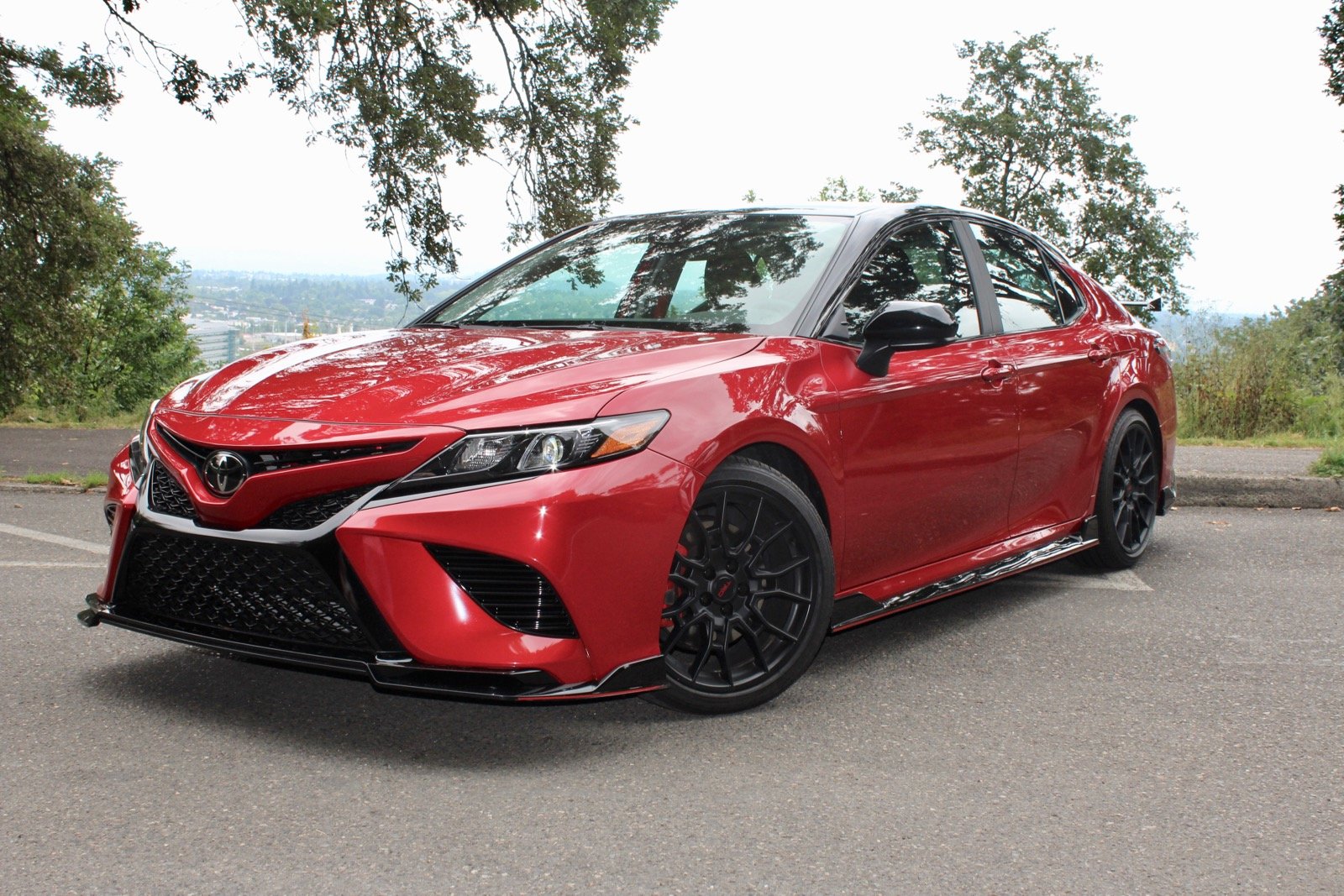
Overview | |
MSRP$24,425 | MSRP$19,300 |
Listings41 | Listings201 |
Ratings & Reviews | |
User Reviews | User Reviews |
Expert reviews7.5 out of 10 | Expert reviews8.3 out of 10 |
Pros
Cons
| Pros
Cons
|
2020 Toyota Camry Reviews SummaryIf you can't beat them, join them. That seems to be Toyota's philosophy in updating the eighth generation of the Camry for the 2020 model year. This latest version debuted in 2017 as a 2018 model. As buyers continue to defect from cars into SUVs like Toyota's own RAV4, Toyota hopes to entice more shoppers to stick with its midsize sedan by offering all-wheel drive on the Camry for the first time since 1991. What's new for 2020 is the Camry TRD option package on the XSE V6, with 301 horsepower that make the case to a buyer who might never have considered a Camry. | |
2020 Hyundai Elantra Reviews SummaryHyundai isn’t pulling any punches when it comes to the compact car segment, where value is of utmost importance. And though a completely redesigned 2021 Elantra is coming soon, the automaker bestows several value-enhancing improvements upon the outgoing 2020 Hyundai Elantra compact sedan. They include improved fuel efficiency ratings and newly packaged safety features. | |
No video found | No video found |
Popular Features & Specs | |
Engine2.5L 203 hp I4 | Engine2.0L 147 hp I4 |
DrivetrainFWD | DrivetrainFWD |
Seating Capacity5 | Seating Capacity5 |
Horsepower | Horsepower147 hp @ 6200 rpm |
MPG City29 | MPG City31 |
MPG Highway41 | MPG Highway41 |
Engine | |
Engine Name2.5L 203 hp I4 | Engine Name2.0L 147 hp I4 |
Torque | Torque132 lb-ft @ 4500 rpm |
Horsepower | Horsepower147 hp @ 6200 rpm |
DrivetrainFWD | DrivetrainFWD |
Fuel Economy | |
MPG City29 | MPG City31 |
MPG Highway41 | MPG Highway41 |
Interior | |
Seating Capacity5 | Seating Capacity5 |
Safety | |
Front Crash Overall5 | Front Crash Overall4 |
Side Crash Overall5 | Side Crash Overall4 |
Dimensions & Capacity | |
Cargo Space14.1 cu ft | Cargo Space14.4 cu ft |
Curb Weight3241 lbs | Curb Weight2844 lbs |
Height56.9 in | Height56.5 in |
Length192.1 in | Length181.9 in |
Width72.4 in | Width70.9 in |
Wheelbase111.2 in | Wheelbase106.3 in |
Maximum Payload925 lbs | Maximum Payload1080 lbs |
Number of doors4 | Number of doors4 |
Overview | ||
MSRP | $24,425 | $19,300 |
Listings | ||
Ratings & Reviews | ||
User reviews | ||
Expert reviews | 7.5 out of 10Read full review | 8.3 out of 10Read full review |
Pros & cons | Pros
Cons
| Pros
Cons
|
Summary | If you can't beat them, join them. That seems to be Toyota's philosophy in updating the eighth generation of the Camry for the 2020 model year. This latest version debuted in 2017 as a 2018 model. As buyers continue to defect from cars into SUVs like Toyota's own RAV4, Toyota hopes to entice more shoppers to stick with its midsize sedan by offering all-wheel drive on the Camry for the first time since 1991. What's new for 2020 is the Camry TRD option package on the XSE V6, with 301 horsepower that make the case to a buyer who might never have considered a Camry. | Hyundai isn’t pulling any punches when it comes to the compact car segment, where value is of utmost importance. And though a completely redesigned 2021 Elantra is coming soon, the automaker bestows several value-enhancing improvements upon the outgoing 2020 Hyundai Elantra compact sedan. They include improved fuel efficiency ratings and newly packaged safety features. |
Video | No video found | No video found |
Popular Features & Specs | ||
Engine | 2.5L 203 hp I4 | 2.0L 147 hp I4 |
Drivetrain | FWD | FWD |
Seating Capacity | 5 | 5 |
Horsepower | 147 hp @ 6200 rpm | |
MPG City | 29 | 31 |
MPG Highway | 41 | 41 |
Engine | ||
Engine Name | 2.5L 203 hp I4 | 2.0L 147 hp I4 |
Torque | 132 lb-ft @ 4500 rpm | |
Horsepower | 147 hp @ 6200 rpm | |
Drivetrain | FWD | FWD |
Fuel Economy | ||
MPG City | 29 | 31 |
MPG Highway | 41 | 41 |
Interior | ||
Seating Capacity | 5 | 5 |
Safety | ||
Front Crash Overall | 5 | 4 |
Side Crash Overall | 5 | 4 |
Dimensions & Capacity | ||
Cargo Space | 14.1 cu ft | 14.4 cu ft |
Curb Weight | 3241 lbs | 2844 lbs |
Height | 56.9 in | 56.5 in |
Length | 192.1 in | 181.9 in |
Width | 72.4 in | 70.9 in |
Wheelbase | 111.2 in | 106.3 in |
Maximum Payload | 925 lbs | 1080 lbs |
Number of doors | 4 | 4 |
The 2020 Toyota Camry had a renewed focus on quality and appeal, aiming to reclaim its status as a top contender in the sedan market. Its styling was more expressive than ever, with a bold front fascia and taut lines that gave it a sporty appearance. The design borrowed cues from BMW, with a character line across the doors and an upturned kink of the C-pillar. The Camry offered 13 exterior colour options, including a fashionable black roof. Inside, the Camry used high-quality materials, and the driver-focused dashboard design made even the base trims feel upscale. The top trims featured leather and wood, aligning them with entry-level Lexus models, although the Camry was not a luxury car. With a starting price of $26,620, the Camry aimed to balance sportiness and luxury without overreaching.
The 2020 Hyundai Elantra, last redesigned in 2017 and restyled in 2019, maintained its geometric-influenced appearance for 2020. It was available in five trims: Essential, Preferred, Luxury, Ultimate, and Sport, with prices ranging from $17,099 to $27,549. The Elantra's angular design was highlighted by a black paint job, contrasting with chrome detailing. Inside, the Elantra's interior was updated for a more upscale look, with silver trim and some hard plastics reminding drivers of its compact car status. The Elantra offered a comfortable ride for four adults, with a fifth squeezed in for short trips. The trunk provided 407 litres of space, nearly matching some midsize sedans. The Elantra's interior storage was well-proportioned, and the trunk featured a convenient grab handle.


The 2020 Toyota Camry offered four powertrains, including a 2.5-litre four-cylinder with FWD or AWD, a 3.5-litre V6, and a hybrid option. The V6 produced 301 horsepower and was paired with an eight-speed automatic transmission, providing a smooth and powerful driving experience. The 2.5-litre four-cylinder delivered 203 hp (206 in XSE trim) and was lighter, enhancing steering feel. The AWD system, similar to the RAV4's, could send up to half of the engine's 184 lb-ft of torque to the rear wheels. Fuel consumption for the FWD Camry was 7.6 L/100 km, increasing to 8.4 L/100 km with AWD. V6 models managed 9.0 L/100 km, with slight variations for different trims.
The 2020 Hyundai Elantra featured a base 147-horsepower, 2.0-litre four-cylinder engine with a new CVT, replacing the previous six-speed automatic. The Elantra Sport trim offered a 1.6-litre turbo four-cylinder with 201 horsepower and 195 lb-ft of torque, along with an independent rear suspension. The CVT, called the "Intelligent Variable Transmission," provided simulated gear shifts for a traditional feel. Despite claims of improved fuel efficiency, real-world testing showed an average of 8.0 L/100 km, similar to the previous model. The Elantra's torsion beam axle rear suspension detracted from ride and handling, while the Sport trim's independent suspension offered a superior experience. The Elantra was more of a commuter car, with the Sport trim providing a more enjoyable drive.
The 2020 Toyota Camry was user-friendly, with most controls easily accessible. The centre console housed a shifter, cupholders, a cell phone tray, and a storage bin. Front legroom and hip room increased, but rear legroom and overall passenger volume decreased, leaving the Camry with a tighter backseat and smaller trunk than competitors. The trunk offered 428 litres of space, comparable to the Honda Civic. The addition of AWD did not affect trunk or passenger space, thanks to modifications in the floor structure and fuel tank.
The 2020 Hyundai Elantra was among the roomier compact cars, comfortably accommodating four adults. The test car featured power driver's seat adjustment, leather upholstery, and a sliding centre console armrest. All Elantras had a front passenger's seat-height adjuster, and upper trims included dual-zone automatic climate control. Heated front seats were standard in Canada, but rear passengers lacked air conditioning vents. The trunk provided 407 litres of space, nearly matching some midsize sedans. The interior grab handle inside the trunk lid was a thoughtful touch.
The 2020 Toyota Camry added Android Auto compatibility, joining Apple CarPlay, Bluetooth, and SiriusXM satellite radio. The standard infotainment system felt dated, but the touchscreen was functional and responsive, with hard buttons for major functions. The standard 7-inch screen could be upgraded to 8 inches. A single USB-A port was available, with additional charging ports in the centre console. An optional Qi wireless charging pad was offered, but USB-C ports were unavailable. Some trims allowed smartphone-based remote access, and higher trims featured a larger multi-information display and an optional 10-inch head-up display.
The 2020 Hyundai Elantra's standard equipment included a touchscreen infotainment system with Bluetooth and a USB port. The base Essential trim had a 5-inch screen, while the Preferred trim offered a 7-inch display with Apple CarPlay, Android Auto, and SiriusXM. The Ultimate trim added a wireless charging pad, a premium Infinity sound system, and an 8-inch touchscreen with navigation. The Sport trim's packaging was similar to the Luxury grade. The touchscreen was easy to use, with shortcut buttons and volume and tuning knobs. The Infinity sound system impressed for a compact car, providing uncommon depth of sound.
The 2020 Toyota Camry included a version of Toyota Safety Sense, featuring a pre-collision system, dynamic radar adaptive cruise control, lane-departure warning, and automatic high beams. A one-year trial of Safety Connect was included with most trims. Blind-spot monitoring and rear cross-traffic alert were optional. The Camry had 10 airbags, stability control, and a backup camera, with higher trims offering Bird's Eye View for a 360-degree view. The NHTSA gave the Camry a five-star rating, and the IIHS awarded it a Top Safety Pick+. A recall for leaking engine coolant affected some models.
The 2020 Hyundai Elantra offered advanced driving assistance systems on the Preferred trim, including forward-collision warning, automatic emergency braking, lane departure warning, and a driver attention monitor. The Preferred trim also had blind-spot monitoring and rear cross-traffic alert. The Ultimate grade added full LED headlights, adaptive cruise control, pedestrian detection, and Safe Exit Assist. The Elantra earned a Top Safety Pick from the IIHS with full LED headlights and a four-star rating from the NHTSA. The NHTSA noted a concern about rear-door intrusion during side-impact tests.
CarGurus highlights

According to CarGurus experts, the overall rating for the 2020 Toyota Camry is 7.5 out of 10, while the 2020 Hyundai Elantra scores 8.3 out of 10. Based on these ratings, the 2020 Hyundai Elantra is the recommended choice, offering better value, modern technology, and a spacious interior at a more affordable price point.
Choose the 2020 Toyota Camry if:
- You prioritize a more powerful engine lineup, including a V6 option.
- You value a higher safety rating with a Top Safety Pick+ from the IIHS.
- You prefer a sedan with a more luxurious interior feel and design.


Choose the 2020 Hyundai Elantra if:
- You seek a more affordable compact car with a lower starting price.
- You want a vehicle with a more modern infotainment system and connectivity options.
- You need a compact car with ample interior space and a roomy trunk.


CarGurus highlights
According to CarGurus experts, the overall rating for the 2020 Toyota Camry is 7.5 out of 10, while the 2020 Hyundai Elantra scores 8.3 out of 10. Based on these ratings, the 2020 Hyundai Elantra is the recommended choice, offering better value, modern technology, and a spacious interior at a more affordable price point.
Choose the 2020 Toyota Camry if:
Shop Now- You prioritize a more powerful engine lineup, including a V6 option.
- You value a higher safety rating with a Top Safety Pick+ from the IIHS.
- You prefer a sedan with a more luxurious interior feel and design.
Choose the 2020 Hyundai Elantra if:
Shop Now- You seek a more affordable compact car with a lower starting price.
- You want a vehicle with a more modern infotainment system and connectivity options.
- You need a compact car with ample interior space and a roomy trunk.

By: CarGurus + AI
At CarGurus, our team of experienced automotive writers remain at the heart of our content operation, conducting hands-on car tests and writing insightful guides that are backed by years of industry experience. To complement this, we are harnessing AI to make our content offering more diverse and more helpful to shoppers than ever. To achieve this, our AI systems are based exclusively on CarGurus content, ratings and data, so that what we produce is both unique to CarGurus, and uniquely helpful to car shoppers.
