Chevrolet Blazer vs Chevrolet Bolt
Overview | |
Years produced1969-2005 | Years produced2027 |
MSRP$35,100 | MSRP$27,600 |
Listings754 | Listings1393 |
Ratings & Reviews | |
User Reviews | User Reviews |
Expert reviews7.2 out of 10 | Expert reviews6.3 out of 10 |
Pros
Cons
| Pros
Cons
|
Reviews SummaryThe Chevrolet Blazer is one of the oldest SUV nameplates on the market, and while the current version might disappoint fans of the original, it’s very much on-trend with modern times. Chevy launched the Blazer as truck-based off-roader, starting with the original K5 Blazer, and following that it up with a smaller S-10 Blazer based on its compact pickup truck. The Blazer was shelved in the early 2000s, then revived for the 2019 model year as a car-based crossover SUV, eschewing ruggedness for greater efficiency and on-road refinement in a shift that reflected the utility-vehicle market as a whole. The General Motors decision not to go all-in on nostalgia with a new off-road Blazer might seem questionable in the wake of the revived Ford Bronco, but the market for two-row midsize crossovers like the modern Blazer is even stronger, and it's filled with rival offerings like the Ford Edge, Honda Passport, Hyundai Santa Fe, Nissan Murano, Toyota Venza, and Volkswagen Atlas Cross Sport. For 2023, notable changes include a new 10-inch touchscreen display and available wireless charging for all trim levels, some styling changes, and new wheel designs and colour options. In Canada, the lineup consists of LT, True North, Premier, and RS trim levels (we checked out a Blazer RS for this review). A Chevy Blazer EV is also on the way for the 2024 model year, but this will be a completely different vehicle based on GM’s Ultium EV component set. | |
Reviews SummaryWith more range, more power, and improved technology, the Chevrolet Bolt EV returns after a three-year hiatus. It’s also one of the most affordable EVs in Canada, but it’s due to remain in production only until mid-2027. Verdict: The 2027 Chevrolet Bolt EV is an excellent choice for shoppers seeking an electric vehicle that won't break the bank. It may not be all that fancy or refined, but it gets the basics right when it comes to range and capabilities. | |
No video found | No video found |
Popular Features & Specs | |
Engine2.0L 228 hp I4 | Engine |
DrivetrainFWD | Drivetrain |
Seating Capacity5 | Seating Capacity5 |
Horsepower228 hp @ 5000 rpm | Horsepower |
EV Battery Capacity | EV Battery Capacity65 kWh |
MPG City22 | MPG City |
MPG Highway29 | MPG Highway |
Battery Charge Time (120V) | Battery Charge Time (120V)64 hours |
Battery Charge Time (240V) | Battery Charge Time (240V)9.8 hours |
Engine | |
Engine Name2.0L 228 hp I4 | Engine Name210 hp Electric |
Torque258 lb-ft @ 1500 rpm | Torque |
Horsepower228 hp @ 5000 rpm | Horsepower |
Battery Charge Time (120V) | Battery Charge Time (120V)64 hours |
Battery Charge Time (240V) | Battery Charge Time (240V)9.8 hours |
DrivetrainFWD | DrivetrainFWD |
Fuel Economy | |
EV Battery Capacity | EV Battery Capacity65 kWh |
MPG City22 | MPG City |
MPG Highway29 | MPG Highway |
Interior | |
Seating Capacity5 | Seating Capacity5 |
Key Features | |
Navigation System | Navigation SystemStandard |
Safety | |
Front Crash Overall5 | Front Crash Overall |
Side Crash Overall5 | Side Crash Overall |
Dimensions & Capacity | |
Cargo Space30.5 cu ft | Cargo Space16.2 cu ft |
Curb Weight3918 lbs | Curb Weight3776 lbs |
Height67.0 in | Height63.9 in |
Length191.9 in | Length169.6 in |
Width76.7 in | Width80.1 in |
Wheelbase112.7 in | Wheelbase105.3 in |
Maximum Payload1824 lbs | Maximum Payload873 lbs |
Number of doors4 | Number of doors4 |
Maximum Towing Capacity1500 lbs | Maximum Towing Capacity |
Overview | ||
Years produced | 1969-2005 | 2027 |
MSRP | $35,100 | $27,600 |
Listings | ||
Ratings & Reviews | ||
User reviews | ||
Expert reviews | 7.2 out of 10Read full review | 6.3 out of 10Read full review |
Pros & cons | Pros
Cons
| Pros
Cons
|
Summary | The Chevrolet Blazer is one of the oldest SUV nameplates on the market, and while the current version might disappoint fans of the original, it’s very much on-trend with modern times. Chevy launched the Blazer as truck-based off-roader, starting with the original K5 Blazer, and following that it up with a smaller S-10 Blazer based on its compact pickup truck. The Blazer was shelved in the early 2000s, then revived for the 2019 model year as a car-based crossover SUV, eschewing ruggedness for greater efficiency and on-road refinement in a shift that reflected the utility-vehicle market as a whole. The General Motors decision not to go all-in on nostalgia with a new off-road Blazer might seem questionable in the wake of the revived Ford Bronco, but the market for two-row midsize crossovers like the modern Blazer is even stronger, and it's filled with rival offerings like the Ford Edge, Honda Passport, Hyundai Santa Fe, Nissan Murano, Toyota Venza, and Volkswagen Atlas Cross Sport. For 2023, notable changes include a new 10-inch touchscreen display and available wireless charging for all trim levels, some styling changes, and new wheel designs and colour options. In Canada, the lineup consists of LT, True North, Premier, and RS trim levels (we checked out a Blazer RS for this review). A Chevy Blazer EV is also on the way for the 2024 model year, but this will be a completely different vehicle based on GM’s Ultium EV component set. | With more range, more power, and improved technology, the Chevrolet Bolt EV returns after a three-year hiatus. It’s also one of the most affordable EVs in Canada, but it’s due to remain in production only until mid-2027. Verdict: The 2027 Chevrolet Bolt EV is an excellent choice for shoppers seeking an electric vehicle that won't break the bank. It may not be all that fancy or refined, but it gets the basics right when it comes to range and capabilities. |
Video | No video found | No video found |
Popular Features & Specs | ||
Engine | 2.0L 228 hp I4 | |
Drivetrain | FWD | |
Seating Capacity | 5 | 5 |
Horsepower | 228 hp @ 5000 rpm | |
EV Battery Capacity | 65 kWh | |
MPG City | 22 | |
MPG Highway | 29 | |
Battery Charge Time (120V) | 64 hours | |
Battery Charge Time (240V) | 9.8 hours | |
Engine | ||
Engine Name | 2.0L 228 hp I4 | 210 hp Electric |
Torque | 258 lb-ft @ 1500 rpm | |
Horsepower | 228 hp @ 5000 rpm | |
Battery Charge Time (120V) | 64 hours | |
Battery Charge Time (240V) | 9.8 hours | |
Drivetrain | FWD | FWD |
Fuel Economy | ||
EV Battery Capacity | 65 kWh | |
MPG City | 22 | |
MPG Highway | 29 | |
Interior | ||
Seating Capacity | 5 | 5 |
Key Features | ||
Navigation System | Standard | |
Safety | ||
Front Crash Overall | 5 | |
Side Crash Overall | 5 | |
Dimensions & Capacity | ||
Cargo Space | 30.5 cu ft | 16.2 cu ft |
Curb Weight | 3918 lbs | 3776 lbs |
Height | 67.0 in | 63.9 in |
Length | 191.9 in | 169.6 in |
Width | 76.7 in | 80.1 in |
Wheelbase | 112.7 in | 105.3 in |
Maximum Payload | 1824 lbs | 873 lbs |
Number of doors | 4 | 4 |
Maximum Towing Capacity | 1500 lbs | |
The 2023 Chevrolet Blazer presented a sleek and modern aesthetic, diverging from the rugged appearance typical of crossovers. It featured a low roofline with leaned-back front and rear pillars, creating a streamlined profile complemented by a prominent grille and stacked headlights. Despite its road car styling cues, the Blazer maintained the visual heft of an SUV, thanks to its tall ride height and robust body sides. The Blazer RS test vehicle stood out with its blackout trim, vibrant Red Hot paint, and 21-inch wheels, making it a striking choice in the mainstream crossover segment. For 2023, the Blazer received subtle styling updates, including new taillights with twisted, filament-like elements, and revised grille and LED headlight designs. These changes, along with new wheel designs and additional colour options, kept the Blazer's look fresh. Inside, the Blazer's sportier interior, reminiscent of the Camaro, featured an upright dashboard and large round air vents. The RS model boasted blue trim, chrome accents, and a two-tone upholstery scheme, enhancing its premium feel.
The 2027 Chevrolet Bolt retained a familiar look, with slight styling changes that made its front end resemble a conventional gas-powered car more than an EV. The 2027 model continued the design of the 2023 version, offering only the EUV body style, which combined elements of a large hatchback and a subcompact SUV. The Bolt's tall and narrow stance prioritized utility and interior space over a sporty appearance. The RS model added gloss black exterior trim for a touch of flair. Inside, the Bolt underwent a more dramatic makeover, featuring a larger digital instrument panel and infotainment touchscreen. The push-button gear selector was relocated to the steering column, freeing up centre console space. While the cabin was dominated by hard plastic surfaces, the RS trim offered Evotex synthetic leather with red stitching. The rear seating area, though lacking padding for door armrests, provided ample headroom and thigh support.

The 2023 Chevrolet Blazer carried over its powertrain options from the previous year. The base LT model featured a 2.0-litre turbocharged four-cylinder engine, delivering 228 horsepower and 258 pound-feet of torque. A 3.6-litre V6 engine, producing 308 horsepower and 270 pound-feet of torque, was optional on the LT and standard on other trims. Both engines were paired with a nine-speed automatic transmission, and all-wheel drive (AWD) was standard in Canada. The Blazer's AWD system required manual engagement, unlike some rivals with automatic switching. The V6-powered Blazer RS impressed with its quick acceleration and sporty exhaust note, though it wasn't a performance SUV. Its weight and top-heavy design affected handling, but it offered a comfortable highway ride with Active Noise Cancellation and a well-tuned suspension. The Blazer's 2,041-kilogram towing capacity was competitive for midsize SUVs.
The 2027 Chevrolet Bolt featured significant changes under the surface. It housed a new 65-kilowatt-hour lithium-iron phosphate battery pack, reducing costs and reliance on rare earth minerals. The Bolt's motor, sourced from the Equinox EV, produced 210 horsepower and 169 pound-feet of torque, achieving a 0-100 km/h time in the low seven-second range. While not the fastest EV, the Bolt's acceleration was impressive compared to gas-powered subcompact SUVs. One-pedal driving was available, with adjustable brake regeneration levels. The Bolt's ride was firm but not overly stiff, and its low centre of gravity contributed to agile handling. On a full charge, it offered up to 422 kilometres of range, with improved charging speed and a Tesla-derived charging port.
The 2023 Chevrolet Blazer was a two-row, five-seat vehicle, offering a spacious interior without being cumbersome to maneuver. It provided nearly identical front-seat headroom to rivals like the Ford Edge and Honda Passport, though rear-seat headroom was slightly below average. The Blazer offered 864 litres of cargo space with rear seats up and 1,818 litres with them folded, trailing behind competitors like the Honda Passport and Nissan Murano. Despite this, the Blazer felt spacious from the driver's seat, with functional interior details like USB port placement and temperature controls integrated into air vents. A heated steering wheel was standard on the RS trim.
The 2027 Chevrolet Bolt featured an upright driving position with ample space for larger occupants. Taller drivers might have wished for more telescopic steering wheel extension. The rear seats provided plenty of headroom and thigh support, with a flat floor reducing discomfort for centre-seat passengers. The Bolt offered 459 litres of cargo space behind the rear seats, with a large bin underneath the floor for additional storage. The rear seats folded flat with the cargo floor, enhancing luggage capacity. Up front, the Bolt provided ample storage for personal items, including a large bin with dividers, a floor tray, and a deep centre armrest bin.
The 2023 Chevrolet Blazer received tech upgrades for 2023, including a standard 10.2-inch touchscreen and available wireless device charging. The RS and Premier trims featured an 8-inch digital instrument cluster display, built-in navigation, and an eight-speaker Bose audio system. The infotainment system was intuitive, with a user-friendly menu layout. However, a physical button for the optional 360-degree camera system would have been appreciated. The Blazer's tech presentation was competitive, with a large touchscreen matching segment leaders like the Hyundai Santa Fe.
The 2027 Chevrolet Bolt came equipped with an 11-inch digital instrument panel and an 11.3-inch centre touchscreen, running on a Google-based operating system. While Apple CarPlay and standalone Android Auto were not supported, the system offered sufficient browsing control via Bluetooth. The optional Technology package added features like a surround-view camera system, digital rear-view mirror, and wireless charging pad. The infotainment system was user-friendly, with logical menus and quick responses. The Bolt's navigation system assisted in finding charging stations and preconditioned the battery for optimal charging rates. It also offered vehicle-to-load charging capability.
The 2023 Chevrolet Blazer offered a standard Chevy Safety Assist Package, including automatic emergency braking, forward collision warning, lane keep assist, and more. Adaptive cruise control was newly available on all trims. Optional safety features included blind spot monitoring, rear cross-traffic alert, and a 360-degree camera system. The Blazer received high safety ratings from the IIHS and NHTSA, though it lacked GM's advanced Super Cruise system.
The 2027 Chevrolet Bolt's crash test results were not available at the time of writing, but it was expected to perform well based on its platform. Standard safety features included forward-collision warning, adaptive cruise control, lane-keep assist, and blind-spot monitors. The optional Technology package added features like a surround-view camera system and traffic-sign recognition. GM's Super Cruise system was available for an additional cost, offering advanced hands-free highway driving.
CarGurus highlights
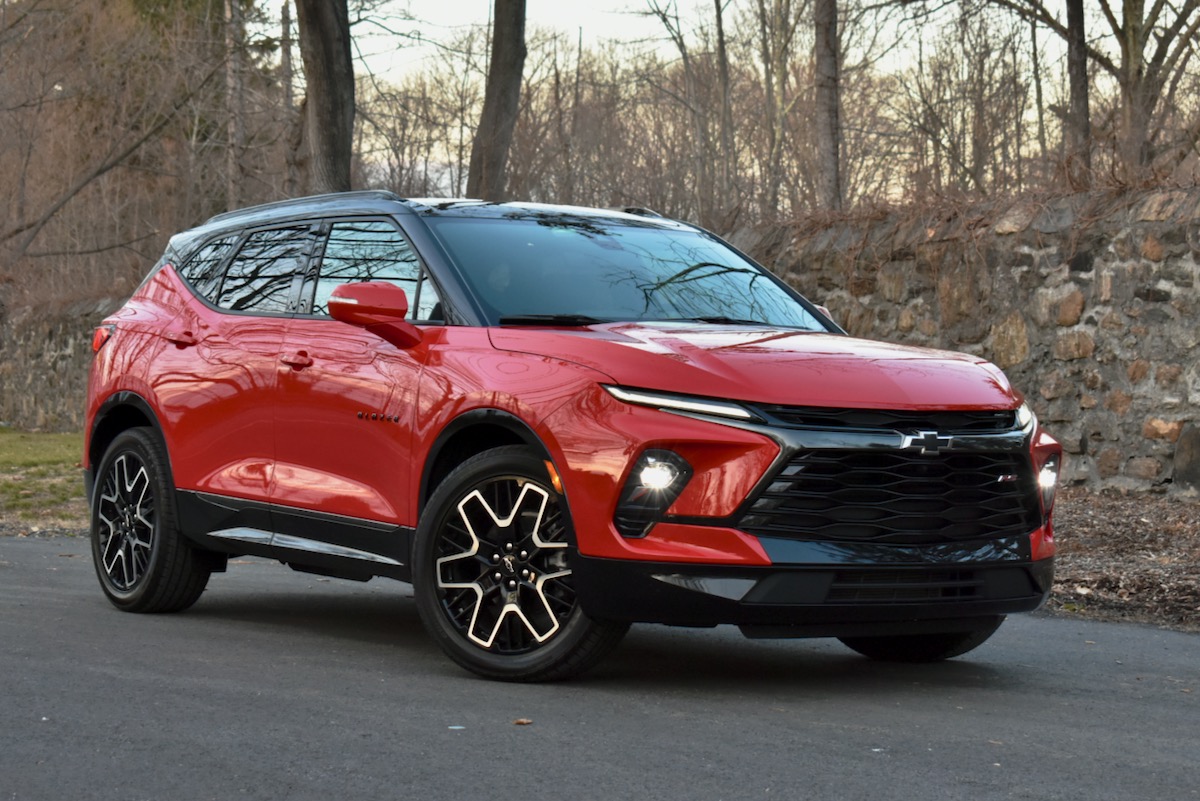
According to CarGurus experts, the overall rating for the 2023 Chevrolet Blazer was 7.2 out of 10, while the 2027 Chevrolet Bolt scored 6.3 out of 10. Based on these ratings, the 2023 Chevrolet Blazer is the recommended choice, offering a more balanced combination of style, performance, and safety features.
Choose the 2023 Chevrolet Blazer if:
- You prefer a vehicle with a sleek, road car-inspired design and a spacious interior.
- You value a powerful V6 engine option with impressive towing capacity.
- You want a comprehensive array of safety features with high safety ratings.


Choose the 2027 Chevrolet Bolt if:
- You seek an EV with a familiar design and improved range and charging capabilities.
- You appreciate advanced technology features, including a Google-based infotainment system.
- You desire a budget-friendly EV with optional Super Cruise hands-free driving.


CarGurus highlights
According to CarGurus experts, the overall rating for the 2023 Chevrolet Blazer was 7.2 out of 10, while the 2027 Chevrolet Bolt scored 6.3 out of 10. Based on these ratings, the 2023 Chevrolet Blazer is the recommended choice, offering a more balanced combination of style, performance, and safety features.
Choose the 2023 Chevrolet Blazer if:
Shop Now- You prefer a vehicle with a sleek, road car-inspired design and a spacious interior.
- You value a powerful V6 engine option with impressive towing capacity.
- You want a comprehensive array of safety features with high safety ratings.
Choose the 2027 Chevrolet Bolt if:
Shop Now- You seek an EV with a familiar design and improved range and charging capabilities.
- You appreciate advanced technology features, including a Google-based infotainment system.
- You desire a budget-friendly EV with optional Super Cruise hands-free driving.

By: CarGurus + AI
At CarGurus, our team of experienced automotive writers remain at the heart of our content operation, conducting hands-on car tests and writing insightful guides that are backed by years of industry experience. To complement this, we are harnessing AI to make our content offering more diverse and more helpful to shoppers than ever. To achieve this, our AI systems are based exclusively on CarGurus content, ratings and data, so that what we produce is both unique to CarGurus, and uniquely helpful to car shoppers.
