2026 Honda Pilot vs 2026 Hyundai IONIQ 9
Overview | |
Listings78 | Listings588 |
Ratings & Reviews | |
User Reviews | User Reviews |
Expert reviews7.3 out of 10 | Expert reviews7.0 out of 10 |
Pros
Cons
| Pros
Cons
|
2026 Hyundai IONIQ 9 Reviews SummaryAlthough the 2026 Hyundai Ioniq 9 isn’t the first three-row electric SUV through the door, it may be the best choice for most shoppers. With a starting price of $59,999 before fees and qualifying for EV rebates where they still exist, it’s much more affordable than a Tesla Model X or a Rivian R1S. And its standard 110.3-kWh battery pack provides a long range compared to a base-model Kia EV9. Verdict: The Hyundai Ioniq 9 isn’t a perfect vehicle, but it offers terrific passenger space, good tech, and family-friendly features. Shoppers may find its design polarizing — you could easily say the same about the Hyundai Ioniq 5 or the Ioniq 6 — but families interested in electric vehicles will do well to test drive this new option. | |
2026 Honda Pilot Reviews SummaryWhile it has a more truck-like presence, the 2026 Honda Pilot remains fundamentally the same as before—and that's a good thing. It's the automaker's midsize three-row crossover SUV, competing against family-focused models such as the Toyota Grand Highlander and the Ford Explorer. Verdict: Clever features help the Pilot stand out from other three-row SUVs. Our only major complaint is the lack of a more fuel-efficient model. | |
Popular Features & Specs | |
Engine215 hp Electric | Engine |
DrivetrainRWD | Drivetrain |
Seating Capacity7 | Seating Capacity8 |
EV Battery Capacity110 kWh | EV Battery Capacity |
Fuel Economy (City)2.3 L(e)/100 km | Fuel Economy (City) |
Fuel Economy (Highway)2.9 L(e)/100 km | Fuel Economy (Highway) |
Battery Charge Time (120V)93 hours | Battery Charge Time (120V) |
Battery Charge Time (240V)9.7 hours | Battery Charge Time (240V) |
Engine | |
Engine Name215 hp Electric | Engine Name |
Battery Charge Time (120V)93 hours | Battery Charge Time (120V) |
Battery Charge Time (240V)9.7 hours | Battery Charge Time (240V) |
DrivetrainRWD | Drivetrain |
Fuel Economy | |
EV Battery Capacity110 kWh | EV Battery Capacity |
Fuel Economy (City)2.3 L(e)/100 km | Fuel Economy (City) |
Fuel Economy (Highway)2.9 L(e)/100 km | Fuel Economy (Highway) |
Interior | |
Seating Capacity7 | Seating Capacity8 |
Key Features | |
Navigation SystemStandard | Navigation SystemStandard |
Safety | |
Front Crash Overall5 | Front Crash Overall4 |
Side Crash Overall5 | Side Crash Overall5 |
Dimensions & Capacity | |
Cargo Space620 L | Cargo Space527 L |
Curb Weight2498 kg | Curb Weight1967 kg |
Height1791 mm | Height1803 mm |
Length5060 mm | Length5083 mm |
Width1981 mm | Width1994 mm |
Wheelbase3129 mm | Wheelbase2891 mm |
Maximum Payload632 kg | Maximum Payload608 kg |
Number of doors4 | Number of doors4 |
Maximum Towing Capacity1588 kg | Maximum Towing Capacity1588 kg |
Overview | ||
Listings | ||
Ratings & Reviews | ||
User reviews | ||
Expert reviews | 7.3 out of 10Read full review | 7.0 out of 10Read full review |
Pros & cons | Pros
Cons
| Pros
Cons
|
Summary | Although the 2026 Hyundai Ioniq 9 isn’t the first three-row electric SUV through the door, it may be the best choice for most shoppers. With a starting price of $59,999 before fees and qualifying for EV rebates where they still exist, it’s much more affordable than a Tesla Model X or a Rivian R1S. And its standard 110.3-kWh battery pack provides a long range compared to a base-model Kia EV9. Verdict: The Hyundai Ioniq 9 isn’t a perfect vehicle, but it offers terrific passenger space, good tech, and family-friendly features. Shoppers may find its design polarizing — you could easily say the same about the Hyundai Ioniq 5 or the Ioniq 6 — but families interested in electric vehicles will do well to test drive this new option. | While it has a more truck-like presence, the 2026 Honda Pilot remains fundamentally the same as before—and that's a good thing. It's the automaker's midsize three-row crossover SUV, competing against family-focused models such as the Toyota Grand Highlander and the Ford Explorer. Verdict: Clever features help the Pilot stand out from other three-row SUVs. Our only major complaint is the lack of a more fuel-efficient model. |
Video | ||
Popular Features & Specs | ||
Engine | 215 hp Electric | |
Drivetrain | RWD | |
Seating Capacity | 7 | 8 |
EV Battery Capacity | 110 kWh | |
Fuel Economy (City) | 2.3 L(e)/100 km | |
Fuel Economy (Highway) | 2.9 L(e)/100 km | |
Battery Charge Time (120V) | 93 hours | |
Battery Charge Time (240V) | 9.7 hours | |
Engine | ||
Engine Name | 215 hp Electric | |
Battery Charge Time (120V) | 93 hours | |
Battery Charge Time (240V) | 9.7 hours | |
Drivetrain | RWD | |
Fuel Economy | ||
EV Battery Capacity | 110 kWh | |
Fuel Economy (City) | 2.3 L(e)/100 km | |
Fuel Economy (Highway) | 2.9 L(e)/100 km | |
Interior | ||
Seating Capacity | 7 | 8 |
Key Features | ||
Navigation System | Standard | Standard |
Safety | ||
Front Crash Overall | 5 | 4 |
Side Crash Overall | 5 | 5 |
Dimensions & Capacity | ||
Cargo Space | 620 L | 527 L |
Curb Weight | 2498 kg | 1967 kg |
Height | 1791 mm | 1803 mm |
Length | 5060 mm | 5083 mm |
Width | 1981 mm | 1994 mm |
Wheelbase | 3129 mm | 2891 mm |
Maximum Payload | 632 kg | 608 kg |
Number of doors | 4 | 4 |
Maximum Towing Capacity | 1588 kg | 1588 kg |
The 2026 Hyundai Ioniq 9 presented a polarizing design that some found appealing due to its unique and aerodynamic shape, while others found it less attractive. Inspired by various elements like smooth pebbles and midcentury modern sofas, the Ioniq 9 aimed to offer a spacious interior for seven passengers. Its dimensions, slightly shorter than a Honda Pilot but with a longer wheelbase than a Chevy Tahoe, provided ample interior space. Despite its size, the Ioniq 9 achieved a commendable drag coefficient of 0.27, enhancing its aerodynamic efficiency. However, its design, with a swooping roofline and a stubby rear end, was not universally praised for beauty. The rear view, with LED taillights wrapping around the tail, was particularly distinctive.
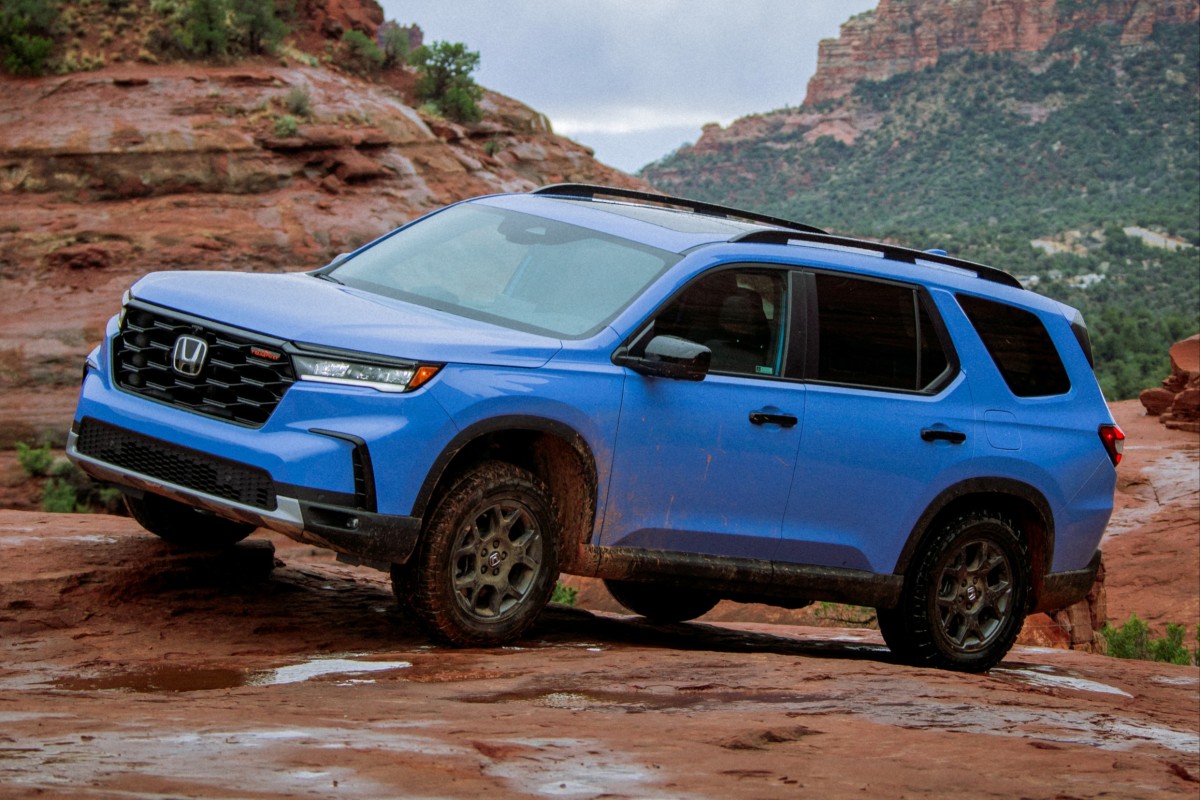
In contrast, the 2026 Honda Pilot underwent a makeover that emphasized a more rugged, truck-like appearance with a larger, blockier grille and utilitarian roof rails. The interior retained its practical design, with upgrades like larger infotainment and instrument panel screens. The top trims featured diamond quilting and contrast stitching for added visual appeal. Despite these changes, the Pilot maintained its reputation as a tastefully designed midsize SUV, excelling in practicality and material quality. The updates for 2026 did not drastically alter its core design, which remained focused on functionality and comfort.
The 2026 Hyundai Ioniq 9 was equipped with a 110.3-kWh battery pack on Hyundai's e-GMP platform, offering a larger capacity than similar models like the Kia EV9 and Tesla Model X. The base Essential trim featured a single rear-mounted 160-kW motor, delivering 215 horsepower with rear-wheel drive. Other trims boasted dual-motor all-wheel-drive systems, with the Preferred AWD producing 303 hp and the Preferred AWD+ generating 422 hp. Despite its weight and soft suspension, the Ioniq 9 provided a smooth ride, though it lacked agility in corners. It offered a towing capacity of 1,587 kg for RWD and 2,268 kg for AWD models. Charging options included Tesla-style NACS superchargers and CCS-port Level 3 chargers, with varying charging times depending on the method used.
The 2026 Honda Pilot retained its 3.5-litre V6 engine, producing 285 horsepower and 262 pound-feet of torque, paired with a 10-speed automatic transmission. Standard all-wheel drive in Canada ensured adequate acceleration and confident handling. The Pilot's steering was revised for improved feedback and stability, addressing previous concerns about vagueness. While not sporty, the Pilot offered a comfortable and confident driving experience, suitable for family use. The brake pedal effort was soft, aligning with its family SUV character, though occasional downshifts affected smooth stops.
The Hyundai Ioniq 9 focused on family-friendly practicality, seating seven with a middle-row bench or six with captain's chairs in the Preferred AWD+ Ultimate Calligraphy Package. The sliding centre console enhanced accessibility for middle-row passengers. With 1,086 mm of legroom in the middle row and 813 mm in the third row, the Ioniq 9 offered ample space, comparable to the Hyundai Palisade. The large rear doors facilitated easy access, while dual-zone climate control and air vents in all rows ensured comfort. Cargo space ranged from 620 litres behind the third row to 2,462 litres with seats folded, though the front trunk was limited to storing charging accessories.
The Honda Pilot's cabin remained largely unchanged, maintaining its reputation for interior space and versatility. The removable second-row centre seat offered flexibility, with storage space under the cargo floor. The outboard seats provided ample legroom and comfort, while the third row was accessible via a single button push. Although the third row's materials were of lower quality, USB ports were included. Cargo capacity ranged from 635 litres behind the third row to 3,219 litres with seats folded, depending on the trim. The front seats offered generous storage options, enhancing practicality.
The Hyundai Ioniq 9 featured dual curved 12.3-inch displays for infotainment, similar to other Hyundai models. While the screens were visually appealing, they were prone to fingerprints and glare. Standard features included SiriusXM Satellite Radio, wireless Android Auto and Apple CarPlay, and a wireless charging pad, though the latter struggled to keep up with high-demand devices. Six USB-C ports provided ample charging options. The 14-speaker Bose audio system, standard on higher trims, delivered impressive sound quality.
The Honda Pilot upgraded to a 12.3-inch infotainment touchscreen and a 10.2-inch digital instrument panel. Physical shortcut buttons were replaced with customizable on-screen shortcuts. Wireless Apple CarPlay and Android Auto were standard, with a wireless phone charger available on higher trims. The charging pad required precise positioning and experienced occasional disconnections. Unique features like multiple camera angles and the CabinTalk intercom system carried over, enhancing convenience.
The 2026 Hyundai Ioniq 9 had not yet been rated by NHTSA or IIHS, but it came equipped with a comprehensive suite of advanced driver assistance systems. Standard features included collision avoidance, lane-guidance technologies, driver attention warning, safe-exit assist, and Highway Driving Assist 2, which combined lane-keeping assist with adaptive cruise control. Higher trims added a surround-view monitor and blind-spot view monitor for enhanced safety.
The 2026 Honda Pilot's crash test scores were unavailable, but it was expected to perform similarly to the 2025 model, which received high ratings. The Honda Sensing suite of safety features was standard across all trims, including forward collision warning, lane-departure warning, adaptive cruise control, blind-spot monitoring, and more. The system generally performed well, though the forward collision warning was slightly sensitive.
CarGurus highlights
According to CarGurus experts, the overall rating for the 2026 Hyundai Ioniq 9 is 7.3 out of 10, while the 2026 Honda Pilot scores 7.0 out of 10. Based on these ratings, the Hyundai Ioniq 9 is recommended for those seeking a modern electric SUV with advanced features and a spacious interior.
Choose the 2026 Honda Pilot if:
- You need a versatile and practical midsize SUV with flexible seating and ample cargo space.
- You prefer a rugged design with a comfortable and confident driving experience.
- You want a comprehensive suite of safety features and user-friendly technology.


Choose the 2026 Hyundai IONIQ 9 if:
- You prioritize a spacious and aerodynamic electric SUV with advanced driver assistance features.
- You value a smooth and quiet ride with impressive energy efficiency and towing capacity.
- You appreciate a high-quality audio system and ample charging options for devices.


CarGurus highlights
According to CarGurus experts, the overall rating for the 2026 Hyundai Ioniq 9 is 7.3 out of 10, while the 2026 Honda Pilot scores 7.0 out of 10. Based on these ratings, the Hyundai Ioniq 9 is recommended for those seeking a modern electric SUV with advanced features and a spacious interior.
Choose the 2026 Honda Pilot if:
Shop Now- You need a versatile and practical midsize SUV with flexible seating and ample cargo space.
- You prefer a rugged design with a comfortable and confident driving experience.
- You want a comprehensive suite of safety features and user-friendly technology.
Choose the 2026 Hyundai IONIQ 9 if:
Shop Now- You prioritize a spacious and aerodynamic electric SUV with advanced driver assistance features.
- You value a smooth and quiet ride with impressive energy efficiency and towing capacity.
- You appreciate a high-quality audio system and ample charging options for devices.

By: CarGurus + AI
At CarGurus, our team of experienced automotive writers remain at the heart of our content operation, conducting hands-on car tests and writing insightful guides that are backed by years of industry experience. To complement this, we are harnessing AI to make our content offering more diverse and more helpful to shoppers than ever. To achieve this, our AI systems are based exclusively on CarGurus content, ratings and data, so that what we produce is both unique to CarGurus, and uniquely helpful to car shoppers.
