2026 Hyundai IONIQ 9 vs 2026 Volkswagen Atlas
Overview | |
Listings78 | Listings286 |
Ratings & Reviews | |
User Reviews | User Reviews |
Expert reviews7.3 out of 10 | Expert reviews6.8 out of 10 |
Pros
Cons
| Pros
Cons
|
2026 Hyundai IONIQ 9 Reviews SummaryAlthough the 2026 Hyundai Ioniq 9 isn’t the first three-row electric SUV through the door, it may be the best choice for most shoppers. With a starting price of $59,999 before fees and qualifying for EV rebates where they still exist, it’s much more affordable than a Tesla Model X or a Rivian R1S. And its standard 110.3-kWh battery pack provides a long range compared to a base-model Kia EV9. Verdict: The Hyundai Ioniq 9 isn’t a perfect vehicle, but it offers terrific passenger space, good tech, and family-friendly features. Shoppers may find its design polarizing — you could easily say the same about the Hyundai Ioniq 5 or the Ioniq 6 — but families interested in electric vehicles will do well to test drive this new option. | |
2026 Volkswagen Atlas Reviews SummaryThe 2026 Volkswagen Atlas continues as VW’s North American-market three-row SUV (a two-row Atlas Cross Sport is also available, but we’ll cover that separately), and it’s largely unchanged from its substantial 2024 refresh. What remains, however, is a vehicle that impresses with its upscale appearance and genuinely spacious interior. A stiff ride and poorly executed technology will fight and frustrate you every step of the way, but the Atlas will nonetheless make you look good. Verdict: The 2026 Volkswagen Atlas delivers on its core promise of style and space at a non-luxury price point. If you can tolerate its sub-par ride quality and maddening infotainment system—or if you simply plan to rely on Apple CarPlay and ignore the native tech—this handsome three-row SUV offers compelling value for shoppers prioritizing looks and space. | |
No video found | |
Popular Features & Specs | |
Engine215 hp Electric | Engine |
DrivetrainRWD | Drivetrain |
Seating Capacity7 | Seating Capacity7 |
EV Battery Capacity110 kWh | EV Battery Capacity |
Fuel Economy (City)2.3 L(e)/100 km | Fuel Economy (City) |
Fuel Economy (Highway)2.9 L(e)/100 km | Fuel Economy (Highway) |
Battery Charge Time (120V)93 hours | Battery Charge Time (120V) |
Battery Charge Time (240V)9.7 hours | Battery Charge Time (240V) |
Engine | |
Engine Name215 hp Electric | Engine Name |
Battery Charge Time (120V)93 hours | Battery Charge Time (120V) |
Battery Charge Time (240V)9.7 hours | Battery Charge Time (240V) |
DrivetrainRWD | Drivetrain |
Fuel Economy | |
EV Battery Capacity110 kWh | EV Battery Capacity |
Fuel Economy (City)2.3 L(e)/100 km | Fuel Economy (City) |
Fuel Economy (Highway)2.9 L(e)/100 km | Fuel Economy (Highway) |
Interior | |
Seating Capacity7 | Seating Capacity7 |
Key Features | |
Navigation SystemStandard | Navigation System |
Safety | |
Front Crash Overall5 | Front Crash Overall4 |
Side Crash Overall5 | Side Crash Overall5 |
Dimensions & Capacity | |
Cargo Space620 L | Cargo Space583 L |
Curb Weight2498 kg | Curb Weight1958 kg |
Height1791 mm | Height1788 mm |
Length5060 mm | Length5098 mm |
Width1981 mm | Width2248 mm |
Wheelbase3129 mm | Wheelbase2979 mm |
Maximum Payload632 kg | Maximum Payload500 kg |
Number of doors4 | Number of doors4 |
Maximum Towing Capacity1588 kg | Maximum Towing Capacity907 kg |
Overview | ||
Listings | ||
Ratings & Reviews | ||
User reviews | ||
Expert reviews | 7.3 out of 10Read full review | 6.8 out of 10Read full review |
Pros & cons | Pros
Cons
| Pros
Cons
|
Summary | Although the 2026 Hyundai Ioniq 9 isn’t the first three-row electric SUV through the door, it may be the best choice for most shoppers. With a starting price of $59,999 before fees and qualifying for EV rebates where they still exist, it’s much more affordable than a Tesla Model X or a Rivian R1S. And its standard 110.3-kWh battery pack provides a long range compared to a base-model Kia EV9. Verdict: The Hyundai Ioniq 9 isn’t a perfect vehicle, but it offers terrific passenger space, good tech, and family-friendly features. Shoppers may find its design polarizing — you could easily say the same about the Hyundai Ioniq 5 or the Ioniq 6 — but families interested in electric vehicles will do well to test drive this new option. | The 2026 Volkswagen Atlas continues as VW’s North American-market three-row SUV (a two-row Atlas Cross Sport is also available, but we’ll cover that separately), and it’s largely unchanged from its substantial 2024 refresh. What remains, however, is a vehicle that impresses with its upscale appearance and genuinely spacious interior. A stiff ride and poorly executed technology will fight and frustrate you every step of the way, but the Atlas will nonetheless make you look good. Verdict: The 2026 Volkswagen Atlas delivers on its core promise of style and space at a non-luxury price point. If you can tolerate its sub-par ride quality and maddening infotainment system—or if you simply plan to rely on Apple CarPlay and ignore the native tech—this handsome three-row SUV offers compelling value for shoppers prioritizing looks and space. |
Video | No video found | |
Popular Features & Specs | ||
Engine | 215 hp Electric | |
Drivetrain | RWD | |
Seating Capacity | 7 | 7 |
EV Battery Capacity | 110 kWh | |
Fuel Economy (City) | 2.3 L(e)/100 km | |
Fuel Economy (Highway) | 2.9 L(e)/100 km | |
Battery Charge Time (120V) | 93 hours | |
Battery Charge Time (240V) | 9.7 hours | |
Engine | ||
Engine Name | 215 hp Electric | |
Battery Charge Time (120V) | 93 hours | |
Battery Charge Time (240V) | 9.7 hours | |
Drivetrain | RWD | |
Fuel Economy | ||
EV Battery Capacity | 110 kWh | |
Fuel Economy (City) | 2.3 L(e)/100 km | |
Fuel Economy (Highway) | 2.9 L(e)/100 km | |
Interior | ||
Seating Capacity | 7 | 7 |
Key Features | ||
Navigation System | Standard | |
Safety | ||
Front Crash Overall | 5 | 4 |
Side Crash Overall | 5 | 5 |
Dimensions & Capacity | ||
Cargo Space | 620 L | 583 L |
Curb Weight | 2498 kg | 1958 kg |
Height | 1791 mm | 1788 mm |
Length | 5060 mm | 5098 mm |
Width | 1981 mm | 2248 mm |
Wheelbase | 3129 mm | 2979 mm |
Maximum Payload | 632 kg | 500 kg |
Number of doors | 4 | 4 |
Maximum Towing Capacity | 1588 kg | 907 kg |
The 2026 Hyundai Ioniq 9 presented a polarizing design that drew both admiration and criticism. Its aerodynamic shape, inspired by smooth pebbles and midcentury modern sofas, was crafted to house seven passengers comfortably. Measuring 5,060 millimetres in length with a 3,130 mm wheelbase, the Ioniq 9 offered impressive interior volume, comparable to larger SUVs like the Chevy Tahoe. Despite its size, it achieved a remarkable 0.27 drag coefficient, enhancing its aerodynamic efficiency. However, its design, with a swooping roofline and stubby rear end, was not universally praised. The rear view, featuring LED taillights wrapping around the tail, was particularly distinctive.
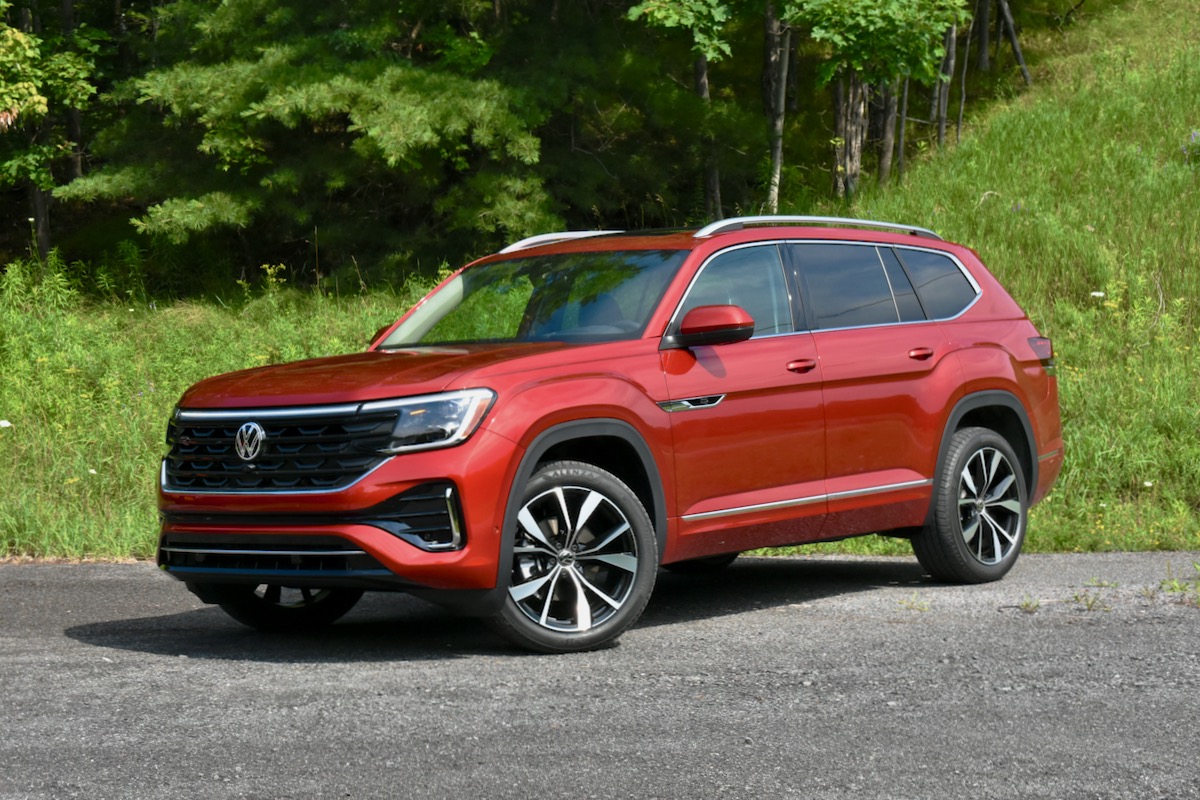
In contrast, the 2026 Volkswagen Atlas exuded an expensive look, especially in the Execline trim, which bordered on luxury crossover territory. The Atlas maintained a sculpted silhouette since its 2018 debut, with full-LED lighting, power-adjustable heated side mirrors, and a trailer hitch as standard features. The Peak Edition added rugged elements like all-terrain tires and blackout trim pieces. The Execline trim featured 21-inch two-tone alloy wheels and R-Line exterior design elements. Despite its premium appearance, the Atlas was competitively priced, starting at $54,492 for the base Comfortline trim, making it more affordable than some competitors. The interior, with quilted diamond-pattern leather seats and metallic accents, created a warm and inviting environment, although the infotainment system's functionality left room for improvement.
The 2026 Hyundai Ioniq 9 was equipped with a 110.3-kWh battery pack on Hyundai's e-GMP platform, offering a range of power outputs depending on the trim. The base Essential trim featured a single rear-mounted 160-kW electric motor, producing 215 horsepower, while the Preferred AWD and Preferred AWD+ trims delivered 303 hp and 422 hp, respectively. The Ioniq 9 impressed with its energy efficiency, often exceeding the estimated 500-kilometre range. Its smooth and quiet ride was complemented by active noise cancellation and sound-absorbing tires. The Ioniq 9's towing capacity ranged from 1,587 kilograms for the RWD model to 2,268 kilograms for AWD models. Charging options included Tesla-style NACS superchargers and CCS-port Level 3 chargers, with fast charging times of 24 to 40 minutes.
The 2026 Volkswagen Atlas retained its turbocharged 2.0-litre inline four-cylinder engine, producing 269 horsepower and 273 pound-feet of torque. Paired with an eight-speed automatic transmission and standard AWD in Canada, the Atlas prioritized flexibility over excitement. Its wide torque band, peaking at 1,600 rpm, provided a capable driving experience, although initial acceleration felt adequate rather than eager. The Atlas achieved a 0-100 km/h time of approximately eight seconds. The Drive Mode Select system offered various driving modes, including Sport, which enhanced throttle response. Fuel efficiency was recorded at 10.7 litres per 100 kilometres during testing. The 4Motion AWD system performed well in rain and light snow, with a towing capacity of 2,268 kilograms. However, the ride quality suffered due to the Execline model's 21-inch wheels, transmitting vibrations on imperfect roads.
The 2026 Hyundai Ioniq 9 prioritized family-SUV practicality with its spacious interior. Most configurations seated seven, while the Preferred AWD+ with the Ultimate Calligraphy Package offered seating for six with ventilated captain's chairs. The sliding centre console improved access for middle-row passengers. The Ioniq 9 provided 1,086 millimetres of legroom in the middle row, although the third row's 813 mm felt tight for adults. The rear doors swung wide, facilitating easy access. Dual-zone climate control, air vents in all rows, and a standard heat pump enhanced comfort. Cargo space measured 620 litres behind the third row, expanding to 2,462 litres with seats folded.
The 2026 Volkswagen Atlas excelled in accommodating passengers and cargo. The Execline's front seats offered heating, ventilation, and massage functions, while all models featured heated and ventilated front seats. The driver's seat had 10-way power adjustment, and the passenger's seat varied by trim. The second row's captain's chairs folded flat and tipped forward for easy third-row access. The third-row bench provided decent leg support, and sliding the second row forward improved legroom. Cargo capacity was a strong point, with 583 litres behind the third row, expanding to 2,735 litres with seats folded. The Atlas offered competitive space across all rows, making it ideal for hauling people and belongings comfortably.
The 2026 Hyundai Ioniq 9 featured dual curved 12.3-inch displays for its infotainment system, offering a familiar interface found in other Hyundai models. While the screens looked good, they were prone to fingerprints and glare. Standard features included SiriusXM Satellite Radio, wireless Android Auto and Apple CarPlay, and a wireless charging pad. However, the charging pad struggled to keep up with demanding devices. Six USB-C ports provided ample charging options. The test car's 14-speaker Bose audio system delivered impressive sound quality, rivaling higher-end systems.
The 2026 Volkswagen Atlas came with a 12-inch touchscreen running VW's MIB3 operating system, along with a 10.25-inch Digital Cockpit Pro instrument cluster. Wireless Apple CarPlay and Android Auto, wireless charging, and six USB-C ports were standard. The Highline trim added a Harman Kardon 12-speaker audio system and a surround-view camera system, while the Execline included a head-up display. Despite its impressive features, the MIB3 system was frustrating to use, with complex menus and touch-sensitive controls that were invisible at night. The Harman Kardon audio system sounded excellent, but the overall tech experience prioritized form over function.
The 2026 Hyundai Ioniq 9 had not yet received crash-test ratings from NHTSA or IIHS. However, it came equipped with an impressive array of advanced driver assistance systems (ADAS) as standard. These included collision avoidance, lane-guidance technologies, driver attention warning, safe-exit assist, and Hyundai's Highway Driving Assist 2, which provided supervised hands-free driving. The Preferred AWD's Luxury package and all Preferred AWD+ versions added a surround-view monitor and blind-spot view monitor.
The 2026 Volkswagen Atlas earned a five-star overall safety rating from NHTSA, with five stars in side-crash testing and four stars in frontal and rollover tests. The 2025 Atlas was named a Top Safety Pick+ by IIHS, though 2026 ratings were unavailable. Volkswagen's IQ.Drive suite of driver assistance features was standard across all trims, including forward-collision warning, automatic emergency braking, blind-spot monitors, lane-keep assist, rear cross-traffic alert, adaptive cruise control, and Travel Assist. The Execline added Park Assist, although it wasn't deemed necessary due to the Atlas's maneuverability.
CarGurus highlights
According to CarGurus experts, the overall rating for the 2026 Hyundai Ioniq 9 is 7.3 out of 10, while the 2026 Volkswagen Atlas scores 6.8 out of 10. Based on these ratings, the Hyundai Ioniq 9 emerges as the better choice, offering a more refined and efficient driving experience with its electric powertrain and spacious interior.
Choose the 2026 Hyundai IONIQ 9 if:
- You prioritize a spacious and quiet interior with advanced noise cancellation features.
- You value energy efficiency and impressive range in an electric vehicle.
- You seek a family-friendly SUV with practical interior dimensions and easy access.


Choose the 2026 Volkswagen Atlas if:
- You desire a vehicle with a premium appearance and competitive pricing.
- You need ample cargo capacity and genuinely usable third-row seating.
- You appreciate a comprehensive suite of standard safety features.


CarGurus highlights
According to CarGurus experts, the overall rating for the 2026 Hyundai Ioniq 9 is 7.3 out of 10, while the 2026 Volkswagen Atlas scores 6.8 out of 10. Based on these ratings, the Hyundai Ioniq 9 emerges as the better choice, offering a more refined and efficient driving experience with its electric powertrain and spacious interior.
Choose the 2026 Hyundai IONIQ 9 if:
Shop Now- You prioritize a spacious and quiet interior with advanced noise cancellation features.
- You value energy efficiency and impressive range in an electric vehicle.
- You seek a family-friendly SUV with practical interior dimensions and easy access.
Choose the 2026 Volkswagen Atlas if:
Shop Now- You desire a vehicle with a premium appearance and competitive pricing.
- You need ample cargo capacity and genuinely usable third-row seating.
- You appreciate a comprehensive suite of standard safety features.

By: CarGurus + AI
At CarGurus, our team of experienced automotive writers remain at the heart of our content operation, conducting hands-on car tests and writing insightful guides that are backed by years of industry experience. To complement this, we are harnessing AI to make our content offering more diverse and more helpful to shoppers than ever. To achieve this, our AI systems are based exclusively on CarGurus content, ratings and data, so that what we produce is both unique to CarGurus, and uniquely helpful to car shoppers.
