2021 Volvo XC40 vs 2021 Volkswagen ID.4

Overview | |
MSRP$33,700 | MSRP$39,995 |
Listings22 | Listings12 |
Ratings & Reviews | |
User Reviews | User Reviews |
Expert reviews8.0 out of 10 | Expert reviews7.3 out of 10 |
2021 Volvo XC40 Reviews SummaryIntroduced for the 2019 model year, the Volvo XC40 enters 2021 with one major change—the addition of an all-electric powertrain option. The 2021 Volvo XC40 Recharge is the Scandinavian automaker’s first mass-market pure electric vehicle, in fact. The Recharge will be sold alongside gasoline versions of the XC40, which carry over largely unchanged, and compete against small luxury crossovers like the Audi Q3, BMW X1, Mercedes-Benz GLA-Class, and Lexus UX. With its electric powertrain, the Recharge is a de facto Tesla Model Y competitor. It’s also priced similar to high-end versions of the Ford Mustang Mach-E, although the two electric crossovers have somewhat different philosophies. In addition to that zero-emission powertrain, the Recharge gets an Android-based operating system, over-the-air (OTA) software update capability for all vehicle systems, and some updates to driver-assist tech. These changes don’t apply to gasoline 2021 XC40 models, but Volvo does plan to add the Android operating system to more vehicles in the future. Since the Recharge is the main new thing for the 2021 XC40, that’s what we focused on for this review. While the gasoline XC40 is available in three trim levels—Momentum, R-Design, and Inscription—with standard all-wheel drive (AWD) in Canada, the Recharge is only offered in a single trim level. | |
2021 Volkswagen ID.4 Reviews SummaryThe “Dieselgate” emissions scandal forced Volkswagen to double down on electric cars, and now we’re finally seeing the first result of that: the 2021 Volkswagen ID.4 electric crossover. VW has made an electric car before, but its last attempt, the e-Golf, was built to satisfy emissions standards, not rack up sales. It was barely advertised, and it was sold only in certain locations. With the ID.4, it will launch in the three largest Canadian EV markets—British Columbia, Quebec, and Ontario—and will even be built in North America, in Chattanooga, Tennessee, starting in 2022. Volkswagen views the ID.4 as a rival not to other EVs, but to mainstream gasoline vehicles like the Honda CR-V and Toyota RAV4. Being late to the party means there are already several other EVs trying to coax new-car buyers away from internal combustion, however. If you want a reasonably priced EV, the Nissan Leaf, Hyundai Kona Electric, and Kia Niro EV already exist, and General Motors has the 2022 Chevrolet Bolt EUV—a new variant of the Chevy Bolt EV with a crossover body style similar to the Volkswagen. Our test car was an ID.4 1st Edition, a U.S.-only model released to commemorates the car’s launch. Its closest Canadian equivalent is the ID.4 RWD Pro with the Statement Package. | |
No video found | |
Popular Features & Specs | |
Engine2.0L 187 hp I4 | Engine201 hp Electric |
Drive TrainFWD | Drive TrainRWD |
Seating Capacity5 | Seating Capacity5 |
Horsepower187 hp @ 4700 rpm | Horsepower |
EV Battery Capacity | EV Battery Capacity82 kWh |
MPG City23 | MPG City104 |
MPG Highway32 | MPG Highway89 |
Battery Charge Time (240V) | Battery Charge Time (240V)8 hours |
Engine | |
Engine Name2.0L 187 hp I4 | Engine Name201 hp Electric |
Torque221 lb-ft @ 1400 rpm | Torque |
Horsepower187 hp @ 4700 rpm | Horsepower |
Battery Charge Time (240V) | Battery Charge Time (240V)8 hours |
DrivetrainFWD | DrivetrainRWD |
Fuel Economy | |
EV Battery Capacity | EV Battery Capacity82 kWh |
MPG City23 | MPG City104 |
MPG Highway32 | MPG Highway89 |
Interior | |
Leather SeatsStandard | Leather Seats |
Seating Capacity5 | Seating Capacity5 |
Safety | |
Front Crash Overall5 | Front Crash Overall5 |
Side Crash Overall5 | Side Crash Overall5 |
Dimensions & Capacity | |
Cargo Space20.7 cu ft | Cargo Space30.3 cu ft |
Curb Weight3627 lbs | Curb Weight4517 lbs |
Height65.3 in | Height64.4 in |
Length174.2 in | Length180.5 in |
Width80.1 in | Width72.9 in |
Wheelbase106.4 in | Wheelbase108.9 in |
Maximum Payload1133 lbs | Maximum Payload1347 lbs |
Number of doors4 | Number of doors4 |
Maximum Towing Capacity3500 lbs | Maximum Towing Capacity |
Overview | ||
MSRP | $33,700 | $39,995 |
Listings | ||
Ratings & Reviews | ||
User reviews | ||
Expert reviews | 8.0 out of 10Read full review | 7.3 out of 10Read full review |
Pros & cons | ||
Summary | Introduced for the 2019 model year, the Volvo XC40 enters 2021 with one major change—the addition of an all-electric powertrain option. The 2021 Volvo XC40 Recharge is the Scandinavian automaker’s first mass-market pure electric vehicle, in fact. The Recharge will be sold alongside gasoline versions of the XC40, which carry over largely unchanged, and compete against small luxury crossovers like the Audi Q3, BMW X1, Mercedes-Benz GLA-Class, and Lexus UX. With its electric powertrain, the Recharge is a de facto Tesla Model Y competitor. It’s also priced similar to high-end versions of the Ford Mustang Mach-E, although the two electric crossovers have somewhat different philosophies. In addition to that zero-emission powertrain, the Recharge gets an Android-based operating system, over-the-air (OTA) software update capability for all vehicle systems, and some updates to driver-assist tech. These changes don’t apply to gasoline 2021 XC40 models, but Volvo does plan to add the Android operating system to more vehicles in the future. Since the Recharge is the main new thing for the 2021 XC40, that’s what we focused on for this review. While the gasoline XC40 is available in three trim levels—Momentum, R-Design, and Inscription—with standard all-wheel drive (AWD) in Canada, the Recharge is only offered in a single trim level. | The “Dieselgate” emissions scandal forced Volkswagen to double down on electric cars, and now we’re finally seeing the first result of that: the 2021 Volkswagen ID.4 electric crossover. VW has made an electric car before, but its last attempt, the e-Golf, was built to satisfy emissions standards, not rack up sales. It was barely advertised, and it was sold only in certain locations. With the ID.4, it will launch in the three largest Canadian EV markets—British Columbia, Quebec, and Ontario—and will even be built in North America, in Chattanooga, Tennessee, starting in 2022. Volkswagen views the ID.4 as a rival not to other EVs, but to mainstream gasoline vehicles like the Honda CR-V and Toyota RAV4. Being late to the party means there are already several other EVs trying to coax new-car buyers away from internal combustion, however. If you want a reasonably priced EV, the Nissan Leaf, Hyundai Kona Electric, and Kia Niro EV already exist, and General Motors has the 2022 Chevrolet Bolt EUV—a new variant of the Chevy Bolt EV with a crossover body style similar to the Volkswagen. Our test car was an ID.4 1st Edition, a U.S.-only model released to commemorates the car’s launch. Its closest Canadian equivalent is the ID.4 RWD Pro with the Statement Package. |
Video | No video found | |
Popular Features & Specs | ||
Engine | 2.0L 187 hp I4 | 201 hp Electric |
Drive Train | FWD | RWD |
Seating Capacity | 5 | 5 |
Horsepower | 187 hp @ 4700 rpm | |
EV Battery Capacity | 82 kWh | |
MPG City | 23 | 104 |
MPG Highway | 32 | 89 |
Battery Charge Time (240V) | 8 hours | |
Engine | ||
Engine Name | 2.0L 187 hp I4 | 201 hp Electric |
Torque | 221 lb-ft @ 1400 rpm | |
Horsepower | 187 hp @ 4700 rpm | |
Battery Charge Time (240V) | 8 hours | |
Drivetrain | FWD | RWD |
Fuel Economy | ||
EV Battery Capacity | 82 kWh | |
MPG City | 23 | 104 |
MPG Highway | 32 | 89 |
Interior | ||
Leather Seats | Standard | |
Seating Capacity | 5 | 5 |
Safety | ||
Front Crash Overall | 5 | 5 |
Side Crash Overall | 5 | 5 |
Dimensions & Capacity | ||
Cargo Space | 20.7 cu ft | 30.3 cu ft |
Curb Weight | 3627 lbs | 4517 lbs |
Height | 65.3 in | 64.4 in |
Length | 174.2 in | 180.5 in |
Width | 80.1 in | 72.9 in |
Wheelbase | 106.4 in | 108.9 in |
Maximum Payload | 1133 lbs | 1347 lbs |
Number of doors | 4 | 4 |
Maximum Towing Capacity | 3500 lbs | |
The 2021 Volvo XC40 presented a more traditional SUV aesthetic, characterized by its tall, flat roof and upright rear hatch, aligning it with the rest of Volvo's lineup through signature design elements like the "Thor’s Hammer" LED headlights and a simple oval grille. The gasoline models offered a retro touch with an optional white contrasting roof. The electric XC40 Recharge differentiated itself with a blanked-off grille, subtle "Recharge" badging, and unique alloy wheels, alongside a gloss black roof and mirror caps. It also featured a model-exclusive Sage Green Metallic colour and a charging port in place of the fuel filler. The interior was minimalist yet premium, with real metal trim and a combination of Nappa leather and Nubuck textile upholstery, creating a cohesive and upscale cabin environment.
In contrast, the 2021 Volkswagen ID.4 was designed as an electric vehicle from the ground up, showcasing a distinctive look that diverged from the gasoline models like the Tiguan and Atlas. It featured a streamlined profile with wheels pushed to the corners, emphasizing its EV identity. Built on VW’s MEB platform, the ID.4 shared its lineage with the European-market ID.3 hatchback. While it boasted more front and rear headroom than some EV competitors, its SUV-like styling was less pronounced compared to traditional crossovers. The interior combined Volkswagen’s minimalism with a tech-forward aesthetic, featuring piano black and matte plastic elements. The cabin felt spacious, with good forward visibility, although rearward visibility was hindered by thick rear pillars.


The 2021 Volvo XC40 offered a versatile powertrain lineup, with the electric Recharge model at the top. The gasoline variants included a 2.0-litre turbocharged four-cylinder engine paired with an eight-speed automatic transmission. The base T4 model delivered 187 horsepower and 221 pound-feet of torque, while the T5 variant increased output to 248 hp and 258 lb-ft. The Recharge model, sharing its powertrain with the Polestar 2, featured dual electric motors providing all-wheel drive and a combined 402 hp and 486 lb-ft of torque, powered by a 78-kilowatt-hour battery pack. The Recharge accelerated from zero to 100 km/h in 4.9 seconds, while the T5 and T4 took 6.4 and 8.5 seconds, respectively. All models were electronically limited to 180 km/h. The XC40 Recharge emphasized comfort and quietness, with excellent ride quality and the capability for one-pedal driving.
The 2021 Volkswagen ID.4 was available in two powertrain configurations. The base rear-wheel drive version featured a single rear-mounted electric motor producing 201 horsepower and 229 pound-feet of torque, powered by an 82-kilowatt-hour battery pack. An all-wheel-drive version added a second motor for a total output of 295 hp and 339 lb-ft of torque. The ID.4 prioritized comfort over sportiness, with a smooth ride and balanced handling, thanks to its RWD setup. Unlike many EVs, the ID.4 did not offer aggressive regenerative braking for one-pedal driving, instead relying on friction brakes to provide a familiar experience for drivers transitioning from gasoline vehicles.
Volvo claimed no difference in passenger or cargo space between the Recharge and gasoline XC40 models, although the XC40 Recharge was not particularly spacious. It offered less legroom and headroom compared to competitors like the Tesla Model Y and Ford Mustang Mach-E, and its cargo area was smaller. The frunk was also limited in size due to powertrain components. However, Volvo compensated with clever storage solutions, such as a removable trash bin in the centre console and large door bins made possible by relocating the audio system's speakers to the dashboard.
The Volkswagen ID.4 felt more like a crossover compared to other EVs, offering more front and rear headroom than some competitors, although legroom was average. It provided 858 litres of cargo space with the rear seats up and 1,818 litres with them folded, surpassing several EV rivals but falling short of gasoline models like the Honda CR-V and Toyota RAV4. The ID.4 lacked a frunk, opting instead for more cabin space. The interior felt spacious, with good forward visibility, though rearward visibility was compromised by thick rear pillars. The ID.4 featured a unique twist-grip gear selector and a narrow centre console with limited storage space.
The 2021 Volvo XC40 Recharge featured the Android Automotive OS infotainment system, integrating Google apps like Google Assistant and Google Maps. It included a 9-inch touchscreen and a 12.3-inch digital instrument cluster, with top-notch graphics and menu layouts. The system supported Apple CarPlay, Android Auto, SiriusXM, and Bluetooth, with built-in Google features. The Recharge also offered OTA update capability, although Volvo was vague about future plans for this feature. The model lacked a start button, allowing drivers to simply shift out of park with the key fob present.
The Volkswagen ID.4 came with a standard 10-inch touchscreen, with a 12-inch screen optional, and wireless Apple CarPlay and Android Auto. A 5.3-inch display served as the instrument cluster, with haptic touchpads replacing most switchgear. While visually appealing, the touchpads were challenging to use without tactile feedback. The ID.4 included a natural-language voice-control system, responding to prompts like "Hello ID," and the ID.Light feature, a light strip at the base of the windshield providing visual cues. The touchscreen was well-positioned, with smart graphics and easy-to-navigate menus.
The gasoline 2021 Volvo XC40 received the highest "Top Safety Pick+" rating from the IIHS and a five-star overall crash-test rating from the NHTSA. The electric XC40 Recharge was not rated, but Volvo expected it to perform well due to its safety cage and redesigned front crash structure. Standard safety features included lane-keep assist, blind-spot monitoring, automatic emergency braking, and more. The Recharge model featured Volvo’s latest sensor suite, scalable for future driver aids.
The Volkswagen ID.4 was rated as a Top Safety Pick+ by the IIHS, with a five-star safety rating from the NHTSA for RWD versions. It offered a range of driver aids, including forward-collision warning, automatic emergency braking, and adaptive cruise control. New features for 2021 included Travel Assist, providing automated lane centring, and Emergency Assist, designed to stop the car if the driver is incapacitated. Travel Assist performed well, smoothly following curves and responding to acceleration and deceleration.
CarGurus highlights
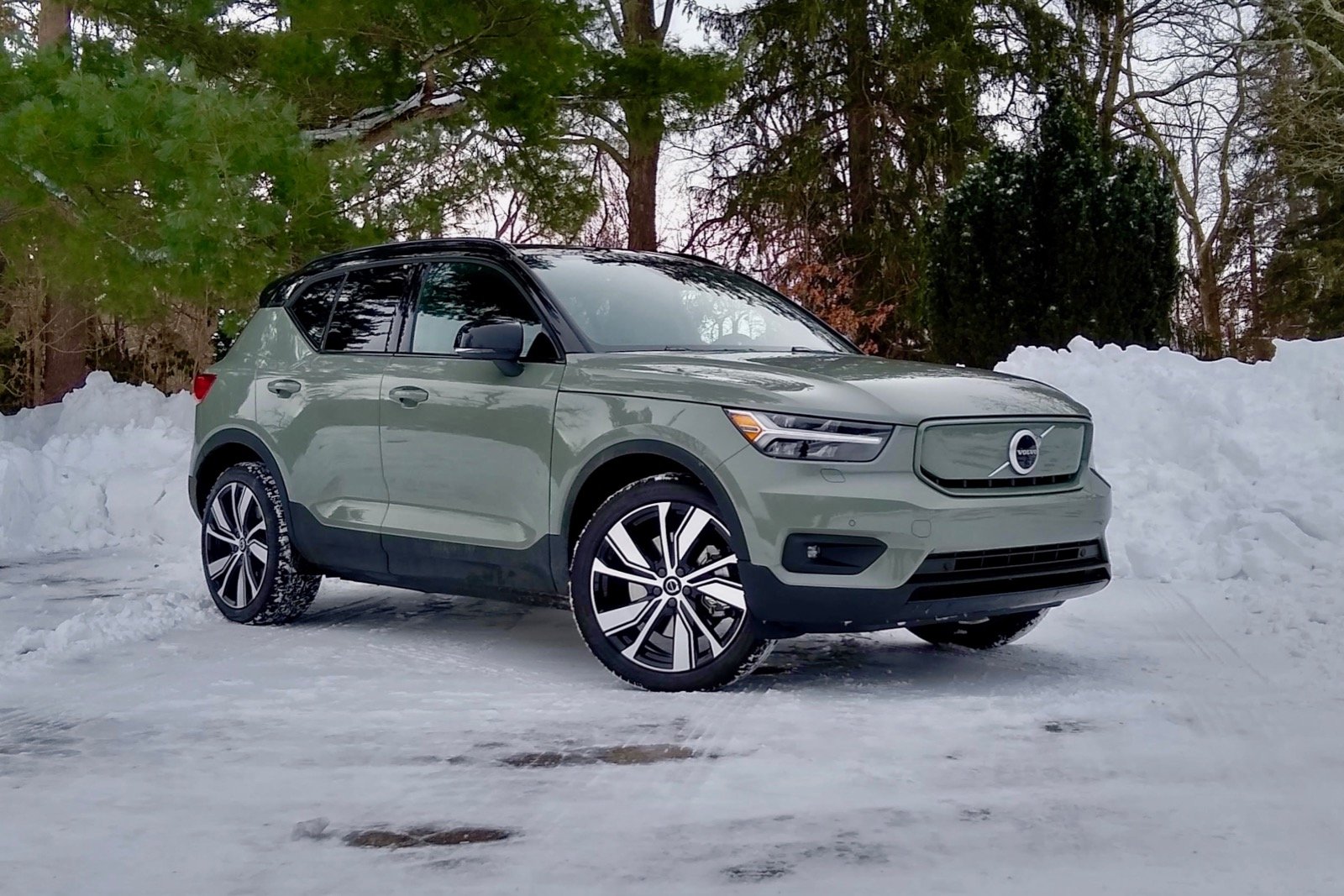
According to CarGurus experts, the overall rating for the 2021 Volvo XC40 is 8.0 out of 10, while the 2021 Volkswagen ID.4 scores 7.3 out of 10. Based on these ratings, the Volvo XC40 is the recommended choice, offering a more refined luxury experience and higher safety ratings.
Choose the 2021 Volvo XC40 if:
- You prioritize a traditional luxury SUV aesthetic with premium interior materials.
- You value advanced safety features and high safety ratings.
- You prefer a vehicle with a strong emphasis on comfort and quietness.


Choose the 2021 Volkswagen ID.4 if:
- You want a vehicle designed from the ground up as an electric vehicle.
- You appreciate a spacious interior with good forward visibility.
- You seek a vehicle with a modern infotainment system and innovative features like ID.Light.


CarGurus highlights
According to CarGurus experts, the overall rating for the 2021 Volvo XC40 is 8.0 out of 10, while the 2021 Volkswagen ID.4 scores 7.3 out of 10. Based on these ratings, the Volvo XC40 is the recommended choice, offering a more refined luxury experience and higher safety ratings.
Choose the 2021 Volvo XC40 if:
Shop Now- You prioritize a traditional luxury SUV aesthetic with premium interior materials.
- You value advanced safety features and high safety ratings.
- You prefer a vehicle with a strong emphasis on comfort and quietness.
Choose the 2021 Volkswagen ID.4 if:
Shop Now- You want a vehicle designed from the ground up as an electric vehicle.
- You appreciate a spacious interior with good forward visibility.
- You seek a vehicle with a modern infotainment system and innovative features like ID.Light.

By: CarGurus + AI
At CarGurus, our team of experienced automotive writers remain at the heart of our content operation, conducting hands-on car tests and writing insightful guides that are backed by years of industry experience. To complement this, we are harnessing AI to make our content offering more diverse and more helpful to shoppers than ever. To achieve this, our AI systems are based exclusively on CarGurus content, ratings and data, so that what we produce is both unique to CarGurus, and uniquely helpful to car shoppers.

