2026 Chevrolet Trax Reviews, Pricing & Specs


Pros & cons
What we like
Stylish design
Great handling
Impressive technology
What to consider
All-wheel drive not available
Poor ergonomic design
Advanced safety features are not standard
The CarGurus verdict
After decades of failures, Chevy proves that it can make a good small car after all.
The Trax is the cheapest new car Chevrolet sells in Canada. It takes the place of compact sedans and hatchbacks in the Bowtie brand’s lineup while competing with entry-level crossover SUVs such as the Hyundai Venue and the Nissan Kicks Play. The current Trax was introduced for the 2024 model year, and for 2026 the only changes are two new exterior colour options. White Sands is available with Activ and RS models, while Apex Red is available with RS and LT models.
Verdict: Blending elements of compact cars and crossover SUVs, the Trax hits a sweet spot of utility and affordability. It’s also pleasant to drive and offers impressive infotainment tech, but a lack of solid safety ratings and all-wheel drive are the trade-offs.
out of 10 expert review
Look & feel
The Trax nameplate first appeared for the 2015 model year on a cheap but boring crossover. After that model went on sale, Chevy dropped most cars from its North American lineup, leaving customers with fewer affordable options. As a result, the second-generation Trax adopted more car-like proportions (shared with the Buick Envista) to appeal to customers who could no longer find a Cruze or a Sonic in dealerships. However, it had enough SUV styling elements to please the marketing department.
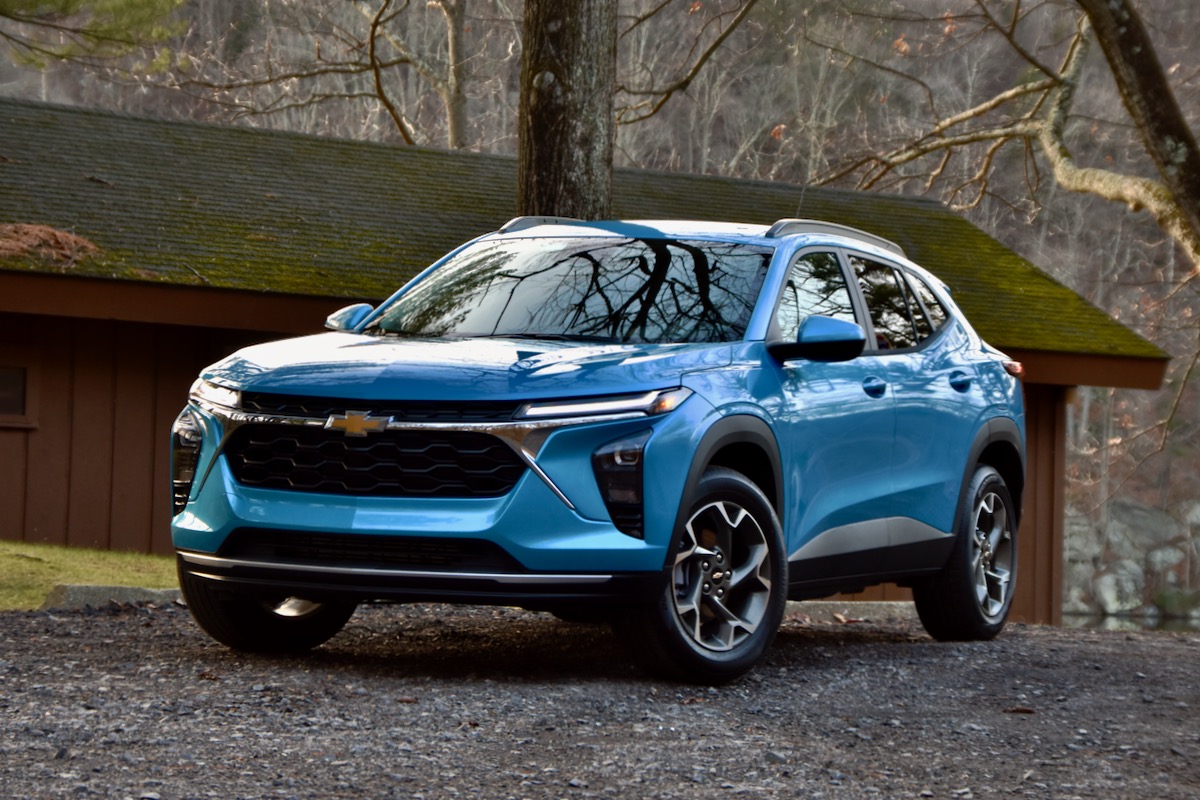
The result packs a lot of personality into a small vehicle. The Blazer-like headlights balance the wide grille and the tall front end. Chunky wheel arches and a pronounced rib in the doors give the sides some definition, while a laid-back windshield and an upward arc of the rear side windows give the Trax a sleeker appearance than other small crossovers. But that wide stance, combined with the imposing grille, give the littlest Chevy some SUV toughness.
In Canada, the Chevy Trax lineup drops the base LS trim for the 2026 model year, leaving the 1RS, LT, 2RS, and Activ trim levels. Wheel sizes range from 17-inch to 19-inch alloys. Activ models have black-painted 18-inch wheels, a black grille with chrome accents, and different front and rear bumpers meant to look like they have skid plates. Besides the model-specific wheels, RS models have black Chevy Bowtie badges and small “RS” callouts front and rear.
Inside, the rubbery feel of most surfaces marks the Trax as an entry-level model, but the design details are a cut above. Large, round air vents and contrasting trim help distract from the economical materials, while the layout of the instrument cluster and touchscreen looks almost Corvette-like. Most of the interior is basic black, but our LT test car’s grey door panels and dashboard trim, along with blue accents to match its Marina Blue Metallic paint, helped break that up. Cloth upholstery is standard with the 1RS, while other trim levels have suede-like Evotex or a combination of the two.

Performance
The Trax continues with a 1.2-litre turbocharged three-cylinder engine, a six-speed automatic transmission, and front-wheel drive (FWD). No other engines are available nor, despite the Trax’s crossover billing, is all-wheel drive (AWD). That would make it too expensive, and Chevy has the Trailblazer to cater to new car buyers wanting a small crossover with the added traction of AWD. Hyundai does the same with the Venue and the Kona, as does Nissan with the Kicks Play and the Kicks.
The engine produces 137 horsepower and 162 pound-feet of torque. Despite having one less cylinder than the norm, that’s 16 hp and 49 lb-ft of torque more than the naturally aspirated 1.6-litre four-cylinder engine in the Hyundai Venue. That’s the power of forced induction, and it provides plenty of confidence when you put your foot down. The Trax eagerly accelerates away from stops and doesn’t run out of breath at higher speeds. Impressively for a small-displacement turbocharged engine, it doesn’t feel overstressed and does a good job of staying on boost with no discernible turbo lag.
Chevy’s decision to fit the Trax with a conventional geared automatic transmission instead of a continuously variable transmission (CVT) also helps with drivability. The shifts may not be lightning quick, but there's still less delay between the engine revving up and the actual application of power to the wheels than you generally find with a CVT.
Performance wasn’t Chevy's goal, but the Trax feels remarkably poised on twisty roads. It’s much more stable and car-like than the average crossover, although there’s still significant body roll and limited grip. Like most new cars, the electric power steering isn’t as communicative as old hydraulic systems, but it’s responsive enough to take advantage of the Trax’s small size. After our test drive, we couldn’t help imagining the possibilities of a Trax SS performance model.
The suspension is competent enough to blunt the worst bumps, giving the Trax an adequately comfortable ride. Standard active noise cancellation helps close the refinement gap with the Trax’s fancier stablemate, the Buick Envista. Some tire noise is still evident, though, along with a persistent drone from the engine.

Form & function
Interior space is competitive with other pint-sized crossovers, including some pricier options. Headroom is within a few millimetres of what you get in a Hyundai Kona or a Subaru Crosstrek. The Subaru offers an extra 2.5 centimetres of front legroom, but the Chevy gives rear-seat passengers an additional 5.5 cm of legroom. The second-row legroom advantage is about 10 cm compared to the lower-priced Hyundai Venue and Nissan Kicks Play, although the Trax is similar in size to these models in other respects.
With 725 litres of cargo space behind its rear seats, the Trax is in line with a Honda Civic hatchback. That spec highlights that, at this size, the real-world difference in utility between a crossover and a car can blur. Whether it’s space behind the second row or the 1,532 litres available with the back seats folded, the Trax compares well with other crossovers of its size. The Hyundai Kona offers more cargo space with the rear seats folded, while the Nissan Kicks Play is behind on both figures.
A tall seating position makes ingress and egress easy and should also give shorter drivers a decent view of the road. You don’t tower over other drivers as in some of Chevy’s bigger SUVs, but you also don’t feel like you’re at eye level with other cars’ licence plates. Forward visibility is impressive for a modern crossover, and while the view out the rear window isn’t quite as clear, large exterior mirrors compensate for that.
The front seats are also far inboard, which doesn’t leave much room for covered centre console storage, but it does allow for large door pockets for storing water bottles. Two large cup holders next to the shifter are adequate for the average take-out beverage or coffee. Drink storage options are great, but the wireless device charger on our LT test car couldn’t hold phones in place.
With the LS trim dropped for 2026, heated front seats, a heated steering wheel, and heated side mirrors are now standard in Canada on the Chevrolet Trax beginning with the base 1RS model.

Technology
An 8-inch touchscreen, wireless Apple CarPlay/Android Auto connectivity, and a four-speaker audio system are standard on the Trax 1RS base model. All higher trim levels get an 11-inch touchscreen, an all-digital 8-inch instrument cluster, and a six-speaker sound system. Two USB ports (one USB-A and one USB-C) for connectivity are standard. A charge-only USB-A and USB-C port for rear-seat passengers are also standard on all but the 1RS trim level.
As an LT model, our test car had the easily readable digital cluster, which features a large centred speed readout with other information such as fuel level and temperature in concentric circles around it. The big touchscreen has a sensible layout, too, with a stack of icons to the left of large display tiles. Chevy also answered automotive journalists’ prayers with an analog volume knob, but it’s a bit hard to reach. That’s the only real ergonomic issue for the driver.
For the front passenger, it’s another story. In keeping with current General Motors practice, the touchscreen is angled toward the driver. That makes it harder for the front passenger to use the screen. Because the climate controls and volume knob are mounted on the same section of dashboard, they’re also hard to reach. The volume knob might be awkward for the driver to use, but it’s even more difficult for the passenger.

Safety
Standard driver-assist features include: automatic emergency braking, front pedestrian braking, lane keep assist, lane departure warning, forward collision warning, automatic high beams, blind spot monitoring, rear cross-traffic alert, rear park assist, and a following distance indicator. Adaptive cruise control is available on higher trim levels.
Chevy continues to offer its Teen Driver monitoring system, which activates all available safety features, includes a shift interlock for the driver’s seatbelt, and lets parents monitor their teens’ driving behaviour. With this tech to satisfy nervous parents and the Trax’s relatively low starting price, it might seem like a good first car. But an important piece of the equation is missing.
Full safety ratings hadn’t been published at the time of writing, but what we have so far isn’t encouraging. The U.S. National Highway Safety Administration (NHTSA) hadn’t released any safety ratings for the current-generation Trax, but the Insurance Institute for Highway Safety (IIHS) gave the Chevy the lowest “Poor” rating in its updated moderate overlap front crash test. The Trax did get the top “Good” rating in the small overlap front test, but those were the only crash test ratings available as we prepared this review. The IIHS also gave the Trax low marks for its headlights and front-crash prevention tech.

Cost-effectiveness
A downsized engine is usually good for fuel economy, but that isn’t exactly the case here. The Trax is rated by Natural Resources Canada at 8.1 litres per 100 kilometres combined (8.5 city, 7.6 highway). The FWD Nissan Kicks Play and Hyundai Venue achieve 7.2 and 7.5 L/100 km combined respectively.
The Trax comes with a three-year, 60,000-kilometre bumper-to-bumper limited warranty and a five-year, 100,000-kilometre powertrain limited warranty that’s comparable with most rivals.
1RS base models start at $30,043 (all prices include a $2,300 destination charge and other fees), which is thousands less than most other crossovers of similar size. You can get a Nissan Kicks Play for almost $5,000 less, though. The Hyundai Venue is also roughly $5,000 less, but it’s also an older design with less impressive tech than the Trax.
The LT trim starts at $31,043, while the Trax Activ and 2RS both start at $33,243. These trim levels mainly add bigger screens and smarter interior trim. Regardless of trim level, the Trax’s style and well-tuned chassis shine, but its lack of solid crash-test ratings is a reminder that this is the economy model of Chevy’s current lineup.

What owners say
Trims & specs
Base MSRP $25,700 | Seating 5 |
Engine N/A | Cargo Capacity 25.6 cu ft |
Combined MPG N/A | Drivetrain N/A |
Base MSRP $21,700 | Seating 5 |
Engine N/A | Cargo Capacity 25.6 cu ft |
Combined MPG N/A | Drivetrain N/A |
Base MSRP $23,200 | Seating 5 |
Engine N/A | Cargo Capacity 25.6 cu ft |
Combined MPG N/A | Drivetrain N/A |
Base MSRP $25,700 | Seating 5 |
Engine N/A | Cargo Capacity 25.6 cu ft |
Combined MPG N/A | Drivetrain N/A |
Base MSRP $23,200 | Seating 5 |
Engine N/A | Cargo Capacity 25.6 cu ft |
Combined MPG N/A | Drivetrain N/A |


Pricing trends
MSRP range
$21,700 - $25,700
Current avg. market price
$29,796
Trending down by 2.0% this month
May 2026 - November 2026