2024 Chevrolet Trax Reviews, Pricing & Specs



Pros & cons
What we like
Stylish design
Great handling
Impressive technology
What to consider
AWD not available
Advanced safety features are not standard
Poor ergonomic design
Expert review
After a one-year hiatus, the 2024 Chevrolet Trax brings a new level of style and tech to the brand's entry-level crossover SUV.
The Trax was launched for the 2015 model year as a no-frills subcompact crossover, designed to serve as basic transportation at an affordable cost. However, the Trax moldered in showrooms without any significant updates until the 2022 model year—when it was discontinued altogether.
But now the Trax is back in totally revamped, second-generation form. It's as big of a reimagining as you'll likely ever see in a car like this. The new Trax is bigger than before, more effort has been put into its styling, and Chevy has added the tech features that have become the norm since the original Trax was launched. Still the entry-level model in Chevy's lineup, the Trax sits below the Chevy Trailblazer, and takes aim at the Hyundai Venue, Kia Soul, and Nissan Kicks, but it was also designed to retain owners of discontinued small cars like the Chevy Cruze, Sonic, and Spark, bridging the gap between car and crossover.
The redesigned 2024 Trax launches in LS, 1RS, LT, the sporty 2RS, and Activ trim levels. We sampled 2RS and Activ Trax models during our first drive on roads around Asheville, North Carolina.
out of 10 expert review
Look & feel
Chevy has given the Trax such an extensive makeover that applying the same badge to the new 2024 model is almost an injustice to the designers. The name is all this new Trax has in common with its dowdy predecessor.
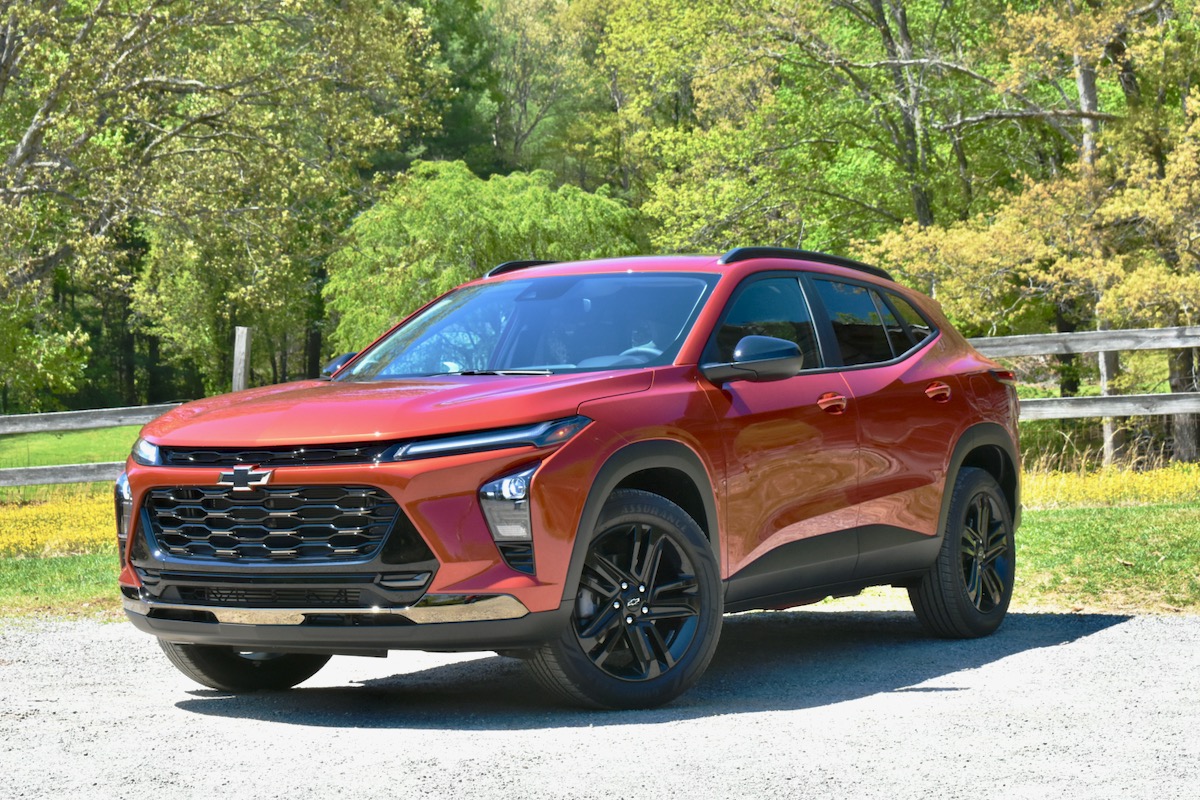
Like the stylists from GM's 1950s and 1960s glory days, the Trax design team's mantra was "longer, lower, wider." The 2024 Trax is 28 centimetres longer (with a nearly 15-centimetre wheelbase stretch), 10 cm lower, and 5 cm wider than the outgoing model. The redesigned Trax also takes on some styling elements from the midsize Chevy Blazer, including a gaping grille that crowds out the headlights and daytime running lights, and a pronounced step between the rear body sides and windows. All of this gives the Trax a surprising amount of presence for such a small vehicle, and a distinctive appearance from the box-shaped Hyundai Venue and Nissan Kicks.
Base Trax LS models roll on 17-inch steelies, but 18-inch and 19-inch aluminum wheels are available on higher trim levels. Like its Trailblazer stablemate, the Trax also gets Activ and RS trims that aim for more rugged and sportier styling, respectively. On the Trax Activ, the effect is a bit more subtle than the comparable Trailblazer model, the main styling flourish being faux skid plate trim on the front and rear bumpers. The Trax RS gets extra blacked-out trim that makes it look even more like a shrunken Blazer—one that's also been avoiding carbs.
The Trax LS comes standard with cloth upholstery and a mostly plastic interior that's typical of an entry-level model, but some interesting design features keep it from being totally boring. Instead of trying to integrate all of the hardware into the dashboard, designers went for a slim design that leaves a freestanding touchscreen and large round air vents standing proud. Most of the controls are in a small pod that hangs below the dash—continuing the design theme without sacrificing functionality.
Higher trim levels get Evotex upholstery, which seems intended as a leather substitute but looks more like something you'd find in activewear. Activ models get yellow contrast stitching that will look out of place with certain exterior colours, while RS models mainly get added piano-black plastic—even on the lower part of the steering wheel. That's not the best place to put an easily smudged material that's also likely to get hot in sunlight.

Performance
As before, Chevy offers only one engine choice. But it's now smaller than it was before.
In place of the previous 1.4-litre turbocharged four-cylinder engine, the 2024 Trax uses a 1.2-litre turbocharged three-cylinder engine. Power specs are down a bit to 137 horsepower and 162 pound-feet of torque, compared to 155 hp and 177 lb-ft for the old turbo-four.
The new engine may be less powerful, but Chevy estimates that the 2024 Trax beats its predecessor to 100 km/h by about a second. We weren't able to stage any drag races, but the new Trax didn't feel lacking in power. The three-cylinder engine's relatively flat torque curve produced strong response when pulling away from a stop, and it made highway overtakes worry-free. Impressively for a small-displacement engine that relies heavily on a turbo for power, turbo lag was minimal, so you won't be left waiting for acceleration.
The previous-generation Trax's six-speed automatic transmission carries over (and General Motors resisted putting a CVT here for additional fuel savings), but unlike its predecessor the 2024 Trax is available only with front-wheel drive (FWD). If you want all-wheel drive (AWD), Chevy will happily sell you a Trailblazer. Differentiating the two similar-sized crossovers was one reason for making the Trax FWD-only, along with cost considerations.
Much like the exterior styling and interior packaging, the Trax's handling was tuned to be more car-like than the average crossover. The wider track in particular allows for a more-planted feel meant to appeal to customers concerned about the tipsy nature of taller SUVs, according to Chevy. We can definitely vouch for that; the Trax felt more like the small hatchbacks it's replacing in Chevy's lineup than a traditional crossover. Limited grip and significant body roll remind you that this is still an econobox, not a hot hatch, but the Trax channels the predictable and nimble handling qualities of the best small cars.
Whether it's a subcompact crossover or hatchback, refinement generally isn't a priority. But the Trax exceeded expectations. Standard active noise cancellation borrowed from the Trailblazer and various Buick models largely erases annoying sounds (we heard a lot of tire noise in our 2RS test vehicle, however). Ride quality in both the 2RS and Activ models we test drove was a bit on the rough side, but it seemed a fair trade-off for the above-average handling.

Form & function
While the new Trax is larger overall, that doesn't uniformly translate to increased interior space. The 2024 model offers 7.6 cm more rear-seat legroom, with a slight increase in front-seat legroom. But first-row headroom is unchanged, and second-row headroom has actually decreased by 1.7 cm. Decreased shoulder room in both rows also indicates the seats have been moved further inboard for the snugger positioning we've noticed on other GM subcompact crossovers like the Chevy Trailblazer and Buick Encore GX.
Passenger space is nearly identical to the Trax's main rivals. The Nissan Kicks and Hyundai Venue have a smidge more first-row and second-row headroom, respectively. The Kicks also has about 5 cm more front-seat legroom, but the Trax has the most rear legroom of the three. Both the front and rear seats also felt decently comfortable for this price range. The Trax also has a more car-like driving position than other crossovers. The driver sits low, and the equally low window sills afford great outward visibility. SUV fans used to towering over normal cars need not apply, though.
Cargo space has increased by about 12%, according to Chevy, to 725 litres with the rear seats in place and 1,532 litres with the rear seats folded. That's only slightly better than the Kicks, but it's a lot more than the Venue.

Technology
Infotainment tech is another area where the Trax sees major upgrades for 2024. An 8-inch touchscreen is standard on LS and 1RS trims, while LT, 2RS, and Activ models get an 11-inch touchscreen and 8-inch digital instrument cluster. Wireless Apple CarPlay and Android Auto, along with wireless phone charging, are also available on the Trax for the first time. Wi-Fi hotspot connectivity continues.
The Trax's array of screens belies its entry-level status. You can't get a fully digital instrument cluster in the Hyundai Venue or Nissan Kicks, and neither can match the size of the Chevy's optional touchscreen.
The new infotainment system was pretty easy to use as well. Both the Trax 2RS and Activ we drove had the larger optional screen, which sported crisp graphics and a logical menu layout, including shortcut buttons arranged vertically on the left side of the screen. However, the screen itself is tilted toward the driver, which isn't ideal for front-seat passenger use. The same goes for the analog climate controls and volume knob. The latter is all the way up in the top-left corner of the screen housing—perfectly positioned for the driver, but too far away for the passenger.
The cars we drove also had the optional digital instrument cluster, which had a simple yet modern design that was easy to read at a glance. Information from the main touchscreen can also be transferred over to the instrument cluster, a good substitute for the head-up display Chevy doesn't offer on the Trax.
Two front USB ports—one USB-A and one USB-C—are standard, and an additional USB-A and USB-C port for rear-seat passengers are standard on Trax LT, 2RS, and Activ grades. Those three trim levels also get the aforementioned wireless phone charging, but only as an optional extra. The charging pad itself is also oddly shaped and angled, so it might not be a perfect fit for all phones.

Safety
Crash-test ratings from the Insurance Institute for Highway Safety (IIHS) and National Highway Traffic Safety Administration (NHTSA) weren't available at the time of publication. We do know that the Trax will be available with a decent array of driver-assist features, though.
Standard safety assist features include automatic emergency braking, front pedestrian braking, lane-keep assist, lane-departure warning, forward collision warning, automatic high beams, and a following distance indicator. Adaptive cruise control, blind-spot monitoring, rear cross-traffic alert, and rear park assist are optional.
Like most other Chevy models, the Trax also comes standard with the Teen Driver system, which automatically activates certain safety features (if equipped), mutes the radio until front-seat occupants have buckled their seat belts, and prevents the driver from shifting out of Park with an unbuckled seat belt. It also monitors teens' driving behaviour and presents a "report card" to parents. Chevy's days of symbolizing teenage freedom are long gone.

Cost-effectiveness
The 2024 Chevy Trax small SUV returns Natural Resources Canada-rated fuel economy of 7.9 litres per 100 kilometres combined (8.3 city, 7.4 highway). Those are improvements of 0.7 L/100 km combined and 1.4 L/100 km city over the previous-generation FWD Trax (highway ratings are nearly identical), so removing a cylinder from the engine may have been worthwhile.
Chevy's standard warranty coverage includes a three-year, 60,000-kilometre, bumper-to-bumper limited warranty and five-year, 100,000-kilometre, powertrain limited warranty.
New car pricing starts at $21,699 for a base Trax LS, not including a mandatory $2,000 destination charge and other fees. We didn't have access to 2024-model-year pricing at the time of publication, but for comparison the 2023 Hyundai Venue and Nissan Kicks start at $20,649 and $21,698 before destination, respectively.
The Trax is currently the cheapest model in Chevy's lineup, and remains a bargain (by today's standards) as you move up the trim-level ladder. The Trax 1RS and LT trims start at $26,060 and $28,930 with destination, respectively. The 2RS and Activ models are both priced at $31,030 with fees.
Thanks to its roomier interior, well-sorted powertrain and suspension, and pleasing design, the Trax is a solid new entry in the niche of FWD subcompact crossovers. But it also redefines it. Hyundai and Nissan have tried to make their entries as SUV-like as possible, stretching credibility to service market trends. Chevy knows it's not fooling anyone; the Trax is simply a good small car with enough SUV DNA to make the marketing department happy.
Note: Images show a US model.


What owners say
"Overall, owners of the 2024 Chevrolet Trax are impressed with its sporty design, fuel efficiency, and comfort. Many appreciate the modern technology and value for money. However, some feel that it lacks power, especially in terms of performance, and miss features such as all-wheel drive along with some interior space."
Actually getting 38 mpg in a nice sized quiet car.
October 27, 2025Very basic car . Has an suv body on a car frame
August 1, 2025Bought this for or second home to replace a 10 year old car. Is this a fast car, no. Is it powerful enough to get you where you need to go while keeping you comfortable...definitely. I see all the reviews complaining about not having AWD. If you are being honest, even living in cold climates with snow front wheel drive does the job 99% of the time. We have an LT trim. I was shocked at everything this car gives you for the money. Bang for the buck nothing is even close. We have sports cars and expensive SUVs for our main home but the Trax does not disappoint. This is a inexpensive daily driver that feels like much more. If you dont tell your friends what you paid they will guess 10k more than what you actually paid. Side note: Our 2024 Trax LT was flooded during the June storms in Florida and was totalled by the insurance company. I now have an order in for a new Trax 2RS that alone should tell you how impressed I am with this cheap car. Go test drive one & I bet you buy one!
July 26, 2024What owners say
Actually getting 38 mpg in a nice sized quiet car.
October 27, 2025Very basic car . Has an suv body on a car frame
August 1, 2025Bought this for or second home to replace a 10 year old car. Is this a fast car, no. Is it powerful enough to get you where you need to go while keeping you comfortable...definitely. I see all the reviews complaining about not having AWD. If you are being honest, even living in cold climates with snow front wheel drive does the job 99% of the time. We have an LT trim. I was shocked at everything this car gives you for the money. Bang for the buck nothing is even close. We have sports cars and expensive SUVs for our main home but the Trax does not disappoint. This is a inexpensive daily driver that feels like much more. If you dont tell your friends what you paid they will guess 10k more than what you actually paid. Side note: Our 2024 Trax LT was flooded during the June storms in Florida and was totalled by the insurance company. I now have an order in for a new Trax 2RS that alone should tell you how impressed I am with this cheap car. Go test drive one & I bet you buy one!
July 26, 2024Great basic subcompact SU, plenty of standard features and the turbo charged 1.2L is quite zippy! MUCH BETTER than previous years of the 1.2L engines.
June 19, 2023The car is amazing, it’s perfect size especially if you’re wanting something a little bigger than the average car but not a whole SUV. It drives really well, there’s no shaking or uncomfortable feeling being behind the wheel. The car is GREAT on gas as well as it’s got great features. One of the reasons I like this car so much is because it’s so spacious, I have a xl dog breed and he doesn’t get motion sickness in this car compared to my last one! I’d compare it to be a baby equinox or a more spacious hornet.
December 4, 2023Super sporty and cute, great on gas, comfortable, decent technology
June 23, 2023I purchased this vehicle because I was ready to downsize from a Toyota Sienna minivan and thought the Trax had the most features for the price compared to other vehicles on the market, not to mention it looks great. I wanted the Activ trim (power driver’s seat), but I found it very difficult to get my hands on one since they all seemed to get snatched up before they hit the lot. I am surprised at how solid and fun it is to drive. I do miss the space I had in my van to put my purse, and I wish the Trax had a rear seat console, but I was able to buy a standalone console at a minimal cost. The value of the Trax is hard to beat, and I am looking forward to the gas mileage from this sporty SUV!
February 8, 2024Drives perfect with great efficiency, looks like it’s super fast. New technology is great also
August 2, 2023Trims & specs
Base MSRP $20,400 | Seating 5 |
Engine 1.2L 137 hp I3 | Cargo Capacity 25.6 cu ft |
Combined MPG 30 | Drivetrain FWD |
Base MSRP $22,300 | Seating 5 |
Engine 1.2L 137 hp I3 | Cargo Capacity 25.6 cu ft |
Combined MPG 30 | Drivetrain FWD |
Base MSRP $23,900 | Seating 5 |
Engine 1.2L 137 hp I3 | Cargo Capacity 25.6 cu ft |
Combined MPG 30 | Drivetrain FWD |
Base MSRP $23,900 | Seating 5 |
Engine 1.2L 137 hp I3 | Cargo Capacity 25.6 cu ft |
Combined MPG 30 | Drivetrain FWD |
Base MSRP $22,100 | Seating 5 |
Engine 1.2L 137 hp I3 | Cargo Capacity 25.6 cu ft |
Combined MPG 30 | Drivetrain FWD |


Pricing trends
MSRP range
$20,400 - $23,900
Current avg. market price
$23,867
Price unchanged this month
May 2026 - October 2026

