2020 Honda Pilot Reviews, Pricing & Specs


Pros & cons
What we like
Powerful engine
Standard advanced safety features
What to consider
Unintuitive technology
Interior materials feel cheap
Expert review
The Pilot is a versatile, comfortable 3-row SUV, but it no longer stands out from the competition the way it once did.
The Honda Pilot was once the leader of the midsize 3-row crossover pack. But several rivals from Hyundai, Kia, and Mazda have caught up to (and in some cases, surpassed) the Pilot. Still, the Pilot offers tons of cargo space, an adult-friendly third row, and an impressive list of standard safety features. But Honda’s choices on driver controls and in-car tech are its biggest shortcomings. Read on to learn how the Pilot stacks up against the competition, and to learn the CarGurus recommended trim.
out of 10 expert review
Look & feel
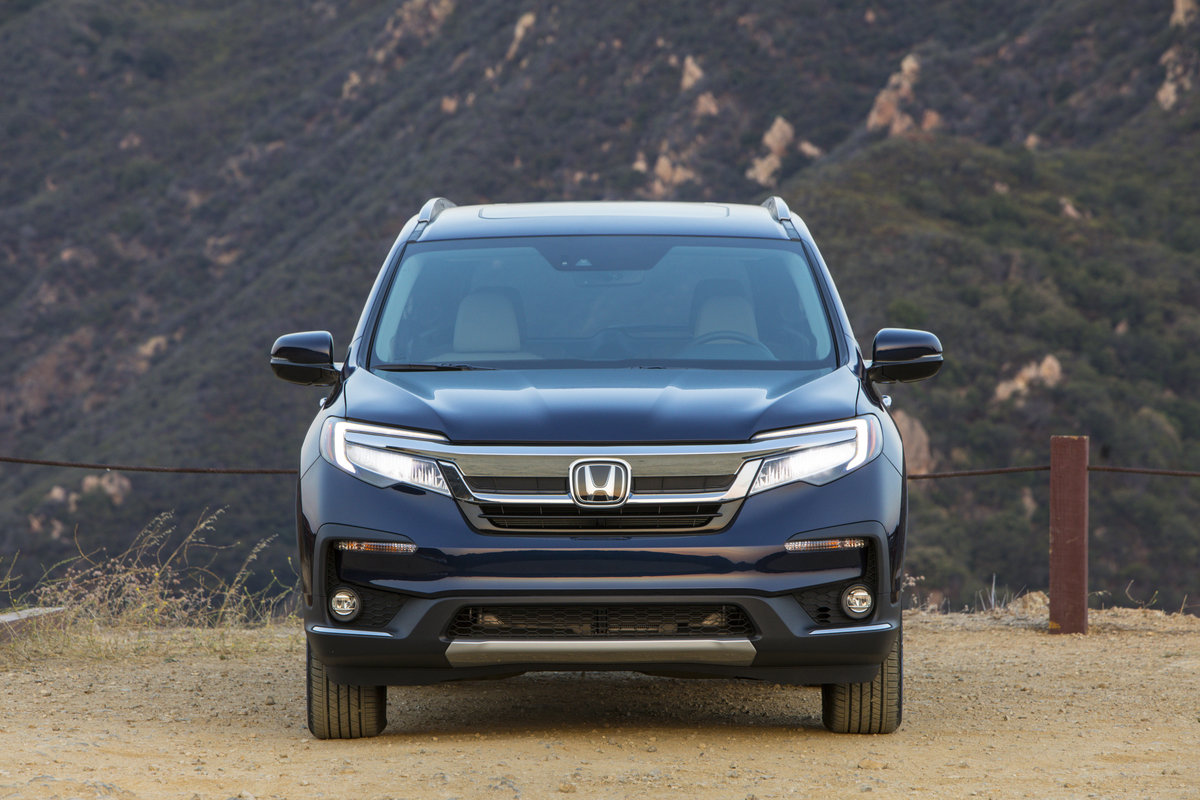
The 2020 Honda Pilot shares the same dynamic styling as the rest of the current Honda lineup. It features thin LED headlights and a multi-tiered grille. The subtle uptick in the belt-line around the rear side windows actually masks the size of the Pilot, making it look more svelte than it really is.
The Pilot features a modern cabin, complete with a semi-digital instrument panel. The fuel and engine-temperature gauges are analog, but all other information is found in a digital screen directly in front of the driver.
The cabin feels comfortable and spacious, and it has a solid level of refinement. Still, hard plastics are used in many spaces, and rivals like the Kia Telluride, Hyundai Palisade and Mazda CX-9 offer more upscale cabins.
Trim levels for the Honda Pilot are LX, EX, EX-L, Touring, and the range-topping Black Edition. The LX is a solid value in Canada with standard all-wheel drive, 18-inch alloy wheels, tri-zone climate control, remote keyless entry, remote start, heated front seats, push-button start, Apple CarPlay, Android Auto, power locks, and power windows with a one-touch driver’s window.
The EX adds a 10-way power-adjustable driver’s seat, LED fog lights, an auto-dimming rear-view mirror, roof rails, and a power moonroof.
The “L” in EX-L stands for the inclusion of leather upholstery, but it's not limited to just that. The EX-L also adds a power liftgate, a heated steering wheel, second-row outboard heated seats and in-door sunshades, a 4-way power-adjustable front passenger’s seat, and on-board navigation and SiriusXM satellite radio.
Moving up to the Touring trim adds 20-inch wheels, blue ambient interior lighting, an upgraded stereo, a massive panoramic sunroof (in seven-seat configuration), heated and ventilated front seats, auto on-off LED headlights, rain-sensing wipers, and plenty of additional on-board tech.
The Pilot Black Edition trim is new to the Pilot lineup for 2020. Based on the Touring trim, it provides unique 20-inch black-painted wheels, black exterior paint, black grille and accents, and red interior lighting.
Performance
A 3.5-litre V6 engine powers the Honda Pilot, no matter the trim selected. It makes power specs of 280 horsepower and 262 pound-feet of torque sent standard all-wheel drive (AWD; a front-wheel drive (FWD) powertrain is not offered in Canada). The V6 engine puts power through a 6-speed automatic on LX, EX, and EX-L trims. The Touring and Black Edition receive a 9-speed automatic transmission. The 9-speed provides more refined acceleration and should pay dividends on fuel efficiency.
Both transmissions are operated via Honda’s proprietary shifter button setup, replacing a normal shifter. As you’ll learn in the technology section, Honda seems hell-bent on rethinking basic automotive controls, and it has not been for the better. With a conventional shifter, you know if you are in Park, Neutral, or Drive right away. But even after you’ve embraced Honda’s learning curve, there’s still no immediate way to tell if you’re in Park or not without looking at the instrument panel or taking your foot off the brake pedal. It’s just so bizarre to insert some unique process into a generally understood control setup. Such efforts are more common in luxury cars, but it’s still an answer to a question no one seems to have asked.
No matter the trim or transmission, the standard V6 provides stout acceleration and will move from a standstill or make a passing move on the highway with ease. It’s not the segment leader for acceleration, but it makes plenty of power for real-world driving.
Speaking of real-world driving, the Pilot’s ride is perfectly tuned for it. It has a refined, comfortable driving experience designed for easy commutes and relaxing road trips. The downside is a lack of any real athleticism, but how many are looking for that from their three-row SUV?
Honda provides drive modes via the Intelligent Traction Management System. The mode selector is a button below the shifter buttons with a cartoon of the Pilot—not very intuitive, yet again. It allows the driver to cycle through Normal, Snow, Mud, and Sand modes. Each has their own drivetrain and traction control tuning for the various conditions. It won’t turn the Pilot into a rock-crawler, but it may give it a slightly better chance of avoiding getting stuck.
Form & function
The Honda Pilot provides a spacious 8-passenger cabin with second-row bench seating. Second-row captain’s chairs are optional on Touring and standard on the Black Edition, bringing seating capacity down to seven.
Some rivals have cramped third rows best suited for children, but the Pilot is among the 3-row SUVs that actually offer an adult-friendly third row with plenty of head and legroom. EX-L trims and higher provide one-touch fold-down rear seats. This makes accessing the third row that much easier.
With the second and third rows folded, the Pilot provides 1,583 litres of cargo space. How does it fare versus the competition? To compare, the Toyota Highlander has 1,371 litres, the Kia Telluride has 1,305 litres, the Hyundai Palisade has 1,297 litres, and the Subaru Ascent has 1,331 litres in most trims. All these rivals are in the same neighborhood as the Pilot, even if they beat the Honda slightly. The Volkswagen Atlas exceeds all but the Pilot with 1,572 litres of space. The Pilot has more cargo capacity than the more upscale Mazda CX-9, which provides just 1,082 litres. EX-L and higher trims provide a power liftgate, while Touring and up have a hands-free power tailgate.
Like a Honda Odyssey minivan, the 3-row SUV's primary duty is family hauling. The Pilot has plenty of spaces for toys, juice boxes, and whatever gear you need to take around with the kids. The second-row captain’s chairs in the higher trims provide a narrow passage for kids to get in and out of the third row without folding the seats forward. The space between the captains also makes for a helpful No Man’s Land between the kids if you need to separate them. You can keep an eye on them with a helpful conversation mirror. It pops down from the sunglasses case area in the ceiling of the cabin. The CabinTalk feature projects speaking from the front row through the speakers so that rear passengers can better hear it.
Technology
In Canada, all trims of the Pilot feature Honda’s Display Audio 8-inch touchscreen infotainment system with Apple CarPlay and Android Auto. It operates a 215-watt, 7-speaker stereo with a subwoofer. Bluetooth connectivity and a USB port are also included on the base trim.
Display Audio is another area where Honda should excel but got too smart for its own good along the way. The Pilot has just a small volume knob and lacks an actual tuning knob. Any interaction with the radio relies on using the touchscreen infotainment system, which has a confusing layout. Menu navigation and user experience have either been overthought or were an afterthought. SiriusXM satellite radio is included from the EX-L trim.
Navigation is added on the EX-L, and a rear entertainment system and Wi-Fi hotspot are standard on the Touring and Black Edition. These also receive an upgraded 590-watt, 11-speaker premium audio system and wireless charging pad.
Safety
The Pilot comes standard with the HondaSensing suite of driver assistance systems. This comprehensive suite of safety technology includes forward-collision warning, automatic emergency braking, lane keep assist and lane-departure warning, road departure mitigation, and adaptive cruise control. Automatic high beams are also standard.
Front and side-impact airbags are standard equipment, as are child-seat anchors, Vehicle Stability Assist, and traction control. Optional safety equipment includes front and rear parking sensors and blind-spot monitoring with rear cross-traffic alert.
The Honda Pilot earns a five-star overall crash test rating from the National Highway Traffic Safety Administration (NHTSA). It also earns the best crash test score of Good from the Insurance Institute for Highway Safety (IIHS). Thanks to Honda Sensing, the Pilot also earns the best score of Superior in IIHS crash prevention technology evaluation.
Cost-effectiveness
Natural Resources Canada rates versions of the Pilot with the six-speed automatic transmission at 13.0 litres per 100 kilometres in city driving, 9.3 on the highway, and 11.3 combined. With the nine-speed automatic, those number change to 12.4 L/100 km city, 9.3 hwy, and 11.0 combined.
Base MSRP for the 2020 Honda Pilot is $41,290 for the LX trim. The EX trim starts at $43,590 and the EX-L starts at $47,490. The Honda Pilot Touring trim starts at $53,290 while adding captain’s chairs for the second-row seats cost $400 extra, and the range-topping Honda Pilot Black Edition starts at $55,190. Fees are $1,930 extra.
That starting price puts it in line with the Volkswagen Atlas, Nissan Pathfinder, and Kia Telluride, and it's about average for the starting price of a new 3-row SUV. The Pilot Black Edition pushes the top end up as one of the more expensive options in the segment, but the LX, EX and EX-L trims represent solid value. They provide plenty of content at a reasonable price point for the class.
Note: Images show a US model.

What owners say
"Overall, owners of the 2020 Honda Pilot are very satisfied with its performance, comfort, and fuel efficiency. They especially love its spacious interior and responsive handling. However, some owners noted it's not the best for towing and has higher fuel consumption in the city compared to other vehicles."
Smooth running, lots of space and low cost to maintain.
March 13, 2025Truly next level, crazy fast and responsive SUV for what it is, did not expect to be so agile and fast. Throttle response and braking are unbelievable again, for something this big. Corners amazing, all while getting great gas mileage. This is the Black Edition, it’s better than anything else in its class, period.
February 4, 2022Perfect size SUV. I love everything about it. The hands free options are amazing. The fact that you dont have a key switch, was a little getting use too. Drives smoothly. Great on gas. Very comfortable interior.
April 4, 2024What owners say
Smooth running, lots of space and low cost to maintain.
March 13, 2025Truly next level, crazy fast and responsive SUV for what it is, did not expect to be so agile and fast. Throttle response and braking are unbelievable again, for something this big. Corners amazing, all while getting great gas mileage. This is the Black Edition, it’s better than anything else in its class, period.
February 4, 2022Perfect size SUV. I love everything about it. The hands free options are amazing. The fact that you dont have a key switch, was a little getting use too. Drives smoothly. Great on gas. Very comfortable interior.
April 4, 2024Great value with awesome upgrades! Wish it had the right rear view mirror camera like our 2015 Honda Accord. Much better bang for my buck in gas mpg than the other vehicles we considered like the Lexus 460 and Toyota Highlander.
December 25, 2021Very comfortable car. Only reason we traded it in was we needed more towing power for our camper. This is not a good tow vehicle. But everything else is outstanding.
September 16, 2023Love how this car drives. Its super comfortable during long commutes and fits our family of 6 with room to spare.
February 16, 2024Loving it, runs very nice and smooth, too bad it only came with one key, but, it works great.
December 3, 2022Nice family car! Would highly recommend! Honda is a good and reliable brand!
January 29, 2024strong, reliable, well made and good gas mileage, plus retain value.
February 28, 2024Easy to drive for big vehicle, does use up a lot of gas in the city
February 10, 2023Trims & specs
Base MSRP $31,650 | Seating 8 |
Engine 3.5L 280 hp V6 | Cargo Capacity 16.5 cu ft |
Combined MPG 23 | Drivetrain FWD |
Base MSRP $33,650 | Seating 8 |
Engine 3.5L 280 hp V6 | Cargo Capacity 16.5 cu ft |
Combined MPG 22 | Drivetrain AWD |
Base MSRP $49,720 | Seating 7 |
Engine 3.5L 280 hp V6 | Cargo Capacity 16.0 cu ft |
Combined MPG 22 | Drivetrain AWD |
Base MSRP $45,020 | Seating 7 |
Engine 3.5L 280 hp V6 | Cargo Capacity 16.5 cu ft |
Combined MPG 22 | Drivetrain AWD |
Base MSRP $48,220 | Seating 7 |
Engine 3.5L 280 hp V6 | Cargo Capacity 16.0 cu ft |
Combined MPG 22 | Drivetrain AWD |
Base MSRP N/A | Seating N/A |
Engine N/A | Cargo Capacity N/A |
Combined MPG N/A | Drivetrain N/A |
Base MSRP $34,530 | Seating 8 |
Engine 3.5L 280 hp V6 | Cargo Capacity 16.5 cu ft |
Combined MPG 23 | Drivetrain FWD |
Base MSRP $36,530 | Seating 8 |
Engine 3.5L 280 hp V6 | Cargo Capacity 16.5 cu ft |
Combined MPG 22 | Drivetrain AWD |
Base MSRP $43,020 | Seating 7 |
Engine 3.5L 280 hp V6 | Cargo Capacity 16.5 cu ft |
Combined MPG 23 | Drivetrain FWD |
Base MSRP $39,960 | Seating 8 |
Engine 3.5L 280 hp V6 | Cargo Capacity 16.5 cu ft |
Combined MPG 23 | Drivetrain FWD |
Base MSRP $44,720 | Seating 8 |
Engine 3.5L 280 hp V6 | Cargo Capacity 16.5 cu ft |
Combined MPG 22 | Drivetrain AWD |
Base MSRP $39,960 | Seating 8 |
Engine 3.5L 280 hp V6 | Cargo Capacity 16.5 cu ft |
Combined MPG 22 | Drivetrain AWD |
Base MSRP $42,720 | Seating 8 |
Engine 3.5L 280 hp V6 | Cargo Capacity 16.5 cu ft |
Combined MPG 23 | Drivetrain FWD |
Base MSRP $41,960 | Seating 8 |
Engine 3.5L 280 hp V6 | Cargo Capacity 16.5 cu ft |
Combined MPG 22 | Drivetrain AWD |
Base MSRP $37,960 | Seating 8 |
Engine 3.5L 280 hp V6 | Cargo Capacity 16.5 cu ft |
Combined MPG 23 | Drivetrain FWD |


Pricing trends
MSRP range
$31,650 - $49,720
Current avg. market price
$29,547
Trending down by 3.5% this month
May 2026 - October 2026


