2020 Ford Escape Reviews, Pricing & Specs





Pros & cons
What we like
Multiple powertrain options
Stylish design
Standard advanced safety features
What to consider
Not much cargo space
Expert review
The 2020 Ford Escape raises the bar for the small SUV with impressive tech, performance, and cabin quality.
In case you didn’t hear, Ford came out with an electric crossover, calling it the Mustang Mach-E. Ford could have called it something else, but the marketing department decided to leverage the famous Mustang name to capture headlines and, hopefully, shoppers. What should not be overlooked is the fact Ford chose to make its first-ever standalone electric vehicle a crossover.
This choice is a testament to how far the sport utility vehicle has come. Paired with Ford's decision to phase out sedans and hatchbacks, it's clear the company is putting all of its eggs into its trucks, SUVs, and crossovers. Suffice it to say, there is just a bit of pressure on the redesigned 2020 Ford Escape.
While the Escape has been around since 2000, it came into its own in 2013 when the “One Ford” philosophy was adopted, meaning that vehicles would be sold in multiple markets around the globe. As a result, the U.S. got Europe’s Ford Kuga, rebranded as the Escape—a high-tech, handsome, and surprisingly athletic small SUV.
So, with all this mind, the new Escape needs to not only be an improvement over the previous generation to compete against the rest of the compact crossover segment, it also needs to win over would-be sedan and hatchback customers. Can the 2020 Escape rise to the occasion?
out of 10 expert review
Look & feel
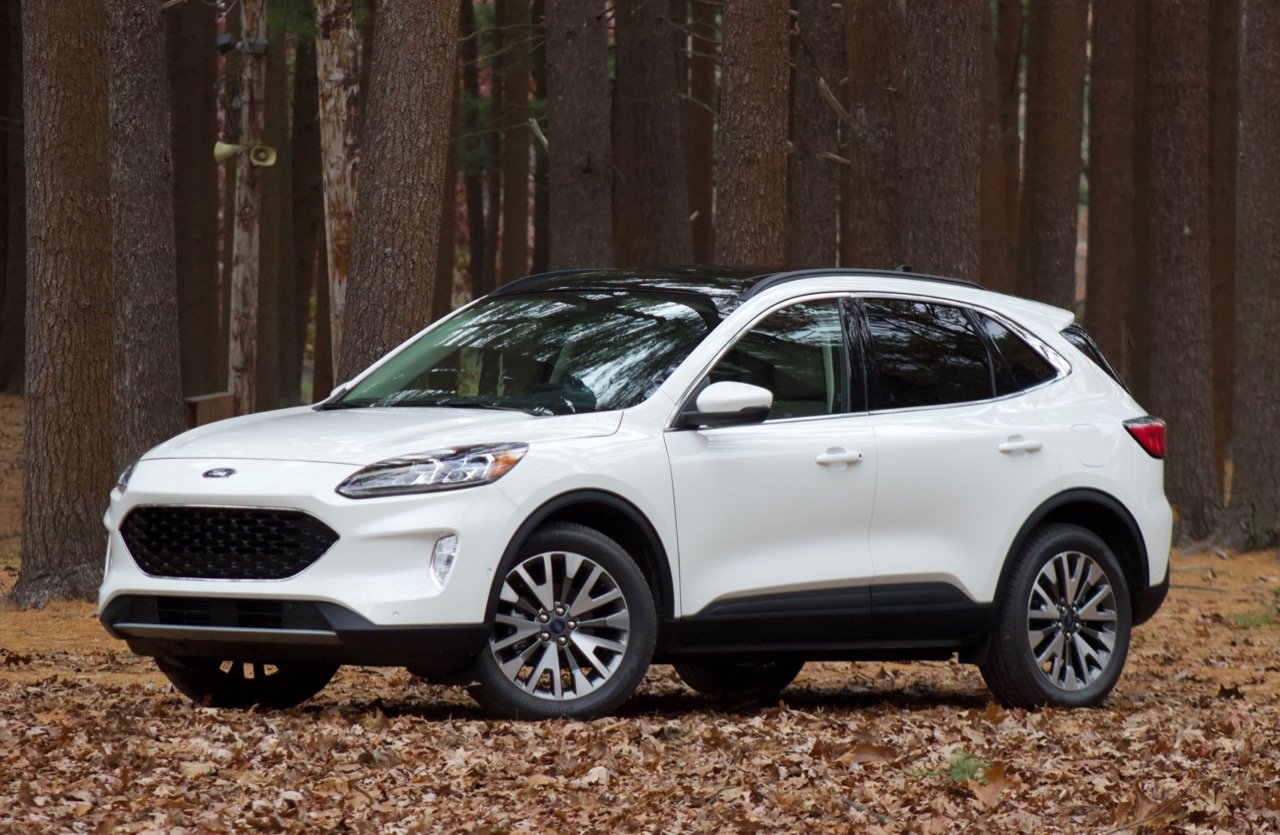
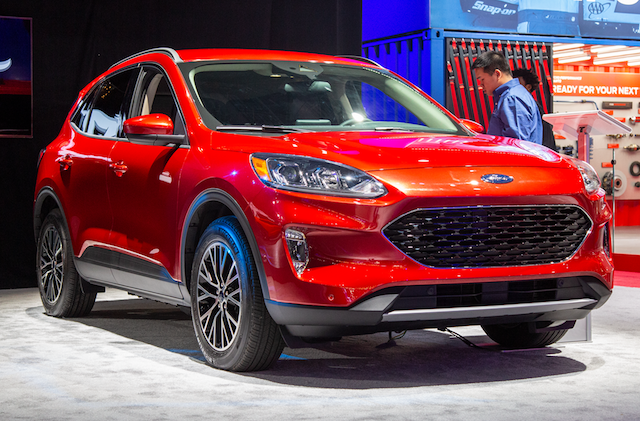
The new Escape is a very attractive compact crossover. It shares its large grille with the outgoing Fiesta and Focus hatchbacks, and the headlights are undoubtedly inspired by the Ford GT supercar. The previous Escape had a more upright rear end, and as we’ll explain later, the more curvaceous design of the new Escape certainly comes at a cost. Yet the Escape is still one of the best-looking small SUVs on the market, perhaps behind the Mazda CX-5 and Jeep Cherokee.
Moving inside reveals a fantastic, modern cabin, but one that is not too futuristic for its own good. The design is forward-looking, but it keeps the basic controls where they belong. Our test model came with a fully digital instrument panel, floating infotainment screen, and an overall smooth, modern design.
The Escape is available in four trim levels: S, SE, SEL, and range-topping Titanium. The base S comes with 17-inch steel wheels with plastic covers, a 4.2-inch instrument-panel screen, three 12-volt power outlets, manually adjustable front seats, and Sync infotainment with a 4.2-inch screen in the centre console. The S also comes with FordPass Connect with Wi-Fi hotspot for up to ten devices and the ability to remotely lock, unlock, and start your vehicle from your mobile device. The S also has a full suite of driver-assistance features.
Moving up to the SE adds 17-inch painted aluminum wheels, tinted side- and rear windows, a chrome grille surround, and body-colour door handles. Inside, the SE adds automatic climate control, heated front seats, satellite radio, a 10-way power driver's seat, and a fold-down centre armrest for the backseat. The SE also swaps out the 4.2-inch infotainment screen for the 8-inch Sync 3 infotainment system. This adds Apple CarPlay and Android Auto.
Moving up to the SEL adds fog lamps, black roof racks, 18-inch machined aluminum wheels, and a hands-free, foot-activated power liftgate. Inside, the SEL adds memory to the power driver’s seat, synthetic upholstery, sport bucket seats up front, a heated steering wheel, and one-touch up/down windows all around.
Our Titanium test model came with unique 19-inch wheels, LED fog lamps, and acoustic-laminated glass for a quieter cabin. It also came with a massive dual-panel moonroof, handsome wood paneling, and a very nice two-tone leather interior. We enjoyed the premium B&O audio system, leather seating, and 6-way power front passenger seat.
CarGurus recommends the SE trim, as it includes an 8-inch Sync 3 screen, automatic climate control, heated front seats, and a power driver’s seat. These features make the SE a tremendous value.
Performance
Among small SUVs, engine choices are typically limited to one or two powertrain options. Rivals like the Honda CR-V, Kia Sportage, and Subaru Forester all offer a base engine and a high-feature engine. The Ford Escape bucks that trend by offering four engine options, including a new three-cylinder engine that makes power specs of 180 horsepower and 177 pound-feet of torque, standard in the S, SE, and SEL trims.
Among the remaining three engines are a turbocharged 4-cylinder engine and two hybrid setups. The 2.0-litre turbocharged 4-cylinder engine is available on the SEL and standard on our Titanium test vehicle. It makes 250 horsepower and 275 pound-feet of torque, and it provides brisk acceleration.
The 2.5-litre 4-cylinder engine is part of the Escape hybrid drivetrain equation that includes a battery pack and electric power and makes 198 horsepower. This setup is available as the Titanium Hybrid.
There is also a plug-in hybrid model of this powertrain, which is optional on the Escape SE, SEL, and Titanium. (You can get the Titanium with every engine but the base 3-cylinder). The conventional engines send power through an 8-speed automatic transmission, while the hybrids route power through a continuously variable transmission (CVT). (Note that the PHEV was introduced for the 2021 model year in Canada.)
The 3-cylinder engine and the non-plug-in hybrid setup are available with either front-wheel drive (FWD) or all-wheel drive (AWD), while the turbo engine comes standard with AWD and the plug-in with FWD.
Our Escape Titanium comes with the most powerful engine, and while the transmission takes a moment to react and downshift, this setup has plenty of power around town. This engine truly shines on the highway—it will kick down as it gets up to speed and when you press the throttle to overtake.
Steering is direct and taut, and the Escape actually has an athletic feel to it. Strong, responsive brakes drive home this borderline sporty personality, raising the bar from the previous Escape. “Sporty” isn’t a necessary attribute for small SUVs, but as demonstrated by vehicles like the Mazda CX-5, buyers do seek it out. Just because you have to sit in traffic every day doesn’t mean you have to like it. You can take a vehicle like the Escape off the next exit to an open back road for a more rewarding drive.
The most efficient version of the Escape is the hybrid. It returns fuel consumption figures of 5.4 litres per 100 kilometres in the city, 6.3 highway, 5.8 combined with FWD, or 5.5 city/6.4 hwy/5.9 combined with AWD. The 1.5-litre turbo engine returns fuel efficiency figures of 8.6/7.1/7.9 combined. With AWD, that same engine returns 8.9/7.6/8.3. The 2.0-litre turbo with AWD on our test model returns 10.4/7.5/9.1.
Form & function
As mentioned, the Escape has a sleeker design than its predecessor, but it pays for that versatility by losing cargo space. Behind the second row, the Escape has 974 litres of cargo space. Fold the rear seats down, and the Escape offers 1,852 litres of cargo space or just 1,722 litres in upper-level trims. That’s fine enough, but consider that the outgoing 2019 Escape had 1,925 litres, and other rivals like the Honda CR-V, Subaru Forester, and Volkswagen Tiguan all offer about 2,100 litres of space. It would seem Ford is going in the wrong direction. But consider that the Mazda CX-5 is a very similar competitor, putting style and performance as high a priority as function, and it has 1,687 litres of cargo space, so Ford just might be settling into its niche.
Rather than cargo capacity, Ford’s emphasis appears to be on passenger space. Second-row passengers have plenty of headroom and a decent amount of legroom. The front passenger and driver have commanding seating positions. They instill confidence and provide good visibility all around. There are also plenty of spots for your gear, including deep water-bottle holders and multiple trays and compartments. The Escape might not have the most cargo space, but it certainly puts an emphasis on real-world storage solutions.
Technology
In-car tech is no longer a luxury. Heck, even a base-trim Toyota Corolla comes with a large infotainment screen. But this is not so for the base Escape, which gets a small 4.2-inch audio control screen. In the past, this small screen would have simply been embedded into the dash, but the new “floating screen” design for the Escape (like many other new cars) makes these low-tier trim features stand out as eyesores.
The SE trim that CarGurus recommends moves right up to the 8-inch Sync touchscreen, and the latest version of Sync is fantastic. It comes with Android Auto and Apple CarPlay. If you already have a car with Apple CarPlay, you may have noticed its new look. The mobile operating system's car interface recently received an over-the-air update, and it’s far more than just a new design. It now allows for multi-tasking. In this example, you—or better yet, your passenger—can operate your phone while it’s projecting on the car’s display. No more closing the CarPlay app screen when you need to use a different app on your phone.
The Titanium trim also has a head-up display (HUD), but it’s a small flip-up screen, rather than a display projected onto the windshield. Making glass specifically for HUD reflection costs a bit more, and having two different types of windshields on an assembly line is inefficient, so the flip-up screen makes adding an HUD more affordable. Still, it seriously limits the experience. For one, as a taller driver, it almost always falls below my line of sight. Even with the screen all the way up and my seat all the way down, I have to set it where it’s projected on the hood of the car, rather than the road ahead. And at that point, I’d be looking at the instrument panel. It adds no value to taller drivers.
Safety
The Escape comes with a full array of front- and side-impact airbags, a reversing camera, traction control, and a tire-pressure-monitoring system (TPMS). The 2020 Ford Escape has not been tested by the National Highway Traffic Safety Administration (NHTSA), but it earned the best overall score of Good from the Insurance Institute of Highway Safety (IIHS) in all phases of testing.
Impressively, the Escape also comes standard with Ford Co-Pilot360, a suite of safety features and advanced safety systems including forward-collision warning with automatic emergency braking and lane-keeping assist. It also comes standard with features that are often optional, such as blind-spot monitoring and rear cross-traffic alert.
Cost-effectiveness
Base MSRP for the 2020 Ford Escape comes in at $28,549 for the base S trim with FWD and $30,049 with AWD. Our recommended Ford Escape SE trim starts at $30,549 with FWD and $32,049 with AWD. The Ford Escape SEL is priced at $33,549 with FWD and $35,049 with AWD, and the range-topping Ford Escape Titanium models start at $40,149.
That is certainly not cheap, especially when the Ford Explorer, which is larger and has been completely redesigned for 2020, starts at just over $45,000. But if you keep things modest and stick with the SE trim, the Escape will present itself as a greater value.
Not every Escape will be outfitted like our Titanium test model, but most will boast premium materials as well as the latest technology and infotainment features. These all help the Escape raise the bar for what an average commuter compact SUV can truly be. We’re also very pleased to see that Ford recognizes a commuter car doesn’t have to be a boring conveyance. The Escape delivers a level of quality and performance that elevates what the small SUV can be.
Note: Images show a US model.

What owners say
"Overall, owners of the 2020 Ford Escape tend to love its smooth driving experience, numerous features, and safety technology. Many drivers appreciate the vehicle's acceleration and comfort, but some have noted issues with space for taller individuals and a noisy engine under acceleration. The mixed feelings about the gearshift design and limited wireless charging compatibility also came up frequently."
This model has all the safety features I’ve been looking for to drive safe and confident on the road! It’s also SO good on gas. The main reason I knew this was the one, was because it has all of this AND it was within my budget!!!
September 2, 2023I love the car. The safety features (Ford co-pilot), the technology, its comfortable and quiet, and the price was right!
March 17, 2021I love my new Ford Escape. It drives smoothly and the engine has zip. It is fully loaded and for a decent price. I also liked the Mazda CX-5, but I thought the Escape was a better value. Better engine and more features for a better price.
February 1, 2021What owners say
This model has all the safety features I’ve been looking for to drive safe and confident on the road! It’s also SO good on gas. The main reason I knew this was the one, was because it has all of this AND it was within my budget!!!
September 2, 2023I love the car. The safety features (Ford co-pilot), the technology, its comfortable and quiet, and the price was right!
March 17, 2021I love my new Ford Escape. It drives smoothly and the engine has zip. It is fully loaded and for a decent price. I also liked the Mazda CX-5, but I thought the Escape was a better value. Better engine and more features for a better price.
February 1, 2021I loved the features of the car. The technology advancements in the car are amazing. Its comfortable to sit in both as the driver and passenger. It drives really smooth with nice acceleration. Nice trunk space.
May 26, 2021Wireless charging compatibility very limited. For iPhone, no support beyond iphone8.
December 13, 2020The SEL is the best most affordable option, the 2020 has all the features you could want, heated steering wheel included!
January 18, 2024Love all the features but that gearshift throws me. I reach for the one that isnt there.
October 27, 2022After some research found the Ford Escape has a lot of inherent problems. The worst being a transmission problem.
December 29, 2022I love it, lots of features, need to go to college to learn how to operate it, I have like a knob you turn it to drive for gears and it is so easy, better than a gear shift. I have never owned any other car like it so I can’t compare it to another car, but if your looking for a small SUV then this is it.
December 13, 2023It’s a different direction. More car feel and that what mostly I want. Still lots of room , style, good gas , and peppy!
March 16, 2021Trims & specs
Base MSRP N/A | Seating 5 |
Engine N/A | Cargo Capacity 37.5 cu ft |
Combined MPG N/A | Drivetrain N/A |
Base MSRP $28,605 | Seating 5 |
Engine 1.5L 181 hp I3 | Cargo Capacity 37.5 cu ft |
Combined MPG 28 | Drivetrain AWD |
Base MSRP $29,265 | Seating 5 |
Engine 1.5L 181 hp I3 | Cargo Capacity 37.5 cu ft |
Combined MPG 30 | Drivetrain FWD |
Base MSRP $26,385 | Seating 5 |
Engine 1.5L 181 hp I3 | Cargo Capacity 37.5 cu ft |
Combined MPG 28 | Drivetrain AWD |
Base MSRP $27,105 | Seating 5 |
Engine 1.5L 181 hp I3 | Cargo Capacity 37.5 cu ft |
Combined MPG 30 | Drivetrain FWD |
Base MSRP $24,885 | Seating 5 |
Engine 1.5L 181 hp I3 | Cargo Capacity 37.5 cu ft |
Combined MPG 30 | Drivetrain FWD |
Base MSRP $36,835 | Seating 5 |
Engine 2.0L 250 hp I4 | Cargo Capacity 37.5 cu ft |
Combined MPG 27 | Drivetrain AWD |
Base MSRP $30,765 | Seating 5 |
Engine 1.5L 181 hp I3 | Cargo Capacity 37.5 cu ft |
Combined MPG 28 | Drivetrain AWD |


Pricing trends
MSRP range
$24,885 - $36,835
Current avg. market price
$17,367
Trending down by 1.6% this month
May 2026 - October 2026

